Tag: Gannet

  • Mirror calm; NEWT’s North Sea Pelagic 05/07/13

    The North Sea can be a strange place.  I’ve been out there in calm, sunny conditions, heavy rain, and I’ve carried out survey work for the North East Cetacean Project in conditions – dense fog, white-out blizzard, ‘interesting’ swell – where we wouldn’t have hesitated to cancel the trip if it was part of our North Sea Pelagics programme.  Yesterday was probably the oddest conditions I’ve seen though…

    The northward stretch of our trip was in very calm sunny conditions that Mary likened to the Greek islands and Andy thought was reminiscent of a sheltered Scottish sea loch.  Gannets were soaring by, Puffins were bobbing about on the barely noticeable swell, small rafts of Guillemots weren’t doing very much at all and there didn’t seem to be a great deal of activity until we were just off Cresswell and amongst the flocks of gulls and terns.

    Then, the journey south brought conditions that were just surreal.  First the sea began to flatten, until what little swell there had been was gone, and it was mirror calm.  Then a hazy mist developed and the reflection of the sky in the water meant that it was no longer possible to see where the sea ended and the sky began; all was a monochrome canvas in front of us – no visible horizon, just a flat grey sheet liberally washed with dense flocks of gulls.  Fulmars and Manx Shearwaters were gliding by just above their own reflections, a flock of Common Scoter flew north just after a Red-throated Diver had passed by and a Harbour Porpoise betrayed the interface between air and water as it surfaced nearby.  As the deep red orb of the sun dipped below the horizon away to the north west, the temperature dropped dramatically and we sailed back into the Tyne.

    All of our evening pelagics from North Shields are sold out (except for one place remaining on July 26th) but we still have a limited number of spaces on our Farne Deeps pelagics, our all day pelagics from Royal Quays in September and our Whale and Dolphin Cruise on August 31st.  Give us a call on 01670 827465 for more details, to check availability or to book 🙂

  • Sunset spectacular; NEWT’s North Sea Pelagic 28/06/13

    We’ve seen some fantastic wildlife during the 16 years that I’ve been running pelagics in the North Sea off Northumberland; Wilson’s Petrel, Great Shearwater, Grey and Red-necked Phalaropes, Sabine’s Gull, Ocean Sunfish, Minke Whale and White-beaked Dolphin are just a few of the highlights.  One thing that so many clients mention though, is just what an experience it is to be offshore approaching sunset and to see the Northumberland coast in a different light (no pun intended!).

    Last Friday brought a reasonable amount of swell, the ‘usual suspects’ – Gannet, Fulmar, Kittiwake, Guillemot, Puffin, Razorbill, Manx Shearwater – and a dense feeding flock of terns and gulls just off Cresswell.  The other thing the trip brought though was probably the best sunset I’ve ever seen on a pelagic.  As the sun dropped out of sight and we were approaching the Tyne piers, the sky away to the northwest was a stunning pinky-orange.  Some things really do take your breath away 🙂

  • The power of the sea

    We rarely let the weather get the better of us.  Apart from our annual programme of North Sea Pelagics, where the weather really can make a difference to a trip going ahead or not, we can pretty much cope with anything the elements throw at us.

    I collected Harry and Maureen for their mini-safari on the North Northumberland coast as the first drops of rain began to speckle the windscreen of the car.  Straight down the coast and we were soon watching Eiders and Common Scoter riding up and over the surf, Guillemots, Puffins and Razorbills loafing offshore, Gannets and Fulmars soaring effortlessly over the sea, Swallows hawking insects within a few feet of us and Rooks foraging around the car park in search of discarded morsels of food.  All of this was in heavy rain, but positioning the car at just the right angle to the wind made it possible to watch all of these birds and the dark majesty of the sea as a backdrop.  Along the coast towards Holy Island a huge group of Grey Seals were basking in the improving weather and, all too soon, it was lunchtime and the end of the trip.

  • Sailing the ocean blue; Seal Safari 20/06/2013

    In any list of ‘Northumberland’s Big 5’ there will always be disagreements about the species that should be included.  One species that really epitomises the wildlife of North Northumberland is the ‘hook-nosed sea pig’…or Grey Seal to give it a less offensive handle than the translation of it’s Latin name 😉

    I collected John and Jennifer from Church Point and we drove northwards along the Northumberland coast.  Arriving in Seahouses, ready for our Seal Cruise on Glad Tidings V, conditions were near perfect; beautiful blue sky, calm sea and just the slight breeze that always seems to be present on the coast, even on calm days.  As the distance between ourselves and the mainland increased, streams of Fulmars, Kittiwakes, Puffins, Guillemots and Razorbills were heading to and from the islands, Gannets were passing by in impressive groups, Cormorants and Shags were sitting like sentinels at the gates of some mystical wildlife world and then we came across the seals.  Bathing in the sunshine, and only occasionally lifting their heads to avoid unexpected sprays of breaking surf, they allowed a close approach that had an entire boat full of camera-wielding visitors clicking away like a knitting circle.

    Back on dry land we sat and had lunch, just along the coast from the impressive bulk of Bamburgh Castle, and then continued north to look for more seals.  As high tide approached they could be seen ‘bottling’ close to Holy Island, and we made our way back down the coast.

  • Seabird Spectacular 10-13 June 2013; birdwatching on the Northumberland coast

    Arriving at The Swan on Monday evening I met up with Ronnie and Liz at the start of our Seabird Spectacular holiday.  Of all of our holidays, this is the one that concentrates on the really outstanding wildlife available on the Northumberland coast in the summer.

    Tuesday started out very nice, although cloud cover was increasing and, by lunchtime, eventually it was overcast, misty and spotting with rain.  We’d spent the morning around Druridge Bay, with one of the highlights being a very obliging male Reed Bunting who sat just a few metres away from us and sang for over 20 minutes, Wall and Green-veined White Butterflies flitted across the tracks ahead of us, Sedge and Reed Warblers played hide-and-seek in the edge of the reeds and a male Marsh Harrier quartered a reedbed, giving prolonged views at relatively close range.  As we ate lunch, overlooking the North Sea, watching Eiders, Guillemots, Kittiwakes, Fulmars and Gannets, the southeasterly breeze was starting to build a noticeable swell…

    The inevitable happened and our planned sailing around Coquet Island was cancelled on safety grounds, so we continued around Druridge Bay.  Sandwich Terns and a Grey Seal were near the weir between Amble and Warkworth and we ended up watching five Otters as they munched their way through a feast of Eels 🙂 A Great Northern Diver flew south between Coquet Island and the mainland and we could see clouds of Puffins and a few ghostly white Roseate Terns from our clifftop vantage point.  Swifts were around in good numbers – a scythe-winged menace to flying insects – and at the end of the day we returned to The Swan and were joined for dinner by Sarah.

    After Tuesday’s cancelled boat trip it was a relief to see that the wind had died down by Wednesday morning, and our all-day birdwatching trip to the Farne Islands went ahead as planned.  There were lines of Puffins, Guillemots and Razorbills streaming back towards the islands, Gannets were effortlessly heading either to or from the Bass Rock, and the sights, sounds and smells of the seabird colony were just a few minutes away when we came across two Harbour Porpoises. Cormorants and Shags perched sentinel-like  on the Scarcar rocks and landing on Staple Island we watched Guillemots, Fulmars, Kittiwakes, Puffins, Razorbills, Shags and Rock Pipits at close range before having our picnic lunch in superb weather conditions on this magical rock just a few miles offshore from the Northumberland coast.  Transferring across to Inner Farne at 13:00, via a brief detour to look at the Grey Seals lazing in the sunshine, we were greeted by Head Ranger David Steel and then enjoyed the very different experience of running the gauntlet of a succession of angry Arctic Terns.  Common and Sandwich Terns were around too, and we watched Puffins skilfully avoiding the attention of Black-headed and Lesser Black-backed Gulls.  A pair of Rock Pipits nesting beneath the boardwalk were carrying beakfuls of food and I had a Farnes ‘tick’ in the shape of a Swift soaring over the lighthouse buildings.  We tried to find a Roseate Tern in amongst the roost by the Inner Farne jetty, but without success.  Back to The Swan for tea, reflection on a successful day and my Plan B…

    Today was planned to be a one-day extension to the holiday, visiting the North Pennines, but we’ve moved that to tomorrow and the ladies have an extra afternoon out with me, to take the boat trip around Coquet Island 🙂

  • Birdwatching on Holy Island 29/05/2013

    After collecting Stephen for his second trip of the week, we drove north and met Susan near Holy Island, for her third trip in four days.  Our Lindisfarne safaris are always an interesting guessing game, other than in the winter when we know that we’ll find vast flocks of waders and wildfowl – although even then there’s the unknown quantity of wintering raptors.

    We started down the coast in the shadow of Bamburgh Castle; sheltering from the wind and rain, we watched Gannets soaring effortlessly, Common Scoter and Eider riding the swell like the most accomplished surfers in the world, Fulmars and Kittiwakes fighting into the stiffening breeze and a Red-throated Diver sliding beneath the waves and resurfacing out of sight.

    What would appear at first glance to be a long line of boulders, exposed at low tide, resolved through binoculars, as expected, into several thousand Grey Seals.  The ‘hook-nosed sea pigs’ (surely the most unflattering translation of the Latin name for any animal) were lazing on the exposed sand

    On Holy Island itself the weather improved dramatically and we watched a flock of Ringed Plover and Dunlin in the harbour, with a surprise find in the form of a Little Stint.  Meadow Pipits were song-flighting, Skylarks rose higher and higher, delivering their outstandingly complex songs, and Lapwings were tumbling over nearby fields as we worked our way slowly along a hedgerow getting close views of Dunnock and House Sparrow, and listening at close range to the repetitive notes of a Song Thrush.  Surprise find of the day was a group of eight Roe Deer between Chare Ends and the Straight Lonnen.  We’ve seen them on the island before, but never so many together at once.

    After a day with two enthusiastic clients who had been excellent company on multiple trips during the week, it was time to drop Susan off and take Stephen back south.  Sometimes, I think what really makes our trips work is the clients that we have 🙂

  • A chance encounter

    “The man sitting at Table 7 is walking the entire coastline of the mainland UK to raise money for the Alzheimers Society and Alzheimer Scotland”

    Chris’ comment as we arrived to spend Friday evening, as we do most Friday evenings, at The Swan suggested a customer with a fascinating repertoire of anecdotes… As Philip was about to head to his room, he came across to say goodnight to Chris and Kirsty, and we all got talking.  As he’s passionate about wildlife, fly-fishing, photography and sustainability there were plenty of shared interests to chat about 🙂  When we discovered that he hadn’t had much publicity for the Northumberland coast section of his walk, a flurry of texts and tweets (at 22:30 on Friday night) led to interviews on BBC Radio Newcastle and Radio Northumberland on Saturday as he walked from Cresswell to Blyth.  The other thing we could help him with was transport to Cresswell on Saturday morning, and some company for the first part of the walk.

    Martin collected Philip at 10:00 and accompanied him for a very wet five miles down the coast to Newbiggin.  Fulmars were soaring steeply above the clifftops, Gannets were heading north into the strong breeze and Skylarks sang overhead during interludes between showers.  As they reached Newbiggin a lady came out of her house and put some money into Philip’s collection tin – she had been keeping an eye out for him after hearing his interview on BBC Radio Newcastle!

    Philip’s a fascinating man, undertaking an amazing journey for a very worthy cause so if you can help him in any way, please do;  follow him on Twitter, donate via JustGiving or check the schedule for the rest of his walk and think if you can help in some way as he passes along your stretch of the coastline 🙂

  • Change of plan

    Snow on Monday, glorious weather on Tuesday…and torrential rain on Wednesday 🙁  When I arrived to collect David and Janet for their Prestige Tour in the Cheviot Valleys we quickly decided to head towards the Northumberland coast instead as that would offer the chance of plenty of birdwatching with the prospect of being able to shelter from the worst of the weather.

    Starting at Stag Rocks, we watched flocks of Eider and Common Scoter as they rolled up and over the substantial waves and a Grey Seal swam just beyond the breaking surf.  One thing that was immediately obvious was that there was a movement of Gannets; birds were flying over the rocks and more could be seen offshore.  Heading down the coast, the intensity of the rain increased and we had our second seawatch of the day, this time just south of Cresswell.  An almost continuous passage of Gannets was evident as they headed north, flocks of Kittiwakes and Guillemots were passing by, the occasional Fulmar arced up above the clifftops and a single Manx Shearwater easily outpaced the Gannets.  Avocets sat tight as the rain hammered down around them and, when the deluge finally ceased and blue sky and sunshine replaced the gloom, we watched a male Marsh Harrier as he quartered a nearby field before soaring heavenwards. A Great Crested Grebe sailed by serenely, a Whimbrel flew north, five Brown Hares were engaged in some half-hearted chasing and Swifts, Swallows, House Martins and Sand Martins all took advantage of the feast of insects that had been stirred to activity by the improvement in the weather.

    Even in poor weather, Northumberland can produce some excellent birdwatching 🙂

  • The power of the sea

    Friday was a safari on the North Northumberland coast for Kathryn and Linda.  As I collected them from the Lindisfarne Inn, the biting wind carried a flurry of snow, and I guessed this could well be a day for birdwatching from the warmth and comfort of the car.

    Over the next few hours we had close views of Bar-tailed Godwit, Dunlin, Redshank and Oystercatcher as they probed in the mud, seemingly oblivious to the breeze, a Peregrine shot by, menace on pointed wings, and a Brown Hare sat majestically in the middle of a field.  From the car park at Stag Rock we could see the MV Danio, still stranded near the Longstone lighthouse, as Common Scoter and Eider rode up and over the impressive swell and Gannets battled into the breeze.  Black-headed Gulls and Rooks were almost perched on the car, and the South Low below the Holy Island Causeway offered impressive views of Eider, Long-tailed Duck and Scaup.

    Our lunch stop was the Bamburgh Castle Inn, which gave us a good view of the extent of the swell rolling from the south east…and the approaching snow, which got to us just before we got back to the car 🙂

  • Every cloud has a silver(y) grey lining

    Our final full-day pelagic for 2012 was on Saturday and, although I was really looking forward to it, it’s always a shame when we reach the end of our offshore season.

    With strong winds on Thursday, and charter boats cancelling trips on Friday, I still felt that we’d be able to sail.  We gathered at Royal Quays just before 09:00 and boarded the SarahJFK.  Brian spotted a Great Spotted Woodpecker just after we set sail, and as we headed downstream we could see a little bit of swell and a few whitecaps offshore.  A skein of Pink-footed Geese high overhead were heading south, and we weren’t too far out of the river when we had our first skua of the day; and it was one of those ‘is it, isn’t it?’ moments as what was probably a dark Pomarine Skua flew north low over the waves.  Three Great Skuas were heading the same way, and another one later caused a ‘dread’ amongst the birds gathered round a fishing boat.  Fulmars and Kittiwakes were with us throughout most of the day and Gannets were soaring by on the breeze.  Our first Sooty Shearwater was in a raft of gulls behind a trawler, and we had at least five more during the day.

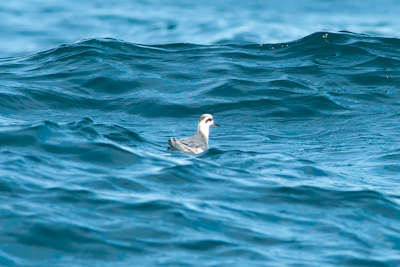
    As the swell began to ease slightly we were 8 miles off Cresswell, heading north west, when I saw two small waders flying up and over a wave crest.  As they dropped onto the sea I shouted “Grey Phalaropes!” and called to Allan to stop the boat.  Eventually we all had excellent views of these two tiny birds as they bobbed about in the swell.  They were the 2nd and 3rd that I’ve seen on pelagics I’ve organised, following the 1st out in the Farne Deeps in 2010.

    Grey Phalarope,Northumberland,bird photography,pelagic birdwatching trips,pelagic wildlife trips

    Grey Phalarope,Northumberland,bird photography,pelagic birdwatching trips,pelagic wildlife trips

    Grey Phalarope,Northumberland,bird photography,pelagic birdwatching trips,pelagic wildlife trips

    We headed towards the coast, and turned to make our way back towards Royal Quays.  Our only Manx Shearwater of the trip was followed soon after by a Pomarine Skua, found by Cain, six Red-throated Divers (including four flying south together), 42 Pale-bellied Brent Geese heading north, 20 Wigeon and 30 Common Scoter.  With only one Manx Shearwater, and no Arctic Skuas at all, this was quite an unusual pelagic but, if you like waders, and you like seabirds, then phalaropes are a dream bird 🙂