Tag: Gannet

  • Weasily identifiable; Lindisfarne Safari 20/04/2015

    April is when we start to spend more time visiting our inland areas, but the coast can still deliver real quality, and quantity, at this time of the year too.

    I collected Sue and Colin from Beadnell and we headed north to Holy Island.  Crossing the causeway we paused to watch Eider and Red-breasted Merganser in the channel under the road.  The mudflats produced Redshank, Oystercatcher, Curlew, Grey Plover and Bar-tailed Godwit, as well as a lot, and it really was a lot, of Grey Seals.  Close to 2000 were hauled out and soon began their eerie moaning.  Black-tailed Godwit and Teal were sleeping by the edge of the Rocket Pool, a lone Brent Goose was kept company by a herd of sheep, Meadow Pipits, Goldfinches and Skylarks were hurrying back and forth, a Redwing was foraging on the ground close to the field edge, a Sedge Warbler was singing it’s repetitive song from the reeds by the Lough as a Common Snipe put in a typically brief appearance and 12 Roe Deer were grazing near the Straight Lonnen.  Then we struck gold…walking slowly along the Hawthorns, a bird flushed from beside us.  The views were only brief but the white breast band, and silvery wing flashes, identified the bird as a male Ring Ouzel.  We continued walking slowly along the lonnen, and the bird kept a few metres ahead of us.  Then we lost track of it but stopped to watch two Blackbirds grubbing about in the undergrowth…and the ouzel called from a tree we’d already passed.  We turned as it flew out of hiding…followed by another, then another, and another and finally, a fifth male Ring Ouzel 🙂

    Over on the mainland we had our picnic lunch as the eerie calls of Curlew floated through the heat haze across the mudflats and Sue spotted a Weasel.  It was running in and out of the vegetation so I started pishing…and it popped up and began running in our direction, sitting up on its hindlegs and staring straight at us 🙂  Eventually it got back on with whatever it was doing, and it put in repeat appearances for a few minutes.  A Brown Hare gave tantalising close views before vanishing into the crops and we finished in the shadow of Bamburgh Castle with Sand Martins hawking insects over the beach, Eiders bobbing in the gentle swell, a pair of Common Scoter slightly further from the shore, more Grey Seals, plunge-diving Sandwich Terns and lines of Gannets heading, mainly, north.  Not a bad range of wildlife for seven hours in mid-April 🙂

  • Elementary; Bespoke Birdwatching 05/11/2014

    There are days when it’s calm, still and sunny, but those days are rarely as good as the days when the weather adds its own weight to the whole experience of being in Northumberland.

    I collected Alan and Sandra for their second day out with NEWT and we headed north, to explore the exceptional birdwatching that the north Northumberland coast has to offer in the late autumn.  The closer we got to the coast. the grimmer the weather looked, and as we settled ourselves into position by the Holy Island causeway the rain began pattering against the windows of the car.  Using the car as a birdwatching hide can be a very profitable approach in poor weather and I positioned it so that Alan and Sandra’s side of the car was out of the wind and rain.  Flocks of Pale-bellied Brent Geese were shuffling along the edge of the rising water, and we could pick out a few Dark-bellied Brent Geese amongst them too.  The rising tide brought Curlew, Redshank, Bar-tailed Godwit, Dunlin, Oystercatcher and Grey Plover towards us in changeable weather – at one point we were in bright sunshine and heavy rain at the same time, while the mudflats away to the north of the causeway were under a perfect double rainbow 🙂  Three Little Auks flew north towards the causeway and conditions improved.  Flocks of Redwing and Fieldfare were typical of poor autumn weather and every bush and tree seemed to hold several Robins.  Gannets were feeding offshore from Bamburgh, where some impressive waves were battering the shore, Red-throated Divers flew by and we finished the same as 24h earlier with Pink-footed Geese yapping in the darkness.

  • Under a darkening sky; Northumberland Coast 27/10/2014

    Yesterday was a safari day on the Northumberland coast, with a plan to enjoy the birdwatching around our regular Otter sites and then a stargazing session in Druridge Bay.

    I collected John and Pam from home in Cullercoats and we drove up the coast.  As we ate our picnic lunch in the shadow of Bamburgh Castle, we could see Gannets diving offshore, beyond the rafts of Common Eider that were surfing the gentle swell.  Kestrels were seen throughout the afternoon and a real ‘from the car’ bonus came in the shape of three Roe Deer.  As so often happens as we approach the winter, wildfowl dominated the birdwatching.  As well as the Eiders, with males resplendent in their breeding finery, Teal, Mallard and Goldeneye looked at their best.  As a Grey Wagtail perched on a mid-stream rock, and fish swirled and leapt from the water, a male Kingfisher perched on a branch overhanging the river, flocks of geese peppered the sky wherever we were, and a flock of Greylag Geese began to flush as the search and rescue helicopter passed noisily overhead.  Whooper Swans looked as stunning as ever, flocks of Lapwing and Golden Plover swirled in the stiff breeze  and, as dusk approached, Pink-footed Geese began arriving to roost.  Flock after flock of Pink-feet appeared out of the gloom, announcing their imminent arrival with their yapping calls, eventually in near darkness when they were just a black speckling against the dark grey brooding clouds.

  • The Island; Lindisfarne Safari 12/10/2014

    After a break from work and blogging, and our first proper holiday in quite a while, I got back into the swing of things on Sunday with a visit to probably my favourite mid-October location…

    Crossing the causeway to Holy Island is always accompanied by a sense of anticipation, and when I collected Graham and Joan from the Manor House they mentioned that Yellow-browed Warblers had been seen the day before.  Checking the bushes and trees in the Vicar’s Garden didn’t produce any sight or sound of the Siberian speciality, but everywhere was heaving with Robins – presumably recent arrivals from the continent – and Grey Plover, Pale-bellied Brent Goose, Bar-tailed Godwit and Grey Seal could be seen, and heard, by turning through 90 degrees from the trees.  After checking other suitable spots around the village, and finding a couple of Goldcrest, we crossed to the mainland and down to Bamburgh.  Oystercatcher, Turnstone, Curlew, Purple Sandpiper and Knot were around the rocks as Eider and Guillemot rose and fell with the gentle swell of the sea and Gannet and Sandwich Tern plunged into shoals of fish offshore in conditions that wouldn’t have been out of place in mid-June.  We made our way slowly back up the coast, taking in vast flocks of Wigeon over the mudflats and a Weasel that responded obligingly to my imitation of a dying mouse (the sound, rather than a visual imitation!).  Little Egrets and Shelduck were exploiting the food supply on the exposed mud and we crossed back on to the island…only to learn that a White-tailed Eagle had been soaring high inland of us while we were watching the Weasel 🙁  We headed down to the causeway, to see if the eagle would make a reappearance, as flocks of Sanderling, Dunlin, Knot, Bar-tailed Godwit, Pale-bellied Brent Goose and Golden Plover concentrated on the rapidly diminishing areas of mud above the rising tide and a Peregrine powered across our field of view before it was time for me to cross back to the mainland and head south.

  • Sealed; Bespoke North Northumberland Coast Safari 22/08/2014

    After some poor sea conditions recently, things looked more promising for Friday’s trip; a seal cruise around the Farne Islands, followed by a few hours of birdwatching along the North Northumberland coast.  A change is as good as a rest, and the North Northumberland coast is quite a change from the sand dunes and coastal pools of Druridge Bay 🙂

    I collected Anne-Marie, Dave, Melanie and Mike from the Queen’s Head in Berwick and we drove to Seahouses for our sailing on Glad Tidings V, which thankfully was fairly smooth, and featured plenty of wildlife.  Gannets were soaring by, Kittiwakes were still on their cliff-edge nest sites in good numbers as Fulmars arced over them, Grey Seals were hauled out on rocks and bobbing around in the water, two Common Guillemots were still sitting on the rocks, Cormorants and Shags were drying their wings in the stiff breeze, Sandwich Terns called as they flew back to the islands and, unexpectedly, five Puffins were seen with beakfuls of fish.  Photographing Puffins in flight can be a challenge on land, with lots of birds to choose from, and a bird appearing unexpectedly at sea is an even harder proposition but Anne-Marie and Melanie responded with lightning fast reflexes to capture these late breeding birds.

    Back on dry land we had our lunch in the impressive shadow of Bamburgh Castle, as Eiders bobbed around just beyond the breaking surf, and then we explored the coast as the tide fell.  Little Egrets have become a frequent feature of our coastal trips, and two birds flew by at quite close range.  Dozens of Grey Seals could be seen ‘bottling’ at high tide and then, as the water receded, exposing patches of mud, we started encountering waders.  Redshank, Ringed Plover, Curlew, Lapwing, Dunlin  and Oystercatcher were joined by Knot, Ruff and Greenshank as more Little Egrets, and a flock of Teal, flew by.

    Heading back to Berwick we could see poor weather to the north and to the east, and I got caught in some heavy rain as I drove south on the way home, but we’d had a day where the only water that landed on us was the spray from the bow of the boat 🙂

  • Curtain call; NEWT’s North Sea pelagic 06/08/2014

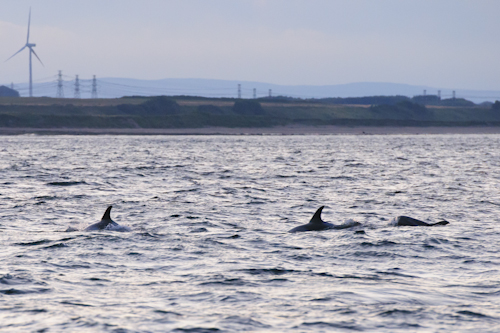
    Our last couple of evening pelagics each year tend to finish in near darkness as we arrive back at Royal Quays.  We have such long daylight hours during the middle of the summer up here, that it comes as a bit of a shock when it starts getting dark by 10pm 🙂  Yesterday was our final evening pelagic for this year, and conditions weren’t as good as they’d beeen on most of the previous sailings; a reasonable amount of swell, choppy surface and occasional whitecaps don’t make for easy observation.  We knew where both White-beaked and Bottlenose Dolphins had been seen on Tuesday though, so that would give us a fighting chance.  Guillemots were rising and falling with the swell, Kittiwakes, Herring Gulls and Lesser Black-backed Gulls were following us throughout the evening and Gannets soared majestically on the breeze.  A Grey Seal was bottling as we sailed by and, just off Lynemouth, we began making our way south.  Then a call from Hector “Martin, over there!”.  Three White-beaked Dolphins, then five 🙂  With a very small calf among them, this was another opportunity to study how their behaviour differs from dolphins without young calves, and our observations will be included in the next report of our White-beaked Dolphin research off Northumberland, and add more to the collective knowledge about these beautiful animals 🙂

    White-beaked Dolphin,Lagenorhynchus albirostris,North Sea,Northumberland,North Sea pelagics,dolphin watching North Sea,dolphin watching Northumberland,whale watching North Sea,whale watching Northumberland

    White-beaked Dolphin,Lagenorhynchus albirostris,North Sea,Northumberland,North Sea pelagics,dolphin watching North Sea,dolphin watching Northumberland,whale watching North Sea,whale watching Northumberland

    Lynemouth,White-beaked Dolphin,Lagenorhynchus albirostris,North Sea,Northumberland,North Sea pelagics,dolphin watching North Sea,dolphin watching Northumberland,whale watching North Sea,whale watching Northumberland

    That may be the end of our evening pelagics for 2014, but we’ve still got a few spaces on our Farne Deeps trips, which are our best trips for encountering White-beaked Dolphin and other marine mammals, on 12th and 28th August from Royal Quays, and our birdwatching-focused trips from Royal Quays on 23rd August, 6th September and 13th September.  Our Whale and Dolphin Cruise from Seahouses on 30th August is an excellent introduction to offshore wildlife for all the family too 🙂  Give us a call on 01670 827465 for more details, or have a look at our North Sea pelagic page.

  • The pot of (White-beaked) gold at the end of the rainbow; NEWT’s North Sea Pelagic 01/08/2014

    Our penultimate evening pelagic had near perfect conditions, calm seas, good visibility – and recent sightings of White-beaked Dolphins in our regular search area…

    Puffins, Guillemots, Kittiwakes, Gannets and Fulmars were expected, but we had a real surprise in the shape of three Harbour Porpoises.  In proper porpoise style they didn’t approach the boat, but they didn’t beat a hasty retreat either so everyone managed to see them.   We began making our way back south, closer to the shore, but there was still no sign of any dolphins.  An interesting sunset over St Mary’s generated a rainbow over the mouth of the Tyne and a remarkable ethereal atmosphere with the quite flat water.

    St Mary's Island,Northumberland,North Sea pelagics,dolphin watching North Sea,dolphin watching Northumberland,whale watchign North Sea,whale watching Northumberland

    Tynemouth,North Tyneside,Northumberland,North Sea pelagics,dolphin watching North Sea,dolphin watching Northumberland,whale watchign North Sea,whale watching Northumberland

    Tynemouth,North Tyneside,Northumberland,North Sea pelagics,dolphin watching North Sea,dolphin watching Northumberland,whale watchign North Sea,whale watching Northumberland

    Then, as we approached the mouth of the river, Allan spotted something splashing between the piers.  Might be Harbour Porpoise?  Might be Sea Trout or Salmon?  No, neither of those, as two White-beaked Dolphins breached at the entrance to the Tyne and then swam across in front of us and back again before heading offshore, as daylight faded to black 🙂


  • In the gloom; NEWT’s North Sea Pelagic 19/07/2014

    Puffins, Guillemots, Gannets, Fulmars, Manx Shearwaters and Kittiwakes came and went in the gloom of a strange eerie evening of long rolling swell, and thickening mist.

    Black-legged Kittiwake,Rissa tridactyla,North Sea,Northumberland,North Sea pelagics,pelagic birdwatching

    Black-legged Kittiwake,Rissa tridactyla,North Sea,Northumberland,North Sea pelagics,pelagic birdwatching

    Black-legged Kittiwake,Rissa tridactyla,North Sea,Northumberland,North Sea pelagics,pelagic birdwatching

    We’ve still got a few spaces on our Farne Deeps trips, which are our best trips for encountering White-beaked Dolphin and other marine mammals, on 12th and 28th August from Royal Quays, and our birdwatching-focused trips from Royal Quays on 23rd August, 6th September and 13th September.  Our Whale and Dolphin Cruise from Seahouses on 30th August is an excellent introduction to offshore wildlife for all the family too 🙂  Give us a call on 01670 827465 for more details, or have a look at our North Sea pelagic page.

  • Drizzle; Farne Islands Press Trip 04/06/2014

    Seeing a familiar location, in unfamiliar conditions, can be like visiting somewhere for the first time.  Over the years nearly all of our trips to the Farne Islands have been in glorious weather.  I could never be blase about the islands, but sometimes I hope for a new experience…

    I arrived at Seahouses Harbour just after 11:30 to meet up with Melanie and Gustavo.  Melanie is a journalist from Germany, currently writing a piece about Northumberland, and I’d been asked to be her guide to the Northumberland coast (Farne Islands, Bamburgh Castle, Holy Island).  We hit a snag straight away – they’d been delayed in Alnwick and didn’t arrive in Seahouses in time for our sailing around the islands!  A quick change of our booking, and a drive to Bamburgh for the quickest tour of the castle imaginable (thanks to Chris and his staff) and we were back in Seahouses for the 13:30 sailing.  The earlier sailing had gone out in fine weather, but this one was cold, densely overcast and drizzly; very, very drizzly.  The sea was mirror calm all around the islands, disturbed only by the patter of raindrops, revealing huge rafts of Puffins, Guillemots andRazorbills.  Kittiwakes shrieked from the cliff faces, Fulmars glided effortlessly overhead and Grey Seals watched warily as we passed by.  Common, Arctic andSandwich Terns were fishing, Shags and Cormorants were standing, sentinel like, on the rocks and Gannets passed by on their way to and from distant feeding grounds.

    It really did feel like a completely different experience to usual, and Holy Island in the rain, although it’s a very special place too, was going to struggle to match that strange other-worldliness of a seabird colony in the gloom 🙂

  • Five star birdwatching; Northumberland Coast 20/02/14

    Our fourth trip this week was a day birdwatching with Simon, who was back again after previous trips including a stunning Farne Deeps pelagic in 2012.  We’d spoken in advance of the trip and Simon was keen to add a few of Northumberland’s wintering birds to his life list; divers, grebes, Purple Sandpiper and Brambling were all mentioned as desirable.

    When I arrived to collect him on Thursday morning, I was still wrestling with the challenge of heading inland for Brambling, yet leaving plenty of time to explore the Northumberland coast.  That worry was quickly taken away, as putting a feeder up outside the holiday cottage meant that Simon had found one of the species on his wish list himself 🙂  Covering most of the coast from north to south produced five lifers;  Red-throated Divers just beyond the surf, Long-tailed Ducks including a breathtakingly beautiful drake, Purple Sandpipers unobtrusively poking around in rock pools, displaying Goldeneye rivaling the attractiveness of the Long-tailed Ducks and, as the afternoon light faded and the rain finally arrived, a very obliging Water Rail.  Twite, Stonechat, Yellowhammer, Reed Bunting, Skylark, Marsh Harrier, Slavonian, Little and Red-necked Grebes, Shelduck, Bar-tailed Godwit, Dunlin, Grey and Golden Plover, Lapwing, Gannet, Curlew, Teal, Mallard and Wigeon may have been reduced to a supporting role for the day, but all combined to produce an excellent day’s birdwatching on the Northumberland coast 🙂