Thursday evening was the AGM of the Northumberland & Tyneside Bird Club, and the speaker following the AGM proceedings was our good friend Martin Davison. Ornithologist is an often overused (and misused) word, but Martin is a real ornithologist, gathering data through hours and hours in the field and involved in several research projects. His talk was entertaining, informative and covered much of the work he has been involved in for 30 years in Kielder and the Border Forests. There were some stunning images in his presentation, and the sort of facts and observations that can only be determined by carrying out a prodigious amount of fieldwork.
Kielder itself is an unusual, even other-worldly, place; mile after mile of rolling hills, steep crags and boggy pools, and lots, and lots, of trees. Our Kielder Safaris have produced some memorable moments; a pair of Mandarins mating, a Common Buzzard catching and devouring a vole, Roe Deer wandering across the remote forest tracks just ahead of our Land Rover and the ‘phantoms of the forest’, Northern Goshawk, beating their way along the edge of spruce plantations. We’ll be back in Kielder from April, and our dates for 2011 will be on our calendar in the next couple of weeks, so give us a call on 01670 827465 to join one of our trips to this little visited area of Northumberland.
With a good breeze coming from the east and misty drizzle on the coast, conditions have been looking good for a fall of migrants since yesterday morning. Some of the most exciting birdwatching available on the Northumberland coast happens in conditions like these…
As we left the house last night to walk down to The Swan, Redwings could be heard overhead and the distinctive call of a Yellow-browed Warbler gave us a heard-only garden tick.
This morning we had to be out well before dawn to count Pink-footed Geese at East Chevington as part of the Icelandic Goose Census. The air over the dunes was filled with the calls of Redwings, Song Thrushes, Blackbirds, Chaffinches, Bramblings and Goldcrests. Eventually, nearly 3000 geese departed their overnight roost and we drove to Cresswell, ready for our second survey of the day. This time it was our regular WeBS count. After a brisk walk north along the beach of Druridge Bay we arrived at East Chevington for the second time this morning, where there were flocks of Chaffinches and Goldcrests in the hedgerows and Sarah spotted a ‘ringtail’ harrier, but it quickly passed through. After taking both cars back home, and deciding how to spend the rest of the weekend (although most of that is predetermined), Sarah’s just gone to do some shopping, and I’ve just had a call about a Red-flanked Bluetail at Newbiggin…decisions, decisions 🙂
Our October tours will concentrate on the coast and birdwatching will feature heavily. Give us a call on 01670 827465 to find out what’s on offer and what we can do to enhance your Northumberland birdwatching experience.
The sun is shining and the temperature is just about perfect. Robins seem to be in every bush, the high-pitched calls from a group of Goldcrests are a reminder that we’re well into the autumn and the flight calls of Skylarks can be heard high overhead. The scent of windfall apples permeates the air around the patio, the final few sloes are just ripening and there, sitting in the dappled shade beneath the apple tree, is a long-predicted garden visitor. I move away, careful not to disturb it. In the house, I swap the 500mm lens on my camera for a much more sensible 105mm macro. Back outside and it’s gone 🙁 A slow, systematic search through the fallen leaves and fruit and there it is, sunning itself. Steadily stalking, I get a few images with it resting on a leaf. Then it drops to the ground and starts feeding and, although not a classical portrait, I get the shot that I was after. Dappled sunlight, autumnal colours…and an entertaining diversion from domestic duties 🙂
It wasn’t a relaxing afternoon for the birds in Budle Bay yesterday, as a juvenile Peregrine worked it’s way back and forth, causing havoc as it went through. Further north, and looking towards Holy Island from the mainland, flocks of Wigeon and Pale-bellied Brent Geese were moving as the tide fell, and Redshank, Dunlin and Grey Plover all took advantage of the newly exposed mud. A Common Buzzard perched in a hawthorn hedge at the roadside flushed as we approached but then hovered lazily over the fields.
Looking the opposite way, from Holy Island back towards the mainland, dark steel grey clouds on the horizon were outlined in gold by the setting sun, Bar-tailed Godwits were feeding along the water’s edge and a quite stunning aural backdrop was provided by Grey Seals. As the sun slipped out of sight, Grey Herons became inky black silhouettes against the shimmering golden reflection of the sky and the air was filled first with the plaintive calls of Grey Plover and then with the high yapping of Pink-footed Geese. Skein after skein rose from the dark backdrop of the clouds on the horizon, appearing like swarms of bees against the dying embers of the day’s light. A Little Egret flapped by, a ghostly white heron vanishing into the night. Then, a grand finale to the afternoon’s birdwatching as the sky darkened, revealing a stunning array of stars, and the dark shapes of more Pink-footed Geese passed overhead, briefly cloaking the pin-points of light. Relaxing, sublime, awe-inspiring…
On Wednesday afternoon we set off from Royal Quays, out into the North Sea, onboard the MV King of Scandinavia as guests of DFDS. The weather forecast was for it to be wet, although we did manage a couple of hours birdwatching from the observation lounge before the driving rain obliterated the view. Gannets were diving into the increasingly heavy swell, a stunning Pomarine Skua arced across the bow of the ship and a single Puffin was tagging along with six Little Auks.
Arriving in IJmuiden the next morning, it was still raining 🙁 We were collected from the ferry terminal by Lin, a local guide who we had been introduced to by the ORCA wildlife officers from the ferry. As we headed north Egyptian Geese were around the grass verges near the port, Cormorants were perched atop most of the lampposts, Common Buzzards were on roadside fences and we saw one lingering Spoonbill. Our destination was the reserve of Zwanenwater, where Lin is a volunteer. As we walked through the reserve the high pitched ‘seep’ of Redwings was a constant backdrop, Song Thrushes were flushing from every patch of cover, every bush seemed to hold several Robins and a Common Redstart flicked up from the path in front of us. We were then taken on a tour of the off-limits areas of the reserve by Fred, another of the volunteers.
Stonechats were seen along the track and there was an impressive spread of Grass of Parnassus.
Stonechat, Zwanenwater, Noord-Holland 30/09/2010Grass of Parnassus, Zwanenwater, Noord-Holland 30/09/2010Despite the rain we managed an impressive haul of raptors; Common Buzzard, Marsh Harrier, Hen Harrier, Kestrel, Sparrowhawk and Osprey were all seen well but, most impressive of all, the real highlight for both of us was the views we had of Northern Goshawk. The birds quartering the dunes in search of rabbits and small birds came as a bit of a surprise, but not as much as the two birds that were perched on dead trees overhanging the lake. Fred explained that they sit there and watch the ducks, before swooping down and taking them off the water. We didn’t see that, but we did manage some distant images of one of the birds.
Northern Goshawk, Zwanenwater, Noord-Holland 30/09/2010All too soon we were on the ferry again and heading back to Northumberland, making plans to return to Holland in the spring.
Rare and scarce migrants are always a delight to find (and, in fact, I’m going to be heading to the coast shortly to try and do just that) but for me there are two sounds that are evocative of the autumn and birdwatching at this time of the year and just as enjoyable as tracking down a ‘rare’. After seeing so many Pink-footed Geese arriving at Budle Bay last week, it could only be a matter of time before they were closer to home. Sure enough, on Sunday afternoon, the distinctive high-pitched calls could be heard in the skies over our southeast Northumberland village and we watched a skein of 100+ birds heading south. The second call comes from one of those species that first grabbed my imagination many many years ago; our primary school playing field played host to a flock of Redwings each winter. I knew that they were something special and only graced us with their presence for a short time each year and now, nearly 40 years later, I still eagerly await the high pitched ‘seep’ calls as they pass overhead in the early autumn. Yesterday morning they began passing westwards over Choppington Woods and I thought to myself “that’s it, summer’s gone, winter’s coming”. Then a Chiffchaff started singing 🙂
Following our adventure in the North Sea on Saturday, I had to gather my thoughts, and clean my binoculars and ‘scope, ready for a full week of guided birdwatching. I drove north on Sunday to meet up with Sheena Harvey, editor of Bird Watching Magazine, and her husband Alan. With nearly three days to show them the delights that Northumberland has to offer, in terms of birdwatching holidays, guided birdwatching and birdwatching in general, I was really looking forward to the trip. It started a bit later than expected due to vehicle and aquarium problems at their end 🙁 but we had a nice meal at the Lindisfarne Inn on Sunday night and discussed the plan for the next few days.
If there was one moment that I thought stood out it was early in the trip, on Monday morning. As we approached Budle Bay I could see a few geese in the ‘goose fields’. We stopped to check them and I commented that with the strong northwesterly winds there should be plenty of geese starting to arrive soon. Then, as if on cue, the skeins started dropping from the skies. Mainly Pink-footed Geese, but with a good handful of Barnacle Geese along for good measure. Well over 1000 birds settled into the field in front of us in just over 20 mins. That was just the start of some very good birding and wildlife watching. I’m not going to spoil Sheena’s article by writing a detailed report so, if you want to read about it, you’ll have to buy the January issue (on sale 20th December) 🙂
By mid-afternoon on Wednesday it was time for Sheena and Alan to head back to the deep south of Lincolnshire, after three really enjoyable days for us – and I’m sure for them as well 🙂
Yesterday was our final full-day pelagic for the year. With a couple of late cancellations, ten of us boarded the SarahJFK and headed out to sea. Before we reached the end of the Tyne piers there was already a bit of swell…
Once we were out and heading offshore it was exhilarating, with an often icy westerly breeze and long rolling waves from the north. Small groups of Pale-bellied Brent Geese passed by during the day and a small group of Greylag Geese and Pink-footed Geese as well – a sure sign that the autumn is here. There was an almost complete absence of Fulmars, leading to speculation about what these enigmatic seabirds are doing when we can’t find them, and only one Manx Shearwater. Arctic Skuas were a bit thin on the ground, but we did find a good pelagic prize – a sub-adult Pomarine Skua that passed by with two Great Skuas. Excellent views of the latter species, and some stunning Sooty Shearwaters were the highlight of the day, and there were lots of Kittiwakes and Gannets, although that accolade could have gone to the 2 White-beaked Dolphins that were seen briefly on 3 occasions late in the afternoon.
Great Skua or 'Bonxie'Sooty Shearwater
Sooty Shearwater – the epitome of graceThe swell proved a bit too much for some participants so, in between scanning for birds and cetaceans, I spent some time providing sympathy and advice for the worst of the stricken 🙂 Don’t let that put you off signing up for any of next-year’s pelagics though; it’s actually quite unusual for anyone to be really seasick on one of our pelagics, but the big swell (probably originating a few days ago from the near the north west coast of Norway) combined with a strengthening westerly breeze was a freak combination of conditions that managed to hinder the enjoyment of all the birds around the boat for a couple of the girls. I was once asked, by someone who was a self-professed non-sailor, why I would spend so much time on a small boat in the North Sea…I think that now I would just send them a link to the images in this post and the videos in my Farne Deeps trip report
We’ve got one more pelagic this year, around the Farne Islands, Holy Island and the Skate Road on Saturday December 4th, so give us a call on 01670 827465 for further details or to book.
We had back-to back birdwatching trips earlier this week, covering two of our favourite areas.
On Tuesday afternoon I collected Keith and Jen from home in Monkseaton and we headed northwards up the Northumberland coast. Our destination was the Holy Island of Lindisfarne, one of the birding hot-spots of the entire country. The strong winds were the only downside to the afternoon, but the birdwatching was good. After checking out a large group of Grey Seals we covered the area around the harbour and the Rocket Field. Bar-tailed Godwits, Common Redshank and lots of Ringed Plover were along the shoreline and a delightful charm of Goldfinches were around the Heugh. A distant group of Lapwings, Starlings and Golden Plover took to the air and the cause of their alarm was glimpsed briefly, although too briefly and too distant to make a positive ID. Holy Island birdwatching stalwart Ian Kerr put us on to a Little Stint and, as we headed back through the village, groups of Golden Plover passed overhead. Re-tracing our route back down the coast and checking the Budle Bay on the rising tide, we were just discussing the indications of the presence of predators when a huge number of birds lifted from the mud. As well as the gulls and waders, Jackdaws, Rooks and Woodpigeons joined the throng as they came out of adjacent fields and trees. This time the culprit was seen and identified; a Peregrine, that most majestic of raptors and one of the highlights of any birdwatching day on the Northumberland coast in the autumn and winter. A quick seawatch produced Sandwich Terns feeding, and Gannets soaring effortlessly on the breeze.
Wednesday was a full day out around Druridge Bay and Southeast Northumberland. I collected Jayne and Andrew from Seahouses, and then Hilary and John from Alnmouth, before beginning our tour of some of the best birdwatching spots in our local area. While we were watching Lapwings, Redshanks, Greenshanks, Ruff, Herons and Cormorants on the River Wansbeck I could hear a rough ‘sreee’ call from high overhead. The strong breeze meant that it wasn’t straightforward to locate the bird, but eventually I picked it out. It was an unfamiliar call, but a familiar species; a juvenile Common Cuckoo. The walk back along the river produced a nice flock of Long-tailed Tits. After lunch we stopped off at Cresswell Pond. Hilary and John mentioned that they’d visited Cresswell once before – when they noticed a large group of birders and stopped, managing to see a Buff-breasted Sandpiper.
Buff-breasted Sandpiper and Ruff, Cresswell Pond, Northumberland 12/09/2008With luck like that, we joked about what this visit could produce...
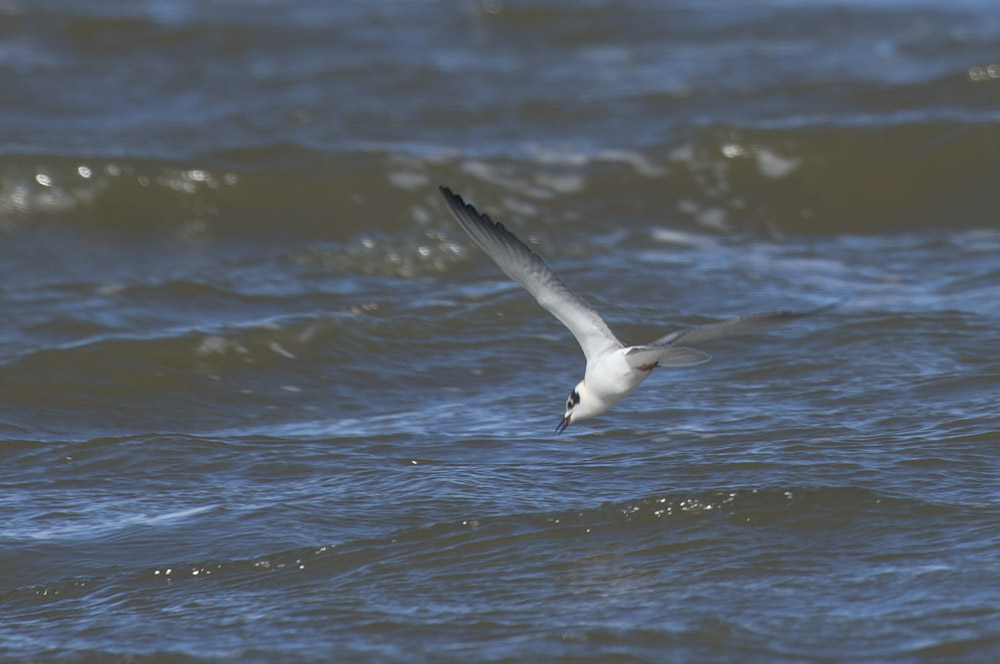
When we arrived at the hide, Jaybee mentioned that he’d had a juvenile Sandwich Tern. I scanned the pond but couldn’t see the tern anywhere and we settled to enjoying the quite remarkable views of Common Snipe that were available. After checking through the assembled ducks, gulls and waders I scanned across the pond again and spotted a tern dip-feeding near the causeway. The bird’s behaviour, combined with it’s very dark back, white rump and silver-grey wings caused me to get rather excited. White-winged Black Tern is a very special bird, and a personal highlight as it’s the third Chlidonias tern that I’ve found in Northumberland. Whiskered Tern is very rare and Black Tern is always a nice bird to see but White-winged Black Tern is such a beautiful species. Jaybee kindly sent me some images to use 🙂
White-winged Black Tern, Cresswell Pond, Northumberland 15/09/2010White-winged Black Tern, Cresswell Pond, Northumberland 15/09/2010
White-winged Black Tern, Cresswell Pond, Northumberland 15/09/2010As other birders began to arrive to enjoy the fruit of our good fortune we continued up the coast. Eiders and a Goosander, as well as some very obliging Grey Herons, were seen as we stopped by the River Coquet. A superb couple of day’s birdwatching, a beautiful rarity and clients who were excellent company.
Now, you shouldn’t need to read too many of my blog posts to realise that seabirds and cetaceans occupy a special place in my heart, and that I’m in my element once I’m on a boat off the Northumberland coast.
Saturday was our annual ‘Whale and Dolphin Cruise’ on Glad Tidings V, out of Seahouses. With 36 participants, including the other NEWT guides (Sarah and Andy), all safely on board we set off down the coast. We were soon enjoying views of two Arctic Skuas and then panic on the deck as our eagle-eyed skipper spotted two Sooty Shearwaters off to one side and everyone rushed to see them. These ocean wanderers are one of the great sights of pelagic seabirding in the North Sea at this time of the year. For one participant though the real excitement was the bird sitting beside the shearwaters; a Puffin 🙂 It’s a few weeks too late to see them at their breeding colonies, but I’d told Sam that we had a good chance of coming across one. Throughout the day we found a few more, as well as plenty of Fulmars, Kittiwakes, Guillemots and a few Razorbills. Perhaps the best entertainment of the day was provided by several feeding groups of Gannets, throwing fountains of water into the air as they hit the sea. There was clearly a lot of fish for them to eat, and it was real mystery to myself, Sarah, Andy and John that there were no cetaceans feeding in the same areas. Oh well, if they weren’t so mysterious it wouldn’t be such an adrenaline rush when we do find them I suppose. A lone Manx Shearwater avoided the boat, as they tend to do, and we headed northwards to the Farne Islands, hoping to see the White-tailed Eagle that has been there for the last week. We were in radio contact with other boats so we knew it had just killed a Shag and was eating it. As we neared the islands our one cetacean for the day appeared, a Harbour Porpoise just to one side of the wake of the boat. Just as we arrived, the eagle crept into a cleft between a grassy bank and some rocks so only one or two people managed to get a glimpse of it’s head as it dropped out of sight. Grey Seals were playing, splashing and racing around and we headed back into the harbour, after a marathon effort by our skipper and everyone on board. We’ve already set the date for the 2011 Whale and Dolphin Cruise – Saturday September 10th so put it in your diaries and give us a call on 01670 827465 to book your place.
Blue skies, calm sea, what more could you wish for?