During the winter, when I’m busy with admin and business development, I do most of my birdwatching close to home. Studying Jackdaw and Starling roosts involves a short walk, but with a constant level of activity around the feeding station (conveniently placed to be visible from the office window) I can enjoy the hobby that has been with me since early childhood throughout most of the day.
For the last couple of weeks, I’ve had my camera and tripod set up in the kitchen. Any newcomers to bird photography could do worse than concentrate on the birds in their own garden. I blogged about our feeding station recently, but I make no apologies for adding a few more images to the blog now 🙂
Brambling
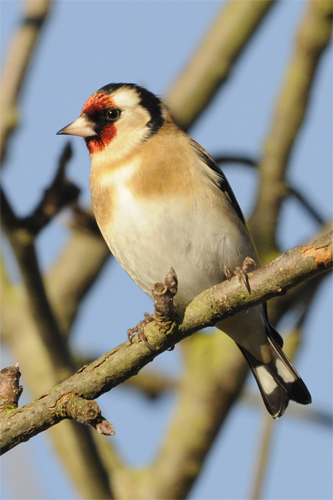
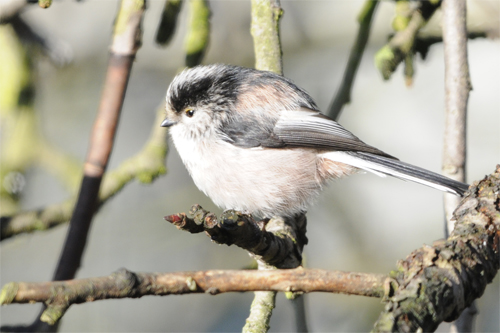
Goldfinch One species I finally managed to get some good images of is a bird that captivated me when I first saw a flock of them, nearly 40 years ago, in my neighbour’s Pear tree. With their almost non-stop movement, persistent vocalisations and, let’s face it, looks that are so cute it should be illegal Long-tailed Tits are enchanting. In previous years they’ve been infrequent visitors to our garden but this winter they are here pretty much all day every day. A lot of our clients have made similar observations and wondered why this change of behaviour has happened. Long-tailed Titsare insectivorous and it seems that likely that the hard winter weather, coming so early in the winter has had a devastating impact on their natural food source and made them increasingly reliant on artificially provided food.
Finishing a mini-safari at dusk combines two of my greatest pleasures; showing our clients the wildlife and landscape of Northumberland, and still being outside as it gets dark.
I met up with Alastair, Roz, Keith and Marian mid-afternoon last Thursday for a few hours of wildlife and birdwatching around Druridge Bay and Southeast Northumberland. As I got out of our Landrover in the car park at Church Point, it occurred to me that it was so cold and misty that I’d be really quite excited if it was mid-October 🙂 Even so, in mid-February a mini-safari finishing at dusk is still exciting.
Beside the River Coquet, a wave of panic rippled through the Jackdaws and Woodpigeons. No sign of any cause though. Then another wave of panic and a Sparrowhawk raced by, narrowly missing a Black-headed Gull perched on a fence post. A group of Roe Deer were spotted by Marian, walking along a ridge opposite us and vanishing behind the bushes before reappearing and then vanishing again. At least 28 Goldeneye were displaying on the river, the comical contortions of the drakes providing good entertainment. Almost as good as the entertainment provided by the sense of humour of all 4 clients 🙂
A flock of 25 Goldfinches was well appreciated, as were all of the tiny lambs in the fields nearby and no fewer than 9 Grey Herons all sitting around one small pool. A pair of Pintail were dabbling, as dabbling ducks do, and Alastair’s sharp eyes provided a Barn Owl for the list as it ghosted it’s way through the sky above the flooded meadows.
Dusk beside a pool with a wader roost is almost indescribable; Lapwing, Curlew and Dunlin all huddled close together is quite a sight but the thing that takes almost everybody by surprise is the noise. The level of vocalisation between the birds is extraordinary, and then the Lapwings fall silent as they begin to fly off to feeding areas. Then, as the light faded to a level where binoculars, and even our eyes, weren’t really sufficient anymore, the trumpeting of 24 Whooper Swans coming to roost rounded the day off.
During the winter months, our mini-safaris are concentrated on the coast and we always keep a close eye on the weather. Sometimes that doesn’t work out though, as the Northumberland coast frequently seems to have it’s own microclimate that doesn’t match either the forecast, or the weather, a few miles inland.
When I arrived at the mainland end of the Holy Island causeway to collect Sharon and Andrew, I was surprised to discover that it was a sublimely beautiful morning. A bitingly cold wind was scything across Fenham Flats but the forecast rain was nowhere to be seen.
Curlew and Bar-tailed Godwit were beside the causeway, and flocks of smaller waders were wheeling around in the air near the island. Winter wildfowl are a feature of the Northumberland coast and, with drakes in near full breeding-dress, Teal and Wigeon are particularly breathtaking. Pale-bellied Brent Geese were alongside Dark-bellied Brent Geese, allowing an easy comparison, Lapwings were gloriously iridescent in the bright sunlight and a Peregrine caused panic before beating a path towards the mainland. 12 Common Seals were an unexpected bonus and a covey of Grey Partridges scurried across a field as we walked by. Common Buzzards were perched on hedgerows and the number of Kestrels we found was astonishing; at least 8 birds in just a few miles of birdwatching on the coast.
After just over 3 hours of birdwatching in near-perfect conditions it was time to return to our starting point and then onwards; Sharon and Andrew heading back across to Holy Island and me heading to Rothbury to Chair a meeting between Northumberland Tourism, Northumberland County Council and the Chairs of Northumberland’s Tourism Associations. The stunning morning really emphasised in my mind the importance of the meeting in the afternoon; Northumberland has some outstanding birdwatching, wildlife and photography opportunities during the winter (and throughout the rest of the year as well) so we need to make sure that we keep shouting as loudly as we can about them.
I’ve never been good at sitting in the office and concentrating on one task for any length of time. Having an office window that looks out over the 76ha of mixed woodland of Choppington Woods LNR is a real blessing, allowing me to mix work and birdwatching. When I need to stretch my legs, a quick trip downstairs lets me open the patio door and turns the kitchen into a very comfortable and convenient bird photography hide.
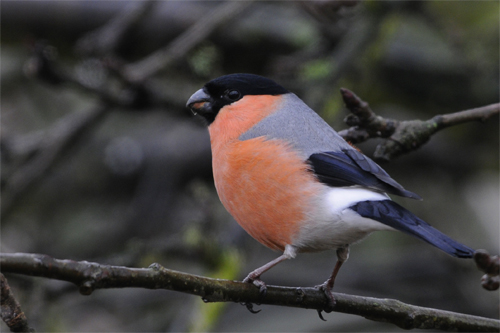
Our garden is currently hosting at least 8 Bramblings, along with Greenfinches, Goldfinches, Chaffinches, Bullfinches, Blue, Great, Coal and Long-tailed Tits, occasional visits from Siskin, Redpoll and Treecreeper and regular fly-throughs by our local Sparrowhawks.
Despised by many, loved by many, a source of great controversy, a tame garden visitor for some and a wild, wary, predator of the countryside for others. The Red Fox is all of these, and much more. One of my projects for this year is to photograph our local foxes, but recently an unexpected opportunity came along.
I was walking along the edge of some heather moorland when I heard the barking of a fox from a conifer plantation a few hundred metres away. Although the light was poor, and fading fast as dusk approached, I set my camera on it’s tripod and started squeaking. Being a predator can’t be an easy life, so it’s no surprise that the possibility of an easy meal (a prey species that’s clearly already distressed) is an attractive one. Within a few seconds, a head popped up at the top edge of the moor.
Where's that squeaking coming from?My main concern now was whether the fox would quickly identify the source of the noise. Foxes are always exciting to see on our evening wildlife watching tours, but they can be a bit of a nuisance as they have very sharp eyesight and often raise the alarm, even if you’re as well hidden as you can be and you avoid making any sudden movements.
On this occasion though, the lure of a ‘distressed rodent’ was so great that the fox made it’s way down the hillside, crossing the moor from side to side as it tried to home in on the sound.
Is it over this way?Finally the fox found the source of the squeaking, and gave me a good hard stare for 30 seconds before trotting back up the hill and chasing another fox in and out of the plantation.
Early morning, and the ground underfoot varies from frozen crunchy to treacherously boggy. The sky overhead is a deep blue, the first rays of sunlight yet to bathe the fields, hedgerows and woodland in that magical golden glow. Clattering wings herald the departure of nearly 1000 Woodpigeons from their overnight roost, and a Blackbird rustles through the vegetation in the hedge bottom. A menacing shape carves through the air just above the treetops; the menacing flap-flap-glide of our local male Sparrowhawk, beating the bounds of his territory in search of the wintering flocks of Siskins, Redpolls, Crossbills, Chaffinches and Bramblings. The pungent scent of a Red Fox marks an area that I’ll want to stake out with my camera on another day, and as I head back towards home a Roe Deer springs across the path just a few metres ahead of me and disappears into the plantation just behind our house. An excellent way to prepare for the day ahead 🙂
January is a quiet month for NEWT as far as days out with clients go, but it’s been an incredibly busy month for other reasons.
The threat to tourism services in Northumberland, following public sector spending cuts and the impending closure of One Northeast, have occupied a lot of my time. As Chair of SENTA (Southeast Northumberland Tourism Association) and also Outdoors Northumberland (until last Monday when I stepped down at our AGM), as well as being part of Northumberland Tourism’s ‘Ambassadors’ group, I’ve been involved in meetings and discussions about where we go from this point on. I’m not going to go into great detail here, as there are many issues to deal with before the position that will be adopted by Northumberland’s tourism businesses is resolved enough to be made public.
The other big meeting this week was the latest NE regional hub meeting for Netgain (the North Sea Marine Conservation Zones Project). Along the Northumberland Coast, and in our offshore waters, we have some stunning wildlife and habitats. The Farne Islands and Druridge Bay are places that we’ve enjoyed so much wildlife with our clients and the North Sea itself has produced encounters with rare, elusive and iconic creatures on our pelagic trips for many years now. With so many different interests represented on the regional hub, there were always going to be conflicts (of ideology and interests, rather than personal conflict between hub members thankfully). The only way forward will be through concensus and that requires a certain amount of give and take by everyone involved. The Netgain team have done a fantastic job of managing the discussions, providing the mapping data that hub members have asked for and answering some often difficult, and contentious, questions.
I care passionately about tourism in Northumberland, and I’m sure that any regular reader of our blog will know my feelings about the North Sea, so I’ll keep doing all I can to help move both of those projects towards a sensible solution. Ultimately though, we’re a conservation-minded tourism business so I’ll be seeking solutions that have the best interests of tourism businesses and the marine environment at their core.
I even managed a couple of hours birdwatching earlier this week as well; a successful trip to see the Hawfinch at Mitford was followed by a walk across some exposed moorland where I was entertained by 2 Red Foxes as they bounded through a patch of heather like a couple of spring lambs. Invigorating and stimulating, and across the coastal plain of central and southeast Northumberland I could see the sea with the full moon rising over it. A truly magical moment that reminded me where my passion comes from.
It’s a few years since I was student, but today I found myself sitting an exam…
Part of our commitment to what we do is to make our business sustainable and as environmentally responsible and aware as we can. Which is why, after setting out from the office after watching the conclusion of the 4th day of the final Ashes test, I found myself at the Rivergreen Centre in Durham undertaking CIEH Level 2 accreditation in ‘Environmental Principles and Best Practice’.
I enjoy learning, although I’ve always had a tendency to take information that has just been delivered and head off down a different route in my head. As well as some interesting stuff about environmental principles, and some very tedious stuff about legislation and policy, I came away from the day with some really exciting ideas about things we can do as a business. Time to plan and implement before the season gets properly underway in late-March 😉
Our first blog post of 2011 has been slightly delayed by some technical difficulties, but we’re up and running again 🙂
We decided that the first few days of the year would be spent birdwatching around southeast Northumberland. New Year’s Day saw us spending a couple of relaxed hours around Druridge Bay, producing 63 different bird species…followed by a very cold, windswept seawatch from Snab Point as we waited for the Humpback Whale found by Mark Newsome and Steve Addinall at Whitburn. It didn’t pass by us (at least not at the sea surface) but hopefully it will herald another excellent year for cetacean sightings off the northeast coast. With the cetacean species accounts for ‘Mammals of the Northeast’ to write, Martin will be hoping for more additions to the already comprehensive Northeast Cetacean database as the year progresses.
Sunday was a family and friends day at the christening, and then birthday party, for Annabel, Sarah’s god-daughter. The only new bird for the year was our garden speciality Willow Tit.
Another relaxed birdwatching day yesterday produced, amongst others, a Waxwing, 5 Goosanders, 2 Grey Wagtails and 2 Nuthatches. All very attractive birds, that brought a warm glow to a cold winter’s day.
Now the working week starts again, and we’re busy dealing with enquiries, bookings and 3 major projects that we’re going to be involved in this year. There’s always time for a spot of birdwatching or photography though 🙂
After postponing our Seal and Seaduck Special last Saturday (sea conditions were ideal, but it would have been really irresponsible to encourage anyone to drive on Northumberland’s roads at the time) we arrived at Seahouses Harbour yesterday morning ready for our final boat trip of the year.
Everyone was well wrapped-up and we were soon boarding Glad Tidings VI. As we sailed out of the harbour a veritable battery of long lenses was produced in readiness for the anticipated wildlife. With a skipper and crewman with excellent eyesight and wildlife-spotting skills, 2 NEWT guides, and clients with sharp eyes as well, the boat was soon being manouvered to offer the best possible opportunities to view or photograph the wildlife. After 13 years of organising offshore wildlife trips we know the importance of the skipper to the success (or otherwise…) of the trip and, with Craig and William, we were in excellent hands.
The first half of the trip concentrated on the Farne Islands themselves. A lot of the Grey Seals had well-grown pups, quite a few of the adults were moulting and there were a couple of cow seals still heavily pregnant.
Grey SealGrey Seal and the Longstone LighthouseGrey Seals
Grey Seals
Shags were sitting around on the islands, Little Auks were bobbing about like corks in the increasing swell, and we had a brief view of a Black Guillemot as it flew from Gun Rock towards Inner Farne. Heading north we enjoyed the sunny (but cold) weather and scoured the sea just south of Holy Island. Plenty of Eider were sitting around, along with a pair of Scaup and several Red-breasted Mergansers but a Slavonian Grebe near Guile Point proved elusive. Red-throated and Great Northern Divers were seen but in much smaller numbers than we would normally expect. The journey back down the coast featured one of our favourite birds; Long-tailed Ducks were sitting around in groups of 10-15 and offering some excellent photo opportunities.
Long-tailed Ducks30 or 40 Common Scoters proved a bit more skittish and didn’t come near the boat. 2 Gannets were a bit of a surprise before we returned to the harbour.
Although the wildlife was very obliging perhaps the best thing about the day was the truly beautiful lighting conditions, a real bonus for wildlife photography and something that all of the photographers on board commented on. We can’t control the light, or the weather, but we keep taking clients to the right places at the right time…