I was giving a talk last night and realised just how important the final week of July has been over the last few years; 7 years ago we were married, 6 years ago I’d just returned from leading a week of birdwatching and whalewatching on Mull, 3 years ago I was in my final week as a teacher and 2 years ago we had our first bespoke tour for clients wanting to experience the wildlife and birdwatching that Northumberland has to offer.
We spent our wedding anniversary on Holy Island, and here are some of the orchids we found;
Common Spotted Orchid, Holy Island, Northumberland 26/07/2010
Northern Marsh Orchid, Holy Island, Northumberland 26/07/2010
Marsh Helleborine, Holy Island, Northumberland 26/07/2010
As I grow older I’m finding that, alongside the generalist birdwatching that we usually do with clients, my own birding interests are becoming increasingly specialised; seawatching (when I can find the time…) still excites me as much as the first time I sat on Flamborough Head, raptors have been an obsession since I was very young and, more recently, I’ve been spending a lot of time reading about moult strategies and studying bird songs and calls. The Sound Approach books have all been incredibly inspirational and then, during the winter, I was on a survey trip for the Northeast Cetacean Project and Tim Sexton was mentioning how he’d added sound files to his blog posts. As we both use the same model of mp3 recorder, and the whole process sounded easy, I thought I’d give it a go. I’d got an external shotgun mic that was included when I last bought a camcorder, so I connected that up and started pointing it at anything that was singing. I added the relevant plugins to the blog…couldn’t make it work. Tim gave me some helpful advice…still couldn’t make it work. Finally, I tried another way of adding sound files and here’s the first (of many…)
This Blackbird was singing from the top of the Apple tree in our garden during a heavy shower in late April and, when he stopped singing and listened to the other Blackbirds (which can be heard faintly in the background), he tilted his head, depending on which other bird he was listening to. We even have a client who asked for a recording of a Blackbird for an arts project he’s involved in. Who can blame him, it really is a beautiful song.
Our two Druridge Bay mini-safaris last Wednesday both featured one of my favourite birds; Black-tailed Godwit. A group of eight flying N at dusk in torrential rain may have included the five that we saw at lunchtime. With plenty of Curlew, Lapwing and Dunlin, as well as a few Ruff and Common Sandpipers there was a ‘busy’ feel to birdwatching the coastal pools. Common Frog and Common Toad were perhaps to be expected in the damp conditions.
Thursday featured more torrential rain, although all of it whilst we were travelling between sites in Druridge Bay. After collecting two clients individually from Alnmouth we headed south. Dave had a day to remember with no less than five ‘lifers’; Little Owl, Dipper, Hobby, Scaup and Arctic Tern. The Hobby was one of those classic moments. I was watching a group of Sand Martins when they all suddenly rose high above the water. As I opened my mouth to suggest that there was a raptor about, Dave said “What’s this?”…and there it was, a first-summer Hobby, heading straight towards us low over the pool. A Whimbrel flew by, giving it’s distinctive call, and the transition from the occasionally difficult birding of mid-summer to the more productive time of mid-July is well underway.
Saturday was spent covering another three tetrads for the Bird Atlas and then on Sunday we had a few hours in our study area, searching for any sign of Hobby or Honey Buzzard. With heavy overcast conditions, occasional light rain, and a cold breeze very few raptors were in evidence; just a Common Kestrel and a Common Buzzard to show for our efforts.
I’m sitting in the office writing this , and the rain is hammering down outside. We had a Prestige Photography trip yesterday in brilliant sunshine, but first a quick catch-up (hard to believe but sometimes there are other things to do that are more important than blogging…).
Kirsty and Sarah continued their running plan by competing in the Sunshine Run last Wednesday, with yours truly again acting as pack animal. I’m seriously considering taking up running, as everyone seems to enjoy it so much. They both bettered their personal best times for 5km, so a big well done to them from me 🙂
On Sunday we had something quite different; a photography tuition afternoon with a group of ‘looked-after’ children. We had planned to visit the Farne Islands but the strengthening wind meant that the afternoon sailings were cancelled, so instead we walked along a section of the North Northumberland coast and looked at techniques for creative landscapes and birds in flight.
Yesterday was a wildlife photography tour of Druridge Bay. I collected Eileen and Dave from Warkworth and we visited our favourite southeast Northumberland sites. Damselflies, butterflies and moths featured heavily throughout the day, as might be expected on a sunny day in mid-July, although with it being so warm they were a bit skittish. As ever, patience paid off.
Ringlet, Druridge Bay, Northumberland 13/07/2010Narrow-bordered Five-spot Burnet, Druridge Bay, Northumberland 13/07/2010Latticed Heath, Druridge Bay, Northumberland 13/07/2010Blue-tailed Damselfly, Druridge Bay, Northumberland 13/07/2010Common Blue Damselfly, Druridge Bay, Northumberland 13/07/2010
In the 17 years that I’ve lived here, I’ve always believed that Northumberland is one of the finest counties for birdwatching in the whole of the UK. That belief played a big part in reaching the decision to launch NEWT, and it’s why we’re such an enthusiastic member of the Birdwatching Northumberland Consortium. We’ll be at the Bird Fair in August (Marquee 1, Stand 53/54) so come along to meet us and find out just how good Northumberland is.
This morning, though, my attention is on mammals. We don’t do too badly for them either; Badger, Red Fox, Grey Seal, Red Squirrel, Roe Deer, Weasel, Stoat and Brown Hare all feature regularly on our safaris and, on our Northern Experience Pelagics, there’s the possibility of Minke Whale, White-beaked Dolphin, Harbour Porpoise and other cetaceans. We’ve had some random sightings as well; a Bank Vole that sat munching on a leaf just a few feet away from us and a Mole that walked into a hide we were sitting in were both bizarre (especially the Mole; I hadn’t seen a live one for a long, long time).
With the exciting news earlier this week of the first confirmed evidence in 16 years of Pine Marten in Northumberland, we’ve got a new challenge 🙂 We’ve spent some time in the last couple of years checking likely sites and following up reports that we’ve received. Some of those have been very tantalising, and the species may be more widespread than people imagine. Otters and Badgers are fairly difficult, but we’ve developed an excellent track record with those two species. Pine Marten is going to be an altogether different proposition, but we relish a challenge.
After a busy week I was looking forward to a couple of days catching up on admin and housework (no, really, I was looking forward to doing some housework…). Then, on Saturday morning, the ‘phone rang and we took a booking for Sunday; a photographer visting the area was frustrated by the weather leading to sailing cancellations (Farne Islands, Isle of May, Coquet Island) so could we take him out and show him some of the better locations for wildlife and birdwatching photography in southeast Northumberland and Druridge Bay?
We pride ourselves on being flexible so a meeting point was arranged, camera kit was cleaned, memory cards loaded, batteries charged. Some excellent views of Red Squirrel, so close that only head shots were possible, were followed by a few hours in the birdwatching mecca that is Druridge Bay.
Here are a few of my favourite images from Sunday and Monday.
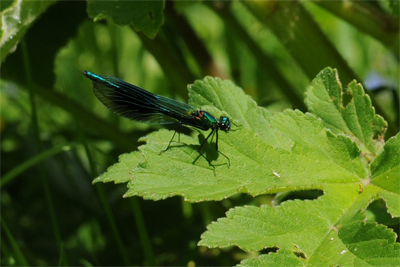
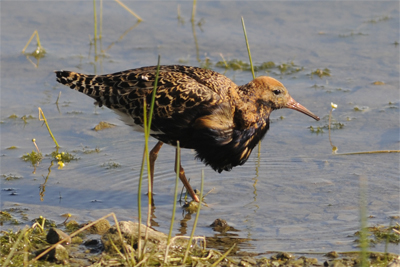
Banded Demoiselle, River Blyth, Northumberland 20/06/2010Ruff, with a ruff, Druridge Pools, Northumberland 21/06/2010Sand Martin, Druridge Pools, Northumberland 21/06/2010
Our fifth safari in four days had been arranged as a birthday present and I collected Barry and Maureen from Ponteland before starting with our usual southeast Northumberland birdwatching woodland walk. The ‘Red vs Grey’ conundrum occupied our conversation as we enjoyed excellent views of a Red Squirrel. As we walked by a wonderful hay meadow it was hard to believe that we were in an area that one of our previous clients had expected to be ‘sort of grim and industrial’ 😉 On the coast our regular Little Owl was as chilled out as ever and the Sedge Warblers and Reed Buntings were struggling to cling to the reeds in a strengthening breeze. Strong wind is just about the worst condition for watching wildlife but I’m ever the optimist…
The combination of that optimism, and a lot of experience of Otter behaviour, meant that I still believed that our target for the day would be achieved. Sure enough, we were able to watch an Otter briefly as it fed. A commotion in a reedbed, a scattering of ducks, and two nervous-looking Coots, meant that I was sure we were about to see a second Otter. It soon appeared and we enjoyed a prolonged period of observation as it made it’s way across the pond, eventually passing close by our position. More Sedge Warblers and Reed Buntings were singing as we walked through another meadow, teeming with vetch and some stunning orchids and a Reed Warbler was picking it’s way along the base of a reedbed before starting to sing and providing a perfect comparison with a nearby Sedge Warbler. As I drove Barry and Maureen home I was thinking about how, no matter how often I lead our tours, every day is different. It may be a cliche, but it’s the best part of what we do.
After collecting Gill and Richard from Bamburgh, mid-afternoon Thursday, we had another southeast Northumberland safari. This one was scheduled to finish at dusk, “a 50-year quest to see a live Badger”. No pressure there then 🙂 As so often, with late finishes, the final hour was simply magical. We’d made our way to the hillside opposite a Badger sett that we’ve been watching for a few weeks. Within a minute of settling into our watching position the tables were turned and we found ourselves under the baleful glare of a Tawny Owl. Still in good daylight, our first Badger of the evening walked across the hillside opposite. Over the next 40 mins we had 7 sightings of at least 5 Badgers. Pipistrelles flicked back and forward across our field of view, Blackbirds, Robins, Wrens and Mistle Thrushes were all alarming from the trees around our watchpoint and we enjoyed all of this with the Badgers carrying on with their dusk perambulations around the woods, safe and undisturbed by anything we were doing.
After returning Gill and Richard to Bamburgh, through what seemed to be a blizzard of moths, it was time to head home. 3 Barn Owls between Bamburgh and Seahouses were an excellent start to the journey and, near Rennington, I had to stop and wait as a Red Fox cub walked across the road in front of the Land Rover. Back home it was time to sleep, ahead of Friday’s Otter Safari.
An early start on Thursday saw us close to home, birdwatching in southeast Northumberland. 6am at Church Point as I collected Mick and Helen was sublime; warm, still and very quiet. Starting with a woodland walk we had excellent views of Red Squirrel and Great Spotted Woodpecker. In the bright sunshine our regular Little Owl was sitting at the entrance to it’s nest. These conditions at this time of the year mean that insects feature prominently in our safaris; Blue-tailed Damselflies and Silver Ground Carpet moths seemed to be everywhere that we walked. Sedge Warblers and Reed Buntings were singing from the reedbeds and Grey Herons stalked patiently along the edges of coastal ponds. The quality of conversation made the morning seem to fly past; environment, conservation, sustainability and renewable energy are all important things to NEWT and it’s always a pleasure to share our love of the northeast and it’s wildlife with clients who know the area and the countryside so well. Mick’s keenness on video recording and photography of the wildlife he sees was enjoyable, and Helen managed to photograph a Sedge Warbler using her mobile ‘phone. All too soon, Thursday (part 1) was over…
Wednesday was our second consecutive Farne Islands trip. I collected Steve and Sarah from Belford and after we’d visited a couple of NEWT’s favourite coastal locations it was time to catch the Glad Tidings across to Inner Farne to enjoy some of the best birdwatching Northumberland has to offer. The sense of anticipation, heightened once the first Puffins, Guillemots and Razorbills begin to fly by, beaks filled with fish, blends with the clean sea breeze and all of the passengers on board start to get excited. After the cruise around the islands we landed on Inner Farne and the Arctic Terns went on the offensive. This year I bought a new hat, after taking a bit of a beating in 2009 🙂 Even though the island is quite small the hour that we spent on there seemed to fly past. Probably the highlight of the islands this time was just how close some of the Puffins came to where we were standing. Back on the mainland we walked through the dunes near Low Newton, where there were lots of Small Heath butterflies, more Arctic Terns and plenty of Meadow Pipits. With the glorious summer weather, it was a really relaxing day. What would Thursday bring?