Blog

  • Busy birdwatching

    Even though we live in southeast Northumberland, we’ll never tire of getting out and about searching for new experiences for our clients.  Days out with clients are always exciting as well, because we never know exactly what we’ll see or what it will be doing.

    Last Thursday we had a Southeast Northumberland/Druridge Bay safari with clients from a fairly wide geographical area; Jeff and Jean from Huddersfield, Lawrie and Linda from Glasgow and Yvonne from southwest Northumberland.  Starting at Newbiggin we managed a brief view of a Mediterranean Gull on the beach, and a small flock of Sanderling.  These little grey, white and black ‘clockwork toys’ are always entertaining as they scurry back and forth along the water’s edge.  The River Wansbeck was our next destination.  As expected there was a good sized flock of Lapwing roosting and Cormorants and Herons were doing what they do; standing with their wings out and just sort of standing respectively.  All of a sudden a wave of panic spread through the Lapwings.  We all scanned backwards, forwards, skywards but couldn’t see any cause.  Perhaps it was just a false alarm?  The birds settled but were up again within a minute, gradually settling back down with a great deal of conversation between them all.  Greenshanks flew by calling and the Lapwings were becoming increasingly jittery.  Even birds from distant streams were high in the air, forming the quite tight flocks that indicate the presence of a predator, something that creates anticipation wherever we’re birdwatching.  Eventually we found a distant Peregrine, and a big female Sparrowhawk slid menacingly through the trees opposite our watchpoint.  One or both of them was presumably the cause for concern.  Even the Great Black-backed Gulls flushed and flew overhead, giving calls of consternation.

    Among the coastal waders, perhaps the best were three Common Snipe, unusually confiding and just a few metres away from us.  The fall of passerine migrants earlier in the week had left a few goodies behind.  Spotted and Pied Flycatchers were quite elusive, sallying forth and then back into cover, Willow Warblers and Chiffchaffs were picking their way through willows beside the path and, providing a visual feast to rival the gaudiest of birds from elsewhere in the world, six male Common Redstarts were along one short stretch of hedge.  There really is little to rival the beauty of these birds.

    At the conclusion of our journey up the coast a bird as lacking in colour as the Redstart is bathed in it was a final wonderful sighting.  As we watched two Grey Herons perched in trees overhanging the River Coquet, a Little Egret flew by before returning and perching high in the treetops in a spot where we could watch it through the ‘scope.  There can’t be many better places to be birdwatching than the Northumberland coast in September 🙂

  • Valley of tranquility

    Although our Cheviot Valleys and North Pennines safaris are concentrated in the springtime, we run a few trips to those inland areas in the late summer and early autumn.  The final day of August was a trip to the Cheviots, and it could hardly have been better; the weather was wonderful, there were hardly any other people to be seen anywhere and the wildlife was, well, as good and varied as we would expect.

    After collecting Hamish and Vanessa we drove past Morpeth then up the A697 and through the ford at Coldgate Mill.  The Happy Valley was deserted and peaceful; a Slow Worm was basking in the dappled light between gorse bushes, Small Copper butterflies (a personal favourite) were feeding and sunning themselves and there were even a few Silver Y moths.  We get these migrants in our trap occasionally, and I’ve seen them in profusion on the coast, but these were well inland.  

    Camera-shy Silver Y
    Goldcrests were calling, and eventually spotted, Spotted Flycatchers, Treecreepers and Long-tailed Tits were all found in one tree, Robins seemed to be everywhere we went and the first of the day’s Common Buzzards, rising rapidly in a thermal, suggested that searching skywards could be productive for birdwatching.

    After lunch we walked along the far end of the valley.  Red Grouse were cackling hysterically on one side of the valley, at the same time as we could hear a shooting party on the other.  Siskins and Lesser Redpolls were feeding around the treetops, although they did pause briefly so we had a chance to look at them.  The warm sunshine and excellent visibility mean that it did turn out to be a raptor day; as well as Common Buzzards there were regular Common Kestrels and a Sparrowhawk then, as we walked back to the car park, a Peregrine  soared majestically and menacingly against the blue sky overhead.  Sadly our only Adder of the day was roadkill, although it had gathered an interesting collection of flies and beetles.

    One thing that our safaris have proved to be is a break from the hustle and bustle of everyday life.  If you need to get away from it all then give us a call, or if you know somebody who would benefit from a day of chilled out wildlife watching then our gift vouchers could be just the thing they need 🙂

    Hamish kindly provided some images from the day (including the Silver Y that really didn’t want to be photographed) and my own favourites are here;

    Mother Nature ages trees better than any bonsai artist can!


    Northumberland heather in bloom
  • Life begins at 40

    Friday was our long-awaited pelagic to the Farne Deeps.  We’d originally planned the trip for August 12th, but the weather put paid to that 🙁  Rescheduling to September 3rd meant that four of the original participants had to withdraw because of other commitments, but we were able to fill those places and have a reserve list.  Birdwatching from a boat in the North Sea, with the possibility of cetaceans as well, is always an enjoyable way to spend a day.

    When I arrived at Royal Quays just after 7.30 I was surprised to see that nine of the other eleven participants were already there; obviously eager to join Northern Experience on our ‘voyage into the unknown’.

    As we left the Tyne we soon began to began to find Guillemots, Razorbills and Puffins on the sea; all 3 species featuring regularly throughout the day.  Gannets, Fulmars and Kittiwakes were all seen in good numbers (Kittiwakes in particular) and we continued to head north northeast, getting further offshore from the Northumberland coast.

    I was watching the depth plotter carefully as we approached the edge of the deep water and, as I stepped out of the wheelhouse, thinking that things could get very interesting quite soon, almost collapsed as Allan shouted “Dolphin!”.  Within a minute we’d got two stunning White-beaked Dolphins bow-riding.  They stayed with us for 40 minutes, and during that time there were at least another three a little distance from the boat.  I managed to get ‘a bit’ of video footage 🙂

    As if all the excitement of having the dolphins around the boat wasn’t enough, Geoff Morgan spotted a Grey Phalarope (Red Phalarope for any readers in the US).  After Geoff’s initial call it was 4 mins before the bird was relocated; sitting on the sea in front of the boat as we continued along with the dolphins.  The phalarope, as well as an excellent bird to see in early September, was a milestone as it’s the 40th ‘seabird’ (defined as those covered by Peter Harrison’s excellent ‘Seabirds: an identification guide’) to be found on pelagic trips off Northumberland since the first NTBC organised trip in 1987.

    As well as the birds mentioned previously we also found;

    Manx Shearwater 4

    Sooty Shearwater 4

    Arctic Skua 4

    Great Skua 9

    Typically, the Manx Shearwaters and Arctic Skuas stayed well away from the boat but the Sooty Shearwaters  and Great Skuas were much more obliging 🙂

    By the end of the day, nearly everyone on board had enjoyed lifers; the White-beaked Dolphins were a much sought-after species for Joanne and the result of a lot of effort 🙂  With the battalion of long lenses on the boat, there’ll be plenty of good quality images for the White-beaked Dolphin identification catalogue that forms part of the Northeast Cetacean Project.  We’ll be running at least two trips out to the Farne Deeps next year (date and cost tbc) so get in touch soon to register your interest.  With only 12 places available they’ll fill quickly.

    After the 10hr marathon of the Farne Deeps, our 8hr pelagic on Saturday was just like a pleasure cruise 🙂  Again we had good numbers of Kittiwake, Gannet and Fulmar,  as well as some very obliging Sooty Shearwaters.  With some of South Tyneside’s finest on board, I was half-hoping that one of them would point his camera at the sky and randomly photograph a Cape Gannet 🙂  Sadly, it wasn’t to be.  Never mind, there’s always next week…and the week after…and next year.

  • Whistle while you work

    Yesterday was one of what are rapidly becoming our favourite trips; afternoon/evening safaris.  I collected Claire and Stuart from their holiday cottage near Brinkburn Priory and we headed towards the coast.

    Our regular Little Owl watched us imperiously, before turning tail and scuttling out of sight as a dog walker came along the track.  The coastal pools along Druridge Bay are hosting an ever increasing number of waders; Dunlin, Turnstone, Redshank, Knot, Ruff, Oystercatcher, Lapwing, Common Sandpiper and Curlew were all roosting, a Spotted Redshank called but remained frustratingly out of sight behind a reedbed, and Greenshank and Whimbrel both responded to imitations of their calls.  Then, that most majestic of waders graced the air in front of us, although only briefly; a Black-tailed Godwit flew low over the roost, everything panicked, and a Peregrine carved through the flock before heading out over the sea and then away high to the north.  Little Grebes and Grey Herons were both well appreciated, then it was time to check some of southeast Northumberland’s finest mammal sites.

    Red Squirrels always go down well with our clients, and the one we watched feeding was no exception.  A juvenile Great Spotted Woodpecker was equally obliging and we watched it for a while before moving on to our favourite site for Badger watching.  Probably the biggest Badger we’ve seen so far trotted across the hillside opposite us and a much smaller animal (maybe a young cub) made it’s way through the undergrowth just over the stream from our position.  As darkness approached we found ourselves on a hilltop with a Tawny Owl calling ‘ke-wick’ from the woodland below us.  After whistling at waders during the afternoon I imitated the quavering hoot of a male Tawny Owl and waited.  The bird called from closer.  I called again, and it came closer still.  Eventually it flew up into a bare tree, silhouetted against the final glow of daylight in the sky, only 20m away from us.  I switched to copying the bird’s ‘ke-wick’ call and it turned to face us directly, ready to challenge this impertinent intruder.  I remained silent, not provoking any further response, and the bird flew to a nearby tree, screeching defiantly as we made our way back down the hillside.  Common Pipistrelles and Daubenton’s Bats were picked up on the bat detector and seen as they flitted back and forth.  The final wildlife of the evening though was close to the cottage at Brinkburn, and was another piece of Northumberland magic; a doe Roe Deer and her fawn ran along the road in front of us.

    As Autumn approaches evening safaris mean finishing at a quite amenable hour, so give us a call on 01670 827465 to find out how you can share in these memorable experiences with us.

  • British Birdwatching Fair 2010

    We’ve been away for a few days, as part of the Birdwatching Northumberland consortium at the British Birdwatching Fair 2010.

    Thursday started very early for Martin, with a North Pennines Prestige Tour for clients who were staying at Wallfoot in Carlisle.  Managing to avoid the worst of the weather, avian highlights included Merlin, Goldcrest, Nuthatch, Red Grouse, Black Grouse, Whinchat and Wheatear.  The long drive down the M6 didn’t, unfortunately, miss the heavy rain.  However, a late arrival at the White Lion in Whissendine, and a few beers in the bar with such luminaries as Ipin set Martin up nicely for an early start on Friday.

    Sarah was at work (in her ‘proper’ job) so, apart from attending a couple of lectures, Martin was on the Birdwatching Northumberland stand for all of the first day.

    Saturday we planned to work ‘split’ shifts, but with Martin again spending most of his time on the stand; apart from another couple of lectures and one or two chats with clients, colleagues, suppliers, competitors and collaborators (both old and new).

    Another excellent curry at the White Lion, and a ‘few’ beers, on Sataurday night was followed by the dawning of the final day of Bird Fair 2010.  One of us was a bit ‘under the weather’ but perked up in time to give his talk ‘The North Sea – a new birding frontier’ at 3.30pm.  What could have been a bit of a graveyard shift managed to generate a lot of interest, with 134 bird fair attendees making their way to the lecture marquee to enjoy a brief history of the Northumberland pelagics.  There were a few questions at the end of the lecture, then Martin was stopped and asked some more, for the next 10 minutes, as he headed back to the stand – where other people who had been in the lecture were waiting to ask more questions.

    After three days at the Bird Fair we’d made a lot of new contacts, renewed some old acquaintances and we’ll shortly be entering exciting partnerships with some big names in the birding world.  Just a few very busy weeks to come first…

    A final night in the midlands was followed by the journey north on Monday, and then a Prestige Tour yesterday.  Beginning with  an actively feeding Dipper was a good start then, with a particular request for wading birds, it was good to strike a rich vein on the coast; Green and Common Sandpipers, Greenshank, Redshank, Spotted Redshank, Curlew, Whimbrel, Oystercatcher, Lapwing, Dunlin and Ruff.  What seemed to go down better than all of the other birds though were the always impressive Grey Herons.

  • When the north wind blows

    We had a couple of disappointments at the end of last week, both due to the weather.  First we had to postpone our Farne Deeps Pelagic and then I was booked on a trip to the Dogger Bank, which also fell victim to the strong northerlies.  Both trips have been rescheduled though so, fingers crossed, they will happen eventually.  We’ve got a few places available for the Farne Deeps on September 3rd, although most of our original participants quickly arranged days off work when I gave them the new date, so call us on 01670 827465 to reserve your place on this groundbreaking trip.

    With Friday morning clear in my diary I managed a spot of seawatching; that most esoteric form of birdwatching.  Then we had a couple of nights in Whitby, followed by a visit to Chesterfield for a Christening, and then home again late last night.  While we were away there was a missed call on my mobile; Alan Tilmouth wondering if we’d be interested in a trip across to the Longstone if Saturday’s Thrush Nightingale had remained there overnight.  As it was it hadn’t, and we were away anyway.  Then, last night came the news of a Booted/Sykes’s Warbler at Hadston Links.  With a frantic two weeks ahead of us, I had to work hard to convince myself that I had the time to go and see the bird 😉

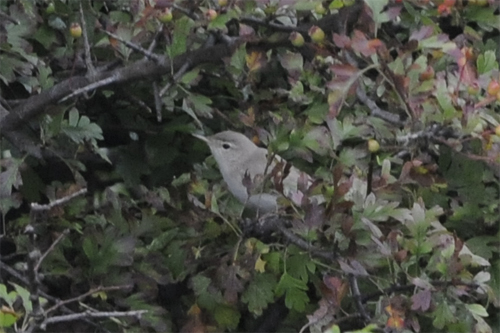
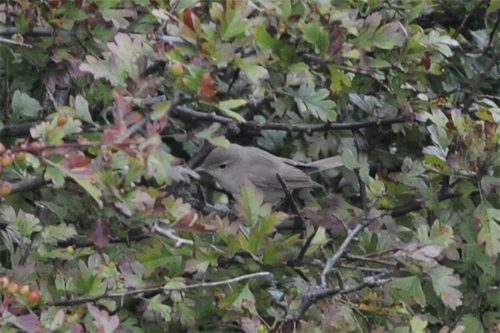
    Booted/Sykes's Warbler, Hadston Links, Northumberland 16/08/2010


    Booted/Sykes's Warbler, Hadston Links, Northumberland 16/08/2010

    Now these two species are a tricky pair to separate and, despite information put out by various bird information services earlier today, I know that the ID isn’t considered to be cut and dried.  For what it’s worth, I’ll stick my neck out and say that, on balance, I’m leaning towards Booted Warbler.  The real problem though is that in some images it looks very much like a Booted Warbler, in some it looks like Sykes’s.  In real life it was just as perplexing, apparently morphing from one to the other.  Is it a Booted Warbler, fluffing itself up against the cold (the opinion I expressed to another local blogger after I saw the bird this morning), or a Sykes’s Warbler that occasionally looks sleeker than expected?

    Another remarkable warbler earned a local birder, and occasional Northern Experience Pelagic participant, a major honour this month.  Dougie Holden, the finder of the Trow Quarry Eastern Crowned Warbler, won the Carl Zeiss Award, which is presented for the photograph or set of photographs considered to have been the most instructive during BBRC’s assessment of rarities over the previous year.

    As if all these rare warblers weren’t enough to be going on with, I went into the kitchen this morning only to find Sarah staring intently through her binoculars.  Wood Warbler is an extraordinary bird for a southeast Northumberland garden, but there it was.  Neither of us had that down as the next addition to the garden list but, as with most of the really good birds on our list, it’s no surprise that Sarah found it 🙂

  • Wildlife and birdwatching on the Northumberland coast 08/08/2010

    Sunday’s Northumberland coast safari started very close to home, with Germaine and Greg having stayed at The Swan on Saturday evening.  We started with our usual riverside walk, looking at an artificial holt and talking about the ecology of the Otter.  Our first really good sighting of the day was a Red Squirrel, which chattered angrily at a photographer who was sitting beneath the tree that it was descending.  Woodland birdwatching can be sometimes be very quiet, but with a large mixed flock of tits and Goldcrests, as well as Treecreepers and a very aggressive Nuthatch around the same glade there was plenty to see.  Out on to the coast south of Druridge Bay and, in the warm sunshine, our favourite Little Owl was posing for the camera.  The sunshine was also encouraging insect activity and we quickly added to the day list; Common Darter, Blue-tailed Damselfly, Common Blue Damselfly, Meadow Brown, Small Copper, Shaded Broad-bar, Lesser Marsh Grasshopper, Common Blue Butterfly, Green-veined and Small White were all found along one small stretch of footpath.  Grey Herons were stalking along the pond edges and one got into a gruesome wrestling match with a large Eel.  All of the ducks scattered, clearly there was something in the reeds that they were unhappy about, but what it was didn’t reveal itself.  Further north, we came across three Little Egrets (surely the next addition to Northumberland’s breeding birds – if they haven’t already…), a Common Lizard that was sunning itself and, thanks to Germaine’s sharp eyes, a pair of Roe Deer.  A really good day, with a real mixed bag of wildlife and clients who made it all the more enjoyable.  And to think…Sunday used to be homework-marking day 😉

  • Fin-tastic

    We’re in one of our busier periods at the moment;  two trips on Thursday, two on Friday and then we’ll be out again tomorrow.

    Thursday’s two mini-safaris featured some of our old favourites; Little Owl is one of the best crowd-pleasers that there is, Dunlin, Greenshank, Common Sandpiper, Grey Heron  and summer-plumaged Knot  all went down very well and some attractive insects added a touch of glitter – Common Darter, Blue-tailed Damselfly, Small Copper, Red Admiral and Dark Green Fritillary are all easily overlooked (well maybe not Red Admiral), but quite stunning if you take the time to search for them and then look closely.  After finishing Thursday’s first trip, and dropping Kevin, Angela and Georgia back at Newbiggin, I went back to the office, dealt with a few e-mails, packed the head torches and bat detectors ready for the evening and then headed back out for the day’s second tour of Druridge Bay and Southeast Northumberland.  Then the heavens opened.  With windscreen wipers barely able to provide a clear view, traffic was crawling.  I was considering the unthinkable – cancelling a trip.  The rain eased and I collected Andy and family.  The trip list was very similar to the morning and then I thought it might be worthwhile to have a quick look at the sea.

    Now, seawatching is an obsessive pastime but it isn’t for everyone; I’m certain that long periods staring at the sea, hoping that something exciting will appear, don’t make for good client experiences.  So we don’t do it…very often.  The sea had been flat calm during the day and there was only a gentle breeze.  Ideal conditions for searching for cetaceans, in fact.  The number of e-mails, texts and ‘phone calls I’d had during the week was the clincher.  I knew that cetaceans sightings were increasing and viewing conditions were just right…surely the right time to take clients for a seawatch.  Gannets were passing by and we all scanned the sea.  Quickly I picked up 2 dolphins away to the south.  Then another 2, then 3 including 2 calves.  Through binoculars I had little doubt that these were White-beaked Dolphins.  A quick look through the ‘scope revealed all of the relevant ID features; tall falcate dorsal fin, white flanks arcing up behind the dorsal to form a pale saddle.  As everyone managed to see the dolphins, I scanned slowly to estimate how many dolphins there were.  At least 25 individual animals were found, and the pod was spread out over at least 6 square miles of the North Sea!  Another birder arrived and we managed to get him on to the dolphins as well.  It’s almost impossible to describe just how extraordinary such a sighting is.  Normally the best opportunities arise when you’re on an organised pelagic trip.  We’ve got 4 more of these this year; and with only one place remaining on September 18th, two places on September 4th and four places on August 12th, get in touch now on 01670 827465 to join us and experience the best pelagic wildlife and birdwatching opportunities available on the east coast.  August 12th will be a groundbreaking trip; we’re heading out to the Farne Deeps and reports from anglers and researchers suggest that the area could produce sightings of some spectacular wildlife.  Minke Whale, White-beaked Dolphin, Common Dolphin and Killer Whale have all been found previously.

    After the dolphins we had another of the species that always captivates our clients as a Barn Owl allowed a prolonged period of observation as it hunted along the coastal dunes.  As darkness descended and we headed back to our starting point the raindrops began to speckle the windscreen of the Landy again.

    The highlights of Friday’s first trip were Red Squirrel and Little Owl (for Kate and Lucy) and a very unexpected Green Sandpiper (for me).

    The evening pelagic took place with some extraordinary glowering skies to the north.  As the swell began to develop, we were treated to very close views of Gannet and Fulmar before returning to Royal Quays in the dark, but the abiding memory of the last week is the extraordinary spectacle of a little-known cetacean, hunting, leaping and playing in the seas off Northumberland.

  • Variety Show

    Yesterday we had an afternoon/evening safari around southeast Northumberland and Druridge Bay, an exciting prospect as these are producing some of our most memorable sightings.

    Around lunchtime I started to receive calls about Bottlenose Dolphins, 5 past Newbiggin and 20-40 E of St Mary’s.  When I arrived at Church Point at 14:40, the dolphins had departed but a Harbour Porpoise was close inshore.  Once our clients had arrived we set off up the coast.  First stop produced a juvenile Little Owl, lazing in the afternoon sunshine.  A seawatching session revealed plenty of Gannets and Sandwich Terns, and Katie quickly spotted more Harbour Porpoises.  The rest of the afternoon’s birdwatching produced excellent views of Lapwing, Common Sandpiper, Dunlin, Greenshank, Common Tern and some very entertaining Grey Herons.  Non-birdy interest included Small Copper and Dark Green Fritillary butterflies, Blue-tailed Damselfly and a Common Frog.  I chose a picnic spot giving us a wide view over the increasingly calm sea, producing further sightings of Harbour Porpoise, a distant group of Bottlenose Dolphins and a Peregrine.

    Then we were on our way to the evening’s final destination.  As we walked, quietly, through a heavily shaded steep wooded valley, I began to question myself; could we really be succesful with a group of 6 clients, when we were searching for an animal that is so easily disturbed?  A Red Fox crossed the path ahead of us, although everyone other than Alice was looking the other way.  I allowed everyone to settle into position on one side of the valley and we waited.  In what seemed like no time at all, a stripy black-and-white head appeared from the undergrowth on the opposite side of the stream and our first Badger of the evening came trotting along.  It paused briefly and then crossed the stream before vanishing up the hill behind us.  After 30 mins, and another 6 Badgers!, we headed back to the Landy.  With the bat detector switched on, we listened to, and had close views of, Common Pipistrelle and Daubenton’s Bat.  Family bookings are always interesting, but the enthusiasm and cheerfulness of Emma, Katie and Alice made it such an enjoyable day (not forgetting the three older members of the group of course).

    We’ll be running afternoon/evening safaris throughout the year, so give us a call on 01670 827465 to arrange your own Northern Experience 🙂

  • A pelagic birdwatching guide’s approach to exercise

    In the last week we’ve had a few days out with clients, but gentle, short walks birdwatching in Druridge Bay, southeast Northumberland and on Holy Island rather than the somewhat more strenuous treks into the Cheviots or the North Pennines.  I can’t currently use the exercise bike when I’ve got a day in the office – because I broke one of the pedals.  Yesterday though, I managed to find an activity which, after 2 hours left me barely able to move…

    I’d had a good day, stayed focused, achieved (almost) everything on my daily task list and decided to start preparing things for this coming Friday’s pelagic (Wednesday, Thursday and Friday daytime are already booked with clients).  First task was to strip, clean, oil and re-assemble our chum grinder.  Then the bulk of the ‘chum’; prepare 3.5kg of popcorn…that’s 35 large pans full of the stuff.  I dropped the pan lid on myself, along with some sizzling hot oil, but not to worry…it’s a purposeful activity.

    Then a brief detour into a very important task; Sarah’s on her way home from work and it’s my turn to cook.  Having checked the contents of the freezer, the fridge and the cupboards earlier in the day I decided that the all-new efficient Martin was going to serve up something special;  Guineafowl breast, stuffed with mozzarella and chorizo, wrapped in streaky bacon and served on a bed of couscous and roasted vegetables.  More by good luck than good judgement, everything was ready at the same time.  Then I cleared away the dishes, did the washing up, cleaned all the kitchen work surfaces…have I been taken over by aliens 🙂

    Then to the real work of preparing the ‘chum’.  Slowly, painstakingly, just a few handfuls at a time all that popcorn needed to go through the grinder.  Sarah did some work in the office, I was grinding popcorn.  Sarah went for a 5km run, I was still grinding popcorn.  Eventually, after 2 hours, it was all done.  Moths were swarming around the patio, Common Pipistrelles were swishing close by my head, Red Foxes were calling in the woods behind the house and it was so dark that I could only just see to find my way around the garden.  I added a mixture of oils to the popcorn, put the lid on, and there it will sit until Friday evening when it will be put to use as we continue our quest for petrels.