Blog

  • Talking birdwatching

    Woodcock are continuing to feature in our birdwatching at the moment.  Martin saw two more yesterday; one flying ahead of the car as he drove through Ashington and another one flying over our house, as Lee from G&S Organics was delivering our weekly groceries.

    Yesterday evening we were out and about again.  This time it wasn’t a nocturnal birdwatching trip but a much more sociable occasion, meeting up with a friend for a meal and a few drinks.

    Nick was already in the pub, with a pint of Guinness in hand, when we arrived.  The conversation through the evening focused primarily on raptors; a real obsession for all three of us.  He didn’t make it to this year’s North of England Raptor Conference so we filled him in on the highlights.  As our discussions covered population ecology, persecution, identification and migration patterns, the time raced by and soon we were driving back through the snowy wastes of Northumberland.  Unsurprisingly, most of our discussion had focussed on the Hen Harrier; probably the most persecuted raptor in Britain.  Our study area covers twelve 10km squares in southwest Northumberland, notable for having no breeding Hen Harriers, although a vast amount of suitable habitat.  There’s a lack of Peregrines as well, although at one site they can often be seen displaying in the early spring…

    On our North Pennines tours, the lack of raptors is often commented on by our clients.  When we explain the reasons, and back this up with our own observations and experiences from the harrier nest we monitored in North Tynedale, we’re generally met with looks of incredulity, horror or dismay.  Who knows, maybe 2011 will be the year when the Hen Harrier starts to make a comeback on the moors of Northern England?  Don’t hold your breath though…

    Now, after a morning which Martin spent being interviewed for the BBC Politics Show (which will be shown at 12:00 on Sunday 11th December), it’s time to process another batch of Gift Voucher orders and finalise details for this Saturday’s boat trip around the Farne Islands and Holy Island.  Gift Vouchers are an ideal present, and our final boat trip of the year looks like being a really good one, so give us a call on 01670 827465 to book.
  • Owling

    When Sarah arrived home from work at 19:30 yesterday, I suggested a spot of nocturnal motorised birdwatching.

    We headed north past Ellington and up to Widdrington before turning towards the coast and down through Druridge.  With the thermometer hitting -7C, the ungritted roads were a bit of a challenge.  Following some recent big counts of Woodcock it was no great surprise that they flushed regularly from the roadside as we passed.  Our main target for the drive was Barn Owl, and we eventually found one perched on a post beside the Spine Road near Blyth.  Bird of the evening though was a stunning Long-eared Owl, on a fence post by the edge of the road.  As we passed slowly, on the skating rink of a road surface, it turned it’s head imperiously, following us with those piercing orange eyes.  Over the last 3 years we’ve shared views of all of Northumberland’s regularly occurring owls with our clients, but for sheer ‘other-worldliness’ you really can’t beat Long-eared Owl.

  • Mulling things over, a wild goose chase and some garden ticks

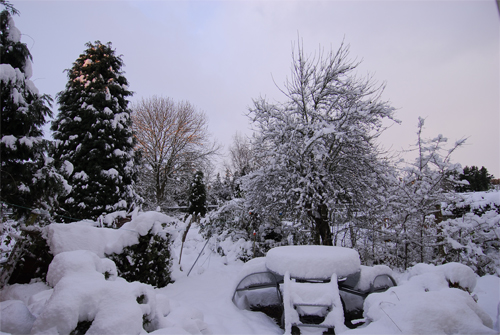
    Most of the last week has been spent working on various admin type things ready for 2011, and clearing snow and ice.

    On Friday we both went along to Choppington First School to help with clearing the car park so that school could re-open yesterday.  As a business that values sustainability we’re committed to supporting our local community, and this certainly fitted the bill, as well as providing good exercise.  Along with the Head, the caretaker and one of the teachers we’d made good progress when 2 contractors turned up, having been engaged by Northumberland County Council, to clear the car park.  So, we then watched the entertaining spectacle of a JCB and a snow plough racing around the car park, clearing it completely in 20 minutes.

    Saturday saw us clearing the 2.5′ wall of ice and snow that was blocking Martin’s car on the drive.  Mulled wine and a mince pie afterwards seemed like an appropriate reward 😉

    Of course, we’ve still managed to fit in some birdwatching 🙂

    Sunday was Goose Count day.  The East Chevington access road was a treacherous sheet of ice and compacted snow, so we parked near the main road and walked up to the pools.  With most of the North Pool frozen, goose numbers were lower than we would expect for December.  Highlights of the walk were at least 15 Woodcock, and 3 Barn Owls  that drifted along the hedgerows just after dawn.

    Monday is Martin’s ‘office day’, and the vantage point of the office window allowed him to add 2 more species to the garden list; Woodcock and Tree Sparrow.  It’s still white-over outside, but maybe there’s a thaw on the way…

  • Another big freeze

    Here we go again…

    It’s hard to believe that we posted on the blog back in January about the big freeze last winter and here we are again in a similar position already before the end of November (although at least at the moment it isn’t so prolonged).

    I went in to Newcastle last Wednesday for a seminar about the IMCORE project, and there was a bit of light snowfall.  When I came out of the Ridley Building an hour later the world was white, and it’s just gone on from that point.  After Sarah got home from work on Thursday evening the next time we used either of the cars was when we dug her car out of the snow this morning so she could go to work.  We’ve made the most of the last few days though; walking the 2 miles there (and 2 miles back) each day to visit a friend who’s now in a residential care home, doing most of the admin in 3 days that we would usually do through the winter (including adding all of our 2011 trips to the website) and finalising a couple of projects that we’ve been working on.

    Birdwatching in our little part of southeast Northumberland has been interesting for the last few days.  We’ve got an ever-expanding flock of Coal, Great and Blue Tits, Dunnocks and Wrens are now ever present around the feeding station and a very optimistic pair of Collared Doves were mating at the top of the Apple tree earlier this morning.  Two pairs of Bullfinches are regular visitors but other finches are in short supply; there’s just a single pair of Chaffinches, we’ve only had one visit from Goldfinches in the last few days and, particularly worrying, we haven’t seen any Greenfinches around the feeders at all.  A Sparrowhawk is still regularly patrolling over Choppington Woods and a flock of 50-60 Redwings flies out from the woods each morning.

    Now, after a morning of blue skies, it’s just started snowing again.

  • Walking the Wansbeck

    We’d planned to do some survey work this morning, but the prospect of walking along the beach from Cresswell to East Chevington into a stiff northerly with heavy rain and temperatures only hovering just above freezing wasn’t too tempting.

    Instead we opted for some southeast Northumberland birdwatching with a walk along the River Wansbeck near Morpeth.  Our local river is a real gem in some parts and we walk several of them regularly.  In the gloom and wet of this morning we still enjoyed the Mallards and Moorhens on the river, the flocks of Coal Tits and Long-tailed Tits in the trees and, best of all, the iridescent electric blue of a Kingfisher as it perched on a tree overhanging the water.  An afternoon spent working (on the Northeast Cetacean Project and a business plan that we’ve been preparing) will be followed (we hope!) by a relaxing Sunday evening and then a busy week ahead; finalising and submitting the business plan, bringing the Northeast Cetacean Project database up to date, drafting a couple of articles that Martin’s writing and meeting up with some old friends (and new ones) as we put together next year’s itinerary for NEWT.  Oh, there’ll be a few blog posts as well 🙂

  • Stormy weather

    November is generally a quiet month for NEWT; the half-term rush in late October has come and gone, thoughts are turning to Christmas…and the weather can be a bit suspect.  We had a Safari Day around Druridge Bay and Southeast Northumberland at the end of last week that could have succumbed to the elements but, as it turned out, a combination of excellent birdwatching sites that could be watched from the Land Rover, clients with a real interest in natural history (and expertise in wildlife sound recording)and a badger-watching spot where the trees sheltered us from the rain, made it an enjoyable afternoon.  The flock of Waxwings in Ashington delighted yet again.  Who could fail to be impressed by them? After a spell of birdwatching that was then characterised by ‘lovely weather for ducks’ (Teal, Wigeon, Mallard, Gadwall, Goosander, Goldeneye and Pochard were all seen), and some good flocks of Lapwing, Golden Plover, Redshank and Pink-footed Goose, we headed inland to the steep, wooded hillside that has produced some excellent views of Badgers on our Safaris in recent months.  Only one Badger came wandering along – perhaps the others that we’ve watched so often this year were indulging in that particularly human pastime of curling up somewhere nice and warm out of the wind and the rain.

    Since then it’s been a busy week, mainly with planning and preparation for 2011 but also giving 2 presentations about the Northeast Cetacean Project.  The first was to a group of postgrad students and lecturers at Newcastle University and then last night, to the Northumberland & Tyneside Bird Club.  Both presentations produced some interesting questions, and some potentially excellent volunteers to assist with our ongoing survey work.

    Now it’s Friday morning, the howling westerly winds are bringing waves of rain and then sunshine, there’s an intense rainbow visible from our office window and a flock of Redwings are being blown about like autumn leaves.  No matter what the weather throws at us, Northumberland is still a superb county for wildlife and birdwatching; you just need to know how to enjoy it 🙂

  • In a dark wood

    October ended with a Prestige Tour around Druridge Bay and Southeast Northumberland.  I collected Christine and Mark from Stannington and we headed across to the coast.  Flocks of Linnets. Lapwings and Grey Partridges were close to the road and we settled to check one of our regular Otter sites.  All of the assembled Mallard, Teal, Wigeon, Gadwall and Coot were concentrated in one area of the pool and clearly nervous about one particular corner.  We weren’t fortunate enough to catch a glimpse of any predators, but the behaviour of the waterfowl was typical of the type of indication you get that there’s an Otter about.  Our lunch spot for the day was beside the River Coquet and, along with the Cormorants and Grey Herons that were patrolling the water’s edge, an Atlantic Salmon provided some spectacular entertainment as it launched itself vertically out of the water, three times in rapid succession, just a few metres away from us.

    As we walked along the River Wansbeck after lunch, via a detour around the north edge of Ashington to enjoy the spectacle of 90+ Waxwings gorging themselves on Rowan berries, skeins of Pink-footed Geese passed overhead and, as the sun sank towards the horizon, it was time to seek out the wildlife that occupies that magical time of day.  As we settled into position near one of our favourite badger-watching spots there was an incredible commotion from the trees on the other side of the stream.  Blackbirds, Song Thrushes, Wrens, Robins and Magpies were all alarming loudly.  The mobbing was too intense, and too stationary, to be the mild alarm that a Red Fox or Badger often triggers and shortly after one Tawny Owl flew through the trees opposite, a second bird finally got fed up with the mobbing and flew from it’s perch.  An unwelcome sighting was a Grey Squirrel, in a woodland that until recently still held Red Squirrels.  Our first Badger of the evening was a big adult, trotting across the top of the clearing.  Then, after a few minutes of near silence, two Badger cubs came crashing through the undergrowth.  They crossed the stream beneath a fallen tree, paused briefly rising on their haunches like stripy black-and-white meerkats, and then headed uphill behind us.  Our fourth Badger of the evening followed the same route before we headed back to the Landrover and civilisation.

    I dropped Christine and Mark back at Stannington and there was time for one last piece of magic as a Barn Owl floated lazily from a fence post as I drove back towards the A1.

    Throughout the late autumn and winter we’ll be scheduling most of our trips to finish in darkness.  Druridge Bay and Lindisfarne are both excellent locations through the winter, and as darkness descends, so give us a call on 01670 827465 to find out how we can bring that experience to you.

  • Going batty at Bamburgh

    Saturday saw our annual Halloween bat walk, again at the excellent location of Bamburgh Castle.  Bookings had been slow until the end of last week but we eventually had 24 participants booked on the walk.  As we set off just after 5pm, the sky darkened and the first drops of cold rain began to fall.  With Chris’s excellent commentary about the history of the castle and it’s surroundings, and the two of us filling in with wildlife info, we were soon round at the base of the Miller’s Nick – a route into the castle that isn’t open to the public.  Once inside the castle walls, Chris regaled everyone with a series of ghostly tales about the castle.  Then, as we walked around the eastern edge of the castle grounds, the first Common Pipistrelle of the evening was spotted.  As well as listening to them using our bat detectors, everyone managed to see them as they raced and swooped along the walls.  Then it was time to head inside for pumpkin soup, homemade bread…and a walk along an unlit tunnel beneath the castle.

    We’re adding more family events to our calendar for 2011 so keep checking to see what we can do for your family.

  • To intervene in nature…or not?

    We were watching Autumnwatch yesterday evening and one discussion between the presenters, concerning intervention when you’re filming/photographing an animal in distress, was particularly pertinent to the mini-safari that Martin led earlier yesterday evening…but back to that later in this post.

    The half-term week was busy, as expected, and included some fantastic wildlife watching; Salmon leaping up a weir on the River Coquet, Starlings massing and swirling above a coastal reedbed before dropping to roost, 2000+ Pink-footed Geese filling the sky overhead, as they left their feeding sites and headed for the overnight safety of the water, and Grey Seals around the Farne Islands as they approach the height of their breeding season.

    Yesterday brought an evening mini-safari in southeast Northumberland.  Damp gloomy conditions and increasingly glowering clouds weren’t making things look too promising.  Our walk along the River Blyth produced a Nuthatch, and a Kingfisher called as it flew along the swollen, muddy river.  Two birdwatching gems, but quality rather than quantity was the order of the evening.  A Sparrowhawk provided some entertainment as it swooped repeatedly down towards the trees, flushing flocks of Woodpigeon with each descent, before finally vanishing into the canopy.  We continued our walk and, as we rounded a bend in the path, we found the reason for the Sparrowhawk’s disappearance; flapping lamely in the undergrowth was a Woodpigeon with a nasty head wound.  The predator had presumably flushed as we approached.  We’ve seen similar before and the question from clients is always “what are we going to do?”.  The answer may seem quite cold and heartless but we do nothing.  The pigeon was mortally wounded and would provide a meal either for the hawk or possibly a Red Fox would come along and make off with it.  Nature really is ‘red in tooth and claw’ and we shouldn’t interfere in the everyday life (and death) of our wildlife where we can avoid doing so.

    Our next destination was what is rapidly becoming our favourite Badger sett.  As we watched quietly (and we really have to congratulate the 6-year old in our group for remaining so very quiet) over the open area close to the sett, a Red Fox crossed the track ahead of us, we could hear scuffling in the undergrowth and then two stripy black-and-white faces appeared out of the gloom.  After a withering stare in our direction the two cubs trotted along the hillside and were joined by a third before vanishing into the night.  The final leg of the trip was a search for owls.  Local knowledge paid off, as the ghostly figure of a Barn Owl floated through the beam of our headlights just where we expected it to.  There was still time for more wildlife though and the application of our bat detector revealed a Common Pipistrelle feeding on the rich bounty of moths.  After the recent frosts it was good to find bats still active, and our final event for this October is a Bat Walk at Bamburgh Castle tomorrow evening.  Give us a call on 01670 827465 to book your place for what should be an evening of family fun.

  • Frenetic Friday

    Yesterday involved a real mixture of my favourite places, and a wide range of activities.

    Starting just after 07:00 I checked the 12 Longworth traps that we set on pre-bait in Choppington Woods earlier in the week.  With 9 of the 12 having been emptied of food, the small mammals we’re interested in had obviously found the bait.  The one slight problem was that initially I could only find 11 traps!  Despite having a GPS location for each, and marking adjacent vegetation with tags, it took 20 minutes to locate one of them.  Veronica Carnell, who is supervising me while I gain sufficient experience to run a trapping programme on my own, had warned me that this would happen 🙂

    Then I had a short drive across to Blyth for the second day of the Netgain regional hub meeting.  It’s been incredibly educational to listen to the views and concerns of other stakeholders, who don’t necessarily approach things from a conservation point of view.  Equally, it was impressive to see such wide and varied viewpoints coalescing into a concensus by the end of the meeting.  Although I have an interest in the project from a nature tourism angle, my main input was on the distribution and seasonality of cetaceans and seabirds off the Northumberland coast.  The protection of the marine habitat is so important to us that, as a business, we’ll keep making my time available for Netgain meetings until the conclusion of the project.

    After the meeting I drove to Seahouses and collected a journalist from the Edinburgh Evening News, for a trip across to the Farne Islands.  We occasionally run press trips where the journalist will be accompanied by wife/husband/partner, but 2 adults, a 6-year old, a 3-year old and a baby was pretty much a first (apart from a guy from a local paper in Cumbria who managed to blag a free holiday, for himself and his family, from accommodation providers, activity providers and attractions in Northumberland in 2008…and then never wrote the article that was used as the hook for getting all the freebies – ah well, live and learn).  The trip across to the Farnes was everything I would expect in late October; breezy, cold and a fantastic wildlife experience.  The Grey Seal pups were predictably cute, and at least 3 Peregrines were hunting the Feral Pigeons that live on the islands.  We’ve got a Seal Safari next Friday, which includes a trip around the Farne Islands (weather permitting), a Landrover safari and picnic so give us a call on 01670 827465 for more details or to book (especially if you are a family – it’s 1/2 term week so we’re offering generous discounts on family bookings).  With 5 trips out with clients over the next 5 days (including 2 days where we’re fully booked already) it’s going to be  a busy week.

    All of that would have a been a busy day…but there was one thing left, and it was something that I was really looking forward to.  As Newcastle University graduates, myself and Sarah both have an emotional attachment to the Hancock Museum (or Great North Museum:Hancock as it’s now named…but you won’t find either of us, or many other local naturalists, calling it that).  So, yesterday evening I felt quite honoured to be standing in the Clore Learning Centre at the museum giving a lecture about the Northeast Cetacean Project to the Natural History Society of Northumbria.  With an attendance of over 100 at the lecture it’s a subject that people are really interested by.  One of the question asked at the end of the talk was “how will the data be used?  what value does it have?”.  Which took us nicely back round the loop to the day and a half of Netgain meetings.