Tag: Redshank

  • If at first you don’t succeed; Bespoke Otter Safari 14/02/2015

    When we’re searching for Otters, a fair degree of success is down to hard work (checking sites repeatedly, so we know when and where they are), a good bit of it is down to luck (they are wild animals after all, so don’t perform to order…) and those often combine to give a gut-feeling…

    I collected Adam and Heather from Newcastle Central Station and we set off towards southeast Northumberland and Druridge Bay for their bespoke Otter Safari.  Our first destination was the site that’s our current ‘Plan A’…where there wasn’t any indication of Otter activity 🙁 Along the coast we checked other sites without any luck, although there were lots of Goldeneye, Little Grebe and thousands of Pink-footed Geese.  Canada and Greylag Geese, Curlew and Redshank were all making a racket that suggested there was an Otter nearby, but still no sign.  In marked contrast to the Arctic blast of a day earlier, we had our lunch on the top of the dunes looking over towards Coquet Island, above a beach covered in Sanderling, Turnstone, Ringed Plover, Oystercatcher, Curlew, Bar-tailed Godwit and Redshank and a lone Grey Plover.

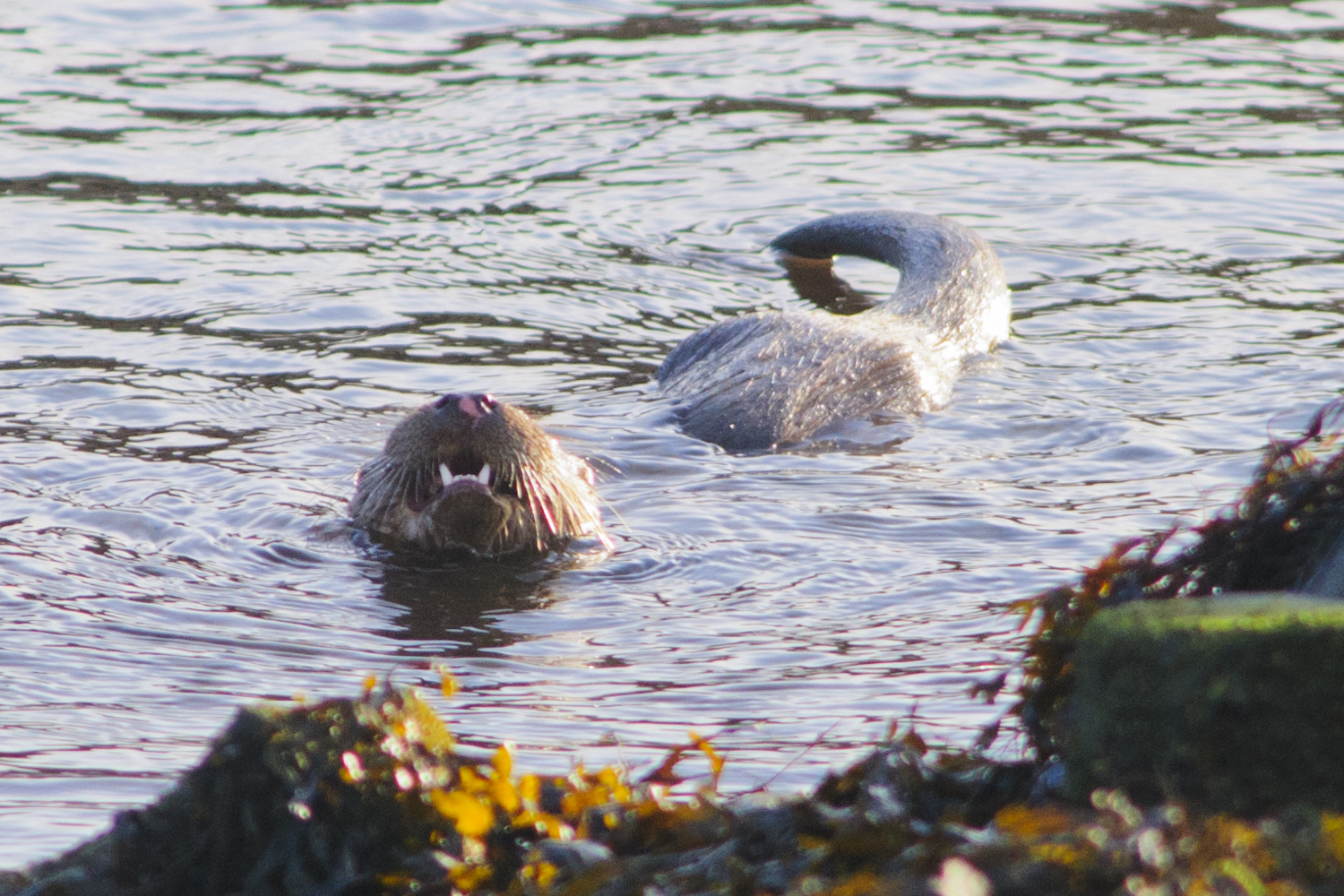
    Then we headed back to ‘Plan A’.  I was as confident as I could be that, with no Otter activity earlier in the day, at least one would be out and feeding as the afternoon wore on.  Sure enough, we were soon watching the lithe sinuous shape twisting and turning in the water as an Otter fed on small fish 🙂  The look on Heather’s face was priceless, and reminded me that as much as I enjoy watching wildlife, I really enjoy seeing our clients enjoying it too 🙂

    Here’s an image of the Otter we were watching, taken in mid-January.
    Eurasian Otter,Lutra lutra,Northumberland,wildlife tours UK,wildlfie tours Northumberland,otter watching UK,otter watching Northumberland

    Our Otter Safaris take place all year round, from warm summer evenings when we’re still out an about late in the day, through to the depths of winter, so there’ll be a time and date that suits you – just give us a call on 01670 827465 to find out when!

  • Bone-chilling; Beginners Photography 13/02/2015

    I pulled into the car park at the mainland end of the Holy Island causeway, and Heather was already there for our Beginners Photography ‘Winter Wildfowl’ workshop.  The first thing that struck me as I go out of the car was just how cold it was.  With a bitingly cold cold wind racing across the exposed mudflats, it felt like the middle of the harshest winter.  So, we started with a session in the car, checking camera settings and delving deep into the recesses of the camera menu.  Then it was time to venture back out into the cold.  Curlew, Redshank, Bar-tailed Godwit and Turnstone were eking out an existence in the wind-blasted landscape, a Little Egret still looked supremely elegant, with barely a feather ruffled out of place, and Heather’s attention was on a flock of Common Eider in the channel under the causeway.  Our county bird is quite stunning, and makes a excellent photographic subject, so Heather was soon engrossed in capturing them whenever they turned their heads towards us and the slightly trickier task of catching one in the act of stretching and flapping it’s wings.  Here’s one of my images of a drake Eider, from a warmer and less windy session a few years ago, showing just how beautiful they are.

    Common Eider,Somateria mollissima,Northumberland,beginners photography workshops,bird photography workshops,photography tuition,wildlife photography Northumberland,wildlife photography workshops Northumberland

    Our Beginner’s Photography Workshops are ideal if you’re just getting used to your camera, or want to improve a particular skill or technique, so give us a call on 01670 827465 to reserve your place.

  • Plan A, Plan B; Otter Safari 07/02/2015

    A question I’ve been asked a few times recently is “What if we hadn’t seen an Otter there?”.  The answer, of course, is that we have a Plan B (and Plan C and Plan D as well, just in case…).

    I collected Bing and Martin and we headed out towards the coast for their bespoke Otter Safari.  Just over an hour later, and Plan A wasn’t looking good; there were Cormorants, Goldeneye and Little Grebes as far as the eye could see, but no sign of our target species…however, good things come to those who wait, and when Bing mentioned that she’d just seen something diving I looked across in the same direction, and up popped an Otter 🙂  Here’s an image of an Otter at ‘Plan A’ in mid-January.

    Eurasian Otter, Lutra lutra,Northumberland,otter watching UK,otter watching Northumberland,otter watching,otter photography workshops,otter photography

    We watched it for a few minutes before it slipped out of sight, and I thought it would be sensible to put Plan B into action.  First though, it was time for lunch.  We paid a visit to probably the most endearing star of our recent days out

    Little Owl,Athene noctua,Northumberland,birdwatching Northumberland,bird photography,birdwatching holidays,birdwatching holidays UK,birdwatching holidays Northumberland,bird photography workshops,bird photography workshops Northumberlanbd,owl photography workshops Northumberland

    and then we sat on a cliff top as Turnstone, Sanderling, Grey Plover, Ringed Plover, Oystercatcher, Bar-tailed Godwit and Curlew scurried, stalked, prodded and probed their way along the shoreline below us.  Plan B proved to be much more successful, as we watched an Otter as it startled Redshank, Curlew, Mallards, Canada Geese and Greylag Geese.  We lost track of it for a few minutes, then suddenly it was right in front of us, getting out of the water briefly, before heading off into the reflection of the sun, and creating the typical ‘ring of bright water’, each time it surfaced 🙂  A Stoat provided some entertainment, as they always do – this one was photographed on New Year’s Day, when we were checking Plans A, B, C and D 🙂

    Stoat,Mustela erminea,Northumberland,wildlfie tours UK,wildlfie photography,wildlife photography workshops,wildlfie photography workshops Northumberland

    Another species that we’ve been watching regularly over the last few weeks provided a vivid splash of colour in the fading light of the afternoon,

    Eurasian Kingfisher,Alcedo atthis,Northumberland,birdwatching Northumberland,birdwatching holidays Northumberland,bird photography holidays Northumberland,bird photography holidays UK,bird photography holidays,bird photography workshops Northumberland,bird photography workshops,bird photography workshops UK

    and then it was time to return Bing and Martin to their hotel, with the goal of seeing an Otter in the wild reached via Plan A and Plan B 🙂  If you’d like to search for Otters in the wild, or any of Northumberland’s other stunning wildlife, then give us a call on 01670 827465 – wildlife is unpredictable, but the one thing we can guarantee is that we’ll always do everything we can to make sure you’re in the right place at the right time!


  • Mud, glorious mud; Lindisfarne Safari 28/11/2014

    The Northumberland coast in the late autumn is a birdwatching destination that I’ll never tire of.  Even in weather that could best be described as inclement, there’s a wealth of wildlife to enjoy.

    I collected Mike and Janet from the Dunstanburgh Castle Hotel and we headed north for a day birdwatching around Lindisfarne and the North Northumberland coast.  Starting with a walk around Holy Island village, a harsh chuckling call betrayed the presence of a Fieldfare in a small tree. Two others joined it, before they all departed noisily.  Then more chuckling Fieldfare, and the high seee calls of Redwing, carried through the air from high overhead and we could make out, in the mist, a mixed flock of these thrushes arriving high from the north east and bypassing the island on their way across to the mainland.  A Sparrowhawk raced by, hedge-hopping and swerving out of sight behind The Heugh, as thousands of Pale-bellied Brent Geese flew out onto the exposed mud of the wildfowl refuge area and Shag, Eider and Red-breasted Merganser dived just offshore.  A couple of very obliging Rock Pipits showed the subtle, dusky beauty that can only be appreciated with close views and Bar-tailed Godwit, Curlew, Redshank, Oystercatcher and Grey Plover were reaping the rich bounty of the mud, as Dark-bellied Brent Geese settled in the newly exposed mud of the harbour, and the high whistling calls of drake Teal carried across to us from the Rocket Field, a Little Auk flew along the main street through the village.  Crossing back to the mainland, a Little Egret was stalking through the shallows along the roadside and Curlew and Oystercatcher were so close we could have almost reached out of the car and touched them.  As the falling tide exposed sandbars, Grey Seals were moaning eerily and splashing about in shallow water.  Suddenly, there were thousands of Wigeon and Golden Plover in the air.  They settled but then flushed again so I started a methodical check of every rock that I could see on the mud.  Then I found what I was looking for – a rock that was just too vertical…and the view through our ‘scope revealed the impressive muscular menace of a female Peregrine 🙂  She shuffled around and took off, only to settle on another rock closer to us.  Our attention was drawn to a charm of Goldfinches feeding nearby, and the Peregrine departed while we weren’t looking.

    As the weather moved through in waves of varying grot, we watched a group of three Roe Deer grazing in a roadside field, and then headed a bit further down the coast.  Dusk was approaching rapidly as we watched more waders feeding busily as the tide rose, Lapwings flew over like giant bats and thousands of Black-headed and Common Gulls arrived to roost.  Wave after wave of mist and drizzle, wave after wave of birds, wave after wave of  waves 🙂

  • Charming; Bespoke Birdwatching 10/11/2014

    Even after 40+ years birdwatching, there are times when I’m not sure whether the thing that excites me the most is a lone rarity, a life or death interaction involving one of the predators we encounter, or an impressive flock of something common…

    I collected David and Dot from Gosforth and we made our way across to the coast for a day of mid-November birdwatching.  This proved to be a day of flocks; Pink-footed Geese rose then dropped in nearby fields, peppering the sky and cutting through the autumn air with their yapping calls.  Mini-murmurations of  Starlings twisted, turned, bunched and swirled, demonstrating that they don’t just reserve that spectacle for the fading light of evening.  Common Snipe were sitting in the vegetation close to the water’s edge, extraordinarily well camouflaged when asleep and only really betraying their presence once they woke up and started probing in the soft mud of the shallows.  Oystercatcher, Turnstone, Redshank, Curlew and Eider are almost a given on the coast in the winter, a lone Sanderling hurried back and forth in a flock of Ringed Plover and Teal, Wigeon and Goldeneye are eyecatching whether in flocks or alone.  Elegant Pintail glided by and Stonechats flicked their tails nervously perched in the tops of bushes in the dunes along the coast.  One isolated tree brought a memorable spectacle, with a charm of Goldfinches, and a lone Greenfinch.  For a couple of years now, a lot of our clients have reported increasing numbers of Goldfinch, and a tremendous decrease in Greenfinch.  No matter how numerous Goldfinch become, it’s hard to imagine that we could ever become blase about them; strikingly patterned, with their red face, black and white head and yellow wing flashes, and with liquid, twittering songs and calls, they really are quite charming 🙂

  • Elementary; Bespoke Birdwatching 05/11/2014

    There are days when it’s calm, still and sunny, but those days are rarely as good as the days when the weather adds its own weight to the whole experience of being in Northumberland.

    I collected Alan and Sandra for their second day out with NEWT and we headed north, to explore the exceptional birdwatching that the north Northumberland coast has to offer in the late autumn.  The closer we got to the coast. the grimmer the weather looked, and as we settled ourselves into position by the Holy Island causeway the rain began pattering against the windows of the car.  Using the car as a birdwatching hide can be a very profitable approach in poor weather and I positioned it so that Alan and Sandra’s side of the car was out of the wind and rain.  Flocks of Pale-bellied Brent Geese were shuffling along the edge of the rising water, and we could pick out a few Dark-bellied Brent Geese amongst them too.  The rising tide brought Curlew, Redshank, Bar-tailed Godwit, Dunlin, Oystercatcher and Grey Plover towards us in changeable weather – at one point we were in bright sunshine and heavy rain at the same time, while the mudflats away to the north of the causeway were under a perfect double rainbow 🙂  Three Little Auks flew north towards the causeway and conditions improved.  Flocks of Redwing and Fieldfare were typical of poor autumn weather and every bush and tree seemed to hold several Robins.  Gannets were feeding offshore from Bamburgh, where some impressive waves were battering the shore, Red-throated Divers flew by and we finished the same as 24h earlier with Pink-footed Geese yapping in the darkness.

  • From the sublime to the gloomy; Bespoke Birdwatching 04/11/2014

    The first of two bespoke birdwatching days for Alan and Sandra began when I collected them from Weldon Bridge and we headed across to Druridge Bay and the southeast Northumberland coast.

    A ghosty pale Mediterranean Gull was a good start to the morning, Redshank, Turnstone, Oystercatcher and Purple Sandpiper were roosting just above the breaking surf and Eiders were rafting just offshore.  Atlantic Salmon heading upstream on the River Coquet provided lunchtime entertainment, then the afternoon brought beautifully sublime light conditions that illuminated Golden Plover and Lapwing as they twisted and turned while Common Snipe slept, fed and bickered with each other in the muddy margins, a Little Egret stalked patiently along the edges of the reeds and a Spotted Redshank stood out like a shining beacon as the sun sank below a thick bank of cloud on the western horizon and it turned cold and gloomy.  Starlings came to roost, although with little appetite for a full-blown murmuration, and Pink-footed Geese arrived from surrounding fields, yapping noisily as they dropped from the air towards the water.  When it was too dark to see anything and we headed back to the car, the yapping of the late arrivals still cut through the gloom overhead.

  • Wading through the waders; Beginner’s Birdwatching 31/10/2014

    Friday was a Beginners Birdwatching session and I collected George from Beadnell and we headed towards Holy Island.

    Most of the afternoon was spent concentrating on waders, with Purple Sandpiper, Oystercatcher, Bar-tailed Godwit, Curlew, Golden Plover, Grey Plover, Turnstone and Redshank all studied in detail.  A pale, elegant, wader swimming in the channel under the Holy Island causeway turned out to be a Spotted Redshank – possibly the bird I heard calling in the dark on Thursday‘s trip – and flocks of Wigeon and Pale-bellied Brent Goose carpeted the mudflats.  It’s amazing how time flies when you’re engrossed in watching birds sticking their faces in mud, and three hours quickly passed and I dropped George back at Beadnell before heading down the coast to home myself.

  • Wild Goose chase; Bespoke Birdwatching 30/10/2014

    Thursday was Pete and Janet’s 6th trip with NEWT, and the dismal, gloomy, drizzly south easterly weather as I drove to Embleton seemed ever so slightly promising 🙂

    We started around Druridge Bay, checking a small area of woodland close to the coast, and soon encountered one of my favourite passerines, with three Brambling feeding quietly high in the canopy and two more flying over noisily.  Everywhere we went there were Robins and Blackbirds, although little sign of any other migrants other than a large flock of Redwing over Cresswell and a flock of Fieldfare near Beadnell.  Leaping Salmon on the River Coquet provided a lot of entertainment and a Cormorant which had been catching small fish, dived, causing a large Salmon to leap clear of the water.  The fish splashed back down and the Cormorant surfaced, gripping it behind the gills.  As the bird drifted downstream with its catch, we couldn’t believe that it would be able to deal with such a large fish…then it manouvered it so that the fish’s head was pointing down it’s throat and swallowed it whole!

    As dusk approached, we were on the coast near Holy Island.  Little Egrets, Grey Plover, Curlew and Redshank were on the mudflats and the high yapping sound of Pink-footed Geese could be heard distantly.  Skein after skein appeared against the dark clouds overhead, settling close to the oncoming tide.  Then more, and more, and more…thousands and thousands of geese, still arriving when it was so dark that they were just a slightly darker speckling against an almost featureless backdrop.  Finally, as we headed back to the car, the ‘teu-it’ call of a Spotted Redshank cut through the gloom as the geese continued to arrive.

  • Mini-beasting; Bespoke Otter Safari 02/09/2014

    It’s remarkable how often a theme seems to develop during a trip; flocks, migration, raptors, birds with similar names – all have happened over the last few years.

    I drove up to the Breamish Valley to collect Donna and Andy and we headed towards the coast and Druridge Bay with the plan of spending the afternoon and evening birdwatching, finishing at what has been our most reliable Otter site this year (although a run of five successful trips eneded with our last two Druridge Bay safaris not producing any sightings of this enigmatic predator).  Starting in the hills on a nice afternoon, I thought it would be good to search for Adders, and Andy’s sharp eyes produced the goods, with the smallest Adder that I’ve ever seen 🙂

    The afternoon continued with the waders we would expect – Ruff, Curlew, Lapwing, Redshank, Oystercatcher, Dunlin, Common Snipe – and one much more scarce, in the shape of two Little Stints.  We had a rear-end view of a Spoonbill heading north and a Little Egret was stalking along the shallows.  It may be a predominantly white bird, but it’s stunning in good light.  Adult and juvenile Mediterranean Gulls were picked out from the roosting Black-headed Gulls and, as dusk approached, we settled into position to watch for Otters.  A juvenile Marsh Harrier was quartering the reedbeds, Starlings were arriving to roost, with some murmuration, a Spoonbill flew in, magnificent in the sunset, then, in the fading rays of daylight, there was an Otter 🙂  Clearly a theme was developing, as this was a very small Otter cub.  Eventually light levels reached the point where we decided to call it a day and head back northwest.  The day’s theme continued, with a tiny Rabbit along the roadside, and then the final wildlife experience, on a day with wildlife and clients that reminded me so often why I love my job; a Barn Owl crossing the road ahead of us before perching in the beam of our headlights 🙂