Tag: Redshank

  • Bird Watching Magazine Reader Holiday Day 1: 07/07/2011

    I met with Geoff and Jenny, Roy and Lorraine & David and Linda on the Wednesday evening in the bar of the Bamburgh Castle Inn and, after introductions and drinks, we went upstairs to the conservatory for dinner.  A steady stream of Gannets was heading north and I outlined the plan for the coming days; modified in light of the weather forecast!

    An 06:30 start on Thursday morning appealed to three of the group, so we set off to walk around Seahouses Harbour and along to the golf course.  Lorraine had dreamt the night before that we found a Bluethroat.  Not just any Bluethroat though; a Fork-tailed Bluethroat (something that doesn’t exist…although we spent the rest of the holiday looking for one!).  The heavy swell and breaking waves gave the sea an imposing look, and the strong, cold southeasterly wind and dark clouds all around added to the atmosphere.  With high tide approaching, wading birds were concentrated onto just a few exposed rocks; among the Oystercatchers, Redshanks and Curlews were a single Ringed Plover and 5 summer-plumaged Knot, their peachy-orange underparts showing why, in some parts of the world, they’re known as Red Knot.  A Whimbrel flew by and Linnets, Pied Wagtails, Rock Pipits and a reeling Grasshopper Warbler were all added to the day list and we headed back to the inn, and breakfast.  No less than 6 Rock Pipits were outside the window during breakfast and an all too brief probable Hummingbird Hawkmoth whizzed by.

    The main question was whether our all-day birdwatching trip to the Farne Islands with Glad Tidings would go ahead; the weather forecast wasn’t promising, and the sea looked foreboding.  I was optimistic though – by our planned departure time the tide would be ebbing and should take off some of the swell.  Sure enough, we boarded Glad Tidings III just after 10am and headed towards the islands.  Gannets soared majestically above the swell, Puffins raced by on whirring wings and our passage wader list grew with the addition of Grey Plover and Purple Sandpiper.  Grey Seals bobbed around, watching as we passed by on our way to Staple Island.  Enjoyment of the breeding auks, Shags, Kittwakes and Oystercatchers was enhanced by the wild feeling of the islands, as waves smashed into the cliffs and fountained high above the birds.  Transferring to Inner Farne at 1pm, we were the first group onto the island for the day.  The Arctic Terns gave us their usual warm welcome and we spent the afternoon enjoying the fascinating bird behaviour that can be witnessed at close range.  The group were keen to fix the separation criteria for Common and Arctic Terns firmly in mind, so we spent some time looking carefully at lots of birds and considering individual variation.  We spent a lot of time watching Puffins as well; not an identification problem, but endearing and fascinating!  With mobs of Black-headed Gulls waiting to rob the adult Puffins as they return with beaks filled with Sand eels, the Puffins have quickly developed strategies to deal with this; circling back out over the sea until the gulls have moved away from your burrow is an obvious one, but the one that is most fascinating involves a Puffin running into another  bird’s burrow, waiting until the gulls have moved and then running to another burrow – sometimes visiting as many as 5 or 6 sanctuaries before reaching their own chick.  In an increasingly heavy swell, the journey back to the mainland was quite an experience.

  • Subjected to the elements

    Our Druridge Bay/southeast Northumberland mini-safari at the end of last week ‘enjoyed’ a range of weather conditions;  after collecting Richard and Maureen from Blyth, we set off for the Coquet estuary.  Howling winds and sheets of rain didn’t deter us though, and using the car as a birdwatching hide we had excellent views of Grey Herons, Cormorants, Goldeneye, Redshank and Wigeon.  A real highlight of the morning was a young male Marsh Harrier, hunting the coastal reedbeds.  With a range of waders and wildfowl to fill the ‘scope, and the weather improving to bright sunshine, the morning was all too soon over and I was on my way home to wash and clean the car ready for our next trip.

  • Stormy weather

    November is generally a quiet month for NEWT; the half-term rush in late October has come and gone, thoughts are turning to Christmas…and the weather can be a bit suspect.  We had a Safari Day around Druridge Bay and Southeast Northumberland at the end of last week that could have succumbed to the elements but, as it turned out, a combination of excellent birdwatching sites that could be watched from the Land Rover, clients with a real interest in natural history (and expertise in wildlife sound recording)and a badger-watching spot where the trees sheltered us from the rain, made it an enjoyable afternoon.  The flock of Waxwings in Ashington delighted yet again.  Who could fail to be impressed by them? After a spell of birdwatching that was then characterised by ‘lovely weather for ducks’ (Teal, Wigeon, Mallard, Gadwall, Goosander, Goldeneye and Pochard were all seen), and some good flocks of Lapwing, Golden Plover, Redshank and Pink-footed Goose, we headed inland to the steep, wooded hillside that has produced some excellent views of Badgers on our Safaris in recent months.  Only one Badger came wandering along – perhaps the others that we’ve watched so often this year were indulging in that particularly human pastime of curling up somewhere nice and warm out of the wind and the rain.

    Since then it’s been a busy week, mainly with planning and preparation for 2011 but also giving 2 presentations about the Northeast Cetacean Project.  The first was to a group of postgrad students and lecturers at Newcastle University and then last night, to the Northumberland & Tyneside Bird Club.  Both presentations produced some interesting questions, and some potentially excellent volunteers to assist with our ongoing survey work.

    Now it’s Friday morning, the howling westerly winds are bringing waves of rain and then sunshine, there’s an intense rainbow visible from our office window and a flock of Redwings are being blown about like autumn leaves.  No matter what the weather throws at us, Northumberland is still a superb county for wildlife and birdwatching; you just need to know how to enjoy it 🙂

  • Stress reduction

    It wasn’t a relaxing afternoon for the birds in Budle Bay yesterday, as a juvenile Peregrine worked it’s way back and forth, causing havoc as it went through.  Further north, and looking towards Holy Island from the mainland, flocks of Wigeon and Pale-bellied Brent Geese were moving as the tide fell, and Redshank, Dunlin and Grey Plover all took advantage of the newly exposed mud.  A Common Buzzard perched in a  hawthorn hedge at the roadside flushed as we approached but then hovered lazily over the fields.

    Looking the opposite way, from Holy Island back towards the mainland, dark steel grey clouds on the horizon were outlined in gold by the setting sun, Bar-tailed Godwits were feeding along the water’s edge and a quite stunning aural backdrop was provided by Grey Seals.  As the sun slipped out of sight, Grey Herons became inky black silhouettes against the shimmering golden reflection of the sky and the air was filled first with the plaintive calls of Grey Plover and then with the high yapping of Pink-footed Geese.  Skein after skein rose from the dark backdrop of the clouds on the horizon, appearing like swarms of bees against the dying embers of the day’s light.  A Little Egret flapped by, a ghostly white heron vanishing into the night.  Then, a grand finale to the afternoon’s birdwatching as the sky darkened, revealing a stunning array of stars, and the dark shapes of more Pink-footed Geese passed overhead, briefly cloaking the pin-points of light.  Relaxing, sublime, awe-inspiring…

  • White is the new Black

    We had back-to back birdwatching trips earlier this week, covering two of our favourite areas.

    On Tuesday afternoon I collected Keith and Jen from home in Monkseaton and we headed northwards up the Northumberland coast.  Our destination was the Holy Island of Lindisfarne, one of the birding hot-spots of the entire country.  The strong winds were the only downside to the afternoon, but the birdwatching was good.  After checking out a large group of Grey Seals we covered the area around the harbour and the Rocket Field.  Bar-tailed Godwits, Common Redshank and lots of Ringed Plover were along the shoreline and a delightful charm of Goldfinches were around the Heugh.  A distant group of Lapwings, Starlings and Golden Plover took to the air and the cause of their alarm was glimpsed briefly, although too briefly and too distant to make a positive ID.  Holy Island birdwatching stalwart Ian Kerr put us on to a Little Stint and, as we headed back through the village, groups of Golden Plover passed overhead.  Re-tracing our route back down the coast and checking the Budle Bay on the rising tide, we were just discussing the indications of the presence of predators when a huge number of birds lifted from the mud.  As well as the gulls and waders, Jackdaws, Rooks and Woodpigeons joined the throng as they came out of adjacent fields and trees.  This time the culprit was seen and identified; a Peregrine, that most majestic of raptors and one of the highlights of any birdwatching day on the Northumberland coast in the autumn and winter.  A quick seawatch produced Sandwich Terns feeding, and Gannets soaring effortlessly on the breeze.

    Wednesday was a full day out around Druridge Bay and Southeast Northumberland.  I collected Jayne and Andrew from Seahouses, and then Hilary and John from Alnmouth, before beginning our tour of some of the best birdwatching spots in our local area.  While we were watching Lapwings, Redshanks, Greenshanks, Ruff, Herons and Cormorants on the River Wansbeck I could hear a rough ‘sreee’ call from high overhead.  The strong breeze meant that it wasn’t straightforward to locate the bird, but eventually I picked it out.  It was an unfamiliar call, but a familiar species; a juvenile Common Cuckoo.  The walk back along the river produced a nice flock of Long-tailed Tits.  After lunch we stopped off at Cresswell Pond.  Hilary and John mentioned that they’d visited Cresswell once before – when they noticed a large group of birders and stopped, managing to see a Buff-breasted Sandpiper.

    Northumberland birdwatching following the floods of September 2008
    Buff-breasted Sandpiper and Ruff, Cresswell Pond, Northumberland 12/09/2008
    With luck like that, we joked about what this visit could produce...

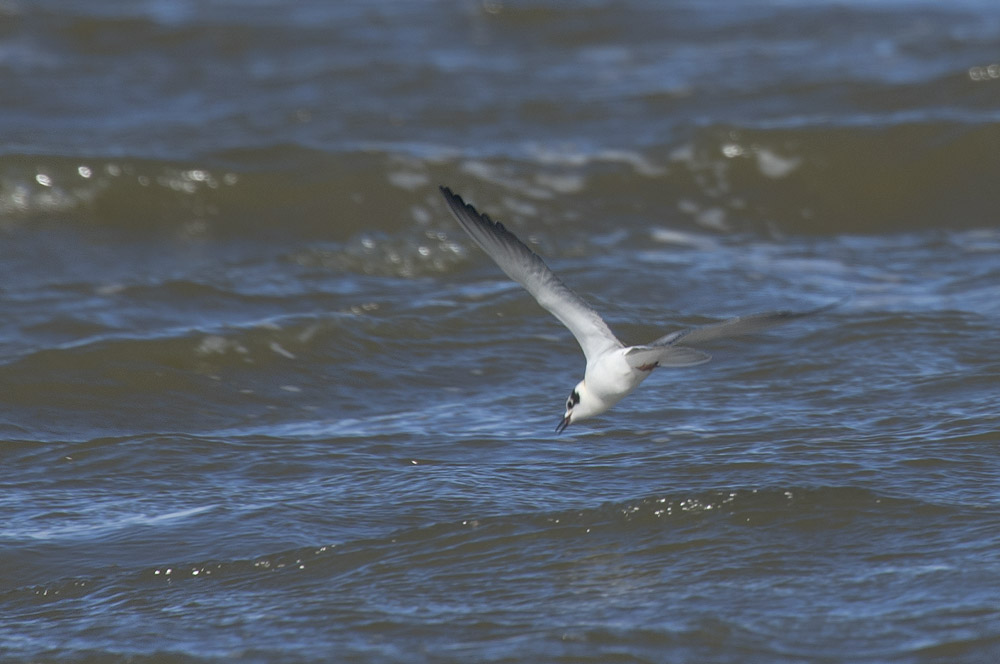
    When we arrived at the hide, Jaybee mentioned that he’d had a juvenile Sandwich Tern.  I scanned the pond but couldn’t see the tern anywhere and we settled to enjoying the quite remarkable views of Common Snipe that were available.  After checking through the assembled ducks, gulls and waders I scanned across the pond again and spotted a tern dip-feeding near the causeway.  The bird’s behaviour, combined with it’s very dark back, white rump and silver-grey wings caused me to get rather excited.  White-winged Black Tern is a very special bird, and a personal highlight as it’s the third Chlidonias tern that I’ve found in Northumberland.  Whiskered Tern is very rare and Black Tern is always a nice bird to see but White-winged Black Tern is such a beautiful species.  Jaybee kindly sent me some images to use 🙂

    White-winged Black Tern, a Northumberland birdwatching highlight 15/09/2010
    White-winged Black Tern, Cresswell Pond, Northumberland 15/09/2010
    Highlight of a day birdwatching on the Northumberland coast 15/09/2010
    White-winged Black Tern, Cresswell Pond, Northumberland 15/09/2010

    White-winged Black Tern, Northumberland, Birdwatching
    White-winged Black Tern, Cresswell Pond, Northumberland 15/09/2010
    As other birders began to arrive to enjoy the fruit of our good fortune we continued up the coast.  Eiders and a Goosander, as well as some very obliging Grey Herons, were seen as we stopped by the River Coquet.  A superb couple of day’s birdwatching, a beautiful rarity and clients who were excellent company.

  • Whistle while you work

    Yesterday was one of what are rapidly becoming our favourite trips; afternoon/evening safaris.  I collected Claire and Stuart from their holiday cottage near Brinkburn Priory and we headed towards the coast.

    Our regular Little Owl watched us imperiously, before turning tail and scuttling out of sight as a dog walker came along the track.  The coastal pools along Druridge Bay are hosting an ever increasing number of waders; Dunlin, Turnstone, Redshank, Knot, Ruff, Oystercatcher, Lapwing, Common Sandpiper and Curlew were all roosting, a Spotted Redshank called but remained frustratingly out of sight behind a reedbed, and Greenshank and Whimbrel both responded to imitations of their calls.  Then, that most majestic of waders graced the air in front of us, although only briefly; a Black-tailed Godwit flew low over the roost, everything panicked, and a Peregrine carved through the flock before heading out over the sea and then away high to the north.  Little Grebes and Grey Herons were both well appreciated, then it was time to check some of southeast Northumberland’s finest mammal sites.

    Red Squirrels always go down well with our clients, and the one we watched feeding was no exception.  A juvenile Great Spotted Woodpecker was equally obliging and we watched it for a while before moving on to our favourite site for Badger watching.  Probably the biggest Badger we’ve seen so far trotted across the hillside opposite us and a much smaller animal (maybe a young cub) made it’s way through the undergrowth just over the stream from our position.  As darkness approached we found ourselves on a hilltop with a Tawny Owl calling ‘ke-wick’ from the woodland below us.  After whistling at waders during the afternoon I imitated the quavering hoot of a male Tawny Owl and waited.  The bird called from closer.  I called again, and it came closer still.  Eventually it flew up into a bare tree, silhouetted against the final glow of daylight in the sky, only 20m away from us.  I switched to copying the bird’s ‘ke-wick’ call and it turned to face us directly, ready to challenge this impertinent intruder.  I remained silent, not provoking any further response, and the bird flew to a nearby tree, screeching defiantly as we made our way back down the hillside.  Common Pipistrelles and Daubenton’s Bats were picked up on the bat detector and seen as they flitted back and forth.  The final wildlife of the evening though was close to the cottage at Brinkburn, and was another piece of Northumberland magic; a doe Roe Deer and her fawn ran along the road in front of us.

    As Autumn approaches evening safaris mean finishing at a quite amenable hour, so give us a call on 01670 827465 to find out how you can share in these memorable experiences with us.

  • British Birdwatching Fair 2010

    We’ve been away for a few days, as part of the Birdwatching Northumberland consortium at the British Birdwatching Fair 2010.

    Thursday started very early for Martin, with a North Pennines Prestige Tour for clients who were staying at Wallfoot in Carlisle.  Managing to avoid the worst of the weather, avian highlights included Merlin, Goldcrest, Nuthatch, Red Grouse, Black Grouse, Whinchat and Wheatear.  The long drive down the M6 didn’t, unfortunately, miss the heavy rain.  However, a late arrival at the White Lion in Whissendine, and a few beers in the bar with such luminaries as Ipin set Martin up nicely for an early start on Friday.

    Sarah was at work (in her ‘proper’ job) so, apart from attending a couple of lectures, Martin was on the Birdwatching Northumberland stand for all of the first day.

    Saturday we planned to work ‘split’ shifts, but with Martin again spending most of his time on the stand; apart from another couple of lectures and one or two chats with clients, colleagues, suppliers, competitors and collaborators (both old and new).

    Another excellent curry at the White Lion, and a ‘few’ beers, on Sataurday night was followed by the dawning of the final day of Bird Fair 2010.  One of us was a bit ‘under the weather’ but perked up in time to give his talk ‘The North Sea – a new birding frontier’ at 3.30pm.  What could have been a bit of a graveyard shift managed to generate a lot of interest, with 134 bird fair attendees making their way to the lecture marquee to enjoy a brief history of the Northumberland pelagics.  There were a few questions at the end of the lecture, then Martin was stopped and asked some more, for the next 10 minutes, as he headed back to the stand – where other people who had been in the lecture were waiting to ask more questions.

    After three days at the Bird Fair we’d made a lot of new contacts, renewed some old acquaintances and we’ll shortly be entering exciting partnerships with some big names in the birding world.  Just a few very busy weeks to come first…

    A final night in the midlands was followed by the journey north on Monday, and then a Prestige Tour yesterday.  Beginning with  an actively feeding Dipper was a good start then, with a particular request for wading birds, it was good to strike a rich vein on the coast; Green and Common Sandpipers, Greenshank, Redshank, Spotted Redshank, Curlew, Whimbrel, Oystercatcher, Lapwing, Dunlin and Ruff.  What seemed to go down better than all of the other birds though were the always impressive Grey Herons.