Tag: Fulmar

  • Against the light

    In near-perfect conditions we arrived at Seahouses yesterday evening for our 3hr coastal cruise on Ocean Explorer.  As well as some of our ‘regulars’ we had Andy, Jan and Sam on board, on their final evening in Northumberland.

    Soon after heading south down the coast towards Dunstanburgh we came across a couple of Harbour Porpoises.  Typically shy, they surfaced a few times and then vanished into the depths.  Gannets featured throughout the evening, passing both north and south, and one or two were seen diving.  Puffins, Guillemots and Razorbills were bobbing about on the water and a mixed flock of Arctic and Common Terns and Kittiwakes had found something to hold their interest.  We stopped to see if anything else would come along, and were soon joined by a Fulmar, stunning in the beautiful light.

    Fulmar,bird photography tuition,Northumberland

    We gradually headed north, and approached the Farne Islands as the sun began to set.  Grey Seals poked their heads out of the water and came off the rocks to investigate our boat, Cormorants and Shags perched sentinel-like on the rocky islets, Turnstones prodded and poked their way around the edge of the mass of Seals and Sam punched the air in elation as his first Curlew flew by 🙂  The setting sun provided an opportunity to experiment with an aspect of photography that I’ve never really been able to get to grips with, and one which I’ve always been fairly ambivalent about.  Excellent light, excellent location, all the ingredients were there to convince me…

    Farne Islands,Inner Farne,Northumberland,landscape photography tuition,seascape photography


    Farne Islands,Northumberland,landscape photography tuition,wildlife photography tuition,seascape photography

  • White-beaked Dolphins

    Friday was our final Royal Quays evening pelagic for this summer, and we were heading once again on to the North Sea in search of a species that has come to occupy much of my time; White-beaked Dolphin.  My first encounter with them was in 2003, on an evening pelagic, and we’ve found them many times since then.

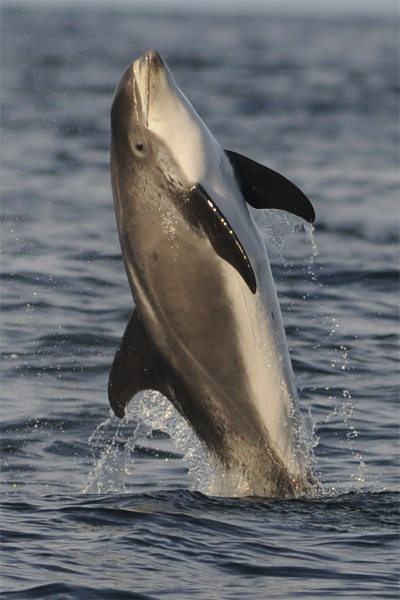
    I’ve spent long, difficult days offshore in the winter, researching their distribution while leading the North East Cetacean Project, I’ve stood on a clifftop with clients (on an Otter and Badger Safari!) as a pod covering several square miles of the North Sea passed by, I’ve taken photos like this one on flat seas in beautiful weather

    White-beaked Dolphin,dolphin watching trips,whale watching trips,Northern Experience Wildlife Tours

    and I’ve had brief encounters in conditions where I was surveying but would never have taken clients out.  I’ve spent several hours watching them bow-riding

    and I’ve laid on the front of a boat, looking down at a dolphin that was bow-riding upside down looking at me.

    On Friday though, we witnessed behaviour that myself and Andy (who was also on board) had never come across before.  We think that what happened was a small group, including a tiny calf, were resting near the surface and we inadvertently woke them up.  The first indication we had that there were any dolphins around was when an adult crossed close to our bow, tail-slapping.  Another adult (or possibly the same one) then began breaching and for 20 minutes we found ourselves shadowed by a pod of about 10 animals.  No bow-riding, no interaction other than escorting us as we travelled slowly through their area, and a rare insight into the behaviour of a pod of dolphins protecting the next generation.  Eventually the pod dropped away from us and, as we headed south, we saw them for the final time as they milled about distantly in our wake.

    We’ve got just one place still available for our September Royal Quays trips (that space is on September 22nd), our Whale and Dolphin Cruise from Seahouses on September 8th is filling rapidly and we’ve got a few spaces on our Farne Deeps trip from Royal Quays in search of White-beaked Dolphin, Minke Whale and seabirds on August 15th and our evening RIB trips from Seahouses.  Click here for more details or to book, or call 01670 827465 to reserve your place before they’re all sold out.

  • Dark night

    This has been a difficult year for boat operators on the east coast, with unseasonable winds and frequent heavy rainfall making it unwise to head out to sea.

    Tuesday was the first of this year’s evening pelagics to survive the weather so, as we set out from Royal Quays on the SarahJFK, I was full of optimism.  Soon after leaving the mouth of the Tyne, Allan spotted a Harbour Porpoise, although it remained typically elusive.  Kittiwakes were following us throughout the evening, no doubt wondering if we were going to throw any scraps overboard, Gannets and Fulmars were passing by and, all around us, the sky looked heavy with something…

    I’d had a call earlier in the day to say that a small pod of dolphins were passing Newbiggin, so I took a guess on where they would be by mid-evening and asked Allan to plot a course that would take us through the area.  Sure enough, just where we expected them, 6 White-beaked Dolphins, including the smallest calf that I’ve seen in the ten years since we first found White-beaked Dolphins on one of our pelagic trips, appeared in front of the boat and then came in to bow-ride 🙂  They stayed with us for several minutes before heading south, probably to feed, and we continued north.    5 Manx Shearwaters were heading north, and a flock of 30 Common ScotersAll the while the weather around us was looking poor, and eventually we found ourselves in a heavy, misty drizzle as we headed back to port, and by the time we docked it was properly dark – not something we’d normally expect in mid-July.

    Glowering, oppressive weather conditions, remarkably good visibility, a sea state that was ideal for cetacean spotting, a boat full of enthusiastic clients and a pod of dolphins…perfect 🙂

  • Some Hobby

    Wednesday was a trip that I’d been looking forward to for some time.  Syd is a regular client, and always very entertaining, and this time around his son Gavin was booked with him as well, for a Farne Islands safari.

    With plenty of comments on Twitter in the weeks leading up to the trip, we were all praying for good sea conditions for the day.  The forecast suggested that the afternoon could be a bit wet so I thought about visiting Staple Island instead of Inner Farne, before satisfying myself that it would stay dry for us in the afternoon and sticking with my original plan of walking along the dunes at Newton in the morning, and catching the 1pm boat to Inner Farne.  The morning walk produced lots of Skylarks and Meadow Pipits as well as Common Blue Butterflies and Northern Marsh, Pyramidal and Bee Orchids. The tern colony was a hive of activity, with the Arctic Terns bringing food to their chicks and some  Little Terns engaging in some late season breeding activity.  While we were there, the terns kept lifting from the dunes in a ‘dread’ but the source of their concern wasn’t immediately obvious.  Myself and the wardens commented that it was what we would expect if a Peregrine was passing over, but scanning the sky overhead didn’t produce the menacing shape of that particular predator.  Eventually we did spot a raptor, although not an expected one, as a Marsh Harrier flew south along the fields inland from the terns.  After having our lunch stop in the shadow of Bamburgh Castle, we took the short drive to Seahouses.  Approaching Monk’s House Pool, Syd and Gavin had the bird of the day as a Hobby flew north over the roadside fields.

    We boarded Glad Tidings IV for the journey across to the islands and sat next to local birder TC, who had watched all of the hirundines in Seahouses start alarming…just a few minutes before the Hobby was between Seahouses and Bamburgh.  After the sailing around the islands, with their Grey Seals, Guillemots, Razorbills, Puffins, Kittiwakes, Fulmars, Shags and Common, Sandwich and Arctic Terns, we landed on Inner Farne and Gavin concentrated on photographing Puffins.  We were ‘treated’ (if that’s the right word…) to an example of just how cruel nature can be as a Kittiwake chick wandered away from it’s nest and towards the edge of the ledge.  It turned back from the edge, made it’s way unsteadily back to the nest, and was promptly tossed over the edge of the cliff by the adult!  As it landed on the next ledge down, it was attacked and killed by 2 juvenile Shags in front of a group of horrified onlookers.

    After nearly 2 hours on Inner Farne, we boarded Glad Tidings for the journey back to the mainland…and the first few drops of rain fell as we reached the top of the steps on the harbour 🙂

  • Farne Islands 11/06/2012

    Monday was an all-day Farne Islands Safari with Mike and Maggie, who I was really happy to meet up with again after their two trips with us last October.

    All-day trips to the islands always face one particular hurdle – landing on Staple Island.  Big tides and any appreciable swell make getting on to the island an interesting proposition and, after our boatman had looked at the swell and decided it wasn’t safe, we had a tour around the outer islands before returning to Staple as the tide fell.  This time all were able to disembark safely, although a number of passengers were struggling to follow the very clear instructions they had been given by Billy and Bobby about how to get off the boat and on to the island!

    Staple is always a popular island with our clients.  You can get on with your photography without the constant aerial bombardment from the Arctic Terns that make Inner Farne such an exciting place to visit 😉  Mike has the same camera that I use so we went through the custom settings to make photographing birds in flight a (slightly) easier proposition, and I settled to spotting approaching photo opportunities while Mike concentrated on the scene through his viewfinder, with Puffins, Guillemots, Razorbills, Kittiwakes, Shags and Fulmars all performing well.  Inner Farne in the afternoon was a different proposition altogether; early June is the time when the Arctic Terns are at their most defensive and aggressive – pity the visitors who turned up without hats 🙂  Judging wind speed and direction, and the position of the Sun, led us to the right spot to photograph Puffins as they arrived back from their fishing expeditions and Mike was able to put his newly learned techniques into practice.  After a day,which seemed much too short, we were on our way back to the mainland, and discussing Mike and Maggie’s next trip north and what we’d do next time.  When the company of our clients is as enjoyable as the wildlife, it’s always a good day 🙂

  • North East Marine Wildlife Festival Pelagic 10/06/2012

    Our Marine Wildlife Festival pelagic trip should have taken place on Saturday, but the poor weather led to several ‘phone calls and e-mails, and a re-scheduling to Sunday instead.

    We lost a few participants who couldn’t make the rearranged date, but we gathered a few extras on Saturday/Sunday too, and arrived at Seahouses Harbour full of enthusiasm for our first pelagic trip this year.  In the extremely capable hands of John, onboard Glad Tidings V, we headed across to the Farne Islands and the Guillemots, Razorbills, Puffins, Shags, terns, Kittiwakes, Fulmars and Grey Seals.  After a journey through the islands we sailed south and then east before heading back north along the coast.   Harbour Porpoises provided the cetacean interest, lots of Gannets were soaring majestically by and three Manx Shearwaters flew north.  The number of positive comments by text, e-mail and ‘phone, since Sunday evening has been great and it’s always good to see how much people appreciate the marine environment of the North Sea, even if it sometimes seems impenetrable.

    Bird of the day though, was the one that was only seen by a couple of very lucky participants.  We were a couple of miles south of the islands when someone asked the question “Martin, which Storm-petrel is it likely to be that we saw back there?”…

  • Three days in early June

    We started June with three trips in the first four days of the month, all focused around our ‘local patch’; Druridge Bay and southeast Northumberland.

    On Friday morning I collected Gary and Claire from their holiday base in Proctor Steads, and we headed down the coast.  Even though we’ve lived close to Druridge Bay for nearly 12 years, the wildlife of this post-industrial landscape is still as special as it always was.  Whether it’s Tree Sparrows feeding young, ghostly pale Roseate Terns on their nest boxes on Coquet Island, a Cuckoo flying low over a coastal reedbed, dense flocks of hirundines and Swifts hawking insects low over a lake, Reed and Sedge Warblers singing from adjacent reedbeds allowing easy comparison of their song, Fulmars soaring along a cliff edge within a few metres of us as we eat our lunch or Blue-tailed Damselflies drifting along footpaths and tracks before settling on the grasses and apparently vanishing, there’s always something going on, always something to watch and the day always seems to end too soon.

    Saturday was an afternoon/evening Otter Safari and I collected Lesley and Kevin from Church Point before heading north.  After an afternoon spent birdwatching, with my own personal highlight being a very yellow Yellow Wagtail, and searching for Otters, we settled into position for an evening session at one of our favourite ponds.  As a pair of Roe Deer grazed poolside vegetation, looking resplendent in the sublime light from a sunset that looked like a fire burning on the horizon, and a Long-eared Owl drifted back and forth over the reedbeds, our quarry made his appearance.  Gliding menacingly through the water, the Otter managed to sneak up on 2 Mallards, who noticed him when he was just a few feet away and took flight.  Exploring the rest of the pool he was pursued by an ever-expanding flock of Black-headed Gulls before finally vanishing into the sanctuary of the reeds.

    Our third excursion around Druridge Bay was a Prestige Tour for Pete and Rachel.  Sedge and Willow Warblers and Reed Buntings all sang from obligingly open locations, although Reed Warblers remained hidden deep in reedbeds, a Roe Deer put in an uncharacteristic daytime appearance and a Mute Swan had a remarkable hissy fit.  The cause of his slightly embarrasing temper tantrum couldn’t be seen, but as he kept charging at a reedbed it seemed likely that a predator he saw as a threat to his cygnets was lurking out of our sight, but not his.  Later in the day an even more impressive display of annoyance was demonstrated by two cock Pheasants as they spent a good 20 minutes posturing and fighting.  Our clients frequently comment about how relaxing a day out with us is…and those Pheasants could really have done with chilling out too 🙂

  • Birding with a touch of luxury

    Delivering a birding package for the first time with a new partner is always a mixture of excitement and worry; will the experience we deliver to our clients blend well with the standards of service, accommodation and food that are provided?  Our exclusive Doxford Hall birding break on Thursday and Friday didn’t hold too many worries though – I’ve attended conferences and other events there before and, having known David Hunter since he was at Matfen Hall, I knew that the entire Doxford experience would be a memorable one for all the right reasons.

    I arrived first thing Thursday morning to collect Paul and Sue, who had won their exclusive birding break in a competition that ourselves and Doxford Hall ran recently in Birdwatch magazine.  Our original plan of Druridge Bay on Thursday, Lindisfarne on Friday, had been altered following a ‘phone call during the week from Sue – there was one species they particularly wanted to see, and our recent blog posts had revealed that now might be a good time…so, after a day of hectic communication with the Forestry Commission to arrange access through Kielder, and check where along our route there would be any forestry activity, our first trip headed inland.  We started at Harwood in near-perfect weather conditions; warm, sunny and with a good breeze.  Common Buzzards, Common Crossbills, Siskins and a very vocal Raven were all seen but no Goshawk so we continued west.  Once we were in Kielder another Raven entertained us, tumbling and cronking over a remote farmhouse in the warm afternoon sunshine before soaring heavenwards and then dropping back out of the sky alongside its mate.  We stopped to scan over another plantation, where I’ve watched Goshawks previously, and I soon spotted a bird just above the trees. He quickly got into a thermal and rose until we lost sight of him.  I suggested that we just needed to wait for a Common Buzzard to drift over the Gos’ territory, and we began a patient vigil.  Eventually a Common Buzzard did appear, we all lifted our binoculars to focus on it…and a distant speck in the binoculars above the buzzard grew rapidly larger as the Goshawk dropped out of the sky.  The intruder thought better of hanging around and quickly folded it’s wings back and crossed the valley like an arrow.  Having shepherded the buzzard away, the Phantom of the Forest rose quickly again to resume his sentinel watch.  More Common Crossbills and Common Buzzards followed as we travelled down the valley back towards civilisation, and 2 pairs of Mandarin brought a touch of stunning colour to the afternoon.

    Dinner at Doxford Hall on Thursday evening was exceptional (outstanding food and outstanding levels of service throughout the 2 days), and having clients with such an enthusiasm for birding, and fantastic sense of humour, made it even better.  After dinner conversation did reveal that there was an obvious gap in their life-lists though…

    Friday’s plan was simple; head to the coast and then bird our way down it to finish in Druridge Bay late afternoon.  We started at Harkess Rocks, in the shadow of Bamburgh Castle, with a very nice flock of 79 Purple Sandpipers.  In the heavy swell a flock of Common Scoters proved elusive, Common Eiders dived through the surf, small rafts of Common Guillemot and Razorbill bobbed about, Gannets soared effortlessly, Sandwich Terns were feeding just offshore and Long-tailed Ducks and Red-breasted Mergansers in breeding finery were a reminder that our winter visitors are about to pack their bags and head north.  Red-throated Divers, including one bird with a very red tinge to it’s throat, were typically elusive, diving just as we got onto them.  I’d got another species in mind though and, when I found one, it was sitting obligingly next to a Red-throated Diver.  Soon, Paul and Sue were admiring the elegant structure, neat contrasty plumage and white flank patch of their first Black-throated Diver. 2 days, 2 lifers 🙂

    We headed south and, after watching an adult Mediterranean Gull, and two 2nd calendar year birds, winter and spring came together with flocks of Greylag and Pink-footed Geese, and a Short-eared Owl, being characteristic of the last 5 months of our coastal trips, Green Sandpiper and Whimbrel on passage and a male Marsh Harrier drifting over a coastal reedbed.

    In beautiful afternoon light, with the sound of the roaring surf of the North Sea crashing into the east coast, the Short-eared Owl quartering a nearby reedbed and a pair of Great Crested Grebes displaying on the pool in front of us, a couple of comments by Sue – two of many memorable ones during the trip 😉 – summed things up nicely “chilled-out birding” and “we like the view from Martin’s office” 🙂

  • Sing when you’re winning

    My own highlight of many trips involves those ‘nature red in tooth and claw’ moments, and they come in many guises…

    A Chiffchaff was singing as I collected Alec and Margaret from Waren Mill and we headed south down the coast toward Druridge Bay with a day of birdwatching ahead of us.  In quite stunning weather we enjoyed fields of Curlew, rafts of Puffins on the sea, and clouds of them swirling over Coquet Island, Fulmars shearing along the cliff-tops, plenty of wildfowl, including a red-head Smew – thanks Gill 🙂 – and Bean, Canada, White-fronted, Greylag and Pink-footed Geese and 2 Short-eared Owls. It’s always a pleasure to take out clients who really appreciate Northumberland, and even more so when it’s their first visit to our beautiful county and they’ve already vowed to return regularly.

    One of those special moments was provided by a bird once described by a good birding friend as “Annoying.  They never stop singing, they’re really, really annoying”.  The object of his ire?  None other than the humble Skylark.  I have to say that I don’t find them annoying at all.  I’ve hidden in rocky crags, monitoring Hen Harrier nest sites, with Skylarks singing directly overhead, I’ve walked around Holy Island in the summer with several birds singing from so high that they were just dots in the sky and I’ve marvelled at their song as it carries on the breeze.  One thing we saw on Thursday was the thing that Chris found particularly annoying; as we drove from Cresswell towards Druridge Pools, we stopped to check the roadside fields  and several Skylarks were singing nearby.  Suddenly, one of the birds was zig-zagging as it tried to avoid the unwelcome attention of a Merlin.  As the falcon chased close on it’s tail, the Skylark continued singing.  It might seem a strange thing to do, but it has been shown that Merlins chase non-singing, or poorly singing, Skylarks for longer periods than they chase Skylarks that sing well and they’re more likely to catch non-singing Skylarks.  As the birds rose higher and out of sight, we didn’t see the outcome of the chase, but the experience of watching a small bird filled with bravado as a predator closes in on it was one of those moments…

  • …and staying local

    After another day on Holy Island on Sunday (carrying out some contract survey work), I collected Jakob and Nancy from Royal Quays early on Monday for a day of birdwatching around the NEWT ‘local patch’; southeast Northumberland and Druridge Bay.

    We started with Mediterranean Gulls at Newbiggin.  Gulls may not be everyone’s bird of choice, but I defy anyone to tell me that adult Med Gulls aren’t stunningly beautiful 🙂  Sanderling, Redshank, Oystercatcher, Turnstone and Pied Wagtail were picking along the tideline as we watched the meds and we left them behind to continue our journey up the coast. Seawatching produced Guillemots, Razorbills, several Red-throated Divers, Fulmars using the breeze to soar incredibly close to the cliffsides and a possible ‘Northern’ Eider drifting south among the Common Eiders.  A Peregrine made its way south with those powerful, menacing wingbeats, Rock Pipits in small flocks danced about on the wind, and we left the sea (although not too far away!) and continued our journey.  Geese, which have characterised so much of our birding this winter are still around and we managed Greylag, Pink-footed, Canada, Barnacle, Taiga Bean and Eurasian White-fronted.  Goldeneyes are still around in good numbers, Teal, Shoveler, Gadwall, Wigeon, Red-breasted Merganser and Mallard were all resplendent (as most ducks tend to be in the late winter) and 2 Common Snipe circled several times before deciding that the pond wasn’t to their liking and heading off again.

    I returned Jakob and Nancy to the ferry terminal for their return journey to the Netherlands, and made the slightly shorter journey back to Scotland Gate myself.