Category: Northumberland Coast

  • Halcyon Days; Otter Safari 13/10/2014

    Monday was a day around Druridge Bay and the southeast Northumberland coast, and an extraordinary contrast with Sunday’s summery weather…

    I collected Trish and Carol from Dunstan and we headed south along the coast.  Kingfisher is always a spectacular sight, and one flew under a bridge beneath our feet, adding a touch of sparkle to a day that was developing into cold, windy and gloomy.  Ducks are, for the most part, out of eclipse plumage now and Wigeon, Teal, Tufted Duck and Gadwall were all looking resplendent.  Little Grebes were engaged in non-stop fish catching, Curlew flew noisily by and a Little Egret was stalking elegantly along the River Coquet.  We were joined for the latter part of the day by Michael and Fiona and we settled into position to search for Otters.  In such gloomy windy conditions even my eternal optimism was dampened slightly, and although there were occasional panicky moments among the ducks, which included a beautifully elegant Pintail, the enigmatic predator didn’t put in an appearance.  What we did get though was a Starling murmuration so close we could hear the wingbeats, thousands and thousands of Pink-footed Geese flying to roost and flock after flock of Golden Plover and Lapwing appearing out of the gloom of the dusk sky and dropping into nearby fields.  Dusk is still my favourite time of the day, and if you’ve never experienced it surrounded by wildlife you really should give it a go, even the common birds are transformed by numbers and there’s always the chance of a mammal or two 🙂

  • Angel of Death; Bespoke Coastal Safari 26/08/2014

    I’ll never tire of watching wildlife.  Whether it’s the birds around the feeding station in our garden, whales and dolphins far from land, grouse on the high moors or hoverflies around wildflowers, I’m fascinated by it all.  There are some species though that are so ethereal and attention-grabbing that I’ve often seen clients literally transfixed watching them.

    I collected Steve and Sue from The Swan and we set off north to begin our exploration of the Northumberland coast and its wildlife.  Waders dominated, as they have done for a few weeks now; Ringed Plover, Curlew, Lapwing, Common Snipe, Golden Plover and Dunlin are all birds of the high moorland in the spring, and the coastal strip for most of the rest of the year.  These annual visitors were alongside Ruff and Black-tailed Godwit, which don’t breed in Northumberland (but probably could!) and the ever expanding (northwards, not outwards) Little Egrets. Grey Herons seemed to be everywhere that we looked, and Goosanders were lazing on a midstream rock as Salmon gorged themselves on the plethora of flies forming a thick film on the river’s surface.  Skeins of Canada and Greylag Geese were heading to roost as dusk approached and we searched without success for an Otter, but a nocturnal bird, putting in an appearance in bright early evening sunlight, was the equal of any television documentary.  Sue spotted it first, as it hovered noiselessly over a small reedbed listening for the tell-tale rustle of a small mammal.  It pounced, then rose carrying a mouse and flew back to its hungry brood.  This has been a good year for our Barn Owls, with many pairs having second broods.  Soon it was out again, quartering, hovering and plunging before lifting again with prey.  Eventually we watched as it perched on a fence post.  Beautiful and deadly in one pale ghostly form.

  • Sealed; Bespoke North Northumberland Coast Safari 22/08/2014

    After some poor sea conditions recently, things looked more promising for Friday’s trip; a seal cruise around the Farne Islands, followed by a few hours of birdwatching along the North Northumberland coast.  A change is as good as a rest, and the North Northumberland coast is quite a change from the sand dunes and coastal pools of Druridge Bay 🙂

    I collected Anne-Marie, Dave, Melanie and Mike from the Queen’s Head in Berwick and we drove to Seahouses for our sailing on Glad Tidings V, which thankfully was fairly smooth, and featured plenty of wildlife.  Gannets were soaring by, Kittiwakes were still on their cliff-edge nest sites in good numbers as Fulmars arced over them, Grey Seals were hauled out on rocks and bobbing around in the water, two Common Guillemots were still sitting on the rocks, Cormorants and Shags were drying their wings in the stiff breeze, Sandwich Terns called as they flew back to the islands and, unexpectedly, five Puffins were seen with beakfuls of fish.  Photographing Puffins in flight can be a challenge on land, with lots of birds to choose from, and a bird appearing unexpectedly at sea is an even harder proposition but Anne-Marie and Melanie responded with lightning fast reflexes to capture these late breeding birds.

    Back on dry land we had our lunch in the impressive shadow of Bamburgh Castle, as Eiders bobbed around just beyond the breaking surf, and then we explored the coast as the tide fell.  Little Egrets have become a frequent feature of our coastal trips, and two birds flew by at quite close range.  Dozens of Grey Seals could be seen ‘bottling’ at high tide and then, as the water receded, exposing patches of mud, we started encountering waders.  Redshank, Ringed Plover, Curlew, Lapwing, Dunlin  and Oystercatcher were joined by Knot, Ruff and Greenshank as more Little Egrets, and a flock of Teal, flew by.

    Heading back to Berwick we could see poor weather to the north and to the east, and I got caught in some heavy rain as I drove south on the way home, but we’d had a day where the only water that landed on us was the spray from the bow of the boat 🙂

  • A game of two halves; Farne Islands Safari 24/06/2014

    Even when you can see inclement weather ahead of you, there’s usually a light at the end of the tunnel 🙂

    I collected Stephen from home in North Shields, and then Peter from his holiday cottage at Eshott, and we headed north towards the Northumberland coast and the Farne Islands, our destination for the afternoon.  The first half of the day was planned to be a walk along the coast from High Newton, but the deteriorating weather made that an unwelcoming prospect and instead we had a ‘car as a hide’ morning of birdwatching.  A Spoonbill in Budle Bay was an unexpected find and the eerie calls of Grey Seals carried through the mist and drizzle across the low-tide mudflats.

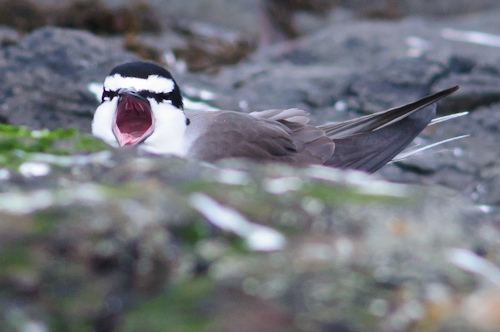
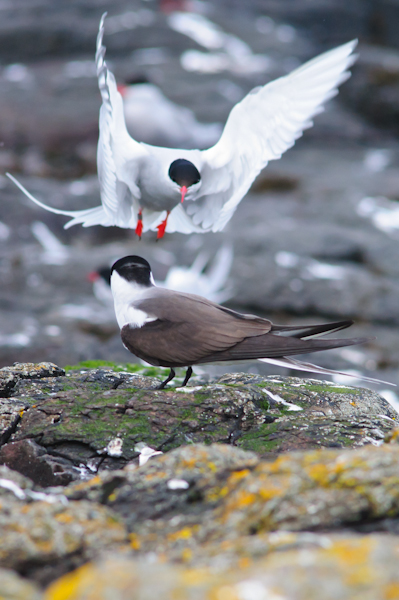
    Then the light at the end of the tunnel appeared, well not so much a light as an incandescent ball of wildlife magic.  We were eating lunch, and looking forward to the journey across to the islands, when Peter said “They look like dolphins off the end of the rocks”.  I lifted my binoculars and the view was filled with Bottlenose Dolphins 🙂  We watched as they passed close to the shore, then they settled and began feeding between Bamburgh Castle and Inner Farne.  A quick text to William meant that, by the time we arrived at the harbour, all of his skippers knew where the dolphins were and our journey across to the islands included several minutes with them bow-riding our boat.  I’ve been studying this group of dolphins for the last three months, and some inital findings are in MARINElife’s press release.  Following a cruise around the islands, we landed on Inner Farne.  One of the wardens mentioned that the Bridled Tern had been seen, and a quick sacn soon revealed it’s location in amongst the roosting Arctic, Common and Sandwich Terns.  Here are a few pictures of this stunning seabird from last year on Inner Farne

    Bridled Tern,Onychoprion anaethetus,Farne Islands,Northumberland,bird photography, bird photography tuition,bird photography holidays,Northern Experience Images

    Bridled Tern,Onychoprion anaethetus,Farne Islands,Northumberland,bird photography, bird photography tuition,bird photography holidays,Northern Experience Images

    Bridled Tern,Onychoprion anaethetus,Farne Islands,Northumberland,bird photography, bird photography tuition,bird photography holidays,Northern Experience Images

    Bridled Tern,Onychoprion anaethetus,Farne Islands,Northumberland,bird photography, bird photography tuition,bird photography holidays,Northern Experience Images

    Bridled Tern,Onychoprion anaethetus,Farne Islands,Northumberland,bird photography, bird photography tuition,bird photography holidays,Northern Experience Images

    After an hour amongst the Guillemots, Kittiwakes, Fulmars, Shags and terns, we crossed back to the mainland and headed south.  Miserable morning, magical afternoon 🙂


  • A wet Wednesday in Warkworth; mini-safari 28/05/2014

    Drizzle and murk aren’t the usual conditions we enjoy in Northumberland, but Wednesday wasn’t looking promising as I drove up the A1 to collect Corin, Claire, Jean, Gene and Lily.

    The drizzle continued steadily as we watched over a beautful stretch of the River Aln.  Blackbirds and Chiffchaffs were singing, fish were rising at surface of the river and a Common Buzzard flapped away downstream.  We headed on, watching a buzzard carrying prey over the road ahead of us, to a site where we hoped to find an Otter.Initially all was serene, Shelducks were watching over their ducklings, Tufted Ducks, Gadwall and a Mute Swan were feeding quietly and a female Mallard was watching over her one remaining duckling (unsurprising given the frequent Otter activity in that pool).  Then there was a change; The Shelducks flew off, abandoning their brood (who all headed away from the edge of the pool and formed a dense cluster), the Mallard abandoned her duckling, which swam up and down plaintively calling and the four Tufted Ducks all turned to stare straight at the same stretch of reedbed.  Then they moved further away, forming a tight mixed flock in the centre of the pool with Mute Swans, Gadwall, Mallards and Greylag Geese.  The drama continued as the lone Mallard duckling swam close to a swan nest and was attacked by both adult swans, diving repeatedly as they struck at it with their beaks.  The swans, ducks andgeese dispersed, still watching the reedbed warily, the Shelducks flew back in, taking the brood under their wing for the night, the lone Mallard duckling contined swimming back and forth, calling for it’s parent and a Roebuck bounded through a reedbed.  Suddenly the air was alive with Swallows, Sand Martins andHouse Martins, indicating one thing…the evening hatch had started.   Zzzzzzzzzzzz, zzzzzzzzzzzzzzzzzz, zzzzzzzzzzzz; the incessant mechanical droning of hundreds, if not thousands, of flying insects,taking to the air in the warm humidity.  It was getting too dark to see any detail, but as the Mallard duckling swam in front of us, it’s mother returned.  Who doesn’t love a story with a happy ending 🙂

  • Variety is the spice of life; Coastal safari 26/05/2014

    A brilliantly sunny Bank Holiday Monday is the only time you’re likely to encounter anything even remotely approaching crowds of people in Northumberland, but it does happen occasionally.

    I collected Marcus, Alison, Norman (Grandad) and Isobel from their holiday cottage in the shadow of the Wandylaw wind farm, and we set off for a day wildlife-watching.  With it being such a sunny morning, I thought it would be worth starting with one of our trickier animals; if it’s too cold they won’t be out and about, if it’s too warm they’ll already have slithered off somewhere cooler, and if they feel the ground vibrate as you approach they’ll beat a hasty retreat.  We know just the spot to see them when everything falls into place though; a warm, bare, stony patch of earth surrounded by tall grass.  At first we couldn’t see any sign, but I crept through the vegetation for a closer look.  Two Adders weren’t keen on this, and quickly slithered away into the long grass.  The third one was much more obliging though, and I motioned for Isobel to come a bit closer.  Incredibly, the snake remained coiled, and settled, for a few minutes.  It eventually lifted it’s head to fix us with a baleful reptilian glare for another minute before following it’s companions into the vegetation and out of sight.

    In the bright sunshine Kestrels hovered over roadside fields, Willow Warblers sang their silvery descending cadence, Chiffchaffs endlessly repeated their name, Chaffinches were proclaiming their territories (and Isobel had done a very impressive colouring of a Chaffinch picture), the scratchy rattle of Whitethroat song buzzed through the warm air, flotillas of goslings patrolled the water with their parents in close attendance and darting damselflies added a streak of azure to the lush green of the grass.  Down on the coast, dainty Avocets swept the water edge for morsels, Grey Plovers (probably my favourite wader, certainly when they’re in their summer finery) chased back and forth, Common andSandwich Terns roosted together, Fulmars rode the updraft of the warm breeze along the clifftops, Eiders were resplendent in the sunshine, and ‘wooly bear‘ caterpillars and cuckoo spitwere just the thing for a six year old to enjoy 🙂

    Most entertaining though, judging by the giggling, was a Rook that was rummaging through a bag of rubbish and found what it seemed to consider a suitable food item.  That item was a (full) dog-poo bag…  So disgusting that I almost titled the blog after it 🙂


  • Watching; Bespoke Safari 25/04/2014

    The first part of the Bank Holiday weekend was a washout, with our scheduled Dark Skies event, for a Hen Party in Kielder, falling victim to the weather 🙁 Sunday was a bespoke wildlife Safari for Claire and Sophie and, as I collected them from home in Gosforth, things were looking a bit more promising.  Away inland we could see a lot of general murkiness, so we headed for the Northumberland coast – planning to drop down to Druridge Bay as the afternoon progressed.

    Glorious, yet chillingly breezy weather was waiting for us at Bamburgh and we watched Eider and Common Scoter as they bobbed about in the swell.  We checked the wake of very passing boat for any sign of Bottlenose Dolphinsand continued south down the coast.  Willow Warblers, Sedge Warblers, Reed Buntings andWhitethroats were singing all around and Little Grebes were diving for prey before bobbing back to the water’s surface.  Our picnic stop featured Fulmars arcing just above the clifftops a few metres away from us and a viewpoint over the River Wansbeck revealed lots and lots of ducklings; Gadwall, Mallard, Shelduck all had broods of between eight and eleven – although this prime source of Otter food didn’t seem to have attracted the attention of any Otters.  A Roe Deer on the far bank appeared than quickly vanished again as it made it’s way through the bushes, and Swifts, Swallows, House Martins andSand Martins feasted on the buzzing clouds of insects overhead.  As daylight faded we arrived at one site to find a Mallard and a Grey Heron both staring intently into a hole that we’ve long suspected of being an Otter holt.  More Mallards, and the three of us, joined the staring contest but the adversary that eventually flushed the heron, and had the Mallards waddling away at a rate of knots, remained unseen as bats began flitting past our ears.

  • All adding up; Bespoke wildlife tour 20/05/2014

    Even after 20 years living in Northumberland, I’m sometimes still amazed at what can be seen in one day, with seven mammals in a day in June 2010 showing what’s possible with planning and just a bit of luck 🙂  Sometimes you just have to hope that the weather’s helpful though…

    I collected Mike and Jane from Greycroft and we set off towards the foothills of the Cheviots.  Our first targets for the day were reptiles…and it wasn’t looking promising; thick low cloud and a cold breeze really aren’t the ideal conditions for these cold-blooded predators.  Nevertheless, we made our way along a track with several likely sunning spots.  All were devoid of reptiles, but an hour later, as we were surrounded by the songs of Blackcaps, Garden Warblers, Sedge Warblers andChaffinches, it turned slightly brighter and the temperature rose (from ‘chilling’ to ‘almost warm’!) so I suggested it was time to retrace our route.  Almost as if scripted, the most likely looking spot had an Adder laid in it 🙂  It slithered away into the grass and out of sight as we headed on our way.  Our next destination was the southeast Northumberland coast and Druridge Bay.  Despite a concentrated session checking their regular hang-outs we didn’t manage to find any Red Squirrels, although it was cold and windy which doesn’t help.  Birdwatching our way up the coast produced Fulmar soaring along the cliff tops as we ate our lunch,  House andSand Martins hawking insects, Dunlin andGrey Plover feeding up on their way north, and a Grey Heron that had found a rich vein of Eels.  It caught, and consumed, four in less than an hour!  Jane spotted a Roebuckas we drove alongside the fields, and then another two by the River Coquet.  Our final stop was in the shadow of Bamburgh Castle, with Common Eider just offshore, as well as waddling up the beach, and a small group of Common Scoter just beyond them.

    With a rich variety of mammals, birds, reptiles, flowers and other wildlife, Northumberland in May really is an excellent destination for the keen naturalist.  I like it almost as much as I like the winter 🙂

  • On silent wings; Northumberland coast 26/04/2014

    There are some species that are favourites with particular clients, there are others that may be fairly common but still have good wildlife experience appeal, and then there are a select few that have everybody watching their every move…

    I arrived at Church Point and quickly located Carol, Dave, Megan and Emily.  Our carload was soon complete with the arrival of Mr and Mrs Robertson and we headed north along the Northumberland coast.  Our aim for the afternoon was to visit several Otter sites, in the hope of catching sight of the elusive sinuous predator.  Cold and windy isn’t an ideal weather condition for the search and it turned out that the closest we came (probably) was a sudden panic and ducks heading purposefully away from a reedbed, and an unseen menace.  Throughout the afternoon and evening there was plenty of avian interest; male Ruff, part way to breeding plumage, Grey Herons, stalking menacingly along the waters edge, Little Grebes, diving before surfacing with tiny fish, the cartoon-like Goosanders and Red-breasted Mergansers, noisy Greylag and Canada Geese and delicate, dainty Avocets, suddenly transformed into a furious vision of Hell when a female Marsh Harrier drifted foolishly over their pond.  As dark descended, Moorhens were making their way along the river side and Emily demonstrated remarkable hearing, picking out the squeaking of a shrew in the bankside vegetation. Eerie mammalian screeching from the woodland on the other side of the river was probably an altercation between Red Foxes as the last remnants of daylight gave way to the dark.

    The moment that had everyone’s attention focused came at sunset, in beautiful light.  We were almost back at the car when I spotted a familiar shape hovering above the dunes.  It dipped out of sight, before lifting from the grasses and heading towards us.  It dipped again, then perched on a fencepost before resuming the hunt.  Subtly coloured with mesmerising black eyes that are quite unforgettable the ‘Ghost Owl’, ‘Death Owl’, ‘Hushwing’ or simply Barn Owl has a rich folklore and really is one of those select few species that you’ll never tire of watching 🙂

  • A trip with extra added bite; Otter Safari 02/04/2014

    After a remarkably mild winter, Wednesday brought some weather with a bit of bite, the sort of day where you really need the wildlife to be performing at it’s best to take your mind off the conditions…

    I collected Katherine and Brenda from Church Point for an afternoon/evening Otter Safari, and we headed north up the coast through Druridge Bay.  Our first stop was looking very promising; Goosanders, Grey Herons, Avocets, Wigeon, Teal, Pintail, Mallard, Curlew, Lapwing, Dunlin, Bar-tailed Godwit, Redshank, Common Snipe, Turnstone…and a noticeable lack of birds in one corner of the pond 🙂 Always the first sign we look for when searching for Otters, so I was confident that there was one moving around close by.  It was looking so promising that I thought we should stay put and have lunch where we were.  I went back to the car to fetch our soup and sandwiches and when I got back to the hide, less than 5mins later, I was greeted with “You’re not going to believe it, but there’s an Otter just over there.”  Sure enough, Brenda’s directions had me looking in exactly the spot where it next surfaced 🙂  After a few minutes it went out of sight, before reappearing 30mins later, spreading panic amongst the ducks that were roosting at the water’s edge.  Then, as mysteriously as it first appeared, it dived and didn’t resurface where it could be seen.

    We headed on up the coast in conditions that were becoming less entertaining, with a brutal southeasterly wind that seemed to drive the cold and damp through every layer of clothing that could be mustered.  Noisy Black-headed Gulls were dive-bombing Canada Geese, Little Grebes were just being their cute selves, Sand Martins swirled back and forth over the River Aln, Coot and Moorhen busied themselves around the reedbeds and Greenfinch, Chaffinch, Blackbird, Mistle Thrush, Woodpigeon, Collared Dove and Wren were all singing.

    Probably a more wintry day than any day out we had during the winter, enriched by the sleek, sinuous menace of the Otter 🙂