Category: Northumberland Coast

  • Stoats, Sandpipers, Starlings and Sparrowhawks; Druridge Bay birdwatching 30/09/2013

    With a brisk southeasterly wind rattling the Northumberland coast, I arrived in Alnmouth on Monday morning to collect John, Annie and Steve for a day of bespoke birdwatching.

    Starting with a seawatch, Gannets were streaming south , occasionally pausing to circle and then plunge into the sea, and Common Scoter were dotted amongst the rafts of Eider, appearing for brief periods as they rode up and over the considerable swell.

    Heading south to Druridge Bay produced the expected crop of passage waders; Redshank, Curlew, Black-tailed Godwit, Dunlin, Lapwing and Ruff were expected and two Curlew Sandpipers were a nice find.  Teal, Mallard, Wigeon, Tufted Duck, Gadwall, Goosander and Pintail provided wildfowl interest and skeins of Canada, Greylag and Pink-footed Geese, which we’d seen earlier in the afternoon as they fed in nearby fields, began to arrive at their overnight roosts.  A Stoat was all energy as it raced backwards and forwards, exploring every nook and cranny along the edge of the water and, as dusk approached, we watched one of the great wildlife spectacles as a murmuration of Starlings swirled above a reedbed before dropping in to roost.  The mass of birds attracted the attention of a Sparrowhawk, and the female raptor made several low passes through the tops of the reeds above the roosting Starlings.  They weren’t going to be tricked into flying out and becoming an easier target though, and the Sparrowhawk soon settled on a fence post.  Then a second Sparrowhawk appeared, this time a male, and the two birds perched on adjacent fence posts, allowing an excellent comparison of their gender differences.  As we headed off, in the fading light and bitterly cold wind, it looked like they would be going without their supper…

  • Birdwatching in an iconic landscape; Lindisfarne 23/09/2013

    After two long hard days offshore (8hr pelagic on Saturday – blog post coming soon! – and 14hr offshore on Sunday for a North East Cetacean Project transect survey) today brought some light relief from the rolling swell of the North Sea as I headed north to Seahouses to collect Phil and Ann (who had won a morning out with NEWT in a competition on Visit Northumberland) and Rachael and Alex, who by happy coincidence were all staying at St Cuthbert’s House.

    In weather that was glorious, even by the high standards set during this year, we headed north towards Holy Island.  In the north of Northumberland, with a falling tide, it was looking like a good waders and wildfowl morning.  Mudflats were dotted with a mosaic of Mallard, Shelduck, Curlew, Dunlin, Lapwing, Redshank, Oystercatcher and Pink-footed Geese and, as we drove along the coastal road towards Holy Island, we had the treat of watching a Sparrowhawk as it flew just ahead of us, only inches above the road.  Ringed Plover and more Dunlin, Curlew and Redshank were feeding in the mud of Holy Island harbour, Pied Wagtails were, well, wagging their tails along the pebbly edge of the harbour, a flock of House Sparrows was engaged in stripping the seeds from grasses just above the tideline and House Martins and Swallows were sallying back and forth in search of insects in the warm autumn sunshine.  Flocks of waders in flight are a spectacle to rival any other and as we watched, and listened to, a group of Grey Seals that were hauled out on the sandbanks between the island and the mainland, the amorphous twisting turning shapes in the air high overhead resolved into flocks of Golden Plover and Bar-tailed Godwit.

    The final part of the plan for the morning was a short session of seawatching.  Sandwich and Common Terns were diving close to the shore, Gannets were a bit further out and the sea was dotted with the dark shapes of Eiders.  Turnstones were perched on the top of rocky outcrops, a Harbour Porpoise proved elusive as it surfaced to breathe and an Arctic Skua raced south before everyone could get on to it.  Obligingly it came back north, settled on the sea for a little while and then continued steadily north before breaking off into a aerobatic attack on a Sandwich Tern with another skua joining in as the tern twisted and turned in an attempt to evade the pirates of the sea as they attempted to rob it of it’s recent catch.

    Lots of birds, lots of interesting wildlife behaviour to watch, and four clients who were all great fun to spend the morning with – if I ever suggest that I’m going to return to teaching, just point me in the direction of this blog post 🙂

  • Call of the wild; Druridge Bay 17/09/2013

    I’ve lost count of how many times I’ve been asked to describe my favourite wildlife experience…and how many times I’ve said that I don’t think it’s possible to narrow it down to just one choice.  There are a few though, that would make a great ‘top five’ (or ‘top ten”)…

    I collected David and Sue from their holiday accommodation and we headed north along the Northumberland coast.  The plan for the afternoon was to search some of our regular Otter sites, and have a good look at the other wildlife that was around.  There’s really only one weather condition that I’m not keen on for wildlife-watching, and unfortunately we got it yesterday afternoon.  A stiff wind is not ideal for finding wildlife; insects are likely to stay deep in vegetation and mammals and birds are more likely to find somewhere sheltered and have a nap than subject themselves to the ravages of the wind.  One bird that seemed to be everywhere we went was Kestrel; we must have seen seven or eight of these small falcons hovering in the breeze during the afternoon.

    As we watched Wigeon, Teal, Mallard and Mute Swan a rarely seen denizen of our reedbeds put in a brief appearance.  In just a few seconds the Water Rail ran out of one reedbed, quickly crossed a patch of open mud and vanished into the depths of another reedbed.  Wader passage was still evident, with Black-tailed and Bar-tailed Godwit, Ruff, Lapwing, Curlew and Dunlin.  One bizarrely comical moment was caused by a Starling flying into the middle of the wader flock to bathe.  We can only guess at what the roosting waders thought it was, but it caused a ripple of alarm that could be traced through the flock as it flew in.

    Then, drifting on the breeze, a high-pitched yapping marked the beginning of one of my favourite wildlife experiences.  First a flock of Pink-footed Geese came in low and splashed down on the water.  Soon after a flock of Greylag Geese arrived, then more Pink-feet, a large flock of Canada Geese and four very endearing, but obviously escaped, Bar-headed Geese.  More geese followed, and then a flock of Pink-feet, heralded by those yapping calls, could be seen as tiny specks high against the clouds overhead.  These birds were surely just arriving from far-flung parts, to join the wintering goose flocks around Druridge Bay.  Suddenly birds took to the air; Dunlin first, then Lapwing, followed by ducks and then geese.  Too much panic, surely, for an Otter?  What the birds had seen, and we eventually spotted as it drifted high against the clouds above us, was a Marsh Harrier.  Making it’s way steadily north west, it eventually drifted out of sight and the birds settled back down.

    As dusk approached , the breeze finally relented and, with the backdrop of a stunning sunset, both Noctule and pipistrelle bats flew by.  The cause of a sudden panic amongst the assembled ducks was caused remained unseen, and as the light faded to the point where it was time to head back, we could still hear the geese – over a mile away from where we were.  The dark of the night brought one last wildlife experience though, as a Badger trotted along the road just in front of the car.

  • Stumbling across a twitch

    Late August/early September is an exciting time on the Northumberland coast; wader passage is still ongoing, wintering wildfowl are arriving and you just never know what could turn up…

    I collected Andy and Lia from Alnwick and we set off for a day birdwatching on the Northumberland coast from Bamburgh to Druridge Bay.  Knot, Turnstone, Oystercatcher, Curlew, Sanderling and some very elusive Purple Sandpipers started the day for us, as Linnets fluttered around in the long grass, Meadow and Rock Pipits were around the tideline, Gannets were soaring majestically by and Eider and Common Scoter were bobbing around just beyond the surf and a mixed flock of Common and Sandwich Terns were flushed by walkers before settling back on the rocks close to the breaking surf.  Offshore a small flock of birds grabbed my attention, and through the telescope resolved into one of Northumberland’s winter specialities; seven Pale-bellied Brent Geese steadily heading north were our first of the autumn.

    Further south, waders were still the main focus of our day;  Dunlin, Redshank, Greenshank, Snipe, Whimbrel, Black-tailed Godwit, Bar-tailed Godwit and Ruff were all pottering about in the water’s edge.  When we arrived at East Chevington to look for the Spotted Crake, there were a few local birders already there.  With an astonishing amount of luck, we’d arrived just as a White-rumped Sandpiper was being watched 🙂  Not the easiest of birds to identify, but as it wandered around a flock of sleeping Teal with Dunlin and Snipe alongside for comparison it stood out quite well.

    Another cracking day’s birdwatching, with a proper rarity to add a touch of the unusual 🙂

  • Whales, Waders and Wildfowl day (1 and) 2

    After getting back to Seahouses harbour at the end of our Whale and Dolphin Cruise, Sarah headed south back towards home, and myself and Bill followed the coast north to Holy Island.  The breeze had been strengthening while we were offshore, and around Holy Island it was close to unmanageable, with even a heavy stable tripod struggling to remain still enough to use the telescope.  We did find Bar-tailed Godwit, Ringed Plover and Dunlin around the harbour, but soon beat a hasty retreat – via the ice cream van 🙂

    Heading back down the coast in the shadow of Bamburgh Castle, we watched flocks of Eider loafing just offshore and a mixed flock of Common, Sandwich and Arctic Terns held a surprise in the shape of an adult Roseate Tern.

    Dinner at The Swan was followed by discussing the plans for the next day, and on Sunday we concentrated on Druridge Bay and south east Northumberland.  It turned out to be a good day for waders, with Ringed Plover, Little Ringed Plover, Dunlin, Curlew and plenty of Snipe.  Perhaps the wader highlight of the day though were flocks of Black-tailed Godwit and Ruff arriving from the north east, pausing briefly to drink and rest and then departing to the south west.  A bird that’s rarely seen made it’s way onto the trip list too, as the long-staying Spotted Crake at East Chevington wandered in and out of the reedbeds.  Goosander, more Eider and lots of Grey Herons were around the River Coquet and it was soon time to head off, collect Sarah and go into Morpeth to eat at the excellent Nadon Thai.  It was an excellent two days, with a client who was excellent company, a keen birdwatcher and knows a lot of sites in and around Norfolk, where we haven’t been for a few years now, really well.

    Whales? yes. Waders? yes. Wildfowl? yes.  It was the holiday that does exactly what it says on the tin 🙂

  • Stoatally different to yesterday…

    By extraordinary coincidence, one of our least observed mammals put in an appearance for the second consecutive day…

    I collected David, Jackie and Alexander from Bamburgh and we headed south to start their Prestige Tour of the Northumberland Coast.  As Swallows and House Martins flitted about low over the water in front of us, a Stoat proved elusive as it darted in and out of the vegetation close to the water’s edge, momentarily startling the dozing ducks before vanishing back into the edge of a reedbed.  As ever something wholly unexpected appeared, on this occasion a Peregrine over Cresswell village.  A Roe Deer walking through an arable field appeared like a disembodied head – only popping up, like a Jack-in-the-box, every few metres as it made it’s way across the field.

    Another elusive mustelid put in a brief appearance too, as a Badger trotted along between reedbeds, but unfortunately hidden from view by the vegetation on our side of the pool.  As dusk approached, pipistrelle bats were flitting back and forth, tiny Common Froglets hopped across the path in front of us and the drive back to Bamburgh produced another impressive mammal, as a Brown Hare loped along the verge as we passed.

  • Breathtaking menace

    One of the species that our clients are always keen to see is the Otter.  From my own perspective though, one of it’s smaller relatives is a much more attractive mustelid.

    I collected Jackie, and Steve and Karen, from Church Point, and we set off on an exploration of Druridge Bay and the Northumberland coast.  As we sat scanning a coastal pool, watching for any sign of agitation among the assembled Mallards, Gadwall, Tufted Ducks, Little Grebes, Teal and Mute Swans, there was a rustling in the grass just in front of us and a Stoat popped it’s head out.  I started making quiet squeaking noises, and soon it peered out at us, then came out in the open and reared up on it’s hind legs – presumably fooled by my pishing into thinking that a small rodent was in trouble and in need of a Stoat to do it’s good deed for the day and end it’s misery 🙂 The Stoat is one of those species that are fairly common and widespread, but rarely seen.  When you do get one sitting out in full view though it really is a quite beautiful creature; lithe and muscular, inquisitive and deadly, it was a real treat to have this little predator right in front of us.

    As the evening wore on, small groups of Starlings were gathering ready to roost, Snipe seemed to be everywhere that we went and the eternal game of cat and mouse, between predators and prey, that is the natural world was still all around us as the sun dropped below the horizon away to the west.

  • Great North Bike Ride 2013

    After decades of struggling to find any form of exercise that I really enjoy, I started cycling in May.  By June I’d modified my mountain bike with lightweight alloy wheels and slick tyres and started following a 0-100mile training plan, by July I’d bought a road bike and last Sunday I completed the Great North Bike Ride 2013🙂

    I’m not keen on warm weather, so waking up on Sunday morning to discover it was cool and misty with a reasonable NNW breeze was near perfect.  Sarah drove me to Seahouses, waved me off at the start and then drove down to Tynemouth ready to collect me at the end of the ride.  I thought I’d prepared well for the ride;  checked the entire route, ridden some of the more challenging bits, followed my training plan fairly closely and made sure everything on my bike was working properly.  Still a couple of nagging doubts though…could I manage to ride 56.5mi, and how would I cope with another 2000 riders on the road when I only ever train alone?  The longest training ride I’d done was 44mi, so there was still a bit to go beyond that distance to make it to the finish line at Tynemouth Priory.  I estimated that it would take me 4-5 hours to complete, so Sarah said she would be at the finish 4h after I started.  As soon as I passed under the start line, those nagging doubts evaporated; having other cyclists around provided lots of inspiration and the miles quickly passed beneath my wheels.  A quick check at the half-way point generated another concern…if I continued at that speed I’d finish in 3h 30m 🙂  As I crossed the finish line in Tynemouth I was cheered on by Sarah and Jodie, and glanced down at my bike computer to discover I’d finished the ride in 3h 22m!  500ml of orange juice barely touched the sides as I rehydrated, and a slice of malt loaf and a packet of Jelly Babies vanished almost as quickly.

    Now I’ve set myself some new goals; 100mi ride, sub-30min 10mi time trial and, of course, complete GNBR 2014 in a faster time than I managed this year 🙂

    What could be better than contributing to a good cause, getting some fresh air and exercise and enjoying the beautiful Northumberland coast…all in one easily accessible package 🙂  Sign up now!  It’s well organised and a really enjoyable way to spend a Sunday morning in late August.

    Great North Bike Ride 2013
    Warming up in the mist
    Great North Bike Ride 2013
    Crossing the start line
    Great North Bike Ride 2013
    Final push to the finish line
  • Predators

    The one group of birds that have gripped my imagination and my attention since I was very young are the birds of prey.  Loved by many, hated by a few, persecuted by the ignorant, the stupid and the self-involved…

    Two raptors put in an appearance during our safari around Druridge Bay and the Northumberland coast last week, and they’re both species that I’ll never tire of watching.  As I drove our carload (Sharon and June, Francis and Julie, Jo and Kirsty) between Embleton and Warkworth, the bird that is the embodiment of power, musculature, speed and scythe-winged menace carved an arc across the sky alongside the road.  Persecuted by gamekeepers, pigeon-fanciers and egg collectors, and once decimated by a population crash caused by pesticides, the sight of a Peregrine beating it’s way majestically across the landscape is one that should stir the heart of everyone, birdwatcher and non-birdwatcher alike.

    The second raptor of the day was a species that, if such a thing is possible, manages to provoke even more outrage than the Peregrine. As we scanned the shadowy edges of a pool at dusk searching, unsuccessfully, for an Otter, I could see that a distant rock didn’t look quite right.  With the increased magnification offered by our telescope the ‘rock’ resolved into the familiar shape of a Sparrowhawk.  As well as gamekeepers, pigeon-fanciers and everyone else with a bee in their bonnets about Peregrines, the Sparrowhawk has managed to make itself even less popular by hunting in urban and suburban gardens.  Bird tables attract small birds, and small birds attract Sparrowhawks…now, while I can understand the indignation of anyone who puts food out for their local birds, only to see their feeding station become a fly-through fast food outlet for a Sparrowhawk, that’s the way that nature works; you have large numbers of very small creatures (e.g. insects) which are food for a smaller number of slightly larger creatures (e.g. Blue Tits), which in turn are food for a very small number of even larger birds (e.g. Sparrowhawks).  A number of organisations, acting very disingenuously with hidden self-interest, would have people believe that there’s a Sparrowhawk population of plague proportions and it’s busy decimating the tits, sparrows and finches in all of our gardens.  Wouldn’t it be better if we could all appreciate the beauty, adaptation and precision of our birds of prey?

  • The sun goes down; NEWT’s North Sea Pelagic 26/07/2013

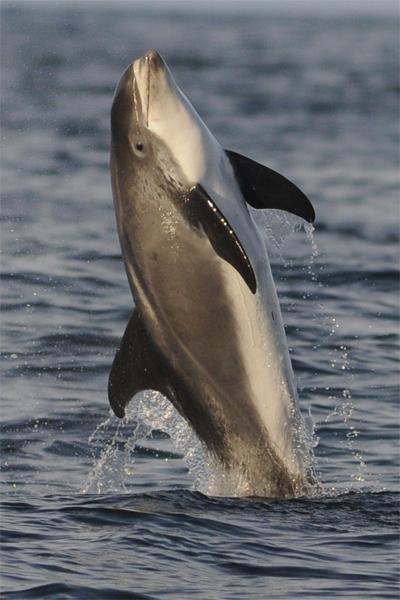
    Our final Royal Quays Friday evening North Sea pelagic for this year was remarkable in that it was Sarah’s second evening pelagic in two weeks.  Now, of the two owners of NEWT one of us loves small boats – and has now racked up over 1000hrs at sea – and the other doesn’t 😉  Not going out on our evening pelagics had a consequence for her life list though…we have a 30″x20″ canvas of a leaping White-beaked Dolphin

    White-beaked Dolphin,dolphin watching trips,whale watching trips,Northern Experience Wildlife Tours

    on our office wall and Sarah has been closely involved with our work for the North East Cetacean Project, but she’d never seen a WBD in real life!

    A late cancellation, and a stunning weather forecast, led to me making an ‘executive decision’ to keep the place available so that Sarah could join us on the trip, and we could celebrate 10 years of marriage in a slightly unorthodox way 🙂

    Our first group of four White-beaked Dolphins came alongside the boat and stayed with us for 1/4 mile before peeling off and heading back to where we’d first encountered them.  When they made that decision we continued heading north and found another group, this time of three White-beaked Dolphins feeding.  One of the dolphins decided to put on a display, before they all melted away into the inky depths and we sailed home against the backdrop of another stunning sunset.

    We’ve still got spaces on our 4hr Whale and Dolphin cruise from Seahouses on August 31st, and there are a limited number of spaces on our 8hr sailings from Royal Quays on 7th and 21st September so give us a call today 01670 827465 for more details or to book your place 🙂

    White-beaked Dolphin,Northumberland,North Sea,North Sea pelagics,dolphin watching Northumberland,whale watching Northumberland

    Sunset,North Sea,Northumberland,North Sea pelagics,dolphin watching Northumberland,whale watching Northumberland