Tag: Red Squirrel

  • Border patrol

    After a day on the coast, yesterday brought something completely different as I headed towards Whitelee Farm and Byrness to collect John and Natalie, and then Bert, for a Kielder Safari.

    As we drove along a remote track through the forest, we came across some of the wildlife that makes Kielder such a special place; Roe Deer trotted across the track ahead of us, family parties of Common Crossbills were adorning the tops of spuce trees like christmas decorations, a Red Squirrel eyeballed us from halfway up a tree, a Common Buzzard tolerated a closer approach than usual, but not for long,  and a pair of Wheatears watched as we passed by.

    North of the border we were entertained by several pairs of Whinchat (surely one of the most attractive birds we have in Britain), including a male who started singing from his perch just a few metres away, a Dipper that was whizzing up and down the stream where we sat to have our lunch, a Red Grouse playing hide-and-seek with us in the heather and the elegant beauty of a male Hen Harrier, still retaining his grace as he battled into the howling gale that made our hot soup at lunchtime all the better.

    Whether it’s the remoteness, the landscape, the species that you rarely, if ever, find elsewhere or just the lack of other people; our inland locations – Kielder, the Cheviot Valleys and the North Pennines always produce memorable birdwatching experiences, for our clients and for ourselves as well!

  • I wish I could remember…

    …the clever title I’d thought of for this blog post 😉

    Just at the moment the pace of life and work is starting to really accelerate.  Last week I had a day of meetings, a day in the office, a day distributing leaflets (and getting the graphics applied to our new vehicle), a day in the North Pennines AONB, and a day out with my camera close to the office.

    The North Pennines day was interesting; giving a talk, and a guided walk, as part of the Know Your North Pennines training programme.  Birdwatching in hail, snow and howling wind all featured during the day.  The bit in the snow came while I was still on my journey to the training session; leaving home in plenty of time had given me the opportunity to check out some potential sites for Black Grouse photography.  I really wish I’d had my camera with me as I found a field with 6 adult Blackcocks in it.  We’ll be checking the site over the next few weeks, but it has the potential to produce even better photo opportunities than the sites where I photographed the birds pictured in this blog post from last year.

    The morning spent close to home in southeast Northumberland had one focus; get a photograph of a Treecreeper.  Not any photograph though; the one I was picturing in my mind was with the bird vertical on a tree trunk, with a dark background.  I even knew exactly where I was going to get the shot – we’ve been baiting an area in some local woodland for quite a while now, and the effort we’ve put into choosing the location and baiting it regularly is starting to pay off.  With some exciting wildlife and landscape photography holidays coming up later this year, our clients can benefit from the work we’re doing year-round as well.

    Red Squirrels were visiting our feeding station;

    Red Squirrel, mammal photography, photography tuition, photogarphy courses, photography holidays

    Nuthatches are always entertaining, active and vocal;

    Nuthatch, bird photography, photography tuition, photography courses, photography holidays

    and the target for the morning put in an appearance 🙂  For whatever reason, it’s a species that I’ve struggled to capture to my satisfaction previously.  I’m fairly happy with this shot…but the shadows could have been lessened using a reflector.  At least that gives me an excuse to spend another morning at the feeding station 🙂

    Treecreeper, bird photography, photography tuition, photography courses, photography holidays

  • Getting ready

    We just had an all too infrequent ocurrence; both of us at home and able to go out and about together for a whole weekend 🙂

    On Saturday we decided to concentrate on our local area.  Southeast Northumberland offers some excellent wildlife and birdwatching opportunities and, with bookings for the rest of this year coming thick and fast, we’re checking over our Safari Day routes whenever we get the chance so that we hit the ground running once the season gets properly underway.

    If our morning excursion is the shape of things to come then it’s going to be an excellent Spring 🙂  Little Owl, Roe Deer (including a handsome buck with velvet antlers, who watched us between the trees as we trained our binoculars on him), Red Squirrel, point-blank views of Treecreeper, Nuthatch and Great Spotted Woodpecker and lots of fresh Otter spraint all combined into a memorable morning.

    As dusk approached we were out and about again.  We monitor a few Badger setts regularly and the activity around the sett we checked on Saturday evening was exactly what we’d expect in early March.  Another successful outing 🙂

    Yesterday we were doing something completely different (although birdwatching featured again, of course).  We set out for the southwestern border of Northumberland, and beyond, as we pre-walked the route that Martin will be leading for the North Pennines AONB ‘Know Your North Pennines’ course on Wednesday.  Journeying to Upper Teesdale gave us the chance to check out some of our favourite Black Grouse sites en route (you’ll be pleased to know that the species hasn’t vanished from Northern England!) and enjoy the sight of Lapwings displaying and flocks of Golden Plover  in the fields.  Our photography holiday in late October ‘Autumn Colours’ is based in the North Pennines and we finished the day with a visit to one of the area’s gems.

    North Pennines,Photography Holidays,Northumberland,Photography Tuition
    Low Force
  • In a dark wood

    October ended with a Prestige Tour around Druridge Bay and Southeast Northumberland.  I collected Christine and Mark from Stannington and we headed across to the coast.  Flocks of Linnets. Lapwings and Grey Partridges were close to the road and we settled to check one of our regular Otter sites.  All of the assembled Mallard, Teal, Wigeon, Gadwall and Coot were concentrated in one area of the pool and clearly nervous about one particular corner.  We weren’t fortunate enough to catch a glimpse of any predators, but the behaviour of the waterfowl was typical of the type of indication you get that there’s an Otter about.  Our lunch spot for the day was beside the River Coquet and, along with the Cormorants and Grey Herons that were patrolling the water’s edge, an Atlantic Salmon provided some spectacular entertainment as it launched itself vertically out of the water, three times in rapid succession, just a few metres away from us.

    As we walked along the River Wansbeck after lunch, via a detour around the north edge of Ashington to enjoy the spectacle of 90+ Waxwings gorging themselves on Rowan berries, skeins of Pink-footed Geese passed overhead and, as the sun sank towards the horizon, it was time to seek out the wildlife that occupies that magical time of day.  As we settled into position near one of our favourite badger-watching spots there was an incredible commotion from the trees on the other side of the stream.  Blackbirds, Song Thrushes, Wrens, Robins and Magpies were all alarming loudly.  The mobbing was too intense, and too stationary, to be the mild alarm that a Red Fox or Badger often triggers and shortly after one Tawny Owl flew through the trees opposite, a second bird finally got fed up with the mobbing and flew from it’s perch.  An unwelcome sighting was a Grey Squirrel, in a woodland that until recently still held Red Squirrels.  Our first Badger of the evening was a big adult, trotting across the top of the clearing.  Then, after a few minutes of near silence, two Badger cubs came crashing through the undergrowth.  They crossed the stream beneath a fallen tree, paused briefly rising on their haunches like stripy black-and-white meerkats, and then headed uphill behind us.  Our fourth Badger of the evening followed the same route before we headed back to the Landrover and civilisation.

    I dropped Christine and Mark back at Stannington and there was time for one last piece of magic as a Barn Owl floated lazily from a fence post as I drove back towards the A1.

    Throughout the late autumn and winter we’ll be scheduling most of our trips to finish in darkness.  Druridge Bay and Lindisfarne are both excellent locations through the winter, and as darkness descends, so give us a call on 01670 827465 to find out how we can bring that experience to you.

  • Whistle while you work

    Yesterday was one of what are rapidly becoming our favourite trips; afternoon/evening safaris.  I collected Claire and Stuart from their holiday cottage near Brinkburn Priory and we headed towards the coast.

    Our regular Little Owl watched us imperiously, before turning tail and scuttling out of sight as a dog walker came along the track.  The coastal pools along Druridge Bay are hosting an ever increasing number of waders; Dunlin, Turnstone, Redshank, Knot, Ruff, Oystercatcher, Lapwing, Common Sandpiper and Curlew were all roosting, a Spotted Redshank called but remained frustratingly out of sight behind a reedbed, and Greenshank and Whimbrel both responded to imitations of their calls.  Then, that most majestic of waders graced the air in front of us, although only briefly; a Black-tailed Godwit flew low over the roost, everything panicked, and a Peregrine carved through the flock before heading out over the sea and then away high to the north.  Little Grebes and Grey Herons were both well appreciated, then it was time to check some of southeast Northumberland’s finest mammal sites.

    Red Squirrels always go down well with our clients, and the one we watched feeding was no exception.  A juvenile Great Spotted Woodpecker was equally obliging and we watched it for a while before moving on to our favourite site for Badger watching.  Probably the biggest Badger we’ve seen so far trotted across the hillside opposite us and a much smaller animal (maybe a young cub) made it’s way through the undergrowth just over the stream from our position.  As darkness approached we found ourselves on a hilltop with a Tawny Owl calling ‘ke-wick’ from the woodland below us.  After whistling at waders during the afternoon I imitated the quavering hoot of a male Tawny Owl and waited.  The bird called from closer.  I called again, and it came closer still.  Eventually it flew up into a bare tree, silhouetted against the final glow of daylight in the sky, only 20m away from us.  I switched to copying the bird’s ‘ke-wick’ call and it turned to face us directly, ready to challenge this impertinent intruder.  I remained silent, not provoking any further response, and the bird flew to a nearby tree, screeching defiantly as we made our way back down the hillside.  Common Pipistrelles and Daubenton’s Bats were picked up on the bat detector and seen as they flitted back and forth.  The final wildlife of the evening though was close to the cottage at Brinkburn, and was another piece of Northumberland magic; a doe Roe Deer and her fawn ran along the road in front of us.

    As Autumn approaches evening safaris mean finishing at a quite amenable hour, so give us a call on 01670 827465 to find out how you can share in these memorable experiences with us.

  • Wildlife and birdwatching on the Northumberland coast 08/08/2010

    Sunday’s Northumberland coast safari started very close to home, with Germaine and Greg having stayed at The Swan on Saturday evening.  We started with our usual riverside walk, looking at an artificial holt and talking about the ecology of the Otter.  Our first really good sighting of the day was a Red Squirrel, which chattered angrily at a photographer who was sitting beneath the tree that it was descending.  Woodland birdwatching can be sometimes be very quiet, but with a large mixed flock of tits and Goldcrests, as well as Treecreepers and a very aggressive Nuthatch around the same glade there was plenty to see.  Out on to the coast south of Druridge Bay and, in the warm sunshine, our favourite Little Owl was posing for the camera.  The sunshine was also encouraging insect activity and we quickly added to the day list; Common Darter, Blue-tailed Damselfly, Common Blue Damselfly, Meadow Brown, Small Copper, Shaded Broad-bar, Lesser Marsh Grasshopper, Common Blue Butterfly, Green-veined and Small White were all found along one small stretch of footpath.  Grey Herons were stalking along the pond edges and one got into a gruesome wrestling match with a large Eel.  All of the ducks scattered, clearly there was something in the reeds that they were unhappy about, but what it was didn’t reveal itself.  Further north, we came across three Little Egrets (surely the next addition to Northumberland’s breeding birds – if they haven’t already…), a Common Lizard that was sunning itself and, thanks to Germaine’s sharp eyes, a pair of Roe Deer.  A really good day, with a real mixed bag of wildlife and clients who made it all the more enjoyable.  And to think…Sunday used to be homework-marking day 😉

  • Fin-tastic

    We’re in one of our busier periods at the moment;  two trips on Thursday, two on Friday and then we’ll be out again tomorrow.

    Thursday’s two mini-safaris featured some of our old favourites; Little Owl is one of the best crowd-pleasers that there is, Dunlin, Greenshank, Common Sandpiper, Grey Heron  and summer-plumaged Knot  all went down very well and some attractive insects added a touch of glitter – Common Darter, Blue-tailed Damselfly, Small Copper, Red Admiral and Dark Green Fritillary are all easily overlooked (well maybe not Red Admiral), but quite stunning if you take the time to search for them and then look closely.  After finishing Thursday’s first trip, and dropping Kevin, Angela and Georgia back at Newbiggin, I went back to the office, dealt with a few e-mails, packed the head torches and bat detectors ready for the evening and then headed back out for the day’s second tour of Druridge Bay and Southeast Northumberland.  Then the heavens opened.  With windscreen wipers barely able to provide a clear view, traffic was crawling.  I was considering the unthinkable – cancelling a trip.  The rain eased and I collected Andy and family.  The trip list was very similar to the morning and then I thought it might be worthwhile to have a quick look at the sea.

    Now, seawatching is an obsessive pastime but it isn’t for everyone; I’m certain that long periods staring at the sea, hoping that something exciting will appear, don’t make for good client experiences.  So we don’t do it…very often.  The sea had been flat calm during the day and there was only a gentle breeze.  Ideal conditions for searching for cetaceans, in fact.  The number of e-mails, texts and ‘phone calls I’d had during the week was the clincher.  I knew that cetaceans sightings were increasing and viewing conditions were just right…surely the right time to take clients for a seawatch.  Gannets were passing by and we all scanned the sea.  Quickly I picked up 2 dolphins away to the south.  Then another 2, then 3 including 2 calves.  Through binoculars I had little doubt that these were White-beaked Dolphins.  A quick look through the ‘scope revealed all of the relevant ID features; tall falcate dorsal fin, white flanks arcing up behind the dorsal to form a pale saddle.  As everyone managed to see the dolphins, I scanned slowly to estimate how many dolphins there were.  At least 25 individual animals were found, and the pod was spread out over at least 6 square miles of the North Sea!  Another birder arrived and we managed to get him on to the dolphins as well.  It’s almost impossible to describe just how extraordinary such a sighting is.  Normally the best opportunities arise when you’re on an organised pelagic trip.  We’ve got 4 more of these this year; and with only one place remaining on September 18th, two places on September 4th and four places on August 12th, get in touch now on 01670 827465 to join us and experience the best pelagic wildlife and birdwatching opportunities available on the east coast.  August 12th will be a groundbreaking trip; we’re heading out to the Farne Deeps and reports from anglers and researchers suggest that the area could produce sightings of some spectacular wildlife.  Minke Whale, White-beaked Dolphin, Common Dolphin and Killer Whale have all been found previously.

    After the dolphins we had another of the species that always captivates our clients as a Barn Owl allowed a prolonged period of observation as it hunted along the coastal dunes.  As darkness descended and we headed back to our starting point the raindrops began to speckle the windscreen of the Landy again.

    The highlights of Friday’s first trip were Red Squirrel and Little Owl (for Kate and Lucy) and a very unexpected Green Sandpiper (for me).

    The evening pelagic took place with some extraordinary glowering skies to the north.  As the swell began to develop, we were treated to very close views of Gannet and Fulmar before returning to Royal Quays in the dark, but the abiding memory of the last week is the extraordinary spectacle of a little-known cetacean, hunting, leaping and playing in the seas off Northumberland.

  • A real challenge

    In the 17 years that I’ve lived here, I’ve always believed that Northumberland is one of the finest counties for birdwatching in the whole of the UK.  That belief played a big part in reaching the decision to launch NEWT, and it’s why we’re such an enthusiastic member of the Birdwatching Northumberland Consortium.  We’ll be at the Bird Fair in August (Marquee 1, Stand 53/54) so come along to meet us and find out just how good Northumberland is.

    This morning, though, my attention is on mammals.  We don’t do too badly for them either; Badger, Red Fox, Grey Seal, Red Squirrel, Roe Deer, Weasel, Stoat and Brown Hare all feature regularly on our safaris and, on our Northern Experience Pelagics, there’s the possibility of Minke Whale, White-beaked Dolphin, Harbour Porpoise and other cetaceans.  We’ve had some random sightings as well; a Bank Vole that sat munching on a leaf just a few feet away from us and a Mole that walked into a hide we were sitting in were both bizarre (especially the Mole; I hadn’t seen a live one for a long, long time).

    With the exciting news earlier this week of the first confirmed evidence in 16 years of Pine Marten in Northumberland, we’ve got a new challenge 🙂  We’ve spent some time in the last couple of years checking likely sites and following up reports that we’ve received.  Some of those have been very tantalising, and the species may be more widespread than people imagine.  Otters and Badgers are fairly difficult, but we’ve developed an excellent track record with those two species.  Pine Marten is going to be an altogether different proposition, but we relish a challenge.

  • Wildlife photography in focus

    After a busy week I was looking forward to a couple of days catching up on admin and housework (no, really, I was looking forward to doing some housework…).  Then, on Saturday morning, the ‘phone rang and we took a booking for Sunday; a photographer visting the area was frustrated by the weather leading to sailing cancellations (Farne Islands, Isle of May, Coquet Island) so could we take him out and show him some of the better locations for wildlife and birdwatching photography in southeast Northumberland and Druridge Bay?

    We pride ourselves on being flexible so a meeting point was arranged, camera kit was cleaned, memory cards loaded, batteries charged.  Some excellent views of Red Squirrel, so close that only head shots were possible, were followed by a few hours in the birdwatching mecca that is Druridge Bay.

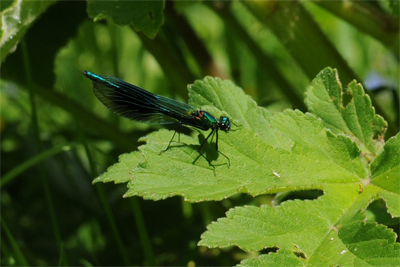
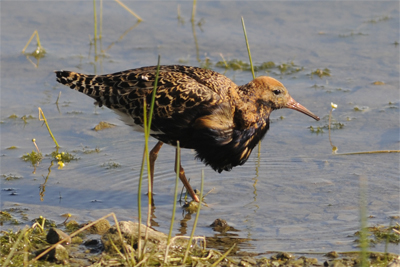
    Here are a few of my favourite images from Sunday and Monday.

    Banded Demoiselle, River Blyth, Northumberland 20/06/2010
    Ruff, with a ruff, Druridge Pools, Northumberland 21/06/2010
    Sand Martin, Druridge Pools, Northumberland 21/06/2010

  • A little otter on Friday

    Our fifth safari in four days had been arranged as a birthday present and I collected Barry and Maureen from Ponteland before starting with our usual southeast Northumberland birdwatching woodland walk.  The ‘Red vs Grey’ conundrum occupied our conversation as we enjoyed excellent views of a Red Squirrel.  As we walked by a wonderful hay meadow it was hard to believe that we were in an area that one of our previous clients had expected to be ‘sort of grim and industrial’ 😉  On the coast our regular Little Owl was as chilled out as ever and the Sedge Warblers and Reed Buntings were struggling to cling to the reeds in a strengthening breeze.  Strong wind is just about the worst condition for watching wildlife but I’m ever the optimist…

    The combination of that optimism, and a lot of experience of Otter behaviour, meant that I still believed that our target for the day would be achieved.  Sure enough, we were able to watch an Otter briefly as it fed.  A commotion in a reedbed, a scattering of ducks, and two nervous-looking Coots, meant that I was sure we were about to see a second Otter.  It soon appeared and we enjoyed a prolonged period of observation as it made it’s way across the pond, eventually passing close by our position.  More Sedge Warblers and Reed Buntings were singing as we walked through another meadow, teeming with vetch and some stunning orchids and a Reed Warbler was picking it’s way along the base of a reedbed before starting to sing and providing a perfect comparison with a nearby Sedge Warbler.  As I drove Barry and Maureen home I was thinking about how, no matter how often I lead our tours, every day is different.  It may be a cliche, but it’s the best part of what we do.