Tag: Dipper

  • Substitute

    There are times when you can visit the same location on successive days and see exactly the same wildlife, other times something you saw the day before has moved on but there’s compensation in the form of something unexpected…

    I collected Julie and David from The Swan and we set off for day of bespoke birdwatching, combining the best of our uplands with the post-industrial birdwatching wonders of southeast Northumberland.  As we headed inland towards the Cheviot valleys the spectacular scenery (not for the first time) elicited a number of ‘oohs’ and ‘aahs’ from the passenger seats of the car. Crossing the ford where the Harthope Burn becomes the Wooler Water we enjoyed very close views of those two riverine specialists, Dipper and Grey Wagtail.  I’m enthusiastic about most, if not all, birds but male Grey Wagtails are truly stunning birds, and one that often holds our clients entranced for extended periods of time.  We continued along the valley, and set off to walk up a narrow valley leading up into the hills from the main valley.  Red Grouse were cackling all around us, flying from one side of the valley to the other and occasionally perching in full view, imperiously staring at us as we followed the burn their territories.  A female Ring Ouzel flew down the valley, over our heads and away to a distant clump of trees, a pair of Sparrowhawks displayed ahead of us, and we stopped for lunch.  Our post-lunch walk was another spectacular one.  This time in a steep-sided valley, with Peregrines, Kestrels, Common Buzzards and Ravens soaring overhead, Mistle Thrushes carrying food to hungry nestlings and the song of a male Ring Ouzel carrying on the strengthening breeze.  An icy April shower added to the wild, remote feel of the valley and we headed back downhill into glorious sunshine.  Our assemblage of raptors (including the honorary member – the Raven) didn’t feature the Osprey I’d seen the day before, but we did have a real bonus bird…one of the things about birding in narrow steep-sided valleys is that birds appear very unexpectedly, and on this occasion it was the enigmatic ‘Phantom of the Forest’ as a male Goshawk broke the skyline in front of us and beat his way powerfully across the moors.

    The second half of the day was spent on the Northumberland coast, finishing close to home around Druridge Bay.  The Common Eiders we found were greatly appreciated and the tour of NEWT’s ‘local patch’ produced a number of highlights with Marsh Harrier, Little Ringed Plover, Avocet, Pintail and Red-breasted Merganser all going down particularly well but, perhaps, the bird of the day was a Short-eared Owl that perched on a roadside fencepost and watched us just as intently as we were watching it; piercing yellow eyes holding us all enthralled as we completed a long day of birdwatching that seemed to be over too soon.  Isn’t that always the way 😉
  • A walk in the park

    There are days when the weather is so good that my resolve to stay in the office and get on with admin work gets stretched beyond breaking point…

    Monday is my usual office day, but the afternoon looked promising and I soon found myself driving inland towards the Northumberland National Park.  Knee surgery last December has given my legs a new lease of life, and the uphill bits (which I always find more interesting from a birdwatching perspective) of the Cheviot valleys are no longer tortuous.  I only live 10 minutes from the coast, so you may wonder why I would drive for an hour inland…but one moment of the afternoon summed up everything that is special about our remoter areas.

    Sitting on a boulder-strewn hillside I can hear a Ring Ouzel on the precipitous crag opposite me.  Along the stream far beneath my perch, Grey Wagtails and Dippers are bobbing their way downstream, flitting from rock to rock.  The complex song of a Skylark carries on the breeze, and Red Grouse cackle in the heather.  There isn’t another human in sight, no sound of motor vehicles, nothing that breaks the natural soundscape of this vast amphitheatre.  Then, black dots appear against the azure sky; two, no four, no wait, six Common Buzzards soaring high overhead, then smaller dots, a pair of Kestrels and a pair of Peregrines. A Raven joins the swirling mass of raptors and, above them all, an Osprey drifting lazily north.  I lay back against the hillside, and watch…

  • Springtime in the hills

    After a day on the coast, heading inland to Kielder seems other-worldly, but it always produces something memorable.

    In rather misty conditions I drove across to Otterburn Hall to collect Anne and Peter for a day of birdwatching around Kielder and the Border forests.  As we travelled through the forest the temperature gauge on the car hit the heady heights of 7C!  Common Buzzards were uncharacteristically obliging, remaining perched in the open, and Crossbills and Siskins were once again shining like jewels in the cloudy, gloomy edges of the forest.  After Thursday’s Skylark/Merlin encounter, Kielder provided another predator-prey experience.  We’d been watching displaying Common Snipe, and listened to one singing from it’s perch on a tree stump in the middle of a clear-fell area.  A Sparrowhawk soared into view, circling high over a nearby plantation, before switching to a much more direct flight mode…and chasing one of the displaying Snipe.  As they vanished out of sight over a plantation the hawk was still in hot pursuit…and the eventual outcome wasn’t for our eyes.  Anne spotted the only Red Squirrel of the day as we continued along our route out onto the ‘main’ road 🙂

    As we continued across the border and into a remote valley, we enjoyed our picnic lunch with Ravens and Common Buzzards soaring along the ridges high above us.  A Dipper sat motionless on a mid-stream rock and a pair of Goosanders flew upstream into the head of the valley.  I may be a cold-weather person, and I’m certainly an evening person…but Springtime in the hills has a magic all of it’s own, and I feel privileged sharing it with our clients.

  • British Birdwatching Fair 2010

    We’ve been away for a few days, as part of the Birdwatching Northumberland consortium at the British Birdwatching Fair 2010.

    Thursday started very early for Martin, with a North Pennines Prestige Tour for clients who were staying at Wallfoot in Carlisle.  Managing to avoid the worst of the weather, avian highlights included Merlin, Goldcrest, Nuthatch, Red Grouse, Black Grouse, Whinchat and Wheatear.  The long drive down the M6 didn’t, unfortunately, miss the heavy rain.  However, a late arrival at the White Lion in Whissendine, and a few beers in the bar with such luminaries as Ipin set Martin up nicely for an early start on Friday.

    Sarah was at work (in her ‘proper’ job) so, apart from attending a couple of lectures, Martin was on the Birdwatching Northumberland stand for all of the first day.

    Saturday we planned to work ‘split’ shifts, but with Martin again spending most of his time on the stand; apart from another couple of lectures and one or two chats with clients, colleagues, suppliers, competitors and collaborators (both old and new).

    Another excellent curry at the White Lion, and a ‘few’ beers, on Sataurday night was followed by the dawning of the final day of Bird Fair 2010.  One of us was a bit ‘under the weather’ but perked up in time to give his talk ‘The North Sea – a new birding frontier’ at 3.30pm.  What could have been a bit of a graveyard shift managed to generate a lot of interest, with 134 bird fair attendees making their way to the lecture marquee to enjoy a brief history of the Northumberland pelagics.  There were a few questions at the end of the lecture, then Martin was stopped and asked some more, for the next 10 minutes, as he headed back to the stand – where other people who had been in the lecture were waiting to ask more questions.

    After three days at the Bird Fair we’d made a lot of new contacts, renewed some old acquaintances and we’ll shortly be entering exciting partnerships with some big names in the birding world.  Just a few very busy weeks to come first…

    A final night in the midlands was followed by the journey north on Monday, and then a Prestige Tour yesterday.  Beginning with  an actively feeding Dipper was a good start then, with a particular request for wading birds, it was good to strike a rich vein on the coast; Green and Common Sandpipers, Greenshank, Redshank, Spotted Redshank, Curlew, Whimbrel, Oystercatcher, Lapwing, Dunlin and Ruff.  What seemed to go down better than all of the other birds though were the always impressive Grey Herons.

  • Birdwatching; more than just a Hobby

    Our two Druridge Bay mini-safaris last Wednesday both featured one of my favourite birds; Black-tailed Godwit.  A group of eight flying N at dusk in torrential rain may have included the five that we saw at lunchtime.  With plenty of Curlew, Lapwing and Dunlin, as well as a few Ruff and Common Sandpipers there was a ‘busy’ feel to birdwatching the coastal pools.  Common Frog and Common Toad were perhaps to be expected in the damp conditions.

    Thursday featured more torrential rain, although all of it whilst we were travelling between sites in Druridge Bay.  After collecting two clients individually from Alnmouth we headed south.  Dave had a day to remember with no less than five ‘lifers’; Little Owl, Dipper, Hobby, Scaup and Arctic Tern.  The Hobby was one of those classic moments.  I was watching a group of Sand Martins when they all suddenly rose high above the water.  As I opened my mouth to suggest that there was a raptor about, Dave said “What’s this?”…and there it was, a first-summer Hobby, heading straight towards us low over the pool.  A Whimbrel flew by, giving it’s distinctive call, and the transition from the occasionally difficult birding of mid-summer to the more productive time of mid-July is well underway.

    Saturday was spent covering another three tetrads for the Bird Atlas and then on Sunday we had a few hours in our study area, searching for any sign of Hobby or Honey Buzzard.  With heavy overcast conditions, occasional light rain, and a cold breeze very few raptors were in evidence; just a Common Kestrel and a Common Buzzard to show for our efforts.

  • Remote birdwatching on Northumberland’s borders

    The North Pennines may not have the highest species density of any of the areas that we visit but, in terms of peace, tranquility and solitude, it takes some beating.

    On Friday morning I drove to Corbridge to collect Lesley and David, two of our Prestige clients, for a day of birdwatching around Northumberland’s remote border.  As we headed southwest the landscape became wilder and with less of any obvious human influence.  Curlew, Lapwing, Golden Plover and Snipe may be common sights on the coast in the winter but, on remote moorland in the spring, they’re transformed into something other-worldly.

    Some of the North Pennines flowers are quite stunning as well; Mountain Pansy, Scottish Asphodel, swathes of Cotton Grass waving in the breeze and, my own favourite, Spring Gentian.  we found no less than 20 gentians, including a group of 11 at a spot where last year there were only 4.  As we used a hand lens to admire the remarkable structures of lichens on the rocks in a deep narrow gorge, the bird species that are typical of that habitat type entertained us; a family of Dippers were feeding in the fast-flowing water, with the juveniles clearly hesitant to take the plunge, Grey Wagtails were flycatching and a Ring Ouzel flew from a pile of boulders.  The afternoon continued with a family of Red Grouse and then a small group of Black Grouse. As is often the case these were all Blackcock, engaging in some half-hearted lekking in the afternoon sunshine.

    After returning Lesley and David to their holiday cottage, stumbling across a Hobby mobbed by hirundines on the way, I headed home, then out to a 30th birthday party (Happy Birthday Kerry!), then to The Swan before going home, checking everything in readiness for Saturday’s 2 Safaris, and hitting the pillow.

  • Birdwatching; Northumberland in the rain

    I’ve always maintained that, whatever the weather (with the possible exception of a howling gale), it’s always possible to have a really good day birdwatching in Northumberland.  Yesterday’s forecast didn’t promise too much in the way of good weather though and, as it turned out, we had to contend with drizzly rain for the whole day.

    I collected Reg and Val from Newcastle and we set off towards the Harthope Valley.  This is one of NEWT’s favourite locations; spectacular scenery, excellent birdwatching and the all important absence of crowds.  A holiday group from another birdwatching company were in the valley as well, though.  Just before we reached the turning for Langleeford, a Brown Hare was sitting in a roadside field.  As we’re in June, and all of the trees are in leaf, a lot of our birding was done by ear.  Grasshopper Warbler was a nice find, Oystercatchers were chasing each other up and down the valley, a Cuckoo flew past, pursued by Meadow Pipits, the shivering trill of a Wood Warbler could be heard over the running water and Grey Wagtail, Common Sandpiper  and Dipper were all along the water’s edge.  Willow Warblers were singing from all around, Siskin and Redpoll were picked up on call and then eventually gave excellent views, Snipe were displaying over a recently planted area on the opposite side of the valley, Curlews were singing their haunting song (so much more appropriate on windswept, remote moorland than on the coast) and then I heard it; a call that is familiar in the winter, but not in the Cheviot valleys in June.  I was still trying to convince myself that I’d misheard the call, when the bird appeared in front of us – unmistakeable really, there was a Twite. I looked, looked away, looked again;  no, I wasn’t imagining it.  It’s a species that’s suspected to breed in tiny numbers in Northumberland, although there seems to be a lack of confirmed records for the breeding season.  Perhaps it was passing through, or maybe, just maybe, there is a breeding site in the Cheviots.

    After the excitement of such an unexpected find, we had one major target species left for the day.  Ring Ouzel is another bird that you may find on coastal headlands in the autumn, and there are sporadic wintering records as well, but the place to see them is surely the remote upland valleys where they breed.  As we made our way up a steep-sided valley we had excellent views of a recently fledged Dipper, and I could hear an ouzel singing.  We continued and then the bird appeared overhead, flying from one side of the valley to the other, singing as it crossed.  It dropped out of sight, still singing, before retracing it’s route over the valley again.  This time we knew where it had landed so we crept along a track towards it.  Patience and persistence paid off (as they so often do) and we enjoyed prolonged views of the bird as it sang from a clump of heather on the skyline.  The rain was becoming colder and more persistent so we headed back to the car and then down the A697 back to civilisation.

  • 2 out of 3

    As the damp, dreary weather of yesterday was giving way to brighter conditions I found myself heading up the coast to collect clients from Craster.  Our targets for the evening were Red Squirrel, Otter and Badger; in that order of priority, so an evening safari in Southeast Northumberland had been planned to try and encompass all three species.  A walk along the River Blyth produced what could well be a ‘must see’ for natural history enthusiasts over the coming years.  Scampering along branches and leaping through the canopy, our first target entertained as it made it’s way through the trees – causing agitation in two Great Spotted Woodpeckers which had been feeding quietly before the squirrel’s appearance.  A Jay allowed us an unusually close approach before it vanished into the trees and Dippers were zipping back and forth along the river as we returned to the Land Rover, and we set out to search for Otters.  It wasn’t to be, although some compensation came in the shape of a Barn Owl, drifting along the dunes and then catching a vole before revealing the location of it’s nest by taking the food back to the waiting mouths.  That’s the great thing about running birdwatching and wildlife tours; it may be unpredictable, but there’s always something to enjoy and appreciate.

    With heavy drizzle hampering visibility, we made our way to a site where Badgers would hopefully be out and about.  Sure enough, James spotted one as soon as we arrived, and a second movement on the hillside was probably another one, although it slipped out of sight in the undergrowth soon after being spotted.

    Finding 2 out of 3 elusive mammals that we were looking for was a good success rate and, with some new sites for Otters  that we’ve been monitoring, our bespoke ‘multi-mammal’ trips are sure to prove popular this summer.

  • A Rosy outlook

    Saturday saw a change in our normal Safari routine, and an early afternoon start.  I collected Gareth and Ruth from the Red Lion at Alnmouth and we drove south.  The hot, sunny weather had brought out hundreds of people to Plessey Woods but we still found a peaceful, undisturbed glade where we could listen to the birds singing and we watched a female Great Spotted Woodpecker; at least we were able to watch her until she realised that we were!  Cresswell Pond produced a real avian soap opera as a Mute Swan defended his pond against two interlopers, racing across the pond like the Spanish Armada.  A Little Gull was as cute and dimunitive as ever, alongside Black-headed, Common and Herring Gulls.  Druridge Pools was hosting some obviously confused geese; amongst the expected flock of Greylags there were single Pink-footed and Barnacle Geese as well.  A late finish concluded with a beautiful, ghostly Barn Owl and at least 3 different species of bat along the River Coquet at dusk.

    Sunday was a day for doing whatever we felt like.  With temperatures still soaring, a day inland, doing survey work for the BTO Bird Atlas, was considered then rejected in favour of a visit to the coast.

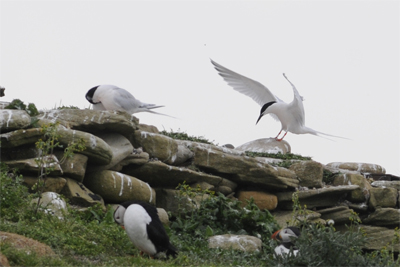
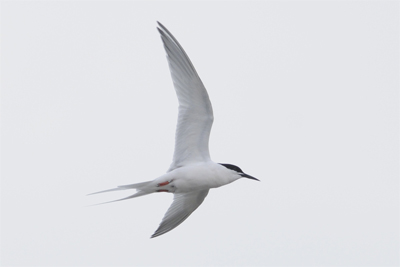
    Sarah had the excellent idea of taking a boat trip around Coquet Island, which I was really enthusiastic about.  When myself and Tom Cadwallender from the Northumberland Coast AONB were designing the backdrop for this year’s Birdwatching Northumberland stand at the Bird Fair we chose eight species that we felt symbolised Northumberland birding; Curlew, Eider, Pale-bellied Brent Goose, Golden Plover, Black Grouse, Roseate Tern, Dipper and Puffin.  A mix of everything that’s good about birdwatching in Northumberland; inland, coastal, summer and winter.  I had images of seven of those species, but the Roseate Tern is the one that I haven’t photographed during the digital age.  Hence, my enthusiasm for a trip around Coquet Island; with 35-40 Rosies already back at their Northumberland colony I was hopeful that photo opportunities would arise.  As we sailed across to the island onboard Shokwave, there was a strengthening NNE breeze and the temperature began to decrease rapidly.  Once Dennis manouvered the boat into the jetty, we could see Roseates sitting on their nest boxes.  They were a bit distant for photography so I waited patiently until I heard the distinctive ‘choo-it’ call and a bird flew by the boat.

    Britain's rarest breeding seabird

    Grey Seals popped their heads above the water to look at the boat, Puffins whizzed past at breakneck speed and more Roseates were busy displaying around the boxes.

    Roseate Tern

    After a pleasant Sunday morning cruise it was time to return home. En route, we stopped off to check a Little Owl nest site and one of the adult birds sat staring at us from the roof of a derelict building.  Finalising the paperwork for a forthcoming project was followed by a wonderful evening sitting on our patio, drinking wine and working on part of our bonsai collection as Blackbirds were singing from our trees and Coal Tits collected food to take to the noisy, and hungry, nestlings that we could hear.  Now, that’s my idea of heaven 🙂

  • Slow, slow

    Yesterday was the first of two days out with the winners of last year’s Birdwatching Northumberland prize draw.  After collecting Andy and Jean from the Bamburgh Castle Inn our destination was the Harthope Valley in the Cheviots.  It’s one of our favourite locations; stunning landscape, interesting geology and, of course, excellent wildlife.  As we reached the start of the valley we stopped to check on a Dipper nest, and there was one of the adults sitting on a rock in the river, so close that we didn’t need binoculars.  Further upstream we watched a pair of Grey Wagtails, eventually locating their nest in the tangled exposed roots of a riverside tree, before setting off in search of Ring Ouzels.  It wasn’t too long before we heard a singing male, but he remained stubbornly out of sight.  As we climbed higher up the valley the song seemed to be coming from somewhere else and careful scanning of the area revealed our quarry, perched on the remnants of a dry stone wall.  A pair of Red Grouse, with at least 7 chicks, were very obliging and a pair of Whinchat were flitting around in the heather.  After lunch we were treated to more Grey Wagtails, including a bird singing and displaying high overhead, and these were a real highlight of the day, a singing Dipper, Tree PipitRedstartCuckoo, a plethora of Willow Warblers and the shivering trill of a Wood Warbler.  Andy was keen to take a photograph of a Green Tiger Beetle and, eventually, one sat still for long enough to allow him to get close to it.

    Green Tiger Beetle

    The non-bird highlight of the day though came as we walked back to the Land Rover; a pair of Slow Worms locked in a mating embrace.  A remarkable end to an excellent day captured on camera by Andy, who kindly sent me the images to add to our blog.

    This embrace can last for up to 10 hours!
    That doesn't look comfortable