Tag: Common Snipe

  • Nothing to grouse about

    On a beautiful spring day, with raptors soaring against an azure sky, and birdsong carrying on the breeze, just being in the landscape is an experience.

    As I collected Peter and Margaret from Barnard Castle for a day of birdwatching around the North Pennines AONB, the temperature gauge on the car hit 18C, and we set off in search of one species in particular.  Our lunch stop, overlooking a Black Grouse lek site, was accompanied by Curlew, Common Snipe, Meadow Pipit and Golden Plover all singing.  As we went deeper into the hills, a Black Grouse stared at us imperiously from a rushy field.  As we enjoyed very close views of the handsome bird, two cyclists came along the road and he flushed…along with another 3 Blackcock.  As Margaret kept a close eye on the birds as they landed and began making their way uphill, Curlew and Golden Plover  landed nearby and began calling.  Then Margaret found another 3 Blackcock, flying by and landing much closer, and watched them before asking “you saw where they landed, can you see them now?”.  I couldn’t but, having watched exactly what they did, Margaret described where they were, and what they were doing.  Incredibly, they were only a few metres from where they’d landed, but had managed to position themselves amongst the rushes and stopped moving so that, unless you happened to be watching them when they did that, you couldn’t see where they were.

    As the day continued and we headed across into Upper Teesdale, we found some very close Black Grouse, Common Snipe drumming overhead, Wheatears flitting along dry stone walls, Red Grouse cackling in the heather, a Short-eared Owl quartering grassland in stunning late-afternoon light and 2 Hen Harriers.  That last sighting was exciting, and yet sobering at the same time; it’s been a long time since they bred successfully in that vast area of prime habitat.

    Fittingly, our last sighting of the day was of 2 more Black Grouse, picking their way through sun-dappled woodland in the early evening.

  • Springtime in the hills

    After a day on the coast, heading inland to Kielder seems other-worldly, but it always produces something memorable.

    In rather misty conditions I drove across to Otterburn Hall to collect Anne and Peter for a day of birdwatching around Kielder and the Border forests.  As we travelled through the forest the temperature gauge on the car hit the heady heights of 7C!  Common Buzzards were uncharacteristically obliging, remaining perched in the open, and Crossbills and Siskins were once again shining like jewels in the cloudy, gloomy edges of the forest.  After Thursday’s Skylark/Merlin encounter, Kielder provided another predator-prey experience.  We’d been watching displaying Common Snipe, and listened to one singing from it’s perch on a tree stump in the middle of a clear-fell area.  A Sparrowhawk soared into view, circling high over a nearby plantation, before switching to a much more direct flight mode…and chasing one of the displaying Snipe.  As they vanished out of sight over a plantation the hawk was still in hot pursuit…and the eventual outcome wasn’t for our eyes.  Anne spotted the only Red Squirrel of the day as we continued along our route out onto the ‘main’ road 🙂

    As we continued across the border and into a remote valley, we enjoyed our picnic lunch with Ravens and Common Buzzards soaring along the ridges high above us.  A Dipper sat motionless on a mid-stream rock and a pair of Goosanders flew upstream into the head of the valley.  I may be a cold-weather person, and I’m certainly an evening person…but Springtime in the hills has a magic all of it’s own, and I feel privileged sharing it with our clients.

  • …and staying local

    After another day on Holy Island on Sunday (carrying out some contract survey work), I collected Jakob and Nancy from Royal Quays early on Monday for a day of birdwatching around the NEWT ‘local patch’; southeast Northumberland and Druridge Bay.

    We started with Mediterranean Gulls at Newbiggin.  Gulls may not be everyone’s bird of choice, but I defy anyone to tell me that adult Med Gulls aren’t stunningly beautiful 🙂  Sanderling, Redshank, Oystercatcher, Turnstone and Pied Wagtail were picking along the tideline as we watched the meds and we left them behind to continue our journey up the coast. Seawatching produced Guillemots, Razorbills, several Red-throated Divers, Fulmars using the breeze to soar incredibly close to the cliffsides and a possible ‘Northern’ Eider drifting south among the Common Eiders.  A Peregrine made its way south with those powerful, menacing wingbeats, Rock Pipits in small flocks danced about on the wind, and we left the sea (although not too far away!) and continued our journey.  Geese, which have characterised so much of our birding this winter are still around and we managed Greylag, Pink-footed, Canada, Barnacle, Taiga Bean and Eurasian White-fronted.  Goldeneyes are still around in good numbers, Teal, Shoveler, Gadwall, Wigeon, Red-breasted Merganser and Mallard were all resplendent (as most ducks tend to be in the late winter) and 2 Common Snipe circled several times before deciding that the pond wasn’t to their liking and heading off again.

    I returned Jakob and Nancy to the ferry terminal for their return journey to the Netherlands, and made the slightly shorter journey back to Scotland Gate myself.

  • Hiding from the wind

    With a forecast for heavy rain today, we had one more client than expected yesterday for our Druridge Bay/southeast Northumberland tour.

    I c0llected Annie from High Weldon, Brian from Bedlington and then David from Warkworth before our first stop at one of our favourite birdwatching spots beside the River Coquet.  The first thing that was apparent was that there was a not inconsiderable wind-chill factor in play.  Thankfully our local area has plenty of reserves with north-facing hides, so plotting a route that would keep us out of the wind wherever possible was quite straightforward.

    It wasn’t a day for passerines, although Blue Tit and Goldcrest could be heard calling from deep inside coastal hedgerows, and we found ourselves in the middle of a big swirling flock of Starlings as we ate lunch overlooking the sea, so waders and wildfowl provided the main focus of the day.  Bar-tailed Godwit, Ruff, Dunlin and some very nice flocks of Golden Plover, Curlew, Knot and Lapwing were feeding, roosting and, at Cresswell, taking to the air in a panic as a Peregrine exuded menace as it passed over.  ‘Scope-filling views of Common Snipe always go down well, and there was an excellent array of wildfowl and waterbirds to enjoy; Gadwall, Mallard, Teal, Wigeon,Pochard, Goldeneye, Tufted Duck, Pintail, Little Grebe, Coot, Moorhen, and Pink-footed, Greylag and Barnacle Geese were all well appreciated, especially with a lot of the drake ducks out of eclipse plumage and looking quite stunning. especially when the sun broke through the clouds.

    When the autumn really starts to feel autumnal, I’m always optimistic 🙂

  • It’s ‘otter in August…

    We’re just about at the point where our 3hr evening safaris will be starting before 6pm; early August and the evenings are drawing in already!  Guided birdwatching, and a search for one of our favourite predators, always has an exciting atmosphere when it happens as darkness approaches.

    On my way to collect Niki and Haydn from Warkworth, I stopped off for a few minutes beside the River Coquet – corvids and pigeons were swirling in the breeze, giving an autumnal feel to the evening.

    With clients safely in our vehicle, we headed down the coast through the post-industrial landscape of Druridge Bay and the (only just) industrial  heartland of southeast Northumberland.  East Chevington was our first stop, producing sightings of 2 very obliging Common Snipe in the roost of Lapwings.  A flock of Curlew heading south were travelling with 2 Whimbrel and a Bar-tailed Godwit and the 2 juvenile Marsh Harriers were much appreciated as they quartered the reedbeds, flushing Mallard, Gadwall and Teal.

    We continued our journey through southeast Northumberland and, as the first drops of rain began to pepper the surface of the water, an obvious edginess among a flock of Gadwall heralded the arrival of the star of the show; gliding along, sleek, dark and menacing, the Otter showed well, although briefly, as it headed across the open water and into the reeds opposite.  Then it was time for us to do the same, and depart into the deepening gloom of the evening.

  • Making the best of the weather

    We put a lot of effort into finding locations for species that our clients are keen to photograph and we can apply decades of experience and fieldcraft…but we can’t control the weather.  As we left the lowland coastal strip of Northumberland on Sunday, gaining altitude in a search for Black Grouse at some of our favoured spots in the North Pennines, the rain started to patter on the car windows.  As the wind strengthened, and the pattering turned to a shower, this added another factor to our considerations; 1) find birds, 2) position vehicle so that a) client has a clear shot and b) lighting angle is good, were joined by c) rain isn’t drenching client 🙂  With all of those achieved it just remained for Arthur to fill his memory cards with those species that the North Pennines produces such close views of; Black Grouse, Red Grouse (with chicks), Curlew, Common Snipe, Lapwing, Golden Plover (with chicks) and Short-eared Owl being the stars of the day.  As we drove a steep remote road towards Weardale we even had excellent, and close, views of the often elusive Greyhen, and throughout the day we found several groups of Blackcock (including 7 in one field).  To be honest, if we could control the weather…I’m not sure we would 😉

  • White is the new Black

    We had back-to back birdwatching trips earlier this week, covering two of our favourite areas.

    On Tuesday afternoon I collected Keith and Jen from home in Monkseaton and we headed northwards up the Northumberland coast.  Our destination was the Holy Island of Lindisfarne, one of the birding hot-spots of the entire country.  The strong winds were the only downside to the afternoon, but the birdwatching was good.  After checking out a large group of Grey Seals we covered the area around the harbour and the Rocket Field.  Bar-tailed Godwits, Common Redshank and lots of Ringed Plover were along the shoreline and a delightful charm of Goldfinches were around the Heugh.  A distant group of Lapwings, Starlings and Golden Plover took to the air and the cause of their alarm was glimpsed briefly, although too briefly and too distant to make a positive ID.  Holy Island birdwatching stalwart Ian Kerr put us on to a Little Stint and, as we headed back through the village, groups of Golden Plover passed overhead.  Re-tracing our route back down the coast and checking the Budle Bay on the rising tide, we were just discussing the indications of the presence of predators when a huge number of birds lifted from the mud.  As well as the gulls and waders, Jackdaws, Rooks and Woodpigeons joined the throng as they came out of adjacent fields and trees.  This time the culprit was seen and identified; a Peregrine, that most majestic of raptors and one of the highlights of any birdwatching day on the Northumberland coast in the autumn and winter.  A quick seawatch produced Sandwich Terns feeding, and Gannets soaring effortlessly on the breeze.

    Wednesday was a full day out around Druridge Bay and Southeast Northumberland.  I collected Jayne and Andrew from Seahouses, and then Hilary and John from Alnmouth, before beginning our tour of some of the best birdwatching spots in our local area.  While we were watching Lapwings, Redshanks, Greenshanks, Ruff, Herons and Cormorants on the River Wansbeck I could hear a rough ‘sreee’ call from high overhead.  The strong breeze meant that it wasn’t straightforward to locate the bird, but eventually I picked it out.  It was an unfamiliar call, but a familiar species; a juvenile Common Cuckoo.  The walk back along the river produced a nice flock of Long-tailed Tits.  After lunch we stopped off at Cresswell Pond.  Hilary and John mentioned that they’d visited Cresswell once before – when they noticed a large group of birders and stopped, managing to see a Buff-breasted Sandpiper.

    Northumberland birdwatching following the floods of September 2008
    Buff-breasted Sandpiper and Ruff, Cresswell Pond, Northumberland 12/09/2008
    With luck like that, we joked about what this visit could produce...

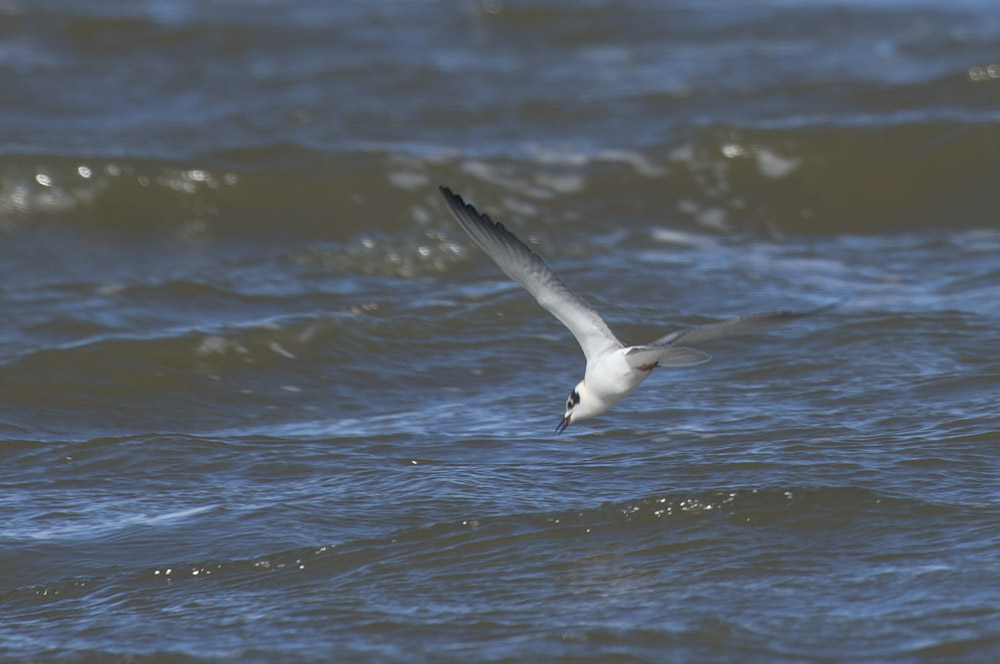
    When we arrived at the hide, Jaybee mentioned that he’d had a juvenile Sandwich Tern.  I scanned the pond but couldn’t see the tern anywhere and we settled to enjoying the quite remarkable views of Common Snipe that were available.  After checking through the assembled ducks, gulls and waders I scanned across the pond again and spotted a tern dip-feeding near the causeway.  The bird’s behaviour, combined with it’s very dark back, white rump and silver-grey wings caused me to get rather excited.  White-winged Black Tern is a very special bird, and a personal highlight as it’s the third Chlidonias tern that I’ve found in Northumberland.  Whiskered Tern is very rare and Black Tern is always a nice bird to see but White-winged Black Tern is such a beautiful species.  Jaybee kindly sent me some images to use 🙂

    White-winged Black Tern, a Northumberland birdwatching highlight 15/09/2010
    White-winged Black Tern, Cresswell Pond, Northumberland 15/09/2010
    Highlight of a day birdwatching on the Northumberland coast 15/09/2010
    White-winged Black Tern, Cresswell Pond, Northumberland 15/09/2010

    White-winged Black Tern, Northumberland, Birdwatching
    White-winged Black Tern, Cresswell Pond, Northumberland 15/09/2010
    As other birders began to arrive to enjoy the fruit of our good fortune we continued up the coast.  Eiders and a Goosander, as well as some very obliging Grey Herons, were seen as we stopped by the River Coquet.  A superb couple of day’s birdwatching, a beautiful rarity and clients who were excellent company.

  • Busy birdwatching

    Even though we live in southeast Northumberland, we’ll never tire of getting out and about searching for new experiences for our clients.  Days out with clients are always exciting as well, because we never know exactly what we’ll see or what it will be doing.

    Last Thursday we had a Southeast Northumberland/Druridge Bay safari with clients from a fairly wide geographical area; Jeff and Jean from Huddersfield, Lawrie and Linda from Glasgow and Yvonne from southwest Northumberland.  Starting at Newbiggin we managed a brief view of a Mediterranean Gull on the beach, and a small flock of Sanderling.  These little grey, white and black ‘clockwork toys’ are always entertaining as they scurry back and forth along the water’s edge.  The River Wansbeck was our next destination.  As expected there was a good sized flock of Lapwing roosting and Cormorants and Herons were doing what they do; standing with their wings out and just sort of standing respectively.  All of a sudden a wave of panic spread through the Lapwings.  We all scanned backwards, forwards, skywards but couldn’t see any cause.  Perhaps it was just a false alarm?  The birds settled but were up again within a minute, gradually settling back down with a great deal of conversation between them all.  Greenshanks flew by calling and the Lapwings were becoming increasingly jittery.  Even birds from distant streams were high in the air, forming the quite tight flocks that indicate the presence of a predator, something that creates anticipation wherever we’re birdwatching.  Eventually we found a distant Peregrine, and a big female Sparrowhawk slid menacingly through the trees opposite our watchpoint.  One or both of them was presumably the cause for concern.  Even the Great Black-backed Gulls flushed and flew overhead, giving calls of consternation.

    Among the coastal waders, perhaps the best were three Common Snipe, unusually confiding and just a few metres away from us.  The fall of passerine migrants earlier in the week had left a few goodies behind.  Spotted and Pied Flycatchers were quite elusive, sallying forth and then back into cover, Willow Warblers and Chiffchaffs were picking their way through willows beside the path and, providing a visual feast to rival the gaudiest of birds from elsewhere in the world, six male Common Redstarts were along one short stretch of hedge.  There really is little to rival the beauty of these birds.

    At the conclusion of our journey up the coast a bird as lacking in colour as the Redstart is bathed in it was a final wonderful sighting.  As we watched two Grey Herons perched in trees overhanging the River Coquet, a Little Egret flew by before returning and perching high in the treetops in a spot where we could watch it through the ‘scope.  There can’t be many better places to be birdwatching than the Northumberland coast in September 🙂