Tag: Common Scoter

  • Mirror calm; NEWT’s North Sea Pelagic 05/07/13

    The North Sea can be a strange place.  I’ve been out there in calm, sunny conditions, heavy rain, and I’ve carried out survey work for the North East Cetacean Project in conditions – dense fog, white-out blizzard, ‘interesting’ swell – where we wouldn’t have hesitated to cancel the trip if it was part of our North Sea Pelagics programme.  Yesterday was probably the oddest conditions I’ve seen though…

    The northward stretch of our trip was in very calm sunny conditions that Mary likened to the Greek islands and Andy thought was reminiscent of a sheltered Scottish sea loch.  Gannets were soaring by, Puffins were bobbing about on the barely noticeable swell, small rafts of Guillemots weren’t doing very much at all and there didn’t seem to be a great deal of activity until we were just off Cresswell and amongst the flocks of gulls and terns.

    Then, the journey south brought conditions that were just surreal.  First the sea began to flatten, until what little swell there had been was gone, and it was mirror calm.  Then a hazy mist developed and the reflection of the sky in the water meant that it was no longer possible to see where the sea ended and the sky began; all was a monochrome canvas in front of us – no visible horizon, just a flat grey sheet liberally washed with dense flocks of gullsFulmars and Manx Shearwaters were gliding by just above their own reflections, a flock of Common Scoter flew north just after a Red-throated Diver had passed by and a Harbour Porpoise betrayed the interface between air and water as it surfaced nearby.  As the deep red orb of the sun dipped below the horizon away to the north west, the temperature dropped dramatically and we sailed back into the Tyne.

    All of our evening pelagics from North Shields are sold out (except for one place remaining on July 26th) but we still have a limited number of spaces on our Farne Deeps pelagics, our all day pelagics from Royal Quays in September and our Whale and Dolphin Cruise on August 31st.  Give us a call on 01670 827465 for more details, to check availability or to book 🙂

  • The power of the sea

    We rarely let the weather get the better of us.  Apart from our annual programme of North Sea Pelagics, where the weather really can make a difference to a trip going ahead or not, we can pretty much cope with anything the elements throw at us.

    I collected Harry and Maureen for their mini-safari on the North Northumberland coast as the first drops of rain began to speckle the windscreen of the car.  Straight down the coast and we were soon watching Eiders and Common Scoter riding up and over the surf, Guillemots, Puffins and Razorbills loafing offshore, Gannets and Fulmars soaring effortlessly over the sea, Swallows hawking insects within a few feet of us and Rooks foraging around the car park in search of discarded morsels of food.  All of this was in heavy rain, but positioning the car at just the right angle to the wind made it possible to watch all of these birds and the dark majesty of the sea as a backdrop.  Along the coast towards Holy Island a huge group of Grey Seals were basking in the improving weather and, all too soon, it was lunchtime and the end of the trip.

  • Birdwatching on Holy Island 29/05/2013

    After collecting Stephen for his second trip of the week, we drove north and met Susan near Holy Island, for her third trip in four days.  Our Lindisfarne safaris are always an interesting guessing game, other than in the winter when we know that we’ll find vast flocks of waders and wildfowl – although even then there’s the unknown quantity of wintering raptors.

    We started down the coast in the shadow of Bamburgh Castle; sheltering from the wind and rain, we watched Gannets soaring effortlessly, Common Scoter and Eider riding the swell like the most accomplished surfers in the world, Fulmars and Kittiwakes fighting into the stiffening breeze and a Red-throated Diver sliding beneath the waves and resurfacing out of sight.

    What would appear at first glance to be a long line of boulders, exposed at low tide, resolved through binoculars, as expected, into several thousand Grey Seals.  The ‘hook-nosed sea pigs’ (surely the most unflattering translation of the Latin name for any animal) were lazing on the exposed sand

    On Holy Island itself the weather improved dramatically and we watched a flock of Ringed Plover and Dunlin in the harbour, with a surprise find in the form of a Little StintMeadow Pipits were song-flighting, Skylarks rose higher and higher, delivering their outstandingly complex songs, and Lapwings were tumbling over nearby fields as we worked our way slowly along a hedgerow getting close views of Dunnock and House Sparrow, and listening at close range to the repetitive notes of a Song Thrush.  Surprise find of the day was a group of eight Roe Deer between Chare Ends and the Straight Lonnen.  We’ve seen them on the island before, but never so many together at once.

    After a day with two enthusiastic clients who had been excellent company on multiple trips during the week, it was time to drop Susan off and take Stephen back south.  Sometimes, I think what really makes our trips work is the clients that we have 🙂

  • Change of plan

    Snow on Monday, glorious weather on Tuesday…and torrential rain on Wednesday 🙁  When I arrived to collect David and Janet for their Prestige Tour in the Cheviot Valleys we quickly decided to head towards the Northumberland coast instead as that would offer the chance of plenty of birdwatching with the prospect of being able to shelter from the worst of the weather.

    Starting at Stag Rocks, we watched flocks of Eider and Common Scoter as they rolled up and over the substantial waves and a Grey Seal swam just beyond the breaking surf.  One thing that was immediately obvious was that there was a movement of Gannets; birds were flying over the rocks and more could be seen offshore.  Heading down the coast, the intensity of the rain increased and we had our second seawatch of the day, this time just south of Cresswell.  An almost continuous passage of Gannets was evident as they headed north, flocks of Kittiwakes and Guillemots were passing by, the occasional Fulmar arced up above the clifftops and a single Manx Shearwater easily outpaced the GannetsAvocets sat tight as the rain hammered down around them and, when the deluge finally ceased and blue sky and sunshine replaced the gloom, we watched a male Marsh Harrier as he quartered a nearby field before soaring heavenwards. A Great Crested Grebe sailed by serenely, a Whimbrel flew north, five Brown Hares were engaged in some half-hearted chasing and Swifts, Swallows, House Martins and Sand Martins all took advantage of the feast of insects that had been stirred to activity by the improvement in the weather.

    Even in poor weather, Northumberland can produce some excellent birdwatching 🙂

  • Early rise

    Saturday 03:30 and the alarm clock starts ringing.  After eight long days out of the office, things were going to be topped off nicely with an early start for our ‘Dawn on the Coast’ Beginners Photography session.  I arrived just ahead of Dave, and met up with Steve who had arrived early.  In the shadow of Bamburgh Castle, with the North Sea washing close to our feet, we worked our way through the holy trinity of photography (shutter speed, aperture and ISO) and various compositional techniques as the approaching dawn illuminated the landscape around us.  Snow, driven by a strong northerly breeze, passed by almost horizontally and the broken cloud to the east produced intermittently good lighting conditions.  Red-breasted Mergansers and Fulmars flew by, Common Scoters and Eider were riding on the swell, Purple Sandpipers crept around the base of the rocks and we finished our session as less amenable weather approached from the east.

  • The power of the sea

    Friday was a safari on the North Northumberland coast for Kathryn and Linda.  As I collected them from the Lindisfarne Inn, the biting wind carried a flurry of snow, and I guessed this could well be a day for birdwatching from the warmth and comfort of the car.

    Over the next few hours we had close views of Bar-tailed Godwit, Dunlin, Redshank and Oystercatcher as they probed in the mud, seemingly oblivious to the breeze, a Peregrine shot by, menace on pointed wings, and a Brown Hare sat majestically in the middle of a field.  From the car park at Stag Rock we could see the MV Danio, still stranded near the Longstone lighthouse, as Common Scoter and Eider rode up and over the impressive swell and Gannets battled into the breeze.  Black-headed Gulls and Rooks were almost perched on the car, and the South Low below the Holy Island Causeway offered impressive views of Eider, Long-tailed Duck and Scaup.

    Our lunch stop was the Bamburgh Castle Inn, which gave us a good view of the extent of the swell rolling from the south east…and the approaching snow, which got to us just before we got back to the car 🙂

  • Every cloud has a silver(y) grey lining

    Our final full-day pelagic for 2012 was on Saturday and, although I was really looking forward to it, it’s always a shame when we reach the end of our offshore season.

    With strong winds on Thursday, and charter boats cancelling trips on Friday, I still felt that we’d be able to sail.  We gathered at Royal Quays just before 09:00 and boarded the SarahJFK.  Brian spotted a Great Spotted Woodpecker just after we set sail, and as we headed downstream we could see a little bit of swell and a few whitecaps offshore.  A skein of Pink-footed Geese high overhead were heading south, and we weren’t too far out of the river when we had our first skua of the day; and it was one of those ‘is it, isn’t it?’ moments as what was probably a dark Pomarine Skua flew north low over the waves.  Three Great Skuas were heading the same way, and another one later caused a ‘dread’ amongst the birds gathered round a fishing boat.  Fulmars and Kittiwakes were with us throughout most of the day and Gannets were soaring by on the breeze.  Our first Sooty Shearwater was in a raft of gulls behind a trawler, and we had at least five more during the day.

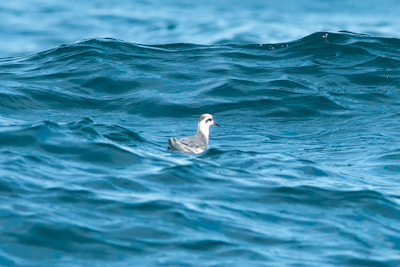
    As the swell began to ease slightly we were 8 miles off Cresswell, heading north west, when I saw two small waders flying up and over a wave crest.  As they dropped onto the sea I shouted “Grey Phalaropes!” and called to Allan to stop the boat.  Eventually we all had excellent views of these two tiny birds as they bobbed about in the swell.  They were the 2nd and 3rd that I’ve seen on pelagics I’ve organised, following the 1st out in the Farne Deeps in 2010.

    Grey Phalarope,Northumberland,bird photography,pelagic birdwatching trips,pelagic wildlife trips

    Grey Phalarope,Northumberland,bird photography,pelagic birdwatching trips,pelagic wildlife trips

    Grey Phalarope,Northumberland,bird photography,pelagic birdwatching trips,pelagic wildlife trips

    We headed towards the coast, and turned to make our way back towards Royal Quays.  Our only Manx Shearwater of the trip was followed soon after by a Pomarine Skua, found by Cain, six Red-throated Divers (including four flying south together), 42 Pale-bellied Brent Geese heading north, 20 Wigeon and 30 Common Scoter.  With only one Manx Shearwater, and no Arctic Skuas at all, this was quite an unusual pelagic but, if you like waders, and you like seabirds, then phalaropes are a dream bird 🙂

  • Dark night

    This has been a difficult year for boat operators on the east coast, with unseasonable winds and frequent heavy rainfall making it unwise to head out to sea.

    Tuesday was the first of this year’s evening pelagics to survive the weather so, as we set out from Royal Quays on the SarahJFK, I was full of optimism.  Soon after leaving the mouth of the Tyne, Allan spotted a Harbour Porpoise, although it remained typically elusive.  Kittiwakes were following us throughout the evening, no doubt wondering if we were going to throw any scraps overboard, Gannets and Fulmars were passing by and, all around us, the sky looked heavy with something…

    I’d had a call earlier in the day to say that a small pod of dolphins were passing Newbiggin, so I took a guess on where they would be by mid-evening and asked Allan to plot a course that would take us through the area.  Sure enough, just where we expected them, 6 White-beaked Dolphins, including the smallest calf that I’ve seen in the ten years since we first found White-beaked Dolphins on one of our pelagic trips, appeared in front of the boat and then came in to bow-ride 🙂  They stayed with us for several minutes before heading south, probably to feed, and we continued north.    5 Manx Shearwaters were heading north, and a flock of 30 Common ScotersAll the while the weather around us was looking poor, and eventually we found ourselves in a heavy, misty drizzle as we headed back to port, and by the time we docked it was properly dark – not something we’d normally expect in mid-July.

    Glowering, oppressive weather conditions, remarkably good visibility, a sea state that was ideal for cetacean spotting, a boat full of enthusiastic clients and a pod of dolphins…perfect 🙂

  • (Not the) Farne Islands 09/07/2012

    Yesterday was a Farne Islands Prestige Tour…or at least that was the plan…

    As I drove towards Seahouses to collect Dick and Jenny, having already figured out that there weren’t going to be any sailings to the islands in those conditions, I received the call that confirmed it.  So, what to do instead?  A quick discussion with clients who had realised before I arrived that it wasn’t a day for heading across to the Farnes…and then we were off on a tour of the Northumberland coast.  Grey Seals were ‘bottling’ just offshore, female Eiders were supervising the creches of this year’s youngsters, Shelduck were feeding along the tideline and Oystercatchers and Redshank were probing next to the breaking surf.  We headed south to see what the weather at that end of the coast would bring…and had a not too bad afternoon around Druridge Bay 🙂  Mediterranean Gulls were loafing alongside Black-headed Gulls, a female Marsh Harrier flew across in front of the car (and we later found her again, perched in a bush overlooking her nest site), Dick found a Long-eared Owl that performed for over ten minutes – hunting amongst the reeds and rushes in broad daylight, Jenny spotted a Roe Deer and a Brown Hare lolloped into view nearby, no less than 23 Little Gulls were in a roost that also had three Black-tailed Godwits, a Dunlin, still with a solidly black belly, was sleeping next to a small pool and we even managed a spot of seawatching; a huge flock of Gannets and terns was circling and plunging, three Arctic Skuas pursued and robbed the successful terns and a raft of Common Scoter rose into view, and then fell again, just beyond the surf.  Perhaps the most unusual sight of the day though, was a Barn Owl carrying prey, not unusual in itself, but the bird flew 3/4 of the way anticlockwise around the north pool at East Chevington, then flew back all the way it had just come before flying 3/4 of the way around the pool clockwise to get back to where it had been five minutes earlier.  Wildlife, you never know when it’s going to appear, you never know what it’s going to do…

  • Birding with a touch of luxury

    Delivering a birding package for the first time with a new partner is always a mixture of excitement and worry; will the experience we deliver to our clients blend well with the standards of service, accommodation and food that are provided?  Our exclusive Doxford Hall birding break on Thursday and Friday didn’t hold too many worries though – I’ve attended conferences and other events there before and, having known David Hunter since he was at Matfen Hall, I knew that the entire Doxford experience would be a memorable one for all the right reasons.

    I arrived first thing Thursday morning to collect Paul and Sue, who had won their exclusive birding break in a competition that ourselves and Doxford Hall ran recently in Birdwatch magazine.  Our original plan of Druridge Bay on Thursday, Lindisfarne on Friday, had been altered following a ‘phone call during the week from Sue – there was one species they particularly wanted to see, and our recent blog posts had revealed that now might be a good time…so, after a day of hectic communication with the Forestry Commission to arrange access through Kielder, and check where along our route there would be any forestry activity, our first trip headed inland.  We started at Harwood in near-perfect weather conditions; warm, sunny and with a good breeze.  Common Buzzards, Common Crossbills, Siskins and a very vocal Raven were all seen but no Goshawk so we continued west.  Once we were in Kielder another Raven entertained us, tumbling and cronking over a remote farmhouse in the warm afternoon sunshine before soaring heavenwards and then dropping back out of the sky alongside its mate.  We stopped to scan over another plantation, where I’ve watched Goshawks previously, and I soon spotted a bird just above the trees. He quickly got into a thermal and rose until we lost sight of him.  I suggested that we just needed to wait for a Common Buzzard to drift over the Gos’ territory, and we began a patient vigil.  Eventually a Common Buzzard did appear, we all lifted our binoculars to focus on it…and a distant speck in the binoculars above the buzzard grew rapidly larger as the Goshawk dropped out of the sky.  The intruder thought better of hanging around and quickly folded it’s wings back and crossed the valley like an arrow.  Having shepherded the buzzard away, the Phantom of the Forest rose quickly again to resume his sentinel watch.  More Common Crossbills and Common Buzzards followed as we travelled down the valley back towards civilisation, and 2 pairs of Mandarin brought a touch of stunning colour to the afternoon.

    Dinner at Doxford Hall on Thursday evening was exceptional (outstanding food and outstanding levels of service throughout the 2 days), and having clients with such an enthusiasm for birding, and fantastic sense of humour, made it even better.  After dinner conversation did reveal that there was an obvious gap in their life-lists though…

    Friday’s plan was simple; head to the coast and then bird our way down it to finish in Druridge Bay late afternoon.  We started at Harkess Rocks, in the shadow of Bamburgh Castle, with a very nice flock of 79 Purple Sandpipers.  In the heavy swell a flock of Common Scoters proved elusive, Common Eiders dived through the surf, small rafts of Common Guillemot and Razorbill bobbed about, Gannets soared effortlessly, Sandwich Terns were feeding just offshore and Long-tailed Ducks and Red-breasted Mergansers in breeding finery were a reminder that our winter visitors are about to pack their bags and head north.  Red-throated Divers, including one bird with a very red tinge to it’s throat, were typically elusive, diving just as we got onto them.  I’d got another species in mind though and, when I found one, it was sitting obligingly next to a Red-throated Diver.  Soon, Paul and Sue were admiring the elegant structure, neat contrasty plumage and white flank patch of their first Black-throated Diver. 2 days, 2 lifers 🙂

    We headed south and, after watching an adult Mediterranean Gull, and two 2nd calendar year birds, winter and spring came together with flocks of Greylag and Pink-footed Geese, and a Short-eared Owl, being characteristic of the last 5 months of our coastal trips, Green Sandpiper and Whimbrel on passage and a male Marsh Harrier drifting over a coastal reedbed.

    In beautiful afternoon light, with the sound of the roaring surf of the North Sea crashing into the east coast, the Short-eared Owl quartering a nearby reedbed and a pair of Great Crested Grebes displaying on the pool in front of us, a couple of comments by Sue – two of many memorable ones during the trip 😉 – summed things up nicely “chilled-out birding” and “we like the view from Martin’s office” 🙂