Blog

  • Five star birdwatching; Northumberland Coast 20/02/14

    Our fourth trip this week was a day birdwatching with Simon, who was back again after previous trips including a stunning Farne Deeps pelagic in 2012.  We’d spoken in advance of the trip and Simon was keen to add a few of Northumberland’s wintering birds to his life list; divers, grebes, Purple Sandpiper and Brambling were all mentioned as desirable.

    When I arrived to collect him on Thursday morning, I was still wrestling with the challenge of heading inland for Brambling, yet leaving plenty of time to explore the Northumberland coast.  That worry was quickly taken away, as putting a feeder up outside the holiday cottage meant that Simon had found one of the species on his wish list himself 🙂  Covering most of the coast from north to south produced five lifers;  Red-throated Divers just beyond the surf, Long-tailed Ducks including a breathtakingly beautiful drake, Purple Sandpipers unobtrusively poking around in rock pools, displaying Goldeneye rivaling the attractiveness of the Long-tailed Ducks and, as the afternoon light faded and the rain finally arrived, a very obliging Water Rail.  Twite, Stonechat, Yellowhammer, Reed Bunting, Skylark, Marsh Harrier, Slavonian, Little and Red-necked Grebes, Shelduck, Bar-tailed Godwit, Dunlin, Grey and Golden Plover, Lapwing, Gannet, Curlew, Teal, Mallard and Wigeon may have been reduced to a supporting role for the day, but all combined to produce an excellent day’s birdwatching on the Northumberland coast 🙂

  • A trio of Grebes and a splash in the gloom

    Tuesday and Wednesday were mini-safaris for one family, but different participants each day; Sue, Phil, Sandra and Inez on Tuesday and Sue (again), Jacqui, Paul and Hannah on Wednesday.

    Both days featured lots of waders and wildfowl; Redshank, Common Snipe, Curlew, Lapwing, Dunlin, Bar-tailed Godwit, Goldeneye, Pintail, Tufted Duck, Gadwall, Mallard, Teal, Wigeon and Red-breasted Merganser were all very obliging, with the ducks particularly stunning, and the Goldeneye engaging in their quite captivating display.  Moorhens picking scraps off a skeleton at the edge of Cresswell Pond were described as ‘totally gross’ by Inez, and it isn’t easy to argue with that summation 🙂

    Although the two days were similar, there were some notable differences; Tuesday produced Slavonian and Red-necked Grebes, alongside the Little Grebes that we saw on both days, and Wednesday featured Water Rail and Roe Deer.  Wednesday also produced a very brief Otter encounter, as a dark shape rolled at the surface in the deepening gloom, crossed the river and rolled again as the local Mallards stared in terror into the darkness.

  • Never work with children or animals…

    Back when I was a teacher, and developing demonstration experiments, I came across a piece of advice that has stuck with me since then ‘prior practice prevents poor presentation’.  It served me well; it’s far better to accidentally set fire to the ceiling tiles in your classroom when there’s just yourself, a lab technician and a fire extinguisher there.  And what did I learn from that incident? Make sure your class are sitting towards the back of the room, and keep the fire extinguisher close to hand 😉

    We apply a similar philosophy with NEWT.  Recce sites consistently and, even when a site is regularly producing sightings of the target species, keep searching for new sites too.  Preparation for our beginners photography workshop at the weekend involved baiting three locations with hazelnuts, to maximise the chances of Red Squirrels appearing right in front of us in a photogenic location with lighting angles worked out well in advance.  We visited the sites on Saturday in poor weather conditions and re-baited with over a pound of nuts.  Sunday dawned and I met up with Bryan.  His previous trip with us had been a successful search for Otters, and Red Squirrels have always been an easier mammal to track down…

    The weather couldn’t have been better; bright sunshine always helps.  Coal Tits, Great Tits, Blue Tits, Long-tailed Tits, Chaffinches, Blackbirds and Magpies seemed to be everywhere around us.  However, not any sight of a squirrel 🙂 They’d cleaned out the nuts from all of the sites we’d baited, so we re-baited, and waited.  The likely explanation is that the combination of a stiff cold breeze and the extraordinary number of people walking their dogs through the woods meant that they were keeping their heads down.  So I’ve set up a baiting area in a much quieter piece of woodland, and invited Bryan to come along for a session photographing the squirrels there once I’ve determined the best angles and times of day.  No matter how much preparation you put in, sometimes the unpredictable nature of wildlife still gets the better of you 🙂

  • Home from home

    During our quieter times of the year, I spend much of each day dealing with NEWT’s admin stuff.  I try to get out and enjoy some fresh air every day though…

    It’s mid-January and it really should be cold; frozen ground, a dusting of snow, hoar frost on leaves and branches.  Instead, there’s a distinct air of early Autumn as I head out of the house and along the track to Choppington Woods.  The cold damp air coats everything in a thin layer of moisture, including me.  I soon give up using my binoculars as no sooner do I dry them than they’re fogged up again.  Instead, I rely on my hearing.  The thin high calls of Goldcrests emanate from the depths of the coniferous parts of the wood while the short sharp notes of Blackbirds surround me as they head to roost.  Then, from a hidden perch near the edge of one plantation, one of my favourite bird sounds lifts the gloom.  The tremulous hooting of a Tawny Owl, a sound that I’ll never tire of hearing.  We have at least two birds singing in the wee hours of the morning currently, both audible from our bedroom, and if they wake me up with their territorial caterwauling I’m not too bothered; I just lie there and listen to them, marveling at the rich complexity.  The bird on the plantation edge proves a master of disguise until, in response to a series of quavering hoots lower down the hill, it begins to move through the trees.  I follow it’s progress until it vanishes into the gloom and darkness of the canopy and I continue my walk.  Lost in my thoughts as daylight fades and everything begins to blur into the monochrome  realm of the owls, my reverie is disturbed as a Common Buzzard flaps laboriously over a plantation of Silver Birch. Like Cinderella, the buzzard is out and about perilously late, struggling to get home on time.

    Now it’s near dark, and I’ve still got the final plantation to negotiate before I’m back home.  Some footpaths are good, some footpaths are bad…and some seem to gather water like a sponge.  As the clarty ground clings to my boots, trying to bind me to the earth, a Red Fox trots by, delivering what can only be a look of contempt at my ungainly struggle 🙂

  • November; Over the border

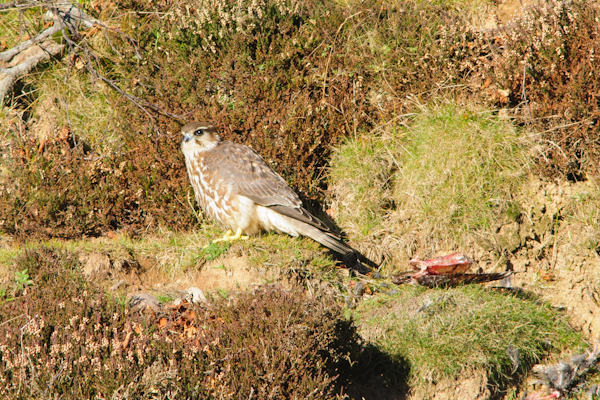
    Hunger sated

    Hunter watches

    Woodcock torn