Blog

  • Life through a (magnifying) lens; Family mini-beast hunt 21/07/2014

    Our routine (if anything involving wildlife can ever be routine…) safari trips have brought some remarkable experiences for our clients, and for us too.  ‘Big stuff’ (for want of a better a description) is always popular; Red Squirrel, Otter, White-beaked Dolphin, Badger, Minke Whale are just a few examples of those perpetual crowd-pleasers.  Sometimes though, I think we may lose a sense of perspective and forget that the ecosystem has a lot of ‘little stuff’ too…

    I collected Penny, Nathan, Alfie, Arthur and Millie from Alnmouth and we set off for a morning in southeast Northumberland.  I armed the two boys with compact binoculars, and Millie with one of my favorite bits of kit 🙂  Sarah, all of our friends and relatives, and many of our clients know that I’m a bit of a gear geek…but a 23mm 10x doublet hand lens is a relatively simple instrument that opens up a world that is quite remarkable.  The boys used the binoculars to look at insects, flowers, grass, the sky and anything else that was in front of us, and Millie learned how to use a hand lens.  With a sample pot as our other toy of choice for the morning we captured, observed and released hoverflies, moths, soldier beetles, a Common Blue Damselfly, a Bee Fly and all sorts of weird and wonderful mini-beasties.

    The enthusiasm of Alfie, Arthur and Millie reminded me that, every so often, I need to stop looking up into the sky or out to sea and look down at the small world around our feet 🙂

  • Challenge; Farne Islands Photography 20/07/14

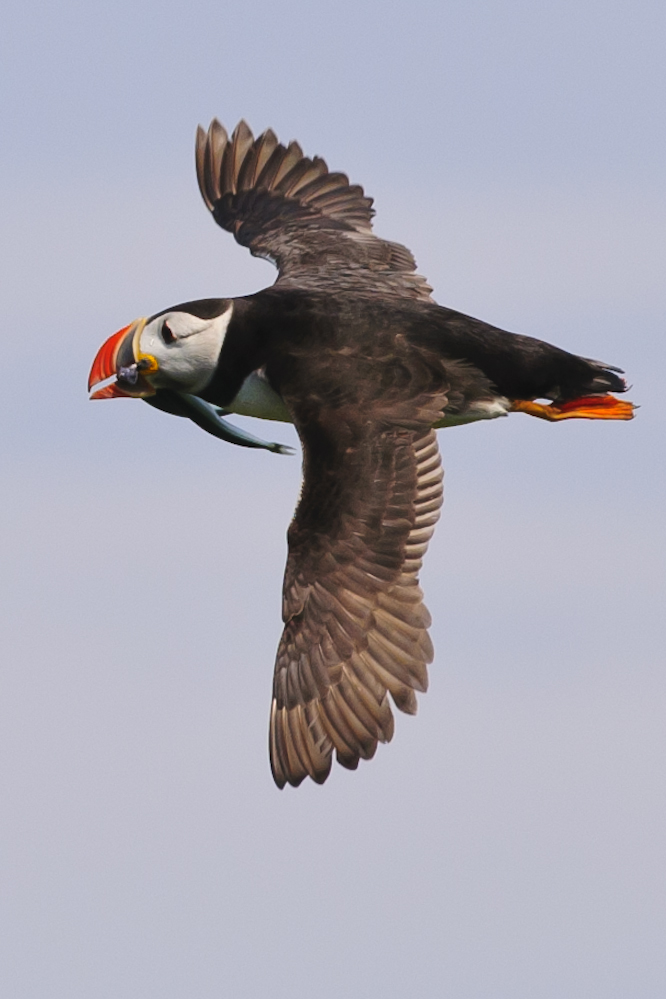
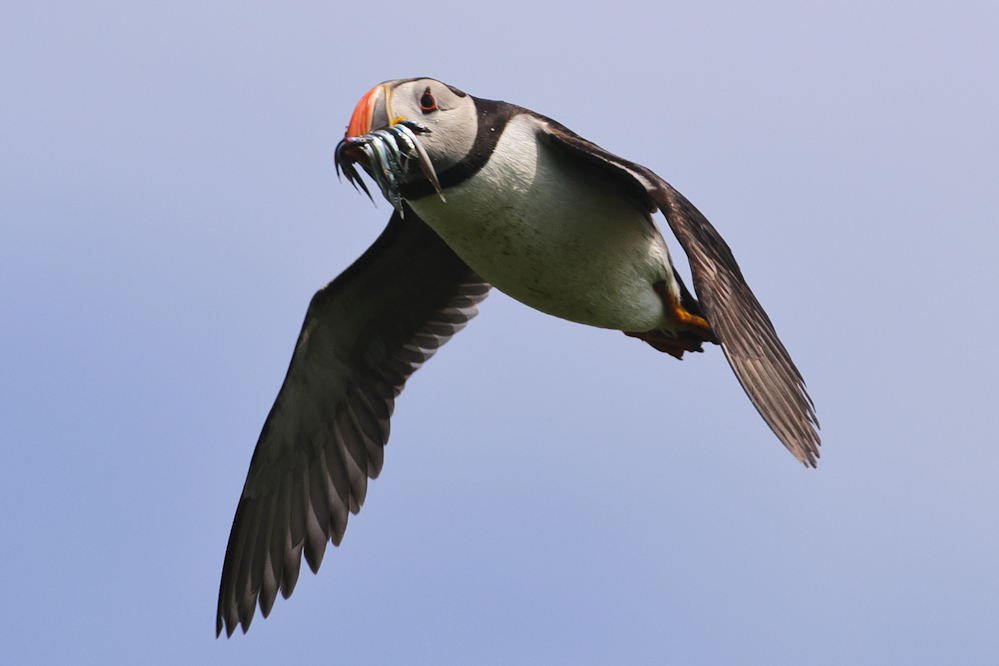
    Our rearranged Farne Islands photography workshop was a second day out with NEWT for Bryan, and a chance for him to take on the challenge of Puffins in flight 😉  We sailed across to the islands on Glad Tidings IV (returning at the end of the afternoon on St Cuthbert III), and amidst the chaos of Arctic, Sandwich and Common Terns, Fulmars, Kittiwakes, Guillemots, Razorbills and Shags we worked on camera settings for action photography, but also on the elusive, almost instinctive skills that need to be developed to capture flight photographs of such a fast moving target.  At one point we swapped cameras, with Bryan taking on the physical challenge of the substantial lump of kit that is a Nikon D300s and 70-200mm f2.8 lens 🙂  As he settled into a smooth panning action, aided by the weight of my camera/lens, and began taking the shot at just the right time, he switched back to his camera with Puffin after Puffin captured through the lens, and I grabbed a couple of shots myself 🙂

    Atlantic Puffin,Fratercula arctica,Inner Farne,Farne Islands,Northumberland,photography workshops,photography holidays,photography tuition

    Atlantic Puffin,Fratercula arctica,Inner Farne,Farne Islands,Northumberland,photography workshops,photography holidays,photography tuition

    Black-headed Gull,Chroicocephalus ridibundus,Atlantic Puffin,Fratercula arctica,Inner Farne,Farne Islands,Northumberland,photography workshops,photography holidays,photography tuition

  • “That’s not a bill. That’s a bill”; Otter Safari 12/07/2014

    Often, the species that we’re specifically searching for appears and is the highlight of the day.  Sometimes, the scenes involving the supporting cast take some beating though…

    I arrived at Church Point to collect Rose, Tom and Alison, and we headed up the coast for an afternoon around Druridge Bay searching for Otters.  July is one of our favourite times to visit the coast, as wading birds are starting to head south, still in breeding plumage.  Black-tailed Godwit, Golden Plover and Dunlin were all lazing at the water’s edge in the increasingly breezy afternoon, and one of our most delicate looking birds provided a lot of entertainment.  Avocets are a fairly recent addition to Northumberland’s breeding avifauna, and their delicate appearance belies their feisty nature.  As three fluffy Avocet chicks swept their heads from side to side in shallow water, occasionally breaking off to go and tuck themselves under their parent’s wing, the adult Avocets were busy keeping the area clear of other birds.  Black-headed Gulls, and even Pied Wagtails were driven off, but the most ferocious assaults were reserved for a flock of Common Snipe.  Secretive and usually hidden out of sight, the snipe had ventured away from the shelter of the reedbeds and into shallow water where they were feeding with a sewing machine action, faces in the water and constantly probing the soft mud beneath.  The Avocets weren’t having that though, and the snipe were persistently flushed by attack after attack.  When we’d first arrived a Spoonbill had been flying above the pond, and it settled and went to sleep.  Eventually it woke up and began walking along the edge of the pond before disappearing from view.  Then it took off and flew across the water, settling near the Avocets…

    The first furious airborne assault on the Spoonbill left it completely unmoved, so the Avocet landed nearby and charged at it, head down and neck stretched forward, menacing with that long, upcurved rapier like bill.  The Spoonbill lifted it’s head from the water, opened it’s bill and waved it as if to say “Do you really want me to slap you with this?” 🙂  Obviously a different approach was required, which involved the Avocet pretending to feed, whilst slowly sidling towards the Spoonbill, ready to launch another attack.  That was greeted in the same manner, and when the Avocet tried again, the Spoonbill simply kept it’s head in the water and charged straight at the Avocet, sweeping it’s bill from side to side.  Eventually the Avocets gave up the attack, but kept a close eye on the Spoonbill, as another ten Avocets flew over and a Little Egret put in a brief appearance.

    As dusk approached we settled into position overlooking another pool.  All seemed calm, Marsh Harriers were hunting the reedbeds as daylight faded, and then an Otter appeared, making it’s way across the shadow-dappled water, twisting, turning, diving, pausing at the surface to consume its catch before resuming the hunt 🙂  A second Otter was hunting in the deep shadow of a reedbed, and the closer one betrayed it’s own presence with the classic ‘ring of bright water’ each time it surfaced.  A Barn Owl came as a shock, when it flew through Rose’s binocular view, and a white Rabbit and four Brown Hares were illuminated by the car headlights as we made our way back to Church Point in the rain.
  • Marshland magic; Druridge Bay 04/07/2014

    I love all of the different locations that we visit on our tours, but a day around NEWT’s local patch of Druridge Bay and southeast Northumberland is always special.  Maybe because it’s so close to home, maybe because of the incredible industrial heritage that has gradually been transformed into fantastic wildlife habitat or maybe just because it’s really, really good 🙂

    I collected Sue from Church Point and we headed north up the coast.  A brood of Goosanders were perched on mid-stream rocks as Grey Wagtails flitted back and forth across our field of view, tails wagging vigorously each time they settled before flycatching again just above the water.  An insistent squawking made us turn our heads – and there was a brood of Blackbird fledglings, just a few metres away, watching us with curiosity as their parents brought food.  Great Crested Grebes, Gadwall and Tufted Duck all had young in attendance too and, as is often the case once we reach July, a lot of our attention was taken by wading birds.  30+ Black-tailed Godwits were sleeping as a Common Sandpiper bobbed around their feet, a group of unusually obliging Common Snipe fed out in the open water, black-bellied Dunlin searched purposefully around the godwits, Redshank stalked along the pool edge and into the longer vegetation and three Wood Sandpipers added a touch of ‘scarce’ to the afternoon.  Two Spoonbills spent most of the time, as Spoonbills do, sleeping until a helicopter passing over roused them from their slumber and they did a fly-around before settling back to their previous spot and immediately returning to sleep close to a Little Egret.  Juvenile Marsh Harriers were making short flights over reedbeds, Reed Buntings were still singing their simple song with enthusiasm and a pair of Avocets with four chicks launched repeated furious assaults on any other birds that came too close; Shelduck, Little Ringed Plover, Sandwich Tern, Black-headed Gull and even the ‘so cute they surely couldn’t do any harm’ Little Gulls all came in for a hard time as the young Avocets pottered about in the shallows.

    A great day with a lovely client (we don’t have any other type!) and even the added bonus of bumping into my favourite double act, Gavin and Syd 🙂

  • Farne Islands; Beginners Photography Workshop 28/06/2014

    Saturday afternoon was our Farne Islands Beginners Photography workshop.  I picked Peter up from Eshott as I headed north, and we met up with Doug at Seahouses harbour.  This was Peter’s fourth trip this week (on his birthday, following his North Pennines trip on Friday – his wedding anniversary!).  Doug had been out with me before too, on our Coastal Dawn photography workshop in March, although the weather was a bit more amenable this time round 🙂  Settings for wildlife and action photography are very different to the settings for extracting a landscape image from the gloom of an early spring morning, so I ran through the settings on Doug’s camera with my recommendations for how to improve his chances of catching ‘the moment’.

    Perhaps the greatest skill a photographer needs on Inner Farne is the ability to tune out the chaos that surrounds them.  Common and Arctic Terns form an angry buzzing cloud around the heads of visitors to the island, the harsh calls of Sandwich Terns cut through you as they fly to and from their colony, Puffins shoot by with beakfuls of sandeels, so close that you can feel the rush of air from their wingbeats and the clifftops are covered in Shags, Kittiwakes, Razorbills and Guillemots as Fulmars soar by on stiff outstretched wings.  Around the Puffin burrows, groups of Black-headed Gulls sit and wait for the return of what should, on the face of it, be an easy meal.  It doesn’t always work out that way though, and the melee provides excellent photo opportunities.  That chaos is the Farne Islands strength as a location for our photography workshops though.  The wildlife is approachable and obliging, so it’s a great place to concentrate on learning, and practicing, new photography techniques.

    Arctic Tern,Sterna paradisaea,Inner Farne,Farne Islands,bird photography courses,bird photography tuition,Northumberland,bird photography holidays

    Sandwich Tern,Sterna sandvicensis,Inner Farne,Farne Islands,bird photography courses,bird photography tuition,Northumberland,bird photography holidays

    Razorbill,Alca torda,Inner Farne,Farne Islands,bird photography courses,bird photography tuition,Northumberland,bird photography holidays

    We’ve still got a few spaces available for our Farne Islands photography workshop this Saturday (July 5th), so give us a call on 01670 827465 if you’d like to come along 🙂

  • Midsummer moorland meanderings, another alliteration; North Pennines 27/06/2014

    I collected Peter for his third day out with NEWT and we headed southwest towards the big hills of the North Pennines.

    Midsummer on the moors is a very different prospect to the spring and early summer.  Common Snipe, Curlew, Redshank, Lapwing, Oystercatcher and Golden Plover are all still there, but occasional calls are the norm, rather than the all-enveloping soundscape of March and April.  Black Grouse have, in the main, finished displaying but can still be found furtively creeping between clumps of rush, and the condensed growing season for plants in the often brutal environment of exposed areas so high above sea level means that some of the most sought-after species aren’t in flower by the time we reach the end of June.

    What midsummer does bring though is chicks, and photo opportunities 🙂  Young Curlew, fluffy, short-billed replicas of their parents, were pottering about, and apparently intent on not letting Peter get his camera focused on them, Red Grouse with their large broods, including one pair with chicks picking grit from the roadside, seemingly oblivious to our presence, and Golden Plover, watching us from raised tussocks in the heather as their young prodded and poked around the vegetation nearby.  A Blackcock, now showing signs of moult and no longer the strutting dandy of the lekking season, wandered across a rushy field and, after a day in the hills, probably my own favourite moment of the day came as a Common Snipe perched on the apex of a dead tree and Peter patiently waited for it to turn its head to one side so that he could capture the extraordinary length of the bill.  The bird obliged, of course 🙂

  • Mid-summer Murmuration Madness; Druridge Bay 26/06/2014

    Thursday was Peter’s second day out with NEWT, this time around our local patch of Druridge Bay and southeast Northumberland.  Avocets bickered and quarrelled, a Water Rail sunned itself on the edge of a reedbed,  dainty Little Gulls were sleeping in amongst relatively huge Sandwich Terns, Black-tailed Godwits probed the soft mud in the shallows and Peter photographed Common Spotted Orchid, Common Twayblade, Marsh Helleborine and Lesser Butterfly Orchid in nice evening light.

    We settled to watch over Druridge Pools, as daylight began to fade, and female Gadwall and Tufted Duck quacked in alarm at an unseen threat and the well-grown Gadwall ducklings came out of the water on to the poolside as the little Tufties scattered in a radiating semi-circle from the spot that their mother had just flown from.  Then a flock of Starlings flew by.  You don’t need a huge murmuration to appreciate the synchronised twists and turns of these gregarious birds in flight, but they were soon joined by another flock..then another…and another.  Ipin was watching from the top of the dunes and estimated 7000 birds in the flock 🙂  That’s an impressive murmuration, but from our position it was extraordinary.  The birds were swirling around the hide, so close that we could hear the roar of 14000 beating wings from all around us and, as they twisted and turned in the light of the setting sun, they alternated between black, brown and gold.  I’m 48 and I’ve been watching wildlife for as long as I can remember, but new experiences still keep coming 🙂

  • A game of two halves; Farne Islands Safari 24/06/2014

    Even when you can see inclement weather ahead of you, there’s usually a light at the end of the tunnel 🙂

    I collected Stephen from home in North Shields, and then Peter from his holiday cottage at Eshott, and we headed north towards the Northumberland coast and the Farne Islands, our destination for the afternoon.  The first half of the day was planned to be a walk along the coast from High Newton, but the deteriorating weather made that an unwelcoming prospect and instead we had a ‘car as a hide’ morning of birdwatching.  A Spoonbill in Budle Bay was an unexpected find and the eerie calls of Grey Seals carried through the mist and drizzle across the low-tide mudflats.

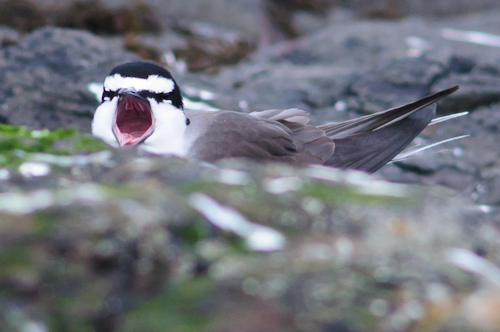
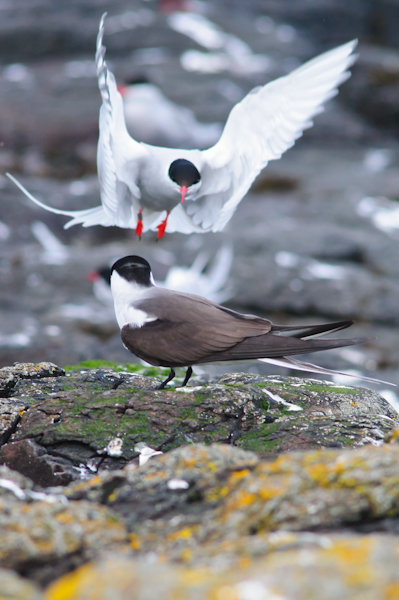
    Then the light at the end of the tunnel appeared, well not so much a light as an incandescent ball of wildlife magic.  We were eating lunch, and looking forward to the journey across to the islands, when Peter said “They look like dolphins off the end of the rocks”.  I lifted my binoculars and the view was filled with Bottlenose Dolphins 🙂  We watched as they passed close to the shore, then they settled and began feeding between Bamburgh Castle and Inner Farne.  A quick text to William meant that, by the time we arrived at the harbour, all of his skippers knew where the dolphins were and our journey across to the islands included several minutes with them bow-riding our boat.  I’ve been studying this group of dolphins for the last three months, and some inital findings are in MARINElife’s press release.  Following a cruise around the islands, we landed on Inner Farne.  One of the wardens mentioned that the Bridled Tern had been seen, and a quick sacn soon revealed it’s location in amongst the roosting Arctic, Common and Sandwich Terns.  Here are a few pictures of this stunning seabird from last year on Inner Farne

    Bridled Tern,Onychoprion anaethetus,Farne Islands,Northumberland,bird photography, bird photography tuition,bird photography holidays,Northern Experience Images

    Bridled Tern,Onychoprion anaethetus,Farne Islands,Northumberland,bird photography, bird photography tuition,bird photography holidays,Northern Experience Images

    Bridled Tern,Onychoprion anaethetus,Farne Islands,Northumberland,bird photography, bird photography tuition,bird photography holidays,Northern Experience Images

    Bridled Tern,Onychoprion anaethetus,Farne Islands,Northumberland,bird photography, bird photography tuition,bird photography holidays,Northern Experience Images

    Bridled Tern,Onychoprion anaethetus,Farne Islands,Northumberland,bird photography, bird photography tuition,bird photography holidays,Northern Experience Images

    After an hour amongst the Guillemots, Kittiwakes, Fulmars, Shags and terns, we crossed back to the mainland and headed south.  Miserable morning, magical afternoon 🙂


  • Pyramids; mini-Safari 22/06/2014

    You’ll probably be familiar with the concept of ‘pyramid of numbers’, but there’s a loop in that pyramid and I spend a lot of my time  on the wrong end of it…

    I collected Boyd and Louise from Newton and we headed south along the Northumberland coast to search around our favourite Otter sites.  Ducks were staring intently at one reedbed (where we suspect an Otter has been resting regularly over the last few weeks) as clouds of midges (extremely numerous) were predated by Swallows, House Martins and Sand Martins (not so numerous).  A thick carpet of insects (extremely numerous) trapped in the surface of a river were greedily gobbled up by shoals of small fish (not so numerous).  With the setting sun illuminating it from behind like an avenging angel, a Barn Owl (scarce) plunged repeatedly into the rank vegetation before emerging with a small mammal (not at all scarce).  Example after example that typify the pyramid of numbers…

    …but, of course, there’s that loop I mentioned before.  Midges (numerous almost beyond measure) munching away merrily on me (really not numerous) 🙁  I don’t know what attraction I hold for these tiny menaces, but there clearly is one.  I’ve been bitten in March, well before any self-respecting midge should be on the wing, and my latest bite in any year was on November 4th.  I sat on a heather covered hillside one day, watching a Hen Harrier nest, attracting a veritable plague of Horseflies in the process, and on a camping trip in 2006, Sarah erected our tent while I, and these are Sarah’s words rather than mine “rolled around on the grass, crying like a little girl”.  A few years ago, during the Q&A session at the end of a talk I’d given, we were asked the question “How do you avoid being bitten by insects”.  Without a moment’s hesitation, Sarah provided the answer “I stand next to Martin” 🙂

  • Putting the bite on; Bespoke safari 20/06/2014

    Some wildlife is popular with everyone, some isn’t popular with many people at all, and some, despite the best efforts of Springwatch/Autumnwatch/Winterwatch…

    I met up with Niel and Nicky at Church Point, and we set out on an exploration of Druridge Bay and southeast Northumberland.  Despite several incidents involving agitated ducks, indicating that they were worried about something in the reeds, we didn’t manage a sighting of any Otters.  The typical quality birdwatching of the Northumberland coast in late June was still in evidence, with at least 5 Avocets and 11 Little Gulls among the throng.  A tiny Tufted Duck travelled back and forth across the water, in what appeared to be an unsuccessful search for it’s parents then, as the sun dropped towards the horizon, we headed to our regular Badger site.

    Intriguingly, no Badgers appeared – which is unusual at a site where we have a 95% success rate – but, as at least three Tawny Owls began penetrating the gloom with their eerie calls, the sharp alarms of Blackbird, Robin and Song Thrush heralded the arrival of another mammal that inhabits the darker parts of the day.  Bloodthirsty killer of farmyard chickens, attempted abductor of babes from cribs in the south of England…whichever way you look at it the Red Fox gets a bad press…which sadly glosses over just what wonderful animals they are.  Sleek, beautiful, playful…we watched as three adults trotted across the clearing in front of us.  As Niel photographed one peering from the undergrowth (oh, for a Nikon D4!), I lifted my binoculars and realised that there were three small cubs chasing around too 🙂  Two of the adults, and the three cubs, disappeared along a track up the hill, and then the adults came out into the clearing again, presumably having tucked the kids up safely in bed.  Pipistrelle bats were flitting across our field of view as we conceded that our vision could no longer penetrate the enveloping dark.

    Love them or hate them, there’s no denying that foxes have a real magic…a bit like Luis Suarez 🙂