It wasn’t a relaxing afternoon for the birds in Budle Bay yesterday, as a juvenile Peregrine worked it’s way back and forth, causing havoc as it went through. Further north, and looking towards Holy Island from the mainland, flocks of Wigeon and Pale-bellied Brent Geese were moving as the tide fell, and Redshank, Dunlin and Grey Plover all took advantage of the newly exposed mud. A Common Buzzard perched in a hawthorn hedge at the roadside flushed as we approached but then hovered lazily over the fields.
Looking the opposite way, from Holy Island back towards the mainland, dark steel grey clouds on the horizon were outlined in gold by the setting sun, Bar-tailed Godwits were feeding along the water’s edge and a quite stunning aural backdrop was provided by Grey Seals. As the sun slipped out of sight, Grey Herons became inky black silhouettes against the shimmering golden reflection of the sky and the air was filled first with the plaintive calls of Grey Plover and then with the high yapping of Pink-footed Geese. Skein after skein rose from the dark backdrop of the clouds on the horizon, appearing like swarms of bees against the dying embers of the day’s light. A Little Egret flapped by, a ghostly white heron vanishing into the night. Then, a grand finale to the afternoon’s birdwatching as the sky darkened, revealing a stunning array of stars, and the dark shapes of more Pink-footed Geese passed overhead, briefly cloaking the pin-points of light. Relaxing, sublime, awe-inspiring…
We had back-to back birdwatching trips earlier this week, covering two of our favourite areas.
On Tuesday afternoon I collected Keith and Jen from home in Monkseaton and we headed northwards up the Northumberland coast. Our destination was the Holy Island of Lindisfarne, one of the birding hot-spots of the entire country. The strong winds were the only downside to the afternoon, but the birdwatching was good. After checking out a large group of Grey Seals we covered the area around the harbour and the Rocket Field. Bar-tailed Godwits, Common Redshank and lots of Ringed Plover were along the shoreline and a delightful charm of Goldfinches were around the Heugh. A distant group of Lapwings, Starlings and Golden Plover took to the air and the cause of their alarm was glimpsed briefly, although too briefly and too distant to make a positive ID. Holy Island birdwatching stalwart Ian Kerr put us on to a Little Stint and, as we headed back through the village, groups of Golden Plover passed overhead. Re-tracing our route back down the coast and checking the Budle Bay on the rising tide, we were just discussing the indications of the presence of predators when a huge number of birds lifted from the mud. As well as the gulls and waders, Jackdaws, Rooks and Woodpigeons joined the throng as they came out of adjacent fields and trees. This time the culprit was seen and identified; a Peregrine, that most majestic of raptors and one of the highlights of any birdwatching day on the Northumberland coast in the autumn and winter. A quick seawatch produced Sandwich Terns feeding, and Gannets soaring effortlessly on the breeze.
Wednesday was a full day out around Druridge Bay and Southeast Northumberland. I collected Jayne and Andrew from Seahouses, and then Hilary and John from Alnmouth, before beginning our tour of some of the best birdwatching spots in our local area. While we were watching Lapwings, Redshanks, Greenshanks, Ruff, Herons and Cormorants on the River Wansbeck I could hear a rough ‘sreee’ call from high overhead. The strong breeze meant that it wasn’t straightforward to locate the bird, but eventually I picked it out. It was an unfamiliar call, but a familiar species; a juvenile Common Cuckoo. The walk back along the river produced a nice flock of Long-tailed Tits. After lunch we stopped off at Cresswell Pond. Hilary and John mentioned that they’d visited Cresswell once before – when they noticed a large group of birders and stopped, managing to see a Buff-breasted Sandpiper.
Buff-breasted Sandpiper and Ruff, Cresswell Pond, Northumberland 12/09/2008With luck like that, we joked about what this visit could produce...
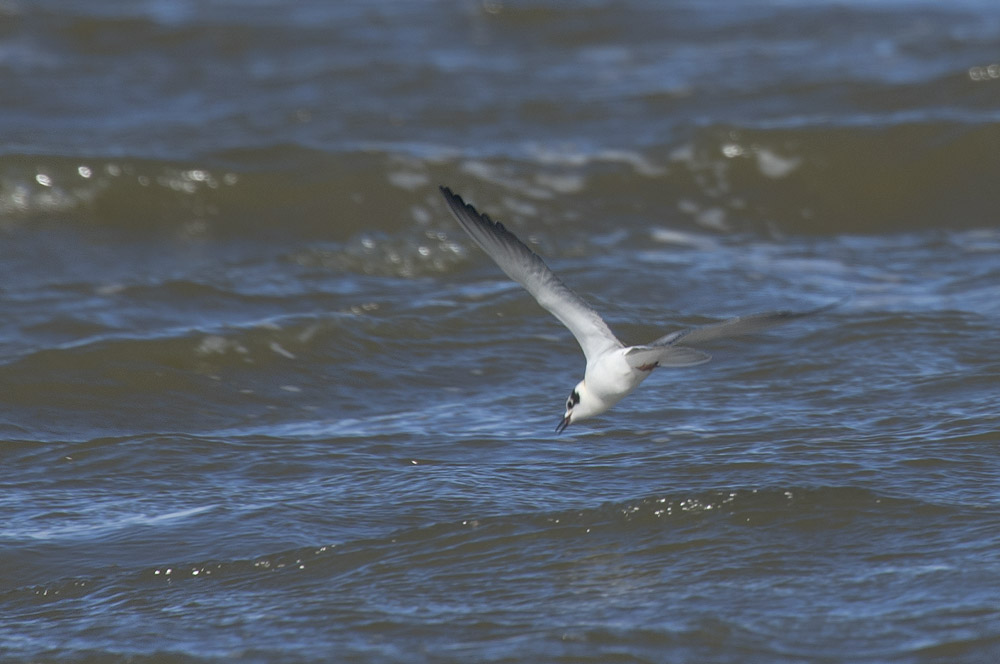
When we arrived at the hide, Jaybee mentioned that he’d had a juvenile Sandwich Tern. I scanned the pond but couldn’t see the tern anywhere and we settled to enjoying the quite remarkable views of Common Snipe that were available. After checking through the assembled ducks, gulls and waders I scanned across the pond again and spotted a tern dip-feeding near the causeway. The bird’s behaviour, combined with it’s very dark back, white rump and silver-grey wings caused me to get rather excited. White-winged Black Tern is a very special bird, and a personal highlight as it’s the third Chlidonias tern that I’ve found in Northumberland. Whiskered Tern is very rare and Black Tern is always a nice bird to see but White-winged Black Tern is such a beautiful species. Jaybee kindly sent me some images to use 🙂
White-winged Black Tern, Cresswell Pond, Northumberland 15/09/2010White-winged Black Tern, Cresswell Pond, Northumberland 15/09/2010
White-winged Black Tern, Cresswell Pond, Northumberland 15/09/2010As other birders began to arrive to enjoy the fruit of our good fortune we continued up the coast. Eiders and a Goosander, as well as some very obliging Grey Herons, were seen as we stopped by the River Coquet. A superb couple of day’s birdwatching, a beautiful rarity and clients who were excellent company.
There are times in the winter when I’m mainly office-based and what I really look forward to, during what often seem like interminably long days, is the arrival of the Spring and increasing numbers of ‘client days’.
On Tuesday morning I headed to Newbiggin to collect John and Christine, clients from last year’s Beginners Birdwatching ‘Seabirds and Waders’, who were back in Northumberland for a birdwatching morning in Druridge Bay. The weather was erratic to say the least, with bright warm sunshine, a bitterly cold northeasterly wind, sleet and even snow it was a morning to be wrapped up warm. The birding was as excellent as we would expect in mid-May; the morning’s highlights included a male Ruff in full breeding plumage, eight elegant beautiful Black-tailed Godwits, a pair of Garganey and some incredibly close views of Whitethroats as they warbled their scratchy song from hedgerows, trees and telegraph poles.
This morning brought something completely different; a Lindisfarne Safari with our first Spanish clients. Alfredo and Nieves had managed to get across from Ibiza, despite the disruption caused by the Icelandic volcano, and were looking forward to a day birdwatching on Holy Island and the north Northumberland coast. The weather was changeable again but, as yesterday, we stayed dry. A flock of 80 Ringed Plover on Holy Island were very vocal as they repeatedly flew overhead, 2 Little Egrets in Budle Bay flew by calling and a Little Gull and a White Wagtail at Monk’s House Pool were both nice surprise finds. Eventually we found ourselves bathed in warm sunshine as pairs of Arctic Terns displayed high overhead against the azure sky and, looking inland, we could still see a lingering snowfield on the Cheviot. Alfredo and Nieves both have a broad, and quite detailed knowledge of natural history, and Alfredo is a keen, and skilful, photographer. I only have a very limited grasp of Spanish but through a combination of Spanish, English, Latin and a shared love of natural history and photography, any language barriers were easily transcended.
We’ve got Northumberland birdwatching tours for the rest of the week and then on Saturday it’ll be time to chill out with a glass of wine, a BBQ and our National Moth Night event at Lee Moor Farm, near Alnwick. All are welcome, so give us a call on 01670 827465 if you would like to come along for an evening of wildlife watching fun, suitable for young or old, beginner or expert.
Occasionally I find myself pondering that question. On Wednesday I left home early to drive to Seahouses and collect Carolyn and Brian, two clients who we first met last year. As we headed up the coast through Bamburgh and towards the Lindisfarne NNR for a day of birdwatching, we stopped at each promising area. Before we reached Holy Island itself we’d already had excellent views of 4 Harbour Porpoises, good views of three Whimbrel (alongside a Curlew for comparison) and a Brown Hare as well as the growing numbers of House Martins and Swifts. A Sedge Warbler perched helpfully on top of a stunted Hawthorn as he belted out his song, a Whitethroat was elusive before eventually showing off the bright white throat feathers that give it it’s name and a Wheatear hopped along a drystone wall. On the island we watched a Heron as it preened whilst hidden in a reed bed, listened to another Sedge Warbler and tried to locate a calling Water Rail. Skylarks and pipits were unobtrusive in a sheep field that also contained at least 6 Wheatears and, once we’d left the island we watched over 1000 Grey Seals as they relaxed in the bright sunshine.
After dropping Carolyn and Brian back in Seahouses, I headed home, packed my bag and drove down the A1, out of Northumberland, to my sister’s house. 04:30 Thursday morning and I was on the road again, this time travelling to King’s Lynn. Two days of being a student were relaxing and enjoyable, studying the acoustic signals used by cetaceans being my own personal highlight, before the north beckoned. Finally, just before 10pm yesterday, I arrived back at home, headed to the ‘beer fridge’, sat down to a delicious Chinese meal with Sarah and then collapsed into bed. With tomorrows “Beginners Birdwatching; Songs and Calls” being close to home we don’t have a really early start so this afternoon is a chance (something that’s going to happen less and less over the next few months) to catch up with e-mails, ‘phone calls and product planning/development. It’s the great paradox of running your own business; many people choose that option in order to have more free time…but if your business is successful there’s a period, certainly during rapid growth/expansion, when 9 to 5 doesn’t look so bad after all. Would I go back to that? What do you think? 😉
After a cold, wet day surveying one of our inland tetrads for the Bird Atlas, we had a very early start on Sunday for our Dawn Chorus walk at Lee Moor Farm. Ian was, as always, an entertaining host for the event and we walked around the farm, enjoying the songs of Willow Warbler, Song Thrush and Sedge Warbler, excellent views of Brown Hare and Roe Deer and then a delicious breakfast. Our next event at Lee Moor is a bat walk, moth trapping demonstration and BBQ on Saturday May 15th.
Monday saw us out on Atlas work again, this time much closer to home as we are covering the tetrads that are immediately north and south of our house. The highlight was a reeling Grasshopper Warbler, and the closest Tree Sparrows to home that we’ve found so far.
Yesterday was our first Farne Islands Safari of the year. With excellent views of Sandwich, Common and Arctic terns, Eiders, Guillemots, Razorbills, Puffins, Shags, Gannets, a very obliging Wheatear and Grey Seals it was everything we would expect the Farnes to be. There’s a good reason that the islands will be the venue for days out with 3 of our photography clients over the next few weeks.
Now, it’s Wednesday morning and I’m just packing the Landy ready for a migrant hunt on Lindisfarne with 2 of our returning clients. Wish us luck 🙂
On Saturday we led a wildlife walk on Holy Island. Grim, murky drizzle on the way north looked less than promising but, as we approached Beal, the weather improved and stayed fine throughout the walk. Possibly the highlight of the day was all of the birds on the Rocket field flushing as two Peregrines flew menacingly above the pools. The journey home produced our rarest sighting of the day, at least in a Northumberland context, when we watched 3 Bewick’s Swans in a field south of Alnmouth.
Sunday really was a case of something completely different, as I headed out to the Farne Deeps for the latest Northeast Cetacean Project survey. The project, which is been run by Northern Experience and Marinelife with our funding partners; Natural England and the Northumberland and Tyneside Bird Club, has several strands, with the surveys backed up by postcards that we’re distributing to local charter boats and marinas so they can submit their sightings, an analysis of all the records and reports we can find for the last 7 years and, coming soon, a website that will allow online submission of whale and dolphin sightings off Northumberland. Meanwhile, back on the boat…my survey team on Sunday was made up of Alan Tilmouth and Ross Ahmed who were part of the team on our surveys back in December, Tim Sexton who was on our blizzard-hit survey two weeks ago and Dan ‘Punkbirder‘ Brown. Highlights were a Common Dolphin and a small group of Little Auks.
Yesterday saw the Landy having it’s 6-monthly safety test. Unsurprisingly, with the work put in by Sandy to keep the mechanical bits working smoothly, and the electrical work that Darren has done to ensure that when you flick a switch what happens is what should happen, it passed again. Peace of mind for our clients, and the NEWT Landy will keep rolling around Northumberland, delivering them to top-quality birdwatching and wildlife experiences.
Now it’s Tuesday and I’ve got 50 miles of offshore survey ahead of me. Bring it on!
Yesterday I led our first Safari Day of this week, to Lindisfarne and the North Northumberland coast. Although I really enjoy trips where the main quarry is Red Squirrel/Badger/Otter/Fox/Roe Deer my lifelong love affair has been with birdwatching. Northumberland is a top-quality destination for a winter birdwatching trip; just ask any of the writers/photographers who we’ve taken to the wilds of our home county during the cold(er) bits of the year.
Yesterday was one of those days where you couldn’t wish for better conditions; clear blue sky, warm sunshine (although with sub-zero air temperatures for much of the day), no rain and only a very gentle breeze. I collected Phil and Barbara from their holiday cottage near Guyzance and we followed the coast all the way to Lindisfarne. Small groups of Pale-bellied Brent Geese beside the causeway were a novelty for birdwatchers from the southeast, who are used to seeing Dark-bellied Brents during the winter, and they commented immediately about just how black-and-white the Svalbard birds look. Scanning the fields on the island we located a flock of ~800 Pale-bellied Brents, with a few Dark-bellied mixed in, allowing a direct comparison of the two. The field was also shared by 200+ Curlew and smaller numbers of Redshank, Lapwing and Golden Plover. Panic among a group of Starlings was traced to a 1st-Winter Merlin that helpfully perched on a post at the back of the Rocket Field. It’s amazing how quickly time passes and after 2 hours we headed back towards the mainland among the general exodus that occurs as the end of safe-crossing approaches. Another Merlin beside the causeway allowed even closer views so we stopped for a few more minutes of appreciation of this small predator.
Our picnic spot, overlooking the mudflats between Holy Island and the mainland, provided excellent views of flocks of Lapwing and Golden Plover in the air as well as lots of Shelduck, Eider, Pintail and more PB Brents. We enjoyed all of these in the company of Tom Cadwallender, Natural and Cultural Heritage Officer for the Northumberland Coast AONB, who was supposed to be meeting a camera crew from Inside Out. When we left Tom, they were already 20mins late…
Continuing down the coast, a very obliging Common Buzzard pranced around a field, presumably looking for worms. The Skate Road held well over 1000 Common Scoter, 90+ Purple Sandpipers were huddled on the rocks as the incoming tide washed against their feet and a careful scan produced a few pairs of Long-tailed Ducks (Barbara’s 2nd lifer in a matter of minutes). Red-throated and Great Northern Divers were, well diving mainly, and Slavonian Grebes were bobbing about just beyond the surf.
Our final destination for the day was Newton, and the decision to detour from the coast route down the dead-end road to Low Newton proved to be an inspired one. As dusk approached the assembled ducks on the pool (Teal, Goldeneye, Mallard, Gadwall) all provided entertainment as they called to each other. Then, just a few feet in front of us, a Long-eared Owl silently hunting. We all held our breath as it approached and then it veered away as silently as it had arrived. The walk back to the Landy was to provide probably the best bird of the day, and one of those Northumberland birdwatching moments that was quite simply sublime; against an increasingly starry sky and crescent moon, with an impressive amount of Earthshine, a Bittern flew low over our heads and out over the bay.
After the changeable weather during the Birdwatching Northumberland press trip culminated in excellent conditions on Monday, I hoped that we would get more of the same on Tuesday for a Lindisfarne Safari that I was leading. It looked good; at home we had a heavy frost and clear blue skies. Yet just a few miles down the road, as I headed to Gosforth to collect our client, there was a bank of thick fog. Not to worry, conditions might be better on Holy Island…they weren’t, in fact the fog was even thicker. As we stood on the Heugh it was eerie. A bitingly cold southeasterly wind and visibility down to just a few metres. Oystercatchers, Redshanks and Herring Gulls could all be heard through the mist and we continued our journey around the island. Song Thrushes lifted from each clump of grass as we walked towards the harbour and slightly improved visibility allowed us to look closely at Teal, Bar-tailed Godwits and Curlew. Lichens and mosses came under great scrutiny (remarkable structures when viewed under a hand lens). Off the island we found Pale-bellied Brent Geese, small groups of Whooper Swans, a field with lots of Greylag and Pink-footed Geese (and a ‘Canalag’ hybrid), several Kestrels, an incredibly obliging Common Buzzard, a mixed thrush flock (Redwing, Fieldfare, Mistle Thrush, Song Thrush and Blackbird), plenty of waders and, finally, as the mist returned and brought steady rainfall with it, Common Scoter, Shag and Eider on the sea. As we drove back down the A1 the worsening weather made it seem likely that we’d had better conditions than back at home. There’s always something to see, whatever the weather.
We set off for Holy Island this morning with a clear objective in mind for the journey – photograph a Little Owl. Many years ago one of my fellow photography students produced a series of excellent images of Tawny Owls and explained his technique for finding the birds. Needless to say, the hard work was done in the dark. Finding Little Owls in daylight isn’t uncommon although I’ve realised in the last couple of weeks that, especially when all the trees are bare of leaves, it’s easier to find them at night. We stopped off at one of the sites I’ve been watching regularly and there, in beautiful light for photography, was a Little Owl. Sarah has been developing (no pun intended) as a photographer, so I manouvered the Landrover into position as she took the shot…with my new D300s.
Who are you looking at?
The highlight of the remainder of the journey north was a large flock of Linnets, with a few Brambling mixed in, swirling backwards and forwards as a male Merlin darted across the field they were in. A covey of Grey Partridges sat tight just long enough for Sarah to fire the shutter again.
Partridges…nowhere near a Pear tree
As we neared Holy Island the rain began, and by the start time for our walk it was icy and heavy. Not the highlight of the day.
Well, with today’s images processed and added to our ‘Northumberland in the Winter’ presentation we’re on our way out now to entertain a group of holidaymakers who may need cheering up 🙂
I’m lucky enough to not suffer from SAD (Seasonal Affective Disorder). In fact I look forward to the winter months – I’m a bit dysfunctional in very hot weather (that’s one of the reasons I live in the north of England, and why I enjoy winter holidays in northwest Scotland so much).
Our very wintry Lindisfarne Safari on Monday was just about my ideal day out; bitterly cold, inspirational winter light, hardly another person to be seen anywhere and plenty of wildlife.
That inspiration manifested itself in a repeat visit to the Lindisfarne NNR yesterday. I had two goals in mind; photograph Pale-bellied Brent Geese, and capture an image of Bamburgh Castle as the light faded.
The geese were some distance away, due to the state of the tide, but I managed to capture the distant birds in the shadow of Lindisfarne Castle, and a small group as they flew along the tideline.
Lindisfarne Castle and Pale-bellied Brent Geese
Pale-bellied Brent Geese
The light was fading rapidly so I drove to Bamburgh, along roads that resembled a ski run, and made my way down to the beach. Frozen rock-pools and a beach dusted with snow aren’t a frequent occurence so it was an unusual opportunity to photograph the castle in these conditions. The big, thick gloves that were keeping my hands nice and toasty were too bulky to let me operate the camera so I had to suffer for the image. And it was suffering; just a few seconds with my gloves off and my hands were protesting at the cold.
Bamburgh Castle in the snow 22/12/09The Moon, high over Bamburgh 22/12/09
20 miles back down the road, with gloves on and the car heater on full, my fingers began to warm through…so I decided to extend the journey home and check some of our favourite owl sites, even though that would require some very, very careful driving. A Barn Owl perched on a stack of hay bales was justification enough for that decision and two Little Owls, perched in trees just a hundred metres apart were the icing on the cake.