Author: martin

  • Setting the scene

    Sunday started with a journey to inland Northumberland, birdwatching on some heather moorland in order to complete our final 2 ‘early season’ visits for the BTO Bird Atlas.  Contrary to the forecast weather, it was cold, windy and drizzly.  However, we set off and were eventually rewarded with a dramatic improvement as the sun came out and so did the birds.  Alongside all of the Willow Warblers, Chaffinches, Skylarks and Meadow Pipits the highlights were at least 3 Spotted Flycatchers and a stunning male Whinchat.  A pair of Curlew began alarming as we crossed the moorland, constantly changing position to draw us away from their nest location.

    After a walk of just over 5 miles we headed home and decided that we would venture out towards dusk in search of badgers.  We’ve got an Otter and Badger trip on Thursday so we needed to check on the current status of a couple of setts that we’ve been watching for some time.  As we settled into position, with what appeared to be a horde of bats flying around, Blackbirds and Mistle Thrushes were alarming (as they often do late in the day).  Soon, movement on the hillside opposite revealed our first badger of the evening.  Very grey, with cream stripes, it came out of a sett, squatted on a patch of bare earth and then vanished into the undergrowth.  A second animal quickly followed, much more gingery than the first, and then a third, starkly black and white.  It really is a privilege to sit and watch these magnificent animals as they go about their business (no pun intended).

    After such a successful evening, getting a ‘phone call earlier today “can you take us out to look for Red Squirrels, Otters and Badgers tomorrow please” was exactly what we wanted.  Once upon a time I wouldn’t have been happy working on a Bank Holiday weekend, now it’s an enjoyable part of my career choice.  Just over 2 years in, and I don’t regret even a tiny part of that decision.
  • Early to rise

    4am, and the insistent ringing of the alarm prises me out of bed.  Stagger down the stairs, get dressed, find binoculars/hat/gloves and head out into the chill early morning Southeast Northumberland air.  The Dawn Chorus is in full flow; Blackbirds are leading the way, and dominating the soundscape around our house, Chiffchaffs are singing from the churchyard and I make a mental note to do this again tomorrow to get some sound recordings.

    Walking along the River Wansbeck I can see a pointed snout sticking out of the water distantly.  Closer inspection reveals a Grey Seal.  A Grey Heron flies by, croaking and screeching as a pair of Carrion Crows harrass it until it turns through 180 and heads away from the annoyance.  I move on as well, heading towards Druridge Bay.  With ethereal mist rising from a coastal pool, Sedge Warblers are singing from the bushes around me, and I’m concentrating on the mimicry that they employ, when a group of Rabbits suddenly scatter and Lapwings, Black-headed Gulls and Common Terns begin circling and alarming.  A movement in the grass reveals itself as a Red Fox; wary, immaculate and healthy – this isn’t the urban scrounger so familiar to many people, but rather what a recent client described as “that’ll be one of those rural foxes then”. 

    Then, one of those moments that take me back the best part of four decades; a Cuckoo starts calling.  My first Cuckoo, all those years ago, was on an early morning birdwatching cycle ride to a site several miles from home.  With nobody else anywhere to be seen, and all of the sounds of the early morning to myself, that haunting sound carried from nearby trees before the pointy-winged long-tailed shape of the bird raced across my field of view.  I stand and marvel at the bird.  It’s fascinating breeding ecology and migration still grip me the way that birdwatching did when I was a little lad.  Perhaps I need to start setting the alarm for very early every morning 🙂

  • A Rosy outlook

    Saturday saw a change in our normal Safari routine, and an early afternoon start.  I collected Gareth and Ruth from the Red Lion at Alnmouth and we drove south.  The hot, sunny weather had brought out hundreds of people to Plessey Woods but we still found a peaceful, undisturbed glade where we could listen to the birds singing and we watched a female Great Spotted Woodpecker; at least we were able to watch her until she realised that we were!  Cresswell Pond produced a real avian soap opera as a Mute Swan defended his pond against two interlopers, racing across the pond like the Spanish Armada.  A Little Gull was as cute and dimunitive as ever, alongside Black-headed, Common and Herring Gulls.  Druridge Pools was hosting some obviously confused geese; amongst the expected flock of Greylags there were single Pink-footed and Barnacle Geese as well.  A late finish concluded with a beautiful, ghostly Barn Owl and at least 3 different species of bat along the River Coquet at dusk.

    Sunday was a day for doing whatever we felt like.  With temperatures still soaring, a day inland, doing survey work for the BTO Bird Atlas, was considered then rejected in favour of a visit to the coast.

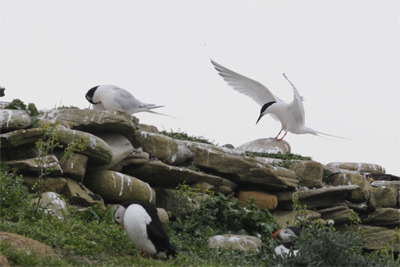
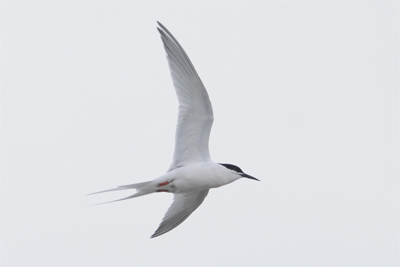
    Sarah had the excellent idea of taking a boat trip around Coquet Island, which I was really enthusiastic about.  When myself and Tom Cadwallender from the Northumberland Coast AONB were designing the backdrop for this year’s Birdwatching Northumberland stand at the Bird Fair we chose eight species that we felt symbolised Northumberland birding; Curlew, Eider, Pale-bellied Brent Goose, Golden Plover, Black Grouse, Roseate Tern, Dipper and Puffin.  A mix of everything that’s good about birdwatching in Northumberland; inland, coastal, summer and winter.  I had images of seven of those species, but the Roseate Tern is the one that I haven’t photographed during the digital age.  Hence, my enthusiasm for a trip around Coquet Island; with 35-40 Rosies already back at their Northumberland colony I was hopeful that photo opportunities would arise.  As we sailed across to the island onboard Shokwave, there was a strengthening NNE breeze and the temperature began to decrease rapidly.  Once Dennis manouvered the boat into the jetty, we could see Roseates sitting on their nest boxes.  They were a bit distant for photography so I waited patiently until I heard the distinctive ‘choo-it’ call and a bird flew by the boat.

    Britain's rarest breeding seabird

    Grey Seals popped their heads above the water to look at the boat, Puffins whizzed past at breakneck speed and more Roseates were busy displaying around the boxes.

    Roseate Tern

    After a pleasant Sunday morning cruise it was time to return home. En route, we stopped off to check a Little Owl nest site and one of the adult birds sat staring at us from the roof of a derelict building.  Finalising the paperwork for a forthcoming project was followed by a wonderful evening sitting on our patio, drinking wine and working on part of our bonsai collection as Blackbirds were singing from our trees and Coal Tits collected food to take to the noisy, and hungry, nestlings that we could hear.  Now, that’s my idea of heaven 🙂

  • Maximising our chances

    So far this year, tracking down Otters has proved slightly more difficult than it did last year.  That’s one of the drawbacks of working with animals 😉  They’re generally not predictable.  That’s what makes a wildlife tour so much fun though, you just never know what you’re going to experience.

    However, after a brief sighting on Thursday evening, I was happy that we’re still visiting the right areas of Northumberland to maximise our clients’ chances of connecting with this elusive, graceful predator.  I arrived at Newbiggin at 10am yesterday to collect Derek and Jacky for a mini-safari in Druridge Bay.  After our usual commentary on the industry and landscape of the area, as we drove towards Cresswell, it was time to settle and be patient.  I’d just finished explaining the two types of bird behaviour that usually accompany the appearance of an Otter, when there was a good example of the first; eight Tufted Ducks scattered from the edge of the pond.  Sure enough, it was less than 20 seconds before I spotted the tell-tale dark back breaking the surface and for the next few minutes we watched an adult Otter as it surfaced, dived and fed, all the while with a flock of Black-headed Gulls circling above it.  After a minute or two without any further sign I was sure it had disappeared into a channel in the reeds, probably going to rest after feeding.  The gulls began moving around the pond randomly; clearly they’d lost sight of the Otter as well.  Further entertainmant was provided by 3 Herons that were following each other around, and a Carrion Crow that was foolhardy enough to fly over several pairs of nesting Lapwings.

    After the morning seemed to just fly past, I took Derek and Jacky back to Newbiggin and then returned to the office, before heading out in the evening to check another new Otter site and enjoy some relaxed birdwatching.  But that’s another story for another day…

  • A day in the Bay, Birdwatching Northumberland (part 2)

    Our second day out with the winners of last year’s Birdwatching Northumberland  competition, was a day in Druridge Bay.  It provided a real contrast with our earlier trip to the Harthope Valley.

    After collecting Jean and Andy from the Bamburgh Castle Inn we headed down to Embleton to collect Helen, our third client on this trip, pausing for a few minutes to watch a very obliging Brown Hare in a field near Chatton.  As we toured our usual sites the weather was more like the caribbean than Northumberland 🙂  Tufted Ducks, Shovelers, Herons, Mute Swans, Lapwings and Coots were around the coastal pools, Sedge, Reed and Willow Warblers, Whitethroats and Reed Buntings were singing from hedgerows, sedges, reeds and willows and Fulmars were arcing gracefully along the cliffs at Cresswell.  On a woodland walk along the River Blyth we heard more than we saw (as you would expect in mid-May) with Nuthatch, Chiffchaff and Great Spotted Woodpecker all being particularly vocal.  Eventually the two days of the Birdwatching Northumberland prize were over and I returned all of our clients to their respective holiday accommodation.

    The day wasn’t finished for NEWT though; as dusk approached we were out on the coast, at separate locations, checking for Otters.  I did have one brief sighting, and on the journey home we began the process of redeveloping our Otter Safaris to make them an even better experience than they already are.

  • Slow, slow

    Yesterday was the first of two days out with the winners of last year’s Birdwatching Northumberland prize draw.  After collecting Andy and Jean from the Bamburgh Castle Inn our destination was the Harthope Valley in the Cheviots.  It’s one of our favourite locations; stunning landscape, interesting geology and, of course, excellent wildlife.  As we reached the start of the valley we stopped to check on a Dipper nest, and there was one of the adults sitting on a rock in the river, so close that we didn’t need binoculars.  Further upstream we watched a pair of Grey Wagtails, eventually locating their nest in the tangled exposed roots of a riverside tree, before setting off in search of Ring Ouzels.  It wasn’t too long before we heard a singing male, but he remained stubbornly out of sight.  As we climbed higher up the valley the song seemed to be coming from somewhere else and careful scanning of the area revealed our quarry, perched on the remnants of a dry stone wall.  A pair of Red Grouse, with at least 7 chicks, were very obliging and a pair of Whinchat were flitting around in the heather.  After lunch we were treated to more Grey Wagtails, including a bird singing and displaying high overhead, and these were a real highlight of the day, a singing Dipper, Tree Pipit, Redstart, Cuckoo, a plethora of Willow Warblers and the shivering trill of a Wood Warbler.  Andy was keen to take a photograph of a Green Tiger Beetle and, eventually, one sat still for long enough to allow him to get close to it.

    Green Tiger Beetle

    The non-bird highlight of the day though came as we walked back to the Land Rover; a pair of Slow Worms locked in a mating embrace.  A remarkable end to an excellent day captured on camera by Andy, who kindly sent me the images to add to our blog.

    This embrace can last for up to 10 hours!
    That doesn't look comfortable
  • Pretty in Pink

    No, not a homage to the Molly Ringwald film , or the Psychedelic Furs track that inspired it, but the latest step in Sarah and Kirsty’s training plan.

    With showers forecast for this morning it looked as though the Cancer Research UK Race for Life in Gateshead could be a bit damp.  As it turned out, the rain didn’t start until well after the girls had finished the race.

    They were pretty relaxed, but both quite excited as well, before the start.  I went along as sherpa to the Northern Experience/Swan at Choppington duo.

    Colder than it looked!

    Birdwatching interest was provided by a family of Mute Swans on the lake

    Mute Swans with 7 cygnets

    Participation in the pre-race warm-up was enthusiastic.

    "Put your hands in the air if you're a runner rather than a jogger"

    Faced with the option of runner/jogger/walker they opted for ‘runner’.  Despite both Sarah and Kirsty having been ill, and unable to train, for the last week they crossed the finish line after 33mins 1sec.

    Nearly there 🙂

    Then they had a well-deserved sit down (and some Jaffa Cakes).  The girls exceeded their fund-raising target and I think they should feel justifiably proud of their achievements; they completed the race in a good time and raised money for a good cause.

    Now we’re on our way to The Swan for Sunday lunch.  I think they might be wearing their medals 🙂

    Done it!
  • NMN 2010

    Our NMN event at Lee Moor Farm was plagued by the scourge of moth trappers everywhere; cloudless skies and plummeting temperatures.  The early evening entertainment included an impromptu cricket match during the BBQ (which was being expertly and skilfully, poked by the two chefs for the evening; Ian and yours truly), where my best off-breaks were dispatched imperiously to all corners of the business park by Ian’s youngest daughter, Larissa 🙂

    We did catch some moths though;

    0647 Brown House Moth Hoffmanophila pseudospretella 2

    1728 Garden Carpet Xanthorhoe fluctuata 2

    2190 Hebrew Character Orthosia gothica 1

    We also recorded one species of bat; Common Pipistrelle Pipistrellus pipistrellus, with up to four flying around as darkness closed in and our cricket match came to a close.

    We’ll be back at Lee Moor for Open Farm Sunday on June 13th, and planning to round off the day with another BBQ, bat walk, moth-trapping session, cricket match.  It’s excellent family fun so give us a call and join us for what promises to be another great evening at Lee Moor 🙂

  • Race for Life

    Taking a break from blogging about birdwatching, Northumberland, photography and wildlife…but just for this afternoon 🙂

    On Sunday, Sarah and Kirsty will be taking part in the Cancer Research UK Race for Life.  It’s only a couple of months since they started training for the Sport Relief Mile (and, when they did run the 1.4 miles around Ladyburn Lake at Druridge Bay Country Park, that was further than they’d run continuously in training).  Now they’re going to run 5km…and that won’t be the end of it.  The grand plan is heading towards completing a marathon sometime before 2020.

    In the meantime though, the Race for Life is really important, so please consider sponsoring Sarah and Kirsty this weekend.  My own background was in Cancer Research, as a medicinal chemist, and several of my relatives passed away after developing cancer so it’s a cause that’s close to my heart.  Poignantly, a very close friend was recently diagnosed with cancer so our thoughts are with him and his family.  He’s more than just a friend though; he can relate anecdotes that I’m embarrassed by (and I really don’t embarrass easily!) and I’ve seen his sons grow from little lads into fine young men, one of whom has just made him a grandad for the first time.  Get well soon Shaun – we still have to take you on a trip to the Farne Islands 🙂

  • Something for the weekend

    There are times in the winter when I’m mainly office-based and what I really look forward to, during what often seem like interminably long days, is the arrival of the Spring and increasing numbers of ‘client days’.

    On Tuesday morning I headed to Newbiggin to collect John and Christine, clients from last year’s Beginners Birdwatching ‘Seabirds and Waders’, who were back in Northumberland for a birdwatching morning in Druridge Bay.  The weather was erratic to say the least, with bright warm sunshine, a bitterly cold northeasterly wind, sleet and even snow it was a morning to be wrapped up warm.  The birding was as excellent as we would expect in mid-May; the morning’s highlights included a male Ruff in full breeding plumage, eight elegant beautiful Black-tailed Godwits, a pair of Garganey and some incredibly close views of Whitethroats as they warbled their scratchy song from hedgerows, trees and telegraph poles.

    This morning brought something completely different; a Lindisfarne Safari with our first Spanish clients.  Alfredo and Nieves had managed to get across from Ibiza, despite the disruption caused by the Icelandic volcano, and were looking forward to a day birdwatching on Holy Island and the north Northumberland coast.  The weather was changeable again but, as yesterday, we stayed dry.  A flock of 80 Ringed Plover on Holy Island were very vocal as they repeatedly flew overhead, 2 Little Egrets in Budle Bay flew by calling and a Little Gull and a White Wagtail at Monk’s House Pool were both nice surprise finds.  Eventually we found ourselves bathed in warm sunshine as pairs of Arctic Terns displayed high overhead against the azure sky and, looking inland, we could still see a lingering snowfield on the Cheviot.  Alfredo and Nieves both have a broad, and quite detailed knowledge of natural history, and Alfredo is a keen, and skilful, photographer.  I only have a very limited grasp of Spanish but through a combination of Spanish, English, Latin and a shared love of natural history and photography, any language barriers were easily transcended.

    We’ve got Northumberland birdwatching tours for the rest of the week and then on Saturday it’ll be time to chill out with a glass of wine, a BBQ and our National Moth Night event at Lee Moor Farm, near Alnwick.  All are welcome, so give us a call on 01670 827465 if you would like to come along for an evening of wildlife watching fun, suitable for young or old, beginner or expert.