Early morning, and the ground underfoot varies from frozen crunchy to treacherously boggy. The sky overhead is a deep blue, the first rays of sunlight yet to bathe the fields, hedgerows and woodland in that magical golden glow. Clattering wings herald the departure of nearly 1000 Woodpigeons from their overnight roost, and a Blackbird rustles through the vegetation in the hedge bottom. A menacing shape carves through the air just above the treetops; the menacing flap-flap-glide of our local male Sparrowhawk, beating the bounds of his territory in search of the wintering flocks of Siskins, Redpolls, Crossbills, Chaffinches and Bramblings. The pungent scent of a Red Fox marks an area that I’ll want to stake out with my camera on another day, and as I head back towards home a Roe Deer springs across the path just a few metres ahead of me and disappears into the plantation just behind our house. An excellent way to prepare for the day ahead 🙂
It’s hard to believe that we posted on the blog back in January about the big freeze last winter and here we are again in a similar position already before the end of November (although at least at the moment it isn’t so prolonged).
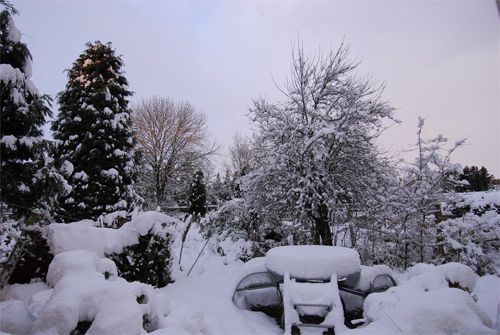
I went in to Newcastle last Wednesday for a seminar about the IMCORE project, and there was a bit of light snowfall. When I came out of the Ridley Building an hour later the world was white, and it’s just gone on from that point. After Sarah got home from work on Thursday evening the next time we used either of the cars was when we dug her car out of the snow this morning so she could go to work. We’ve made the most of the last few days though; walking the 2 miles there (and 2 miles back) each day to visit a friend who’s now in a residential care home, doing most of the admin in 3 days that we would usually do through the winter (including adding all of our 2011 trips to the website) and finalising a couple of projects that we’ve been working on.
Birdwatching in our little part of southeast Northumberland has been interesting for the last few days. We’ve got an ever-expanding flock of Coal, Great and BlueTits, Dunnocks and Wrens are now ever present around the feeding station and a very optimistic pair of Collared Doves were mating at the top of the Apple tree earlier this morning. Two pairs of Bullfinches are regular visitors but other finches are in short supply; there’s just a single pair of Chaffinches, we’ve only had one visit from Goldfinches in the last few days and, particularly worrying, we haven’t seen any Greenfinches around the feeders at all. A Sparrowhawk is still regularly patrolling over Choppington Woods and a flock of 50-60 Redwings flies out from the woods each morning.
Now, after a morning of blue skies, it’s just started snowing again.
We were watching Autumnwatch yesterday evening and one discussion between the presenters, concerning intervention when you’re filming/photographing an animal in distress, was particularly pertinent to the mini-safari that Martin led earlier yesterday evening…but back to that later in this post.
The half-term week was busy, as expected, and included some fantastic wildlife watching; Salmon leaping up a weir on the River Coquet, Starlings massing and swirling above a coastal reedbed before dropping to roost, 2000+ Pink-footed Geese filling the sky overhead, as they left their feeding sites and headed for the overnight safety of the water, and Grey Seals around the Farne Islands as they approach the height of their breeding season.
Yesterday brought an evening mini-safari in southeast Northumberland. Damp gloomy conditions and increasingly glowering clouds weren’t making things look too promising. Our walk along the River Blyth produced a Nuthatch, and a Kingfisher called as it flew along the swollen, muddy river. Two birdwatching gems, but quality rather than quantity was the order of the evening. A Sparrowhawk provided some entertainment as it swooped repeatedly down towards the trees, flushing flocks of Woodpigeon with each descent, before finally vanishing into the canopy. We continued our walk and, as we rounded a bend in the path, we found the reason for the Sparrowhawk’s disappearance; flapping lamely in the undergrowth was a Woodpigeon with a nasty head wound. The predator had presumably flushed as we approached. We’ve seen similar before and the question from clients is always “what are we going to do?”. The answer may seem quite cold and heartless but we do nothing. The pigeon was mortally wounded and would provide a meal either for the hawk or possibly a Red Fox would come along and make off with it. Nature really is ‘red in tooth and claw’ and we shouldn’t interfere in the everyday life (and death) of our wildlife where we can avoid doing so.
Our next destination was what is rapidly becoming our favourite Badger sett. As we watched quietly (and we really have to congratulate the 6-year old in our group for remaining so very quiet) over the open area close to the sett, a Red Fox crossed the track ahead of us, we could hear scuffling in the undergrowth and then two stripy black-and-white faces appeared out of the gloom. After a withering stare in our direction the two cubs trotted along the hillside and were joined by a third before vanishing into the night. The final leg of the trip was a search for owls. Local knowledge paid off, as the ghostly figure of a Barn Owl floated through the beam of our headlights just where we expected it to. There was still time for more wildlife though and the application of our bat detector revealed a Common Pipistrelle feeding on the rich bounty of moths. After the recent frosts it was good to find bats still active, and our final event for this October is a Bat Walk at Bamburgh Castle tomorrow evening. Give us a call on 01670 827465 to book your place for what should be an evening of family fun.
On Wednesday afternoon we set off from Royal Quays, out into the North Sea, onboard the MV King of Scandinavia as guests of DFDS. The weather forecast was for it to be wet, although we did manage a couple of hours birdwatching from the observation lounge before the driving rain obliterated the view. Gannets were diving into the increasingly heavy swell, a stunning Pomarine Skua arced across the bow of the ship and a single Puffin was tagging along with six Little Auks.
Arriving in IJmuiden the next morning, it was still raining 🙁 We were collected from the ferry terminal by Lin, a local guide who we had been introduced to by the ORCA wildlife officers from the ferry. As we headed north Egyptian Geese were around the grass verges near the port, Cormorants were perched atop most of the lampposts, Common Buzzards were on roadside fences and we saw one lingering Spoonbill. Our destination was the reserve of Zwanenwater, where Lin is a volunteer. As we walked through the reserve the high pitched ‘seep’ of Redwings was a constant backdrop, Song Thrushes were flushing from every patch of cover, every bush seemed to hold several Robins and a Common Redstart flicked up from the path in front of us. We were then taken on a tour of the off-limits areas of the reserve by Fred, another of the volunteers.
Stonechats were seen along the track and there was an impressive spread of Grass of Parnassus.
Stonechat, Zwanenwater, Noord-Holland 30/09/2010Grass of Parnassus, Zwanenwater, Noord-Holland 30/09/2010Despite the rain we managed an impressive haul of raptors; Common Buzzard, Marsh Harrier, Hen Harrier, Kestrel, Sparrowhawk and Osprey were all seen well but, most impressive of all, the real highlight for both of us was the views we had of Northern Goshawk. The birds quartering the dunes in search of rabbits and small birds came as a bit of a surprise, but not as much as the two birds that were perched on dead trees overhanging the lake. Fred explained that they sit there and watch the ducks, before swooping down and taking them off the water. We didn’t see that, but we did manage some distant images of one of the birds.
Northern Goshawk, Zwanenwater, Noord-Holland 30/09/2010All too soon we were on the ferry again and heading back to Northumberland, making plans to return to Holland in the spring.
Even though we live in southeast Northumberland, we’ll never tire of getting out and about searching for new experiences for our clients. Days out with clients are always exciting as well, because we never know exactly what we’ll see or what it will be doing.
Last Thursday we had a Southeast Northumberland/Druridge Bay safari with clients from a fairly wide geographical area; Jeff and Jean from Huddersfield, Lawrie and Linda from Glasgow and Yvonne from southwest Northumberland. Starting at Newbiggin we managed a brief view of a Mediterranean Gull on the beach, and a small flock of Sanderling. These little grey, white and black ‘clockwork toys’ are always entertaining as they scurry back and forth along the water’s edge. The River Wansbeck was our next destination. As expected there was a good sized flock of Lapwing roosting and Cormorants and Herons were doing what they do; standing with their wings out and just sort of standing respectively. All of a sudden a wave of panic spread through the Lapwings. We all scanned backwards, forwards, skywards but couldn’t see any cause. Perhaps it was just a false alarm? The birds settled but were up again within a minute, gradually settling back down with a great deal of conversation between them all. Greenshanks flew by calling and the Lapwings were becoming increasingly jittery. Even birds from distant streams were high in the air, forming the quite tight flocks that indicate the presence of a predator, something that creates anticipation wherever we’re birdwatching. Eventually we found a distant Peregrine, and a big female Sparrowhawk slid menacingly through the trees opposite our watchpoint. One or both of them was presumably the cause for concern. Even the Great Black-backed Gulls flushed and flew overhead, giving calls of consternation.
Among the coastal waders, perhaps the best were three Common Snipe, unusually confiding and just a few metres away from us. The fall of passerine migrants earlier in the week had left a few goodies behind. Spotted and Pied Flycatchers were quite elusive, sallying forth and then back into cover, Willow Warblers and Chiffchaffs were picking their way through willows beside the path and, providing a visual feast to rival the gaudiest of birds from elsewhere in the world, six male Common Redstarts were along one short stretch of hedge. There really is little to rival the beauty of these birds.
At the conclusion of our journey up the coast a bird as lacking in colour as the Redstart is bathed in it was a final wonderful sighting. As we watched two Grey Herons perched in trees overhanging the River Coquet, a Little Egret flew by before returning and perching high in the treetops in a spot where we could watch it through the ‘scope. There can’t be many better places to be birdwatching than the Northumberland coast in September 🙂
Although our Cheviot Valleys and North Pennines safaris are concentrated in the springtime, we run a few trips to those inland areas in the late summer and early autumn. The final day of August was a trip to the Cheviots, and it could hardly have been better; the weather was wonderful, there were hardly any other people to be seen anywhere and the wildlife was, well, as good and varied as we would expect.
After collecting Hamish and Vanessa we drove past Morpeth then up the A697 and through the ford at Coldgate Mill. The Happy Valley was deserted and peaceful; a Slow Worm was basking in the dappled light between gorse bushes, Small Copper butterflies (a personal favourite) were feeding and sunning themselves and there were even a few Silver Y moths. We get these migrants in our trap occasionally, and I’ve seen them in profusion on the coast, but these were well inland.
Camera-shy Silver YGoldcrests were calling, and eventually spotted, Spotted Flycatchers, Treecreepers and Long-tailed Tits were all found in one tree, Robins seemed to be everywhere we went and the first of the day’s Common Buzzards, rising rapidly in a thermal, suggested that searching skywards could be productive for birdwatching.
After lunch we walked along the far end of the valley. Red Grouse were cackling hysterically on one side of the valley, at the same time as we could hear a shooting party on the other. Siskins and Lesser Redpolls were feeding around the treetops, although they did pause briefly so we had a chance to look at them. The warm sunshine and excellent visibility mean that it did turn out to be a raptor day; as well as Common Buzzards there were regular Common Kestrels and a Sparrowhawk then, as we walked back to the car park, a Peregrine soared majestically and menacingly against the blue sky overhead. Sadly our only Adder of the day was roadkill, although it had gathered an interesting collection of flies and beetles.
One thing that our safaris have proved to be is a break from the hustle and bustle of everyday life. If you need to get away from it all then give us a call, or if you know somebody who would benefit from a day of chilled out wildlife watching then our gift vouchers could be just the thing they need 🙂
Hamish kindly provided some images from the day (including the Silver Y that really didn’t want to be photographed) and my own favourites are here;
Mother Nature ages trees better than any bonsai artist can!
Friday saw us in the Cheviot Valleys, enjoying probably the best weather so far this year, leading another Prestige Tour. With a client fascinated by geology and botany it was an excellent day out, with the abiding memories being the chuckling of Red Grouse in the Harthope Valley and a yaffling Green Woodpecker at Alwinton, that culminated with a meal at the Angler’s Arms at Weldon Bridge.
Yesterday we had a Kielder Prestige Tour that that had been arranged as a 70th birthday present. Collecting our clients from Belford we headed southwest. After a fine drive in the beautiful weather, we reached Bellingham and left the public roads behind for an hour as we journeyed through the forest. A pair of Red Grouse on a moorland edge provided excellent views, Roe Deer crossed the track in front of us and Common Buzzards flew close by across clearfell areas. Back in civilisation we stopped for a comfort break and found our first Common Crossbills of the day. Small groups were flying overhead, giving their distinctive calls, and a few were perched at the top of nearby trees dismantling cones with ease. Huge numbers of Chaffinches were around the feeding station at Leaplish and, as the day progressed we had excellent views of Siskins, Goldeneye, and an incubating Oystercatcher, as well as one of the Osprey pair that have returned to Kielder this year.
The journey back retraced our route from the morning, with one exception. The birthday boy suggested a short-cut to Chatton, and that proved to be very fortuitous. Just before Chatton village, myself and Vic, who were in the front of the Landrover, noticed a large bird in a flooded field. As we stopped…there was a White Stork! It’s legs were hidden by the bankside vegetation, so we couldn’t see if it had the most obvious sign of captivity; colour rings on it’s legs. As it stalked along the bank, flushing a pair of Oystercatchers, those legs were gradually revealed to be bare of any adornment. Howard managed to take some photos, but the bird was very wary and quickly began to head away from us. With White Storks, there’s always the taint of ‘escapee from captivity’ but this would be a good time for an overshooting bird returning from it’s wintering quarters in tropical Africa and, regardless of it’s origin, this was one stunning bird. An unpredictably exciting end to the day out.
Monday was the second classroom session of the NHSN Lichens and Bryophytes course. On Sunday, while I was out with Sarah on a walk through three atlas tetrads in Harwood, we found some interesting colonies of Cladonias lichens on the upturned root edges of some windblown Spruce. As the lichens course is currently looking at Heath and Moorland, and specifically at Cladonias, this was a chance to put the classroom practice into a fieldwork context. The two most frequent species were C. macilenta (‘Devils Matches’), and C.sulphurina (‘Greater Sulphur-cup’). Unfortunately, the weather was a bit on the harsh side, so it wasn’t possible to take any photographs of the lichens in the field. Never mind, that’s just a reason to go back and have another look on a brighter day 😉
The atlassing itself was a bit esoteric. During the entire 9 miles through the forest we only came across 6 different species;
Common Buzzard 3
Sparrowhawk 1
Goshawk 1
Great Spotted Woodpecker 2
Goldcrest 5
Common Crossbill 103
With temperatures hovering around freezing and 8″ of snow still covering over a mile of the footpaths and tracks, it was no great surprise that there were so few birds. Also unsurprising, throughout those 9 miles of beautiful, windswept, snow-covered Northumberland we didn’t encounter any other walkers. They don’t know what they were missing 🙂
We had a leisurely hour of birdwatching yesterday morning. With all of the feeders stocked with top class bird food from Poltross, and a bacon and egg butty and a mug of coffee in hand, we settled down into our respective positions on either side of the kitchen. With commentary on the dismantling of Andy Murray in the background, binoculars were trained on the feeders, the ground, the shrubbery and the Ash tree. After a slow start, things began to gather pace and we finished with 76 birds of 20 species;
Collared Dove 4
Wood Pigeon 2
Jackdaw 1
Carrion Crow 1
House Sparrow 1
Starling 7
Blue Tit 2
Great Tit 3
Coal Tit 7
Willow Tit 2
Long-tailed Tit 3
Chaffinch 14
Greenfinch 5
Goldfinch 2
Bullfinch 4
Goldcrest 1
Robin 6
Dunnock 2
Blackbird 5
Redwing 4
There were a few absentees as well, all seen regularly in the days leading up to the Big Garden Birdwatch;
Jay
Great Spotted Woodpecker
Sparrowhawk
Siskin
Maybe 25 species in 1hr is a target to aim for in our garden next year.
We’re well into warm(er) weather now, although there was a fresh covering of snow this morning and as Martin sat through a 2hr meeting at Matfen Hall yesterday morning there was steady snowfall throughout.
As well as the flocks of birds that are visiting gardens so that they can find enough food to survive we’ve been finding reasonable flocks of farmland birds. One flock we’ve been watching has lots of Linnets, Reed Buntings and Yellowhammers and at least 12 Bramblings. They’ve found a wheat field that hadn’t been harvested so there was a substantial food source above the snowline even at the weekend when there was still a lot of snow on the ground.
Patience was the key to watching them. Standing motionless meant that they were willing to approach to within the minimum focusing distance of our 500mm lens. Well worth the discomfort of standing in one place in sub-zero temperatures 🙂
Mixed flock in a hedge, a warming winter birdwatching sightBrambling and Reed Buntings5 of the BramblingsLinnetReed BuntingReed BuntingYellowhammerYellowhammer
Of course, with so many birds concentrated in one small area it was inevitable that ours weren’t the only eyes watching them. Through the camera lens there was a rush of wings as everything took off, a blur across the viewfinder and then an opportunity for a morbid portrait.