Tag: Sandwich Tern

  • Some Hobby

    Wednesday was a trip that I’d been looking forward to for some time.  Syd is a regular client, and always very entertaining, and this time around his son Gavin was booked with him as well, for a Farne Islands safari.

    With plenty of comments on Twitter in the weeks leading up to the trip, we were all praying for good sea conditions for the day.  The forecast suggested that the afternoon could be a bit wet so I thought about visiting Staple Island instead of Inner Farne, before satisfying myself that it would stay dry for us in the afternoon and sticking with my original plan of walking along the dunes at Newton in the morning, and catching the 1pm boat to Inner Farne.  The morning walk produced lots of Skylarks and Meadow Pipits as well as Common Blue Butterflies and Northern Marsh, Pyramidal and Bee Orchids. The tern colony was a hive of activity, with the Arctic Terns bringing food to their chicks and some  Little Terns engaging in some late season breeding activity.  While we were there, the terns kept lifting from the dunes in a ‘dread’ but the source of their concern wasn’t immediately obvious.  Myself and the wardens commented that it was what we would expect if a Peregrine was passing over, but scanning the sky overhead didn’t produce the menacing shape of that particular predator.  Eventually we did spot a raptor, although not an expected one, as a Marsh Harrier flew south along the fields inland from the terns.  After having our lunch stop in the shadow of Bamburgh Castle, we took the short drive to Seahouses.  Approaching Monk’s House Pool, Syd and Gavin had the bird of the day as a Hobby flew north over the roadside fields.

    We boarded Glad Tidings IV for the journey across to the islands and sat next to local birder TC, who had watched all of the hirundines in Seahouses start alarming…just a few minutes before the Hobby was between Seahouses and Bamburgh.  After the sailing around the islands, with their Grey Seals, Guillemots, Razorbills, Puffins, Kittiwakes, Fulmars, Shags and Common, Sandwich and Arctic Terns, we landed on Inner Farne and Gavin concentrated on photographing Puffins.  We were ‘treated’ (if that’s the right word…) to an example of just how cruel nature can be as a Kittiwake chick wandered away from it’s nest and towards the edge of the ledge.  It turned back from the edge, made it’s way unsteadily back to the nest, and was promptly tossed over the edge of the cliff by the adult!  As it landed on the next ledge down, it was attacked and killed by 2 juvenile Shags in front of a group of horrified onlookers.

    After nearly 2 hours on Inner Farne, we boarded Glad Tidings for the journey back to the mainland…and the first few drops of rain fell as we reached the top of the steps on the harbour 🙂
  • Birding with a touch of luxury

    Delivering a birding package for the first time with a new partner is always a mixture of excitement and worry; will the experience we deliver to our clients blend well with the standards of service, accommodation and food that are provided?  Our exclusive Doxford Hall birding break on Thursday and Friday didn’t hold too many worries though – I’ve attended conferences and other events there before and, having known David Hunter since he was at Matfen Hall, I knew that the entire Doxford experience would be a memorable one for all the right reasons.

    I arrived first thing Thursday morning to collect Paul and Sue, who had won their exclusive birding break in a competition that ourselves and Doxford Hall ran recently in Birdwatch magazine.  Our original plan of Druridge Bay on Thursday, Lindisfarne on Friday, had been altered following a ‘phone call during the week from Sue – there was one species they particularly wanted to see, and our recent blog posts had revealed that now might be a good time…so, after a day of hectic communication with the Forestry Commission to arrange access through Kielder, and check where along our route there would be any forestry activity, our first trip headed inland.  We started at Harwood in near-perfect weather conditions; warm, sunny and with a good breeze.  Common Buzzards, Common Crossbills, Siskins and a very vocal Raven were all seen but no Goshawk so we continued west.  Once we were in Kielder another Raven entertained us, tumbling and cronking over a remote farmhouse in the warm afternoon sunshine before soaring heavenwards and then dropping back out of the sky alongside its mate.  We stopped to scan over another plantation, where I’ve watched Goshawks previously, and I soon spotted a bird just above the trees. He quickly got into a thermal and rose until we lost sight of him.  I suggested that we just needed to wait for a Common Buzzard to drift over the Gos’ territory, and we began a patient vigil.  Eventually a Common Buzzard did appear, we all lifted our binoculars to focus on it…and a distant speck in the binoculars above the buzzard grew rapidly larger as the Goshawk dropped out of the sky.  The intruder thought better of hanging around and quickly folded it’s wings back and crossed the valley like an arrow.  Having shepherded the buzzard away, the Phantom of the Forest rose quickly again to resume his sentinel watch.  More Common Crossbills and Common Buzzards followed as we travelled down the valley back towards civilisation, and 2 pairs of Mandarin brought a touch of stunning colour to the afternoon.

    Dinner at Doxford Hall on Thursday evening was exceptional (outstanding food and outstanding levels of service throughout the 2 days), and having clients with such an enthusiasm for birding, and fantastic sense of humour, made it even better.  After dinner conversation did reveal that there was an obvious gap in their life-lists though…

    Friday’s plan was simple; head to the coast and then bird our way down it to finish in Druridge Bay late afternoon.  We started at Harkess Rocks, in the shadow of Bamburgh Castle, with a very nice flock of 79 Purple Sandpipers.  In the heavy swell a flock of Common Scoters proved elusive, Common Eiders dived through the surf, small rafts of Common Guillemot and Razorbill bobbed about, Gannets soared effortlessly, Sandwich Terns were feeding just offshore and Long-tailed Ducks and Red-breasted Mergansers in breeding finery were a reminder that our winter visitors are about to pack their bags and head north.  Red-throated Divers, including one bird with a very red tinge to it’s throat, were typically elusive, diving just as we got onto them.  I’d got another species in mind though and, when I found one, it was sitting obligingly next to a Red-throated Diver.  Soon, Paul and Sue were admiring the elegant structure, neat contrasty plumage and white flank patch of their first Black-throated Diver. 2 days, 2 lifers 🙂

    We headed south and, after watching an adult Mediterranean Gull, and two 2nd calendar year birds, winter and spring came together with flocks of Greylag and Pink-footed Geese, and a Short-eared Owl, being characteristic of the last 5 months of our coastal trips, Green Sandpiper and Whimbrel on passage and a male Marsh Harrier drifting over a coastal reedbed.

    In beautiful afternoon light, with the sound of the roaring surf of the North Sea crashing into the east coast, the Short-eared Owl quartering a nearby reedbed and a pair of Great Crested Grebes displaying on the pool in front of us, a couple of comments by Sue – two of many memorable ones during the trip 😉 – summed things up nicely “chilled-out birding” and “we like the view from Martin’s office” 🙂

  • Roost

    Friday was our fourth Druridge Bay/southeast Northumberland safari of the week, and it was a real pleasure to meet up with Lawrie and Linda, 2 of our returning clients from last year.

    We started with a specific request; Brown Hare.  In the strong wind, persistent drizzle and biting cold they were keeping their heads down…all except for one which raised it’s ears, and then it’s head, above the stubble before demonstrating a remarkable vanishing act.

    In Newbiggin Bay, with a big menacing sea breaking in the background, a flock of Pale-bellied Brent Geese flew north as we watched the Turnstones, Ringed Plover, Redshanks and Sanderling on the edge of the surf.

    Fields of Curlew, and fighting cock Pheasants, provided additional entertainment as we drove down the coast.  I’d decided on East Chevington as our final destination of the trip and, as we arrived and began walking down to the North Pool, it looked as though the weather might get the better of us.  The wind was strengthening and the first few drops of rain began to fall as a juvenile Merlin raced across the fenceline in front of us looking, in the fading light, like an oversized hirundine.  The evening roost on the pool was building and hundreds of Great Black-backed, Lesser Black-backed, Herring, Black-headed and Common Gulls were sitting in the shallow water with Sandwich Terns, Lapwings, Knot, Teal, Mallard, Wigeon, Shoveler, Coot, Moorhen and Canada and Greylag Geese.  Then Pink-footed Geese and more Greylag Geese began arriving, and the 4 Snow Geese that we saw last Sunday flew in to join the throng.  A wave of panic spread through the roost, and many of the birds lifted into the air as a Bittern flew from one reedbed to another.  Eventually, even the silhouettes began to merge into the darkness and the birds began to settle as we left the hide and braved the driving rain.  With the footpaths and roads now covered in puddles the walk to the car, and the drive back to Alnwick, featured lots of Common Frogs and Common Toads, as well as a Tawny Owl that was perched on a fence post next to a line of trees.

    It was a great experience to enjoy some pretty awful weather, and some superb wildlife, with Lawrie and Linda. I’ll never get fed up with what we do, and the weather is all a par tof the tapestry of that.

    Thanks for the chocolates 🙂

  • The whistling wind

    Saturday’s Whale and Dolphin Cruise from Seahouses turned out to be an excellent few hours of birdwatching off the Northumberland coast.

    As we left the harbour, the swell of the tide had the boat rocking gently up and down.  A mile or so later and we were in what I think of  as ‘proper’ pelagic conditions; choppy sea, lots of whitecaps, an eerie wind whistling around the boat…and birds everywhere.  The atmosphere when the North Sea is like that is filled with anticipation.  A Pomarine Skua, athletic, muscular and menacing harrassed Kittiwakes, our first Great Skua of the trip (the first of several) lumbered by, Arctic Skuas flew along the wave troughs and the fragile, delicate figure of a Long-tailed Skua headed north in the rapidly strengthening wind.  Fulmars soared effortlessly by, small groups of Gannets, those masters of efficient flight, featured throughout the trip and Sooty Shearwaters, a real seawatcher’s bird, entertained as they circled the boat.  Added to that there were Puffins, Guillemots, Razorbills, Manx Shearwaters and Herring, Great Black-backed, Lesser Black-backed and Black-headed Gulls  and Arctic, Common, Sandwich and Roseate Terns.  With so many whitecaps, and some ‘interesting’ swell, we weren’t fortunate enough find any cetaceans, but one participant summed up offshore wildlife so well “You’re on a boat, it’s an experience, enjoy it, you never know what you’ll see.”

  • Crossing the causeway

    In what appeared to be worsening weather, I drove north to Bamburgh to collect Lyndsey and Petter for their Lindisfarne Safari…and then things improved dramatically, with warm sunshine tempered by a cool southerly breeze 🙂  We started in the shadow of Bamburgh Castle, with Common Eider on the water, Turnstones on the rocks and Sandwich Terns and Gannets fishing just offshore.  A stop at Budle Bay revealed a Greenshank amongst the masses of roosting Redshank and we continued to Holy Island itself.  Waders continued to be the theme of the afternoon, with Ringed Plover, Golden Plover, Dunlin, Curlew and Lapwing all either roosting or feeding on the mudflats close by and Whimbrel calling as they passed through.  As the tide fell, Grey Seals could be seen hauling themselves out of the water, ‘bottling’ in the afternoon warmth, swimming along with a remarkable turn of pace for such big animals, and splashing around like kids in a paddling pool.

    Late August, sunny weather, masses of visitors on Holy Island…and the wildlife is still as good as ever 🙂

  • If at first…

    I had a feeling of deja vu just after the Bird Fair, when Alex and Richard joined us for a Prestige Tour on Richard’s birthday.  My brief was the same as last year; birdwatching, photography and Otters, and I had no doubt that it was going to be a real pleasure.  Last year the Otters eluded us, but we’ve found new sites since then, and changed the route, and timings, of our Otter Safaris to take that into account.  A very obliging Grey Heron allowed consideration of composition…and why you shouldn’t set your camera to one of it’s pre-programmed modes 😉  A Common Snipe was a good subject to investigate why autofocus may sometimes be inferior to manual focus, and a very heavy shower produced a degree of contrast between sky and water that illustrated our discussions about camera metering systems.

    Small groups of Whimbrel and Golden Plover were heading south, and we set ourselves close to one of our regular Otter sites as the day wore on.  All of the wildfowl started heading in one direction…away from the Otter that was making its way menacingly across the water 🙂  It vanished into the reeds, then reappeared before sliding away into the darkness again; leaving behind lots of terrified ducks, 2 very happy clients and a relieved guide 🙂

  • Bird Watching Magazine Reader Holiday Day 3: 09/07/2011

    On Saturday morning our destination was Druridge Bay and southeast Northumberland and another poor weather forecast ( a bit of a running theme during the holiday…) suggested that we may well get wet.  An addition to the mammal list for the trip raced across the road ahead of us; a Stoat – an endearing predator and one of NEWT’s favourite animals.

    We arrived in Amble for our sailing around Coquet Island with Dave Gray’s Puffin Cruises; as Dave manoeuvred the excellent Steadfast into the harbour, the rain arrived from the northeast.  The sailing around the island produced excellent views of Roseate Terns, as well as Common, Arctic and Sandwich Terns, Gannets, Puffins, Razorbills and Guillemots.  As we sailed in a wide arc from the island to begin the journey back to the harbour an Arctic Skua was harassing terns away to the north.  Four more Arctic Skuas were followed by a real seawatching prize as a Pomarine Skua lumbered menacingly by before settling on the sea.    Our final Arctic Skua flew over the harbour just before we docked and I suggested that the Country Barn Coffee Shop at Widdrington would be the best destination once we were back on dry land.

    Refreshed, dried and ready to go we visited the NWT reserve of East Chevington.  The tern roost allowed close comparison of Common and Arctic Terns, but the bird described by one participant as ‘bird of the holiday’ was a superb male Marsh Harrier.  A juvenile harrier appeared briefly over the reedbed as well, but the male perched for several minutes on a fence post.  Just after we reached Druridge Pools, the heavens opened, lightning flashed, thunder rolled and 2 Wood Sandpipers bobbed along the edge of the main pool.  A trip to Cresswell, and the most northerly breeding Avocets in England, followed and we all enjoyed  views of a very obliging Brown Hare, Little Gulls and both Little and Great Crested Grebes.  Another excellent evening meal and entertaining conversation (including David’s comment about Captain Birdseye in a cape..a reference to my appearance during the Coquet Island trip), concluded our final night in Seahouses.

    As I put my coffee cup and glass of orange juice on the table at breakfast on Sunday morning I looked out over the harbour and the words “it’s a glorious morning” were quickly followed by “and there’s a Spoonbill!”.  Everyone rushed to the window to watch, as Northumberland delivered a fantastic finale to the holiday; poor weather forecasts, some stunning downpours, big seas, beautiful weather, iconic landscapes, excellent birdwatching…all in four days!

  • Farne Islands 04/07/2011

    By Monday morning, our car could almost have driven itself to Seahouses 🙂  I collected John and Anthea from their holiday accommodation at St Cuthbert’s House and we had a tour of the North Northumberland coast before boarding Glad Tidings IV and sailing to Inner Farne.  The tern colony was as wonderful as ever.  I felt a little bit let down though, as not one of the terns managed to hit my head!  Arctic, Common and Sandwich Terns were all studied to fix identification criteria firmly in mind and Puffins were, as always, well appreciated.  The hour on the islands passed in no time at all, and soon we were heading back across to Seahouses.  The Farne Islands are still one of the most extraordinary places I’ve ever visited, and that I get to visit them with such nice clients is a real joy.

  • Variety Show

    Yesterday we had an afternoon/evening safari around southeast Northumberland and Druridge Bay, an exciting prospect as these are producing some of our most memorable sightings.

    Around lunchtime I started to receive calls about Bottlenose Dolphins, 5 past Newbiggin and 20-40 E of St Mary’s.  When I arrived at Church Point at 14:40, the dolphins had departed but a Harbour Porpoise was close inshore.  Once our clients had arrived we set off up the coast.  First stop produced a juvenile Little Owl, lazing in the afternoon sunshine.  A seawatching session revealed plenty of Gannets and Sandwich Terns, and Katie quickly spotted more Harbour Porpoises.  The rest of the afternoon’s birdwatching produced excellent views of Lapwing, Common Sandpiper, Dunlin, Greenshank, Common Tern and some very entertaining Grey Herons.  Non-birdy interest included Small Copper and Dark Green Fritillary butterflies, Blue-tailed Damselfly and a Common Frog.  I chose a picnic spot giving us a wide view over the increasingly calm sea, producing further sightings of Harbour Porpoise, a distant group of Bottlenose Dolphins and a Peregrine.

    Then we were on our way to the evening’s final destination.  As we walked, quietly, through a heavily shaded steep wooded valley, I began to question myself; could we really be succesful with a group of 6 clients, when we were searching for an animal that is so easily disturbed?  A Red Fox crossed the path ahead of us, although everyone other than Alice was looking the other way.  I allowed everyone to settle into position on one side of the valley and we waited.  In what seemed like no time at all, a stripy black-and-white head appeared from the undergrowth on the opposite side of the stream and our first Badger of the evening came trotting along.  It paused briefly and then crossed the stream before vanishing up the hill behind us.  After 30 mins, and another 6 Badgers!, we headed back to the Landy.  With the bat detector switched on, we listened to, and had close views of, Common Pipistrelle and Daubenton’s Bat.  Family bookings are always interesting, but the enthusiasm and cheerfulness of Emma, Katie and Alice made it such an enjoyable day (not forgetting the three older members of the group of course).

    We’ll be running afternoon/evening safaris throughout the year, so give us a call on 01670 827465 to arrange your own Northern Experience 🙂

  • Landscape photography and birdwatching on the Northumberland coast

    This has been one of our busiest weeks since we started NEWT, and I’ve only just got around to finding the time to sit in our office and blog about the last few days.

    Tuesday saw Mike, one of our returning clients, coming for his second day out with NEWT, including some photography tuition in the Northumberland Coast AONB and a birdwatching trip across to the Farne Islands.

    After a session on exposure theory, covering topics such as exposure values, ND filters and average metering (the bane of photographers everywhere) and a bit of practice with slow shutter speeds to creatively blur the rising tide it was time to head across to Inner Farne.

    No matter how many times I visit the Farne Islands, I’m always awestruck by just how good the experience is;  Grey Seals, Common, Sandwich and Arctic Terns, Eiders, Kittiwakes, Fulmars, Guillemots, Puffins and Razorbills all offer excellent photo opportunities so plenty of memory cards are a must.

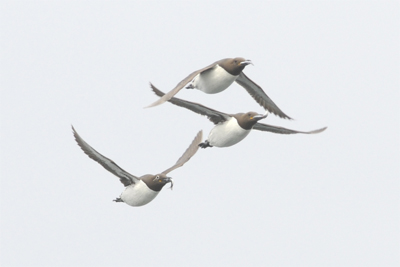
    Common Guillemots (including a 'bridled' Guillemot) after a successful fishing trip
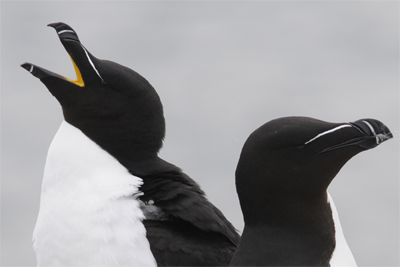
    Razorbills