Tag: Oystercatcher

  • Waders; Druridge Bay 19/09/2013

    Looking out of the office window, it was hard to reconcile the actual weather with the forecast.  I packed the car and set off for Newbiggin to collect Dan and Mary for a Druridge Bay mini-safari…and, just as I reached Church Point, the heavens opened 🙁  Not to worry – even in inclement conditions we can usually find somewhere to shelter and watch the wildlife.

    This was surely going to be a morning to enjoy the bird’s that are comfortable in wet weather, seemingly unconcerned by wind and rain.  Close views of Dunlin, Ruff, Curlew, Redshank and Snipe were possible, and a group of Pintail were wandering around with the Teal, Mallard, Wigeon and Tufted Ducks.  After a morning that just seemed to fly by, and a fascinating one with the opportunity to chat with a professional photographer, we headed back to Newbiggin…as the weather improved 🙂

  • Stumbling across a twitch

    Late August/early September is an exciting time on the Northumberland coast; wader passage is still ongoing, wintering wildfowl are arriving and you just never know what could turn up…

    I collected Andy and Lia from Alnwick and we set off for a day birdwatching on the Northumberland coast from Bamburgh to Druridge Bay.  Knot, Turnstone, Oystercatcher, Curlew, Sanderling and some very elusive Purple Sandpipers started the day for us, as Linnets fluttered around in the long grass, Meadow and Rock Pipits were around the tideline, Gannets were soaring majestically by and Eider and Common Scoter were bobbing around just beyond the surf and a mixed flock of Common and Sandwich Terns were flushed by walkers before settling back on the rocks close to the breaking surf.  Offshore a small flock of birds grabbed my attention, and through the telescope resolved into one of Northumberland’s winter specialities; seven Pale-bellied Brent Geese steadily heading north were our first of the autumn.

    Further south, waders were still the main focus of our day;  Dunlin, Redshank, Greenshank, Snipe, Whimbrel, Black-tailed Godwit, Bar-tailed Godwit and Ruff were all pottering about in the water’s edge.  When we arrived at East Chevington to look for the Spotted Crake, there were a few local birders already there.  With an astonishing amount of luck, we’d arrived just as a White-rumped Sandpiper was being watched 🙂  Not the easiest of birds to identify, but as it wandered around a flock of sleeping Teal with Dunlin and Snipe alongside for comparison it stood out quite well.

    Another cracking day’s birdwatching, with a proper rarity to add a touch of the unusual 🙂

  • Beauty in the ‘mundane’

    LBJ.  No, not the 36th President of the United States, but the acronym used by many birdwatchers to describe any relatively small, nondescript brown bird – ‘Little Brown Job’.  Over the last few years, a number of our clients have applied that term to two birds that I always think deserve closer attention…

    I collected Jo and Kirsty from Alnwick for their second consecutive day out with me and we headed straight up the coast and made our way on to Holy Island.  Curlews were passing overhead as we walked around the bits of the island that weren’t full of other people, those two LBJ’s, Skylark and Meadow Pipit, were dodging in and out of long grass in the fields by the path, Kirsty started photographing Swallows and quickly progressed to using flash to freeze the action as they hovered in front of us feeding beakfuls of flies to recently fledged juveniles and Golden Plover and Oystercatcher were probing around rockpools as Grey Seals bobbed about in the gentle surf just offshore.  Edges are always a productive area; edges of fields, woodland, moorland and the shoreline – that ever shifting edge of the sea and the land.  That latter edge produced some stunning Bar-tailed Godwits, and an impressively large group of very vocal Grey Seals.

    As we continued back down the coast the mist thickened and we were eventually in the surreal position of having blazing sunshine on our backs and visibility of less than 100m in front of us.  As a loose flock of Eiders drifted close inshore and then back out again, and Swallows and House Martins hawked insects low over the beach, a dark menacing shape drifted out of the mist, passed in front of us, and then drifted back into the impenetrable white mass.  Always a bird to grab the attention on a seawatch, the Arctic Skua was only in view for a few seconds as it made it’s way south along the coast, and we headed inland into glorious weather again.

  • Northumberland coast birdwatching and Otter-spotting 16/07/13

    Sometimes I think that I’m lucky, sometimes I’m quite sure that I’m lucky, and sometimes I have absolutely no doubt…

    As the heat of the day began to cool, with increasing cloud cover, it was time to head out and collect the five clients for our Otter mini-Safari.  I picked Gabrielle and Michael up from Morpeth and then drove across to Church Point, where Andy had already met up with David and Rhian.

    Before we’d even got everyone in the car, there was chance for an ID session with a bird that everyone was aware of, but wasn’t quite sure how to identify; a very obliging adult Mediterranean Gull flew by, perched on a lamp post, flew by again, was joined by a 1st summer bird and then drifted off out over Newbiggin bay.

    As the evening passed we had some excellent birdwatching encounters; three Little Egrets were very welcome, Grey Herons were sitting around just about everywhere that we visited, two summer-plumaged Red Knot flew by, Little Gulls were deftly picking flies from the calm water’s surface as Sandwich and Common Terns took a slightly more forthright approach to the acquisition of food, two juvenile Marsh Harriers were testing out their wings low over a reedbed and an adult male, began quartering the sand dunes, Eiders swam close to us and Curlews, Lapwings and Oystercatchers were all roosting peacefully.

    Then, at the site that I’d thought would be the best place to complete our trip, David said the words that everyone was waiting to hear “I’m sure I’ve just seen an Otter“.  Making it’s way quickly along the edge of the pool, it took a few minutes before everyone had seen it.  Then it just got better – first we could track it’s progress by the expanding ring of Mallards, Gadwall and Tufted Ducks around it’s exact location, then by the ring of bright water each time it surfaced in the shadow of the reeds, before we suddenly had a stampede of ducks hurrying past just a few metres away from us.  Sure enough, the Otter was now making it’s way along the edge of the pool on the side where we were sitting, passing closely enough that binoculars weren’t necessary 🙂  As it overshot the ducks, the stampede reversed direction and the Otter made it’s way into the darkness of the reeds.

    With a request for Barn Owl from the back of the car, I knew which route we’d take back down the coast.  Sure enough, perched on a roadside wire, the ‘White Owl‘ might have well been waiting for us, before flying parallel to the road over the fields and into the night 🙂
  • Summer birdwatching

    As I collected Alison and David from The Swan for an afternoon and evening  around Druridge Bay, southeast Northumberland and the Northumberland coast, the weather was continuing in the glorious vein that it had struck a few days previously.

    Mid-summer can be a quiet time, other than the obvious hustle and bustle of the Farne Islands, but there’s always something to see.  At the moment wader numbers are starting to build; Lapwing, Curlew, Redshank and Oystercatcher have all come down to the coastal strip from their breeding grounds and Black-tailed Godwits are moving through.  One of the first things we came across was a group of four of these beautiful elegant waders as they rested with a flock of Lapwings.  Little Gulls were flycatching and then sleeping and a male Marsh Harrier gave views that were simply breathtaking.  As we headed up the coast, a female Marsh Harrier flew low over the car, being equally as obliging as the male.  Grey Herons were stalking along pool edges, Common Spotted Orchid, Bloody Cranesbill and Harebell added colour to pathside vegetation, hirundines heading to roost formed swirling clouds of dark dots against the greying sky, a Common Frog sprang across the path in front of us and a Barn Owl hunted over rough pasture on silent wings.

    The thing that always characterises days out with clients who are passionate about wildlife, and Alison and David have a mouthwatering list of wildlife they’ve seen around the world, is that before you know it, it’s nearly dark, pipistrelles are hawking insects in the last vestiges of daylight and it’s time to head back.

  • Wildlife in the heat of the summer; Otter Safari 06/07/13

    After an enjoyable few hours watching the British & Irish Lions demolition of Australia, I loaded up the car, collected our picnics from The Swan and headed north to collect Jacky and Marcus from their holiday accommodation at the stunning St Cuthbert’s House.  A quick drive back down the coast and we collected Alice and John and embarked on our search of Druridge Bay, southeast Northumberland and the Northumberland coast.

    I’d identified a site where Otters have been active in the late afternoon, so that was our first port of call.  With Common Terns dip-feeding just in front of us, Canada and Greylag Geese with goslings, Gadwall with ducklings and lots of Sand Martins and Swallows there was plenty of birdwatching interest as we waited in hope for the possible appearance of our target species for the trip.  Jacky’s excited comment “there’s a…yes, it’s an Otter” marked the start of nearly an hour of Otter activity.  The initial animal turned out to be two together, and then eventually we were watching four of them as they swam back and forth, feeding, clambering on poolside rocks and play-fighting 🙂

    Lapwings, Curlew and a Greenshank were all evidence of post-breeding gathering/migration, Starlings were grouping into larger flocks as daylight faded, Sand Martins were swirling in a big pre-roost flock, a Barn Owl drifted on silent wings over a reedbed and, as the falling light levels finally rendered everything as a silhouette we headed back to the car with pipistrelles hawking just over our heads.

  • Heading for the hills; Birdwatching in the Cheviot Valleys 06/06/2013

    Thursday brought a trip that I’d been looking forward to for some time; I first met Chris many years ago, while I was Field Trips Officer for the Northumberland and Tyneside Bird Club, so it was going to be a day out with a client who knew me several careers ago.

    We met up at Church Point and headed inland towards the Cheviot Valleys, a location that features some stunning landscapes; steep-sided valleys, towering hills, mysterious sun-dappled woodland, heather moorland and all that goes with it.  As we approached the start of the higher ground, I suggested we check a damp area of an arable field.  It’s often good for wading birds and this was no exception; two broods of Lapwing chicks, as well as Oystercatchers and Redshank, were pottering around the edge of the now small puddle.

    Perhaps the best thing about our forays into the Cheviots is the chance to stretch your legs, get some fresh air…and see hardly anyone else while you’re there 🙂  The time passes quickly and the cackling of Red Grouse, simple song of Spotted Flycatcher, silvery descending cadence of Willow Warbler, plaintive mewing of Common Buzzards and the eponymous songs of Cuckoo and Chiffchaff all accompanied parts of our walk.  Grey Wagtails, Dippers and Common Sandpipers were all occupying that particular ecological niche that they’re all so suited for, a Redstart delivered his distinctive song from a hidden perch, Curlews gave their haunting cries from high on the hillsides, Tree Pipits sang from treetops and a Kestrel was hanging in the air over the ridge at the top of a steep valley.  Away from civilisation, surrounded by wildlife, it was the relaxed enjoyable trip that I always knew it would be 🙂

  • Head for the hills

    Away to the northwest of our base in southeast Northumberland is the skyline-dominating range of the Cheviot Hills.

    I collected Susan from Cheviot View and we headed towards the Harthope Valley via the ford at Coldgate Mill.  A stop along the road produced Redshank, Oystercatcher, Lapwing and the always impressive Brown Hare.  In glorious weather we walked for nearly five hours around various parts of the valley.  Curlews sang their eerie song from the heather clad slopes above, Tree Pipits delivered their challenge to rivals, and serenade to potential partners, the descending silvery cadence of Willow Warblers shimmered in the air around us, a Whinchat flitted from rock to heather, and back again, Grey Wagtails lived up to their name – wagging their tails from rocks and fence posts along our route – and the ‘swee-wee-wee-wee-wee’ of Common Sandpipers echoed around the sides of the swiftly flowing stream in the valley bottom.  As the afternoon wore on we watched as a Kestrel patrolled the steep valley sides, a Sparrowhawk soared across the valley and a Common Buzzard hovered over a distant plantation.

    Delivering peace, solitude and some excellent wildlife-watching opportunities, the hills are a great place to enjoy your wildlife and get some exercise too 🙂

  • Flying in for a day birdwatching in the North Pennines

    I always enjoy meeting up with our previous clients again, and Saturday morning found me at Newcastle Airport waiting to meet Jacob and Nancy as they arrived for a couple of days birdwatching in Northumberland.  They were going to be spending Sunday on the Farne Islands, but our destination on what was developing into a gloriously sunny Saturday was the North Pennines.

    Just 12 days earlier I’d been marvelling at the temperature of 1C at 10:30am but now Curlew, Lapwing and Oystercatcher were all flying around and calling noisily as we reached the higher ground southwest of Hexham, Skylarks were singing exuberantly against the azure sky, Meadow Pipits were ‘parachuting’ down at the end of their song flights and Common Snipe were calling from concealed positions in the grassland.  In the stunning light, Barn Swallows were eye-wateringly iridescent, a pair of Golden Plover flew in front of us and a pair of Red Grouse watched closely over eight chicks.  Red Grouse was a lifer for Jacob and Nancy and one male allowed a very close approach and provided a lot of photo opportunities for them.  Eyebrows, raised, eyebrows lowered, facing left, facing right, staring into the lens; he went through a veritable supermodel repertoire of poses before seemingly melting into the vegetation.

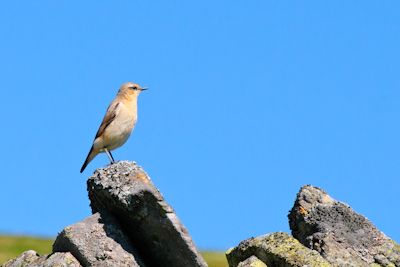
    As we travelled across a high moorland road, a Northern Wheatear posed obligingly for photographs.

    Northern Wheatear Oenanthe oenanthe,bird photography,bird photography holidays,bird photography courses,birdwatching holidays,Weardale,County Durham,North Pennines,www.northernexperienceimages.co.uk

    Skylarks and Meadow Pipits provided a memorable aural backdrop to our lunch stop, and a Golden Plover was silhouetted on top of a nearby ridge, keeping a close eye on it’s territory.  Near perfect weather, a gentle breeze, spectacular landscape and stunning birds; what more could you want from a day’s birdwatching?

  • Spring (Gentian) time in the hills

    The ‘quality over quantity’ birdwatching in the North Pennines has been the predominant feature of our days out with clients in the last two months, and a ‘phone enquiry on Tuesday saw me collecting David and Margaret on Wednesday morning for a day birdwatching in the hills.

    Red Grouse was the first of the upland specialities we encountered and, after a few single birds scattered across the moors we came across a pair with a brood of 10 chicks.  The adults watched us carefully as their offspring wandered about, completely unconcerned by our presence.  Lapwing and Curlew seemed to be everywhere and one Lapwing provided our only sighting of Snipe for the day, as it chased one over the road in front of us.  Oystercatcher, Redshank and Golden Plover were noisily displaying, Kestrels were stationary in the strong breeze and our first three Black Grouse were all seen distantly.  I was sure that we’d get much closer views of Blackcock and, sure enough, at the same spot where I photographed a displaying bird earlier this month, we came across what were probably the same two birds from that trip.

    A walk at Cow Green reservoir brought a non-avian highlight as Spring Gentians were in bloom.  If you’ve never seen one, this is what they look like 🙂

    Spring Gentian,Gentiana verna,Upper Teesdale,macro photography tuition,flower photography tuition,www.northernexperienceimages.co.uk

    Spring Gentian,Gentiana verna,macro photography tuition,flower photography tuition,Upper Teesdale,www.northernexperienceimages.co.uk

    After our walk we watched a small group of Blackcock as they engaged in their, slightly comical, lekking behaviour before heading back north east after another excellent day in the hills.