Thursday was another day for returning clients, as I collected Louise from her holiday accommodation at Brockmill farmhouse for a bespoke photography trip to the Farne Islands. We began, as most of our Farne Islands trips do, with a visit to a mainland tern colony. As happens so often, the Little Tern colony had been washed out by a very high tide – with all 42 pairs having abandoned their nests. The 250 pairs of Arctic Terns was also a long way below the number that had been there, with the tides having washed away the majority of that colony as well. Lots of the Arctic Terns were displaying, so they may well manage to re-lay.
The Farne Islands, once we arrived on Inner Farne following our journey on Glad Tidings, were as spectacular as ever. Guillemots, Puffins, Razorbills, Shags, Kittiwakes and the terns offered up many photographic opportunities and it was great to enjoy all of that with a client whose views on photo agencies, camera equipment and manufacturers are always entertaining. As we stood above lighthouse cliff on Inner Farne, the weather began to change – and not for the better…
When I was on the coast just south of Cresswell on Friday evening, I didn’t hold out much hope for Saturday’s pelagic going ahead; a menacing sea, with waves forming towering peaks, didn’t look likely to abate.
However, the sea is often fickle and Saturday saw nothing more than a long, lazy swell as we set sail into the North Sea for a day of offshore birdwatching along the coastlines of Druridge Bay and southeast Northumberland. Conditions changed throughout the day with, at times, the sea as calm as a millpond. 3 ‘Blue’ Fulmars, 5 Great Skuas, a probable Pomarine Skua, 3 Arctic Skuas, 5 Sooty Shearwaters, 4 Red-throated Divers, 2 Manx Shearwaters, Teal, Puffins, Guillemots, Razorbills, Kittiwakes, Gannets, Mediterranean Gulls and Swallows! were all appreciated and a Grey Seal and 2 Harbour Porpoises added some mammalian interest.
Saturday’s Whale and Dolphin Cruise from Seahouses turned out to be an excellent few hours of birdwatching off the Northumberland coast.
As we left the harbour, the swell of the tide had the boat rocking gently up and down. A mile or so later and we were in what I think of as ‘proper’ pelagic conditions; choppy sea, lots of whitecaps, an eerie wind whistling around the boat…and birds everywhere. The atmosphere when the North Sea is like that is filled with anticipation. A Pomarine Skua, athletic, muscular and menacing harrassed Kittiwakes, our first Great Skua of the trip (the first of several) lumbered by, Arctic Skuas flew along the wave troughs and the fragile, delicate figure of a Long-tailed Skua headed north in the rapidly strengthening wind. Fulmars soared effortlessly by, small groups of Gannets, those masters of efficient flight, featured throughout the trip and Sooty Shearwaters, a real seawatcher’s bird, entertained as they circled the boat. Added to that there were Puffins, Guillemots, Razorbills, Manx Shearwaters and Herring, Great Black-backed, Lesser Black-backed and Black-headed Gulls and Arctic, Common, Sandwich and Roseate Terns. With so many whitecaps, and some ‘interesting’ swell, we weren’t fortunate enough find any cetaceans, but one participant summed up offshore wildlife so well “You’re on a boat, it’s an experience, enjoy it, you never know what you’ll see.”
I met with Geoff and Jenny, Roy and Lorraine & David and Linda on the Wednesday evening in the bar of the Bamburgh Castle Inn and, after introductions and drinks, we went upstairs to the conservatory for dinner. A steady stream of Gannets was heading north and I outlined the plan for the coming days; modified in light of the weather forecast!
An 06:30 start on Thursday morning appealed to three of the group, so we set off to walk around Seahouses Harbour and along to the golf course. Lorraine had dreamt the night before that we found a Bluethroat. Not just any Bluethroat though; a Fork-tailed Bluethroat (something that doesn’t exist…although we spent the rest of the holiday looking for one!). The heavy swell and breaking waves gave the sea an imposing look, and the strong, cold southeasterly wind and dark clouds all around added to the atmosphere. With high tide approaching, wading birds were concentrated onto just a few exposed rocks; among the Oystercatchers, Redshanks and Curlews were a single Ringed Plover and 5 summer-plumaged Knot, their peachy-orange underparts showing why, in some parts of the world, they’re known as Red Knot. A Whimbrel flew by and Linnets, Pied Wagtails, Rock Pipits and a reeling Grasshopper Warbler were all added to the day list and we headed back to the inn, and breakfast. No less than 6 Rock Pipits were outside the window during breakfast and an all too brief probable Hummingbird Hawkmoth whizzed by.
The main question was whether our all-day birdwatching trip to the Farne Islands with Glad Tidings would go ahead; the weather forecast wasn’t promising, and the sea looked foreboding. I was optimistic though – by our planned departure time the tide would be ebbing and should take off some of the swell. Sure enough, we boarded Glad Tidings III just after 10am and headed towards the islands. Gannets soared majestically above the swell, Puffins raced by on whirring wings and our passage wader list grew with the addition of Grey Plover and Purple Sandpiper. Grey Seals bobbed around, watching as we passed by on our way to Staple Island. Enjoyment of the breeding auks, Shags, Kittwakes and Oystercatchers was enhanced by the wild feeling of the islands, as waves smashed into the cliffs and fountained high above the birds. Transferring to Inner Farne at 1pm, we were the first group onto the island for the day. The Arctic Terns gave us their usual warm welcome and we spent the afternoon enjoying the fascinating bird behaviour that can be witnessed at close range. The group were keen to fix the separation criteria for Common and Arctic Terns firmly in mind, so we spent some time looking carefully at lots of birds and considering individual variation. We spent a lot of time watching Puffins as well; not an identification problem, but endearing and fascinating! With mobs of Black-headed Gulls waiting to rob the adult Puffins as they return with beaks filled with Sand eels, the Puffins have quickly developed strategies to deal with this; circling back out over the sea until the gulls have moved away from your burrow is an obvious one, but the one that is most fascinating involves a Puffin running into another bird’s burrow, waiting until the gulls have moved and then running to another burrow – sometimes visiting as many as 5 or 6 sanctuaries before reaching their own chick. In an increasingly heavy swell, the journey back to the mainland was quite an experience.
Last week saw a repeat of a familiarisation trip we led in late March 2010, as the ORCA wildlife officers, who will be on board the DFDS King Seaways over the summer months, had a couple of days with us to familiarise themselves with Northumberland and the wildlife and birdwatching opportunities that it has to offer.
One major difference was the weather; this year it was warm and sunny…a marked contrast with last year’s trip, when the weather threw everything it could at us.
After a very nice meal at Longhirst Hall on Thursday evening with the wildlife officers, and Jude Leitch from Northumberland Tourism, I collected Richard and Isabelle on Friday morning and we headed north along the coast. With a relatively calm sea, we enjoyed a cruise around the Farne Islands on Glad Tidings V. Rafts of Puffins, the raucous calls of Guillemots and Kittiwakes, Grey Seals lazing in the sun and 2 Common Terns displaying and calling high over the islands were all well appreciated. Once back on dry land we drove down the coast to Low Newton, to have lunch at the Ship Inn. As we turned off the main road an unexpected bonus appeared in the shape of a ringtail Hen Harrier, mobbed by crows before heading inland. More birdwatching along the coast followed, including a visit to Holy Island, before an outing at dusk on the North Northumberland coast that produced sightings of a Roe Deer and 2 Otters.
Saturday started with an interesting discussion during breakfast “what’s the difference between a whale and a dolphin?”, then we travelled down the coast, birdwatching in Druridge Bay, before it was time to deliver Richard and Isabelle to the waiting ship. Good luck to them both, and may they find many cetaceans this summer 🙂
Yesterday was our final full-day pelagic for the year. With a couple of late cancellations, ten of us boarded the SarahJFK and headed out to sea. Before we reached the end of the Tyne piers there was already a bit of swell…
Once we were out and heading offshore it was exhilarating, with an often icy westerly breeze and long rolling waves from the north. Small groups of Pale-bellied Brent Geese passed by during the day and a small group of Greylag Geese and Pink-footed Geese as well – a sure sign that the autumn is here. There was an almost complete absence of Fulmars, leading to speculation about what these enigmatic seabirds are doing when we can’t find them, and only one Manx Shearwater. Arctic Skuas were a bit thin on the ground, but we did find a good pelagic prize – a sub-adult Pomarine Skua that passed by with two Great Skuas. Excellent views of the latter species, and some stunning Sooty Shearwaters were the highlight of the day, and there were lots of Kittiwakes and Gannets, although that accolade could have gone to the 2 White-beaked Dolphins that were seen briefly on 3 occasions late in the afternoon.
Great Skua or 'Bonxie'Sooty Shearwater
Sooty Shearwater – the epitome of graceThe swell proved a bit too much for some participants so, in between scanning for birds and cetaceans, I spent some time providing sympathy and advice for the worst of the stricken 🙂 Don’t let that put you off signing up for any of next-year’s pelagics though; it’s actually quite unusual for anyone to be really seasick on one of our pelagics, but the big swell (probably originating a few days ago from the near the north west coast of Norway) combined with a strengthening westerly breeze was a freak combination of conditions that managed to hinder the enjoyment of all the birds around the boat for a couple of the girls. I was once asked, by someone who was a self-professed non-sailor, why I would spend so much time on a small boat in the North Sea…I think that now I would just send them a link to the images in this post and the videos in my Farne Deeps trip report
We’ve got one more pelagic this year, around the Farne Islands, Holy Island and the Skate Road on Saturday December 4th, so give us a call on 01670 827465 for further details or to book.
Now, you shouldn’t need to read too many of my blog posts to realise that seabirds and cetaceans occupy a special place in my heart, and that I’m in my element once I’m on a boat off the Northumberland coast.
Saturday was our annual ‘Whale and Dolphin Cruise’ on Glad Tidings V, out of Seahouses. With 36 participants, including the other NEWT guides (Sarah and Andy), all safely on board we set off down the coast. We were soon enjoying views of two Arctic Skuas and then panic on the deck as our eagle-eyed skipper spotted two Sooty Shearwaters off to one side and everyone rushed to see them. These ocean wanderers are one of the great sights of pelagic seabirding in the North Sea at this time of the year. For one participant though the real excitement was the bird sitting beside the shearwaters; a Puffin 🙂 It’s a few weeks too late to see them at their breeding colonies, but I’d told Sam that we had a good chance of coming across one. Throughout the day we found a few more, as well as plenty of Fulmars, Kittiwakes, Guillemots and a few Razorbills. Perhaps the best entertainment of the day was provided by several feeding groups of Gannets, throwing fountains of water into the air as they hit the sea. There was clearly a lot of fish for them to eat, and it was real mystery to myself, Sarah, Andy and John that there were no cetaceans feeding in the same areas. Oh well, if they weren’t so mysterious it wouldn’t be such an adrenaline rush when we do find them I suppose. A lone Manx Shearwater avoided the boat, as they tend to do, and we headed northwards to the Farne Islands, hoping to see the White-tailed Eagle that has been there for the last week. We were in radio contact with other boats so we knew it had just killed a Shag and was eating it. As we neared the islands our one cetacean for the day appeared, a Harbour Porpoise just to one side of the wake of the boat. Just as we arrived, the eagle crept into a cleft between a grassy bank and some rocks so only one or two people managed to get a glimpse of it’s head as it dropped out of sight. Grey Seals were playing, splashing and racing around and we headed back into the harbour, after a marathon effort by our skipper and everyone on board. We’ve already set the date for the 2011 Whale and Dolphin Cruise – Saturday September 10th so put it in your diaries and give us a call on 01670 827465 to book your place.
Blue skies, calm sea, what more could you wish for?
Friday was our long-awaited pelagic to the Farne Deeps. We’d originally planned the trip for August 12th, but the weather put paid to that 🙁 Rescheduling to September 3rd meant that four of the original participants had to withdraw because of other commitments, but we were able to fill those places and have a reserve list. Birdwatching from a boat in the North Sea, with the possibility of cetaceans as well, is always an enjoyable way to spend a day.
When I arrived at Royal Quays just after 7.30 I was surprised to see that nine of the other eleven participants were already there; obviously eager to join Northern Experience on our ‘voyage into the unknown’.
As we left the Tyne we soon began to began to find Guillemots, Razorbills and Puffins on the sea; all 3 species featuring regularly throughout the day. Gannets, Fulmars and Kittiwakes were all seen in good numbers (Kittiwakes in particular) and we continued to head north northeast, getting further offshore from the Northumberland coast.
I was watching the depth plotter carefully as we approached the edge of the deep water and, as I stepped out of the wheelhouse, thinking that things could get very interesting quite soon, almost collapsed as Allan shouted “Dolphin!”. Within a minute we’d got two stunning White-beaked Dolphins bow-riding. They stayed with us for 40 minutes, and during that time there were at least another three a little distance from the boat. I managed to get ‘a bit’ of video footage 🙂
As if all the excitement of having the dolphins around the boat wasn’t enough, Geoff Morgan spotted a Grey Phalarope (Red Phalarope for any readers in the US). After Geoff’s initial call it was 4 mins before the bird was relocated; sitting on the sea in front of the boat as we continued along with the dolphins. The phalarope, as well as an excellent bird to see in early September, was a milestone as it’s the 40th ‘seabird’ (defined as those covered by Peter Harrison’s excellent ‘Seabirds: an identification guide’) to be found on pelagic trips off Northumberland since the first NTBC organised trip in 1987.
As well as the birds mentioned previously we also found;
Manx Shearwater 4
Sooty Shearwater 4
Arctic Skua 4
Great Skua 9
Typically, the Manx Shearwaters and Arctic Skuas stayed well away from the boat but the Sooty Shearwaters and Great Skuas were much more obliging 🙂
By the end of the day, nearly everyone on board had enjoyed lifers; the White-beaked Dolphins were a much sought-after species for Joanne and the result of a lot of effort 🙂 With the battalion of long lenses on the boat, there’ll be plenty of good quality images for the White-beaked Dolphin identification catalogue that forms part of the Northeast Cetacean Project. We’ll be running at least two trips out to the Farne Deeps next year (date and cost tbc) so get in touch soon to register your interest. With only 12 places available they’ll fill quickly.
After the 10hr marathon of the Farne Deeps, our 8hr pelagic on Saturday was just like a pleasure cruise 🙂 Again we had good numbers of Kittiwake, Gannet and Fulmar, as well as some very obliging Sooty Shearwaters. With some of South Tyneside’s finest on board, I was half-hoping that one of them would point his camera at the sky and randomly photograph a Cape Gannet 🙂 Sadly, it wasn’t to be. Never mind, there’s always next week…and the week after…and next year.
This has been one of our busiest weeks since we started NEWT, and I’ve only just got around to finding the time to sit in our office and blog about the last few days.
Tuesday saw Mike, one of our returning clients, coming for his second day out with NEWT, including some photography tuition in the Northumberland Coast AONB and a birdwatching trip across to the Farne Islands.
After a session on exposure theory, covering topics such as exposure values, ND filters and average metering (the bane of photographers everywhere) and a bit of practice with slow shutter speeds to creatively blur the rising tide it was time to head across to Inner Farne.
No matter how many times I visit the Farne Islands, I’m always awestruck by just how good the experience is; Grey Seals, Common, Sandwich and Arctic Terns, Eiders, Kittiwakes, Fulmars, Guillemots, Puffins and Razorbills all offer excellent photo opportunities so plenty of memory cards are a must.
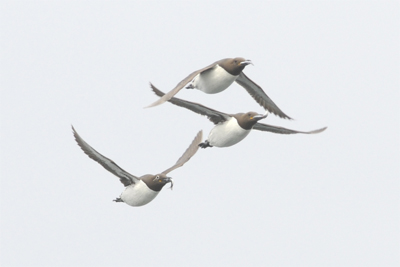
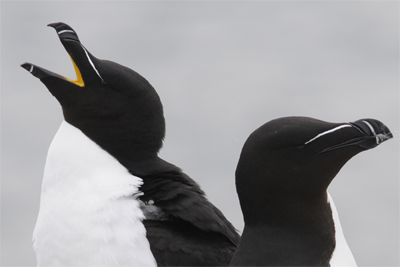
Common Guillemots (including a 'bridled' Guillemot) after a successful fishing tripRazorbills