Tag: Guillemot

  • The icing on the cake

    As the rain hammered down while I packed the car ready for Sunday’s Otter Safari I was filled with optimism; the weather forecast (really, I should stop believing these…) suggested that the afternoon and evening would be dry and bright.

    When I arrived at Church Point Marc and Marika were already there, and we were joined by Becky and Jim soon after.  The trip was a present for one of each couple, and we set off for an afternoon of birdwatching combined with searching for Otters.  First stop was one of our Little Owl sites, and Becky’s sharp eyes picked out a juvenile bird that was doing a very passable impression of a stone.  Our next stop, beside the River Coquet, produced Common Terns fishing, flyby Curlews (and a discussion of separation from Whimbrel), 4 Common Sandpipers and some impressive thunderstorms away to the north and west of us.

    A heavy shower as we reached the NWT reserve at East Chevington kept us in the car for a few minutes, during which time we were entertained by a family party of Stonechats.  As the rain eased we walked to the hide overlooking the north pool.  Amongst the throng of Common, Sandwich and Arctic Terns and Lapwings were 3 adult Knot, still in breeding plumage.  Suddenly the entire roosting flock lifted, and the unmistakeable figure of a Spoonbill flew across our field of vision.  It seemed intent on landing, but the constant harrassment from the terns meant that we were treated to several flypasts, including one where it was just 20m away from us.  As if this wasn’t spectacular enough, 2 Little Egrets appeared, while the Spoonbill was still circling, and were subjected to the same treatment.  Eventually a semblance of calm returned and we watched a juvenile Marsh Harrier as it pranced comically in the wet grass, presumably eating worms that had been brought to the surface by the rain, and a second juvenile harrier harrassed by crows.  Another creature to benefit from the rain was a very young Hedgehog busily eating worms and, in a real ‘aahh’ moment, pausing briefly to sniff the air.

    Our picnic stop, overlooking the southern end of Druridge Bay, produced rafts of Eiders and Common Scoters, the piping calls baby Guillemots rising from the waves below, Gannets and Sandwich Terns plunging into the sea, at least 3 Arctic Skuas and the majestic lumbering menace of a Pomarine Skua passing south just offshore.

    Changeable, showery weather often produces good sunsets, and this was no exception; as a band of steel grey cloud drifted along the horizon, sunlight shone through a narrow gap, fading from gold to orange to red to pink.  And there, in the reflection of the dramatic sky, was the main event – an Otter, twisting and turning, creating panic among the waterfowl, perched imperiously on a boulder and then vanishing into the deepening shadows of the water’s edge.  Clouds of Noctule Bats and Common Pipistrelles swirled overhead, occasionally passing within a few feet of us, a female Tawny Owl called from the nearby trees, and the scene faded to darkness…
  • Bird Watching Magazine Reader Holiday Day 3: 09/07/2011

    On Saturday morning our destination was Druridge Bay and southeast Northumberland and another poor weather forecast ( a bit of a running theme during the holiday…) suggested that we may well get wet.  An addition to the mammal list for the trip raced across the road ahead of us; a Stoat – an endearing predator and one of NEWT’s favourite animals.

    We arrived in Amble for our sailing around Coquet Island with Dave Gray’s Puffin Cruises; as Dave manoeuvred the excellent Steadfast into the harbour, the rain arrived from the northeast.  The sailing around the island produced excellent views of Roseate Terns, as well as Common, Arctic and Sandwich Terns, Gannets, Puffins, Razorbills and Guillemots.  As we sailed in a wide arc from the island to begin the journey back to the harbour an Arctic Skua was harassing terns away to the north.  Four more Arctic Skuas were followed by a real seawatching prize as a Pomarine Skua lumbered menacingly by before settling on the sea.    Our final Arctic Skua flew over the harbour just before we docked and I suggested that the Country Barn Coffee Shop at Widdrington would be the best destination once we were back on dry land.

    Refreshed, dried and ready to go we visited the NWT reserve of East Chevington.  The tern roost allowed close comparison of Common and Arctic Terns, but the bird described by one participant as ‘bird of the holiday’ was a superb male Marsh Harrier.  A juvenile harrier appeared briefly over the reedbed as well, but the male perched for several minutes on a fence post.  Just after we reached Druridge Pools, the heavens opened, lightning flashed, thunder rolled and 2 Wood Sandpipers bobbed along the edge of the main pool.  A trip to Cresswell, and the most northerly breeding Avocets in England, followed and we all enjoyed  views of a very obliging Brown Hare, Little Gulls and both Little and Great Crested Grebes.  Another excellent evening meal and entertaining conversation (including David’s comment about Captain Birdseye in a cape..a reference to my appearance during the Coquet Island trip), concluded our final night in Seahouses.

    As I put my coffee cup and glass of orange juice on the table at breakfast on Sunday morning I looked out over the harbour and the words “it’s a glorious morning” were quickly followed by “and there’s a Spoonbill!”.  Everyone rushed to the window to watch, as Northumberland delivered a fantastic finale to the holiday; poor weather forecasts, some stunning downpours, big seas, beautiful weather, iconic landscapes, excellent birdwatching…all in four days!

  • Familiarising

    Last week saw a repeat of a familiarisation trip we led in late March 2010, as the ORCA wildlife officers, who will be on board the DFDS King Seaways over the summer months, had a couple of days with us to familiarise themselves with Northumberland and the wildlife and birdwatching opportunities that it has to offer.

    One major difference was the weather; this year it was warm and sunny…a marked contrast with last year’s trip, when the weather threw everything it could at us.

    After a very nice meal at Longhirst Hall on Thursday evening with the wildlife officers, and Jude Leitch from Northumberland Tourism, I collected Richard and Isabelle on Friday morning and we headed north along the coast.  With a relatively calm sea, we enjoyed a cruise around the Farne Islands on Glad Tidings V.  Rafts of Puffins, the raucous calls of Guillemots and Kittiwakes, Grey Seals lazing in the sun and 2 Common Terns displaying and calling high over the islands were all well appreciated.  Once back on dry land we drove down the coast to Low Newton, to have lunch at the Ship Inn.  As we turned off the main road an unexpected bonus appeared in the shape of a ringtail Hen Harrier, mobbed by crows before heading inland.  More birdwatching along the coast followed, including a visit to Holy Island, before an outing at dusk on the North Northumberland coast that produced sightings of a Roe Deer and 2 Otters.

    Saturday started with an interesting discussion during breakfast “what’s the difference between a whale and a dolphin?”, then we travelled down the coast, birdwatching in Druridge Bay, before it was time to deliver Richard and Isabelle to the waiting ship.  Good luck to them both, and may they find many cetaceans this summer 🙂

  • Life begins at 40

    Friday was our long-awaited pelagic to the Farne Deeps.  We’d originally planned the trip for August 12th, but the weather put paid to that 🙁  Rescheduling to September 3rd meant that four of the original participants had to withdraw because of other commitments, but we were able to fill those places and have a reserve list.  Birdwatching from a boat in the North Sea, with the possibility of cetaceans as well, is always an enjoyable way to spend a day.

    When I arrived at Royal Quays just after 7.30 I was surprised to see that nine of the other eleven participants were already there; obviously eager to join Northern Experience on our ‘voyage into the unknown’.

    As we left the Tyne we soon began to began to find Guillemots, Razorbills and Puffins on the sea; all 3 species featuring regularly throughout the day.  Gannets, Fulmars and Kittiwakes were all seen in good numbers (Kittiwakes in particular) and we continued to head north northeast, getting further offshore from the Northumberland coast.

    I was watching the depth plotter carefully as we approached the edge of the deep water and, as I stepped out of the wheelhouse, thinking that things could get very interesting quite soon, almost collapsed as Allan shouted “Dolphin!”.  Within a minute we’d got two stunning White-beaked Dolphins bow-riding.  They stayed with us for 40 minutes, and during that time there were at least another three a little distance from the boat.  I managed to get ‘a bit’ of video footage 🙂

    As if all the excitement of having the dolphins around the boat wasn’t enough, Geoff Morgan spotted a Grey Phalarope (Red Phalarope for any readers in the US).  After Geoff’s initial call it was 4 mins before the bird was relocated; sitting on the sea in front of the boat as we continued along with the dolphins.  The phalarope, as well as an excellent bird to see in early September, was a milestone as it’s the 40th ‘seabird’ (defined as those covered by Peter Harrison’s excellent ‘Seabirds: an identification guide’) to be found on pelagic trips off Northumberland since the first NTBC organised trip in 1987.

    As well as the birds mentioned previously we also found;

    Manx Shearwater 4

    Sooty Shearwater 4

    Arctic Skua 4

    Great Skua 9

    Typically, the Manx Shearwaters and Arctic Skuas stayed well away from the boat but the Sooty Shearwaters  and Great Skuas were much more obliging 🙂

    By the end of the day, nearly everyone on board had enjoyed lifers; the White-beaked Dolphins were a much sought-after species for Joanne and the result of a lot of effort 🙂  With the battalion of long lenses on the boat, there’ll be plenty of good quality images for the White-beaked Dolphin identification catalogue that forms part of the Northeast Cetacean Project.  We’ll be running at least two trips out to the Farne Deeps next year (date and cost tbc) so get in touch soon to register your interest.  With only 12 places available they’ll fill quickly.

    After the 10hr marathon of the Farne Deeps, our 8hr pelagic on Saturday was just like a pleasure cruise 🙂  Again we had good numbers of Kittiwake, Gannet and Fulmar,  as well as some very obliging Sooty Shearwaters.  With some of South Tyneside’s finest on board, I was half-hoping that one of them would point his camera at the sky and randomly photograph a Cape Gannet 🙂  Sadly, it wasn’t to be.  Never mind, there’s always next week…and the week after…and next year.

  • Deja vu

    Wednesday was our second consecutive Farne Islands trip.  I collected Steve and Sarah from Belford and after we’d visited a couple of NEWT’s favourite coastal locations it was time to catch the Glad Tidings across to Inner Farne to enjoy some of the best birdwatching Northumberland has to offer.  The sense of anticipation, heightened once the first Puffins, Guillemots  and Razorbills begin to fly by, beaks filled with fish, blends with the clean sea breeze and all of the passengers on board start to get excited.  After the cruise around the islands we landed on Inner Farne and the Arctic Terns went on the offensive.  This year I bought a new hat, after taking a bit of a beating in 2009 🙂  Even though the island is quite small the hour that we spent on there seemed to fly past.  Probably the highlight of the islands this time was just how close some of the Puffins came to where we were standing.  Back on the mainland we walked through the dunes near Low Newton, where there were lots of Small Heath butterflies, more Arctic Terns and plenty of Meadow Pipits.  With the glorious summer weather, it was a really relaxing day.  What would Thursday bring?

  • Landscape photography and birdwatching on the Northumberland coast

    This has been one of our busiest weeks since we started NEWT, and I’ve only just got around to finding the time to sit in our office and blog about the last few days.

    Tuesday saw Mike, one of our returning clients, coming for his second day out with NEWT, including some photography tuition in the Northumberland Coast AONB and a birdwatching trip across to the Farne Islands.

    After a session on exposure theory, covering topics such as exposure values, ND filters and average metering (the bane of photographers everywhere) and a bit of practice with slow shutter speeds to creatively blur the rising tide it was time to head across to Inner Farne.

    No matter how many times I visit the Farne Islands, I’m always awestruck by just how good the experience is;  Grey Seals, Common, Sandwich and Arctic Terns, Eiders, Kittiwakes, Fulmars, Guillemots, Puffins and Razorbills all offer excellent photo opportunities so plenty of memory cards are a must.

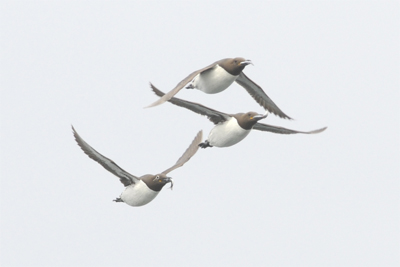
    Common Guillemots (including a 'bridled' Guillemot) after a successful fishing trip
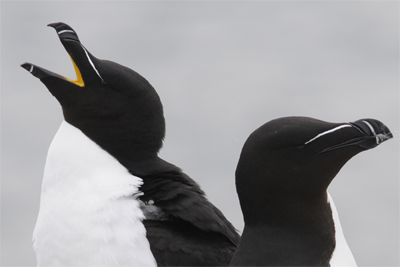
    Razorbills
  • The dawning of the “season”

    After a cold, wet day surveying one of our inland tetrads for the Bird Atlas, we had a very early start on Sunday for our Dawn Chorus walk at Lee Moor Farm.  Ian was, as always, an entertaining host for the event and we walked around the farm, enjoying the songs of Willow Warbler, Song Thrush and Sedge Warbler, excellent views of Brown Hare and Roe Deer and then a delicious breakfast.  Our next event at Lee Moor is a bat walk, moth trapping demonstration and BBQ on Saturday May 15th.

    Monday saw us out on Atlas work again, this time much closer to home as we are covering the tetrads that are immediately north and south of our house.  The highlight was a reeling Grasshopper Warbler, and the closest Tree Sparrows to home that we’ve found so far.

    Yesterday was our first Farne Islands Safari of the year.  With excellent views of Sandwich, Common and Arctic terns, Eiders, Guillemots, Razorbills, Puffins, Shags, Gannets, a very obliging Wheatear and Grey Seals it was everything we would expect the Farnes to be.  There’s a good reason that the islands will be the venue for days out with 3 of our photography clients over the next few weeks.

    Now, it’s Wednesday morning and I’m just packing the Landy ready for a migrant hunt on Lindisfarne with 2 of our returning clients.  Wish us luck 🙂

  • A swell weekend for a survey or two…or three

    Saturday was planned as the next survey day for NEWT/Marinelife…and then in the early hours of Saturday morning the sea began to turn ‘a bit lumpy’ (c)Allan Skinner.  With over 3m of swell smashing it’s way through the harbour mouth at Amble there was no chance of getting the boat out.

    With all three NEWT guides having the day together we headed inland to finish our BTO Winter Atlas timed tetrad visits in Harwood.  Ironically, given the wintry weather on the coast, there was less snow than on our last visit.  Birds were few and far between and, after what turned out to be a strenuous 4 miles over rough ground, as we headed back towards home the late afternoon light looked just about perfect for a visit to Nursery Park to photograph the Waxwings.  The light was as good as we could have wished for and the 20 or so birds that were still present were much more obliging than they had been in previous days.

    Waxwings stacked on top of each other
    Waxwings stacked on top of each other
    Do you think I can swallow this in one?
    Do you think I can swallow this in one?
    Bohemian Waxwing, Ashington, Northumberland 20/02/2010
    Bohemian Waxwing, Ashington, Northumberland 20/02/2010
    Bohemian Waxwing, Ashington, Northumberland 20/02/2010
    Bohemian Waxwing, Ashington, Northumberland 20/02/2010

    On Sunday we separated out to do different surveys; Sarah covered the WeBS count stretch from Cresswell-East Chevington and back (taking her total distance walked over the weekend to nearly 12 miles) and Martin and Andy set out from Amble along with Tim Sexton, on calmer seas, to start surveying the Farne Deeps.  Remarkably, all three surveyors on this trip used to live within 100m of each other in the late 90’s, on Percy Park in Tynemouth.  Tim was on the famous Wilson’s Petrel pelagic back in 2002, and Andy only missed that one as he was delayed while heading back from Mull.  The journey out to the deeps was unremarkable, other than for the number of Gannets that we found, and a lone Common Seal was an interesting find.  Fulmar and Guillemot were also seen throughout most of the survey, and a small number of Puffins were around as well.  As we headed east on the first transect we could see some very dark clouds massing to the south.  By the time we’d completed the 13 mile run and turned to follow the next transect west the clouds had caught up with us.  Sea state 5 in a near white-out was one hell of an experience, but we continued to keep our attention on the sea, still surveying in the hope that the weather would soon pass by.  It did, and we completed that transect before heading north and then east along the next survey line.  Ten miles along the transect we were hit by another winter storm, this time coming from the east.  With the turning tide making our skipper’s task increasingly difficult, we made a note of the position we’d reached and headed back to the warmth and comfort of the shore.  Two days, three NEWT guides, four surveyors.

    Now I’ve got a couple of days of office stuff to catch up on; press trip proposals to write, images to process for articles I’ve written and we’re already well into planning for the Birdwatching Northumberland stand at the British Bird Fair.  I reckon I’ll be able to fit in some time for photography though 🙂