Tag: Goldeneye

  • New Year, quality wildlife; Otter Safari 22/01/2015

    During quiet periods of the year, we keep going out and checking excellent wildlife sites all around Northumberland.  Although we can never predict exactly what we’ll see, and where, those days out on our own are the basis of successful days out with clients…

    I arrived at Church Point to collect Gordon and Michelle and we set off in search of Otters.  I love the pressure of a client being obsessed with Otters but never having seen one in the wild, it keeps me focused 🙂  Soon we were watching a distant Otter as it fed in mirror calm water!  A slow, steady approach took us much closer and then another two Otters appeared, eventually coming so close that we could hear a splash, each time they dived in search of fish, and the crunching, munching sound of them devouring their catch 🙂  We’ve been watching this group of Otters since mid-December, so we’ve got a few images of them…
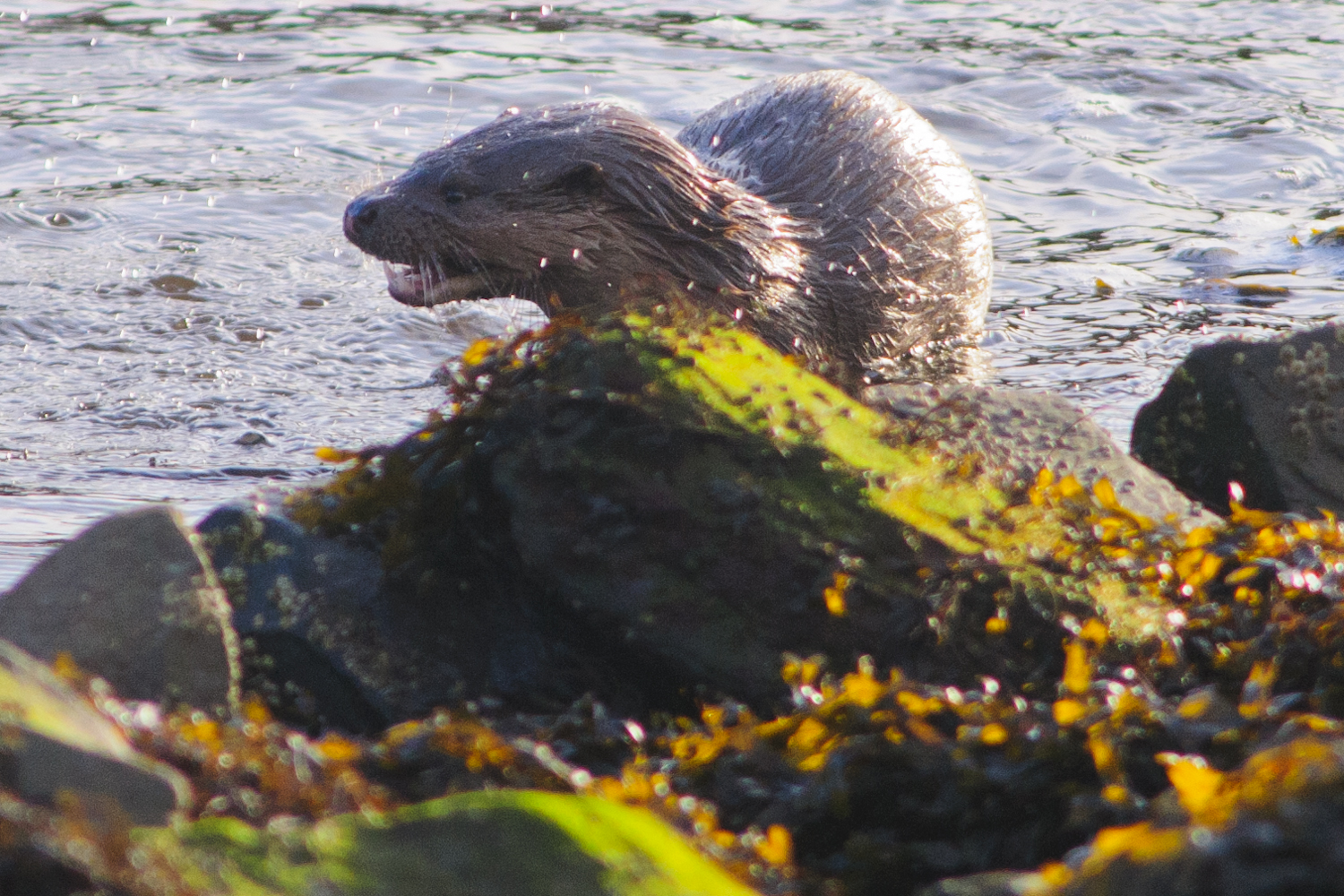
    Eurasian Otter,Lutra lutra,Northumberland,otter watching,otter safari,otter photography

    Eurasian Otter,Lutra lutra,Northumberland,otter watching,otter safari,otter photography workshops

    Eurasian Otter,Lutra lutra,otter watching.otter safari,otter photography workshops

    After 90 minutes they’d moved on and so did we.  Our next wildlife star of the day was another one that we’ve been watching and photographing over the last few weeks – a Little Owl.

    Liite Owl,Athene noctua,Northumberland,birdwatching Northumberland,wildlife sfaris UK,wildlife tours UK,wildlife photography,wildlife photography workshops,

    As the afternoon passed, and the cold damp air held us in it’s icy grip, more stunning wildlife put on a show that demonstrated just how good Northumberland is during the winter.  An array of wildfowl in breeding finery is a highlight of the winter months; Teal, Wigeon, Gadwall, Mallard, Goldeneye, Tufted Duck, Red-breasted Merganser, Eider and a Long-tailed Duck.  A Barn Owl, ghostly white, bringing death on silent wings to unsuspecting mice and voles is always a crowd pleaser while Kestrels, Buzzards and a brief view of a Hen Harrier were the reward for a session of raptor watching as dusk approached.  Another ghostly white winter speciality put in a typically fleeting appearance – a Stoat in ermine 🙂  Possibly my favourite land mammal, here’s an image of one from last winter.

    Stoat,Mustela erminea,Northumberland,wildlife sfaris UK,wildlife tours UK,

    Finally, as the light faded to the point where it was getting difficult to see anything and flocks of Pink-Footed and Greylag Geese peppered the sky, one of our most elusive birds wandered out into the open and entertained us.  Probing and prodding at the marshy ground between two reedbeds, the Water Rail gave obligingly prolonged views.  Surprisingly small, remarkably beautiful, and a great way to end the day with clients who’ve persuaded me (almost…) that there are destinations so spectacular that I really need to get on a ‘plane at some point next year…

  • Charming; Bespoke Birdwatching 10/11/2014

    Even after 40+ years birdwatching, there are times when I’m not sure whether the thing that excites me the most is a lone rarity, a life or death interaction involving one of the predators we encounter, or an impressive flock of something common…

    I collected David and Dot from Gosforth and we made our way across to the coast for a day of mid-November birdwatching.  This proved to be a day of flocks; Pink-footed Geese rose then dropped in nearby fields, peppering the sky and cutting through the autumn air with their yapping calls.  Mini-murmurations of  Starlings twisted, turned, bunched and swirled, demonstrating that they don’t just reserve that spectacle for the fading light of evening.  Common Snipe were sitting in the vegetation close to the water’s edge, extraordinarily well camouflaged when asleep and only really betraying their presence once they woke up and started probing in the soft mud of the shallows.  Oystercatcher, Turnstone, Redshank, Curlew and Eider are almost a given on the coast in the winter, a lone Sanderling hurried back and forth in a flock of Ringed Plover and Teal, Wigeon and Goldeneye are eyecatching whether in flocks or alone.  Elegant Pintail glided by and Stonechats flicked their tails nervously perched in the tops of bushes in the dunes along the coast.  One isolated tree brought a memorable spectacle, with a charm of Goldfinches, and a lone Greenfinch.  For a couple of years now, a lot of our clients have reported increasing numbers of Goldfinch, and a tremendous decrease in Greenfinch.  No matter how numerous Goldfinch become, it’s hard to imagine that we could ever become blase about them; strikingly patterned, with their red face, black and white head and yellow wing flashes, and with liquid, twittering songs and calls, they really are quite charming 🙂

  • Battling the elements; Otter Safari 06/11/2014

    Last Thursday was Sue’s second Otter Safari with us this year, after an unsuccessful search in early July…a trip that was followed by five consecutive successful Otter Safaris for other clients!  I was really looking forward to this trip – Sue is great company and pleasure to be out birdwatching with – but the added pressure of already having one Otter Safari not produce our target species had me planning, re-planning and then planning some more…

    I’d got two sites lined up that I was confident would produce Otter sightings, but the one spanner in the works was the weather forecast.  If it was accurate (and, as it turned out, it was) we’d got three hours of good weather, and four of poor, ahead of us.  As I drove to Church Point, I was mulling over the options for the two sites, and decided to go with the one that’s been our most reliable this year during the good weather, and then head to the other one towards dusk.  Then I thought about it again – would the reliable site, where I can usually predict to within a few metres where the Otter will first put in an appearance,  be better in the poor weather just before dark?  I decided to trust to my first instinct and we were soon watching over the water as the wind strengthened and the first drops of rain were carried towards us on the breeze.  As Goldeneye and Cormorant dived in the ruffled water I noticed a dark shape in the corner of my field of vision.  It might have been nothing, but I held my concentration on that spot and just over a minute later an Otter cub surfaced in front of us 🙂  Twisting, turning, porpoising, diving and feeding, it kept us entertained for 90 minutes before slipping out of sight as the next wave of raindrops stung our faces on the now howling wind.

    We retreated to the car and sat eating lunch overlooking the North Sea, as a distant speck heading towards us over the waves revealed itself to be a Blackbird that paused for a few minutes on the cliff face before continuing its migration inland.  Then a Wheatear came ‘in-off’, and soon after that three Redwings arrived, following what must have been an arduous sea crossing, as the rain intensified.  As dusk approached, and the rain somehow became even heavier, we watched flocks of Teal and Wigeon, Common Snipe and Dunlin probing in soft mud, Curlew appearing as if from out of nowhere, Starlings and Jackdaws heading to roost, and Blackbirds, Robins, Fieldfare and more Blackbirds, and more Blackbirds 🙂

  • Under a darkening sky; Northumberland Coast 27/10/2014

    Yesterday was a safari day on the Northumberland coast, with a plan to enjoy the birdwatching around our regular Otter sites and then a stargazing session in Druridge Bay.

    I collected John and Pam from home in Cullercoats and we drove up the coast.  As we ate our picnic lunch in the shadow of Bamburgh Castle, we could see Gannets diving offshore, beyond the rafts of Common Eider that were surfing the gentle swell.  Kestrels were seen throughout the afternoon and a real ‘from the car’ bonus came in the shape of three Roe Deer.  As so often happens as we approach the winter, wildfowl dominated the birdwatching.  As well as the Eiders, with males resplendent in their breeding finery, Teal, Mallard and Goldeneye looked at their best.  As a Grey Wagtail perched on a mid-stream rock, and fish swirled and leapt from the water, a male Kingfisher perched on a branch overhanging the river, flocks of geese peppered the sky wherever we were, and a flock of Greylag Geese began to flush as the search and rescue helicopter passed noisily overhead.  Whooper Swans looked as stunning as ever, flocks of Lapwing and Golden Plover swirled in the stiff breeze  and, as dusk approached, Pink-footed Geese began arriving to roost.  Flock after flock of Pink-feet appeared out of the gloom, announcing their imminent arrival with their yapping calls, eventually in near darkness when they were just a black speckling against the dark grey brooding clouds.

  • Kettling; Kielder Safari 23/04/2014

    The alarm went off at 06:00 on Wednesday, and my heart sank as I looked out of the window…heavy mist, not ideal for any of our tours, but particularly not good for a day in Kielder.  I drove to Kingston Park to collect Steph and we headed west in much more promising conditions; low cloud in some valleys, but some sunshine too.  We collected Paul and Trish from Wark, and then Ivan from Tower Knowe and headed into the forest.  It was a bit cool and misty for any raptors to be up and about, but two Common Crossbill flew by and the air around us was filled with the descending silvery cadence of Willow Warblers as Woodpigeons, Stock Doves and Carrion Crows caused a brief quickening of the heart rate as they flew between plantations.

    A walk to the Bakethin reserve produced lots of Siskin, and Goldeneye, Tufted Duck, Teal, Oystercatcher, Cormorant and Common Sandpiper were around the water’s edge.  As we got back to the car park, which provided good views of Treecreepers, Paul spotted a raptor high overhead, and binoculars resolved it into the impressive shape of an Osprey.

    Over the border into Scotland we were soon encountering Common Buzzards, lots of them, and a remarkable number of Skylarks and Meadow Pipits.  We reached our picnic spot and, as soup, sandwiches and carrot cake were consumed, raptors began to appear above the skyline.  First Common Buzzards, then a female Hen Harrier, followed soon after by a skydancing grey male 🙂  Then more Common Buzzards, and more Common Buzzards.  At one point we had between four and six birds behind us, while higher up the valley at least ten were kettling in one thermal along with a Peregrine 🙂  Absolute heaven for any birdwatcher who enjoys raptors…and who doesn’t?  Along the stream Reed Buntings were pretending to be Dippers, but we did eventually find the genuine article, which obligingly bobbed up and down on a rock before diving into the fast flowing water, and Wheatears were perched on old stone walls.  On the hillsides high above the valley bottom, Wild Goats were grazing as we enjoyed close views of Common Buzzards both perched and flying, and Red Grouse were found as we crossed the moors back towards England.

    We finished the trip with an uncountable number of Chaffinches and a real Northumberland speciality as a Red Squirrel ran around on the ground before deciding to hang upside down on a peanut cage, and it was time to reverse the route and drop everyone off.

  • A sting in the tale; Druridge Bay 10/04/2014

    With a holiday for a family wedding in Scotland looming, my last day out with clients for a couple of weeks was a mini-safari around Druridge Bay.  The unpredictable weather of recent weeks had been replaced by something much better as we headed north along the coast.

    The remnants of winter birdwatching, in the shape of Wigeon, Goldeneye, Pintail and Red-breasted Merganser, were intermingled with the early spring in the elegant form of at least three Avocets, and a lone Whooper Swan, in the midst of a herd of Mute Swans, probably hasn’t made it’s mind up what it’s doing for the summer yet.  Towards the end of the afternoon a yapping flock of Pink-footed Geese flew north, quickly gaining altitude as if heading off towards Iceland…before encountering the stiff northwesterly wind and looping back round again…and again…and again, before they eventually gave it up as a bad job and settled on the water with the discordant sounds of Canada and Greylag Geese around them.  The comings and goings at a feeding station held the attention for some time, with Great Tits, Coal Tits, Blue Tits, Tree Sparrows and Chaffinches all clustering around the feeders.

    Trips including young children can be a bit fraught but 3-year old Sylvie demonstrated a sharp eye for finding spiders, and 5-year old Felix, with some help from his little sister, wove a remarkable tale of a superhero Otter with a poisonous sting in it’s tail that I could have listened to for the rest of the day – a great way to finish work before NEWT’s first ‘proper’ holiday for a long time 🙂

  • Rain song in beautiful light; Northumberland Birdwatching 12/03/2014

    Last Wednesday was a trip I’d been looking forward to for some time.  Janice and David have visited Northumberland annually for many years and it was David’s 50th birthday so Janice had arranged an afternoon out for him 🙂

    Arriving at Cresswell, I was impressed by the naked-eye view of a Red-throated Diver from the window of the cottage, and we were soon on our way up the coast, for an afternoon’s birdwatching concentrating on locations where there is a better than average chance of seeing an Otter.  David is a keen reader of some of our local birdwatching blogs and it wasn’t long before we bumped into a familiar name as we enjoyed East Chevington’s quartet of grebes – Little, Great Crested, Slavonian and Red-necked – in the company of Alan Gilbertson, who showed us an image he’d taken of Bean Geese at Hauxley.  Goldeneye, Red-breasted Merganser, Long-tailed Duck, Tufted Duck, Teal, Wigeon, Mallard and Gadwall were all stunning in the beautiful afternoon light and we continued on our way.  The closure of one of the footpaths at Hauxley was going to make viewing the geese slightly tricky, as we’d have to be looking into the sun.  We managed to find one spot that gave us a good view of the birds and, after we’d sifted through plenty of Greylag, Canada and Pink-footed Geese, which were obligingly on the pool rather than on a distant field, I spotted the brown wings and orange legs of a Tundra Bean Goose, which was asleep but woke to allow excellent comparison with the Pinkfeet.

    On to a delightful spot that we’ve been checking recently for Otter, and the songs of Wren, Greenfinch and Goldfinch filled the air, as well as the persistent ‘rain song’ of a male Chaffinch, a Dipper came along the river, calling, and secreted itself away from view under the bridge we were standing on, a Grey Wagtail flew over calling, a Common Buzzard glided low over the trees and a flock of Curlew rose noisily from nearby fields.  The Chaffinch and his mate were busy helping themselves to flies that were trapped in spider webs, and a pair of Red-breasted Mergansers really looked at their best in the sublime low sunlight.

    Our final port of call was Cresswell Pond, which was bathed in warm orange sunlight with the tops of the reeds appearing to be aflame as the sun sank closer and closer to the horizon.  Common Snipe were roosting at the water’s edge and a Starling murmuration twisted and turned above the skyline to the north as the light faded and I returned David back to the cottage.  Incredibly, five hours had quite simply flown past as we enjoyed an afternoon birdwatching and chatting about wind farms, raptor persecution, marine conservation and Scottish independence.  Do you know, you can easily tie all of those topics together 🙂

  • Fantastic Mr Fox; Moorland and Coast 07/03/2014

    One of the best bits of being outside and searching for wildlife is the how everything around you ties together to create an experience; the landscape, the wildlife and the weather all come together to produce whatever they may…

    I collected Paul and Jeanette from their holiday accommodation in Warkworth and we started out down the coast towards Druridge Bay.  Originally the plan had been Harwood and then the coast, but weather conditions suggested it would be better to reverse that.  Then there was a sudden change from the poor conditions and it was looking like a glorious morning after all so we reverted to Plan A.  The Northumbrian weather responded by throwing everything it could at us; sunshine, azure blue skies, fluffy white clouds, torrential rain and brutal biting winds all came, went and came again 🙂 There was no sign of any Goshawk activity in the good spells but you could hardly blame them 🙂  Eventually we retreated back down to the coastal plain…and had the same sequence of changeable weather all over again!  Feeding stations were a hive of bird activity, with Chaffinches, Long-tailed Tit, Great Tit, Coal Tit and a very bright male Siskin all entertaining us, but Red Squirrels weren’t to be seen.  Some of our coastal ponds have been producing regular Otter sightings over the last few months…but the most notable thing was that the howling gale was generating waves that you could have surfed on!  Tree Sparrows and Goldfinches were clinging on to branches as the wind buffeted them and, as Curlew, Lapwing and a nice mini-murmuration of Starlings were tossed about on the breeze, Tufted Duck, Goldeneye; Mallard, Wigeon, Teal, Shelduck and Slavonian, Red-necked, Great Crested and Little Grebe struggled in the waves.

    Our final destination for the day was one of our favourite Badger setts.  There was rustling in the scrub on the valley sides, but no stripy black-and-white head appeared, at least not before it was too dark to see.  What did come along though was a Red Fox.  Unusually obliging, this one trotted along just above the sett before stopping and fixing us with a stare.  It didn’t bolt, as foxes so often do, but watched us, and some passing dog walkers, before continuing with its exploration of the hillside.  Often underrated, undervalued, frequently despised…but a thoroughly engaging animal if you take time to watch the almost feline grace of this wild canine.

  • Five star birdwatching; Northumberland Coast 20/02/14

    Our fourth trip this week was a day birdwatching with Simon, who was back again after previous trips including a stunning Farne Deeps pelagic in 2012.  We’d spoken in advance of the trip and Simon was keen to add a few of Northumberland’s wintering birds to his life list; divers, grebes, Purple Sandpiper and Brambling were all mentioned as desirable.

    When I arrived to collect him on Thursday morning, I was still wrestling with the challenge of heading inland for Brambling, yet leaving plenty of time to explore the Northumberland coast.  That worry was quickly taken away, as putting a feeder up outside the holiday cottage meant that Simon had found one of the species on his wish list himself 🙂  Covering most of the coast from north to south produced five lifers;  Red-throated Divers just beyond the surf, Long-tailed Ducks including a breathtakingly beautiful drake, Purple Sandpipers unobtrusively poking around in rock pools, displaying Goldeneye rivaling the attractiveness of the Long-tailed Ducks and, as the afternoon light faded and the rain finally arrived, a very obliging Water Rail.  Twite, Stonechat, Yellowhammer, Reed Bunting, Skylark, Marsh Harrier, Slavonian, Little and Red-necked Grebes, Shelduck, Bar-tailed Godwit, Dunlin, Grey and Golden Plover, Lapwing, Gannet, Curlew, Teal, Mallard and Wigeon may have been reduced to a supporting role for the day, but all combined to produce an excellent day’s birdwatching on the Northumberland coast 🙂

  • A trio of Grebes and a splash in the gloom

    Tuesday and Wednesday were mini-safaris for one family, but different participants each day; Sue, Phil, Sandra and Inez on Tuesday and Sue (again), Jacqui, Paul and Hannah on Wednesday.

    Both days featured lots of waders and wildfowl; Redshank, Common Snipe, Curlew, Lapwing, Dunlin, Bar-tailed Godwit, Goldeneye, Pintail, Tufted Duck, Gadwall, Mallard, Teal, Wigeon and Red-breasted Merganser were all very obliging, with the ducks particularly stunning, and the Goldeneye engaging in their quite captivating display.  Moorhens picking scraps off a skeleton at the edge of Cresswell Pond were described as ‘totally gross’ by Inez, and it isn’t easy to argue with that summation 🙂

    Although the two days were similar, there were some notable differences; Tuesday produced Slavonian and Red-necked Grebes, alongside the Little Grebes that we saw on both days, and Wednesday featured Water Rail and Roe Deer.  Wednesday also produced a very brief Otter encounter, as a dark shape rolled at the surface in the deepening gloom, crossed the river and rolled again as the local Mallards stared in terror into the darkness.