Tag: Common Tern

  • Six of the best; Cheviot Valleys and Druridge Bay 09/06/2014

    Monday’s trip was a birdwatching tour of two of Northumberland’s excellent locations; the Cheviot Valleys in the morning, and Druridge Bay in the afternoon.

    I collected John, Graham, Andy, Sue, Sue and Lesley from their cottage in Shilbottle and we set off inland towards the imposing landscape of the Cheviot massif.  As we got out of the car and donned waterproofs we had the first rain shower of the day, but it quickly passed and the path began gaining in altitude as Oystercatchers perched on fence posts, swallows and martins hawked back and forth through air buzzing with insects in the warm, humid conditions and Willow Warblers and Chaffinches competed with their congeners in a singing contest.  The plaintive cries of Curlew echoed around the steep valley sides, the high calls of Siskin and the buzzy rattle of Lesser Redpoll  came from overhead and one of the archetypal valley birds put in an appearance as we found a succession of adult and juvenile Dippers.  A lone Common Buzzard hovered high over the moors in search of prey and a Peregrine repeatedly rose above the skyline before dropping back down in a prolonged attack on an unfortunate, and unseen, victim.

    Lunch overlooking the sea was accompanied by Fulmars gliding gracefully back and forth on stiff wings, before we switched our attention to waders, wildfowl and waterbirdsLittle Egrets and Grey Herons were stalking menacingly along shallow pool edges, at least 50 Black-tailed Godwits were roosting, and a small group of Little Gulls looked diminutive alongside Black-headed Gulls (which aren’t all that big themselves!).  Reed Buntings were singing their rather repetitive song, Sedge and Reed Warblers flew by before vanishing into the depths of the reedbeds and we enjoyed the sight of delicate and dainty, yet incredibly feisty, AvocetsGreat Crested Grebes were feeding their stripy offspring, Arctic, Common and Sandwich Terns perched obligingly, allowing easy comparison, and the afternoon brought an unexpected surprise in the shape of no less than six Spoonbills.  They did little more exciting than occasionally wake up and preen for a short while before nodding off again, but the sight of six of these impressive birds together wrapped up the day nicely 🙂
  • Bottlenose Dolphins; Farne Islands safari 06/06/2014

    Whenever I head out for a  day guiding clients, I have a plan.  Occasionally we deviate from that plan…

    I was heading to collect Liz and Mark from the Lord Crewe in Bamburgh, for their Farne Islands prestige tour, and I thought I knew what we’d be doing throughout the day – a walk along the coast in the morning, picnic lunch overlooking the Farne Islands and then the 13:00 sailing on Glad Tidings.  Simple, straightforward and a routine we’ve followed so many times with almost military precision.

    However, just before I arrived in Bamburgh, Alan P. played a wild card 🙂 “Hi Martin, the dolphins are in Newbiggin Bay”.  This introduced another option for the morning…a drive south to try and catch up with the pod of Bottlenose Dolphins that have been hanging around the north east coast since late March. I presented the options to Liz and Mark and they didn’t hesitate to decide on a wild dolphin chase 🙂  Alan was sending texts to keep me up-to-date with the location of the pod, so the latest information I had as we reached southeast Northumberland was that they’d headed south.  A day earlier I’d tracked them down the coast at the same time of day, so I thought they may well have repeated their movements.  It isn’t always that simple though, so I headed for a viewpoint that would give us the widest possible spread of coastline in view.  That strategy proved the best one as, away to the north, but further offshore than they’d been earlier in the morning, we could see a dark dorsal fin breaking the surface close behind a small fishing boat 🙂  Having located the pod distantly, we headed for a much closer viewpoint, and enjoyed prolonged views of ~16 Bottlenose Dolphins as they surfaced, breached, and charged through what was presumably a large shoal of Mackerel.  As the pod headed north, it was time for us to do the same so that I could get the day back on track.

    Lunch was followed by a trip to Inner Farne in a stiff cold breeze.  The cliffs were echoing with the onomatopaeic calls of Kittiwake, Puffins, Guillemots and Razorbills were coming off the clifftops like guided missiles as they headed out to fish, Gannets soared effortlessly by on the breeze, Fulmars arced around the cliff faces on stiff wings, Grey Seals were hauled out, soaking up the rays, and Cormorant and Shag seemed to be causing confusion amongst some passengers on the boat.  As we waited to land at the Inner Farne jetty, a call stood out from the general background mayhem of a seabird breeding colony; ‘choo-it, choo-it’, so distinctive, and a ghostly pale Roseate Tern flew just above our heads before landing with the Arctic, Sandwich and Common Terns roosting near the jetty.  On the island we ducked to avoid the attention of some rather agitated Arctic Terns, and concentrated on Liz’s aim for the afternoon – getting a good photograph of a Puffin 🙂  There were plenty of obliging models to choose from, and we watched as birds returning to their burrows with beaks filled with sandeel were mobbed by Black-headed Gulls.  After the chaos of the island, we finished the afternoon relaxing in the dunes at Bamburgh, eating carrot cake as Meadow Pipits and Skylarks sang and displayed in the sky around us 🙂

  • Drizzle; Farne Islands Press Trip 04/06/2014

    Seeing a familiar location, in unfamiliar conditions, can be like visiting somewhere for the first time.  Over the years nearly all of our trips to the Farne Islands have been in glorious weather.  I could never be blase about the islands, but sometimes I hope for a new experience…

    I arrived at Seahouses Harbour just after 11:30 to meet up with Melanie and Gustavo.  Melanie is a journalist from Germany, currently writing a piece about Northumberland, and I’d been asked to be her guide to the Northumberland coast (Farne Islands, Bamburgh Castle, Holy Island).  We hit a snag straight away – they’d been delayed in Alnwick and didn’t arrive in Seahouses in time for our sailing around the islands!  A quick change of our booking, and a drive to Bamburgh for the quickest tour of the castle imaginable (thanks to Chris and his staff) and we were back in Seahouses for the 13:30 sailing.  The earlier sailing had gone out in fine weather, but this one was cold, densely overcast and drizzly; very, very drizzly.  The sea was mirror calm all around the islands, disturbed only by the patter of raindrops, revealing huge rafts of Puffins, Guillemots andRazorbillsKittiwakes shrieked from the cliff faces, Fulmars glided effortlessly overhead and Grey Seals watched warily as we passed by.  Common, Arctic andSandwich Terns were fishing, Shags and Cormorants were standing, sentinel like, on the rocks and Gannets passed by on their way to and from distant feeding grounds.

    It really did feel like a completely different experience to usual, and Holy Island in the rain, although it’s a very special place too, was going to struggle to match that strange other-worldliness of a seabird colony in the gloom 🙂

  • Choosing your battles; Farne Islands bespoke photography trip 31/05/2014

    Last Thursday should have been a bespoke photography trip to the Farne Islands, but a discussion with William on Wednesday evening confirmed what the forecast had been suggesting for a few days – heavy easterly swell would make it impractical to sail.  I was out and about in the drizzle so Sarah got in touch with John, David and Sheila and we rearranged the trip for Saturday instead.

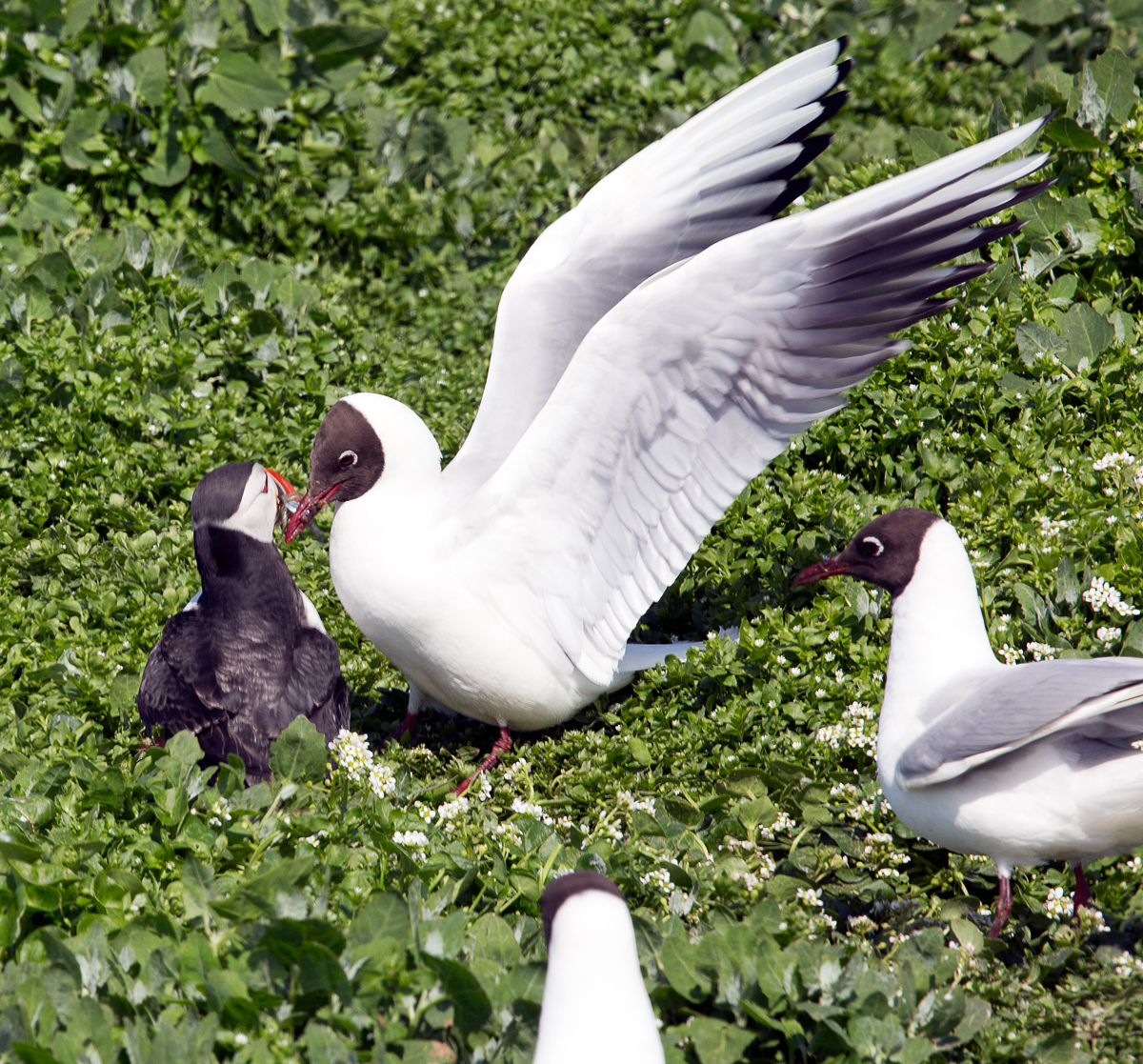
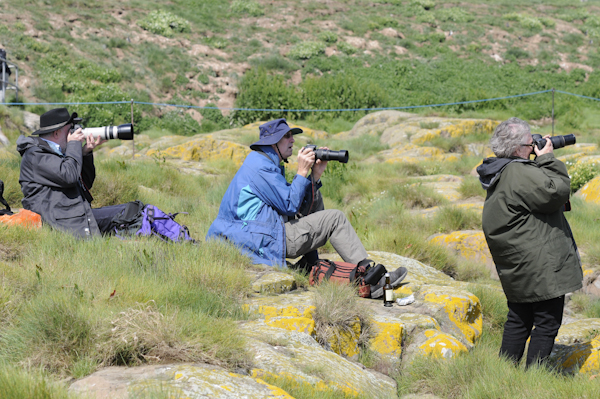
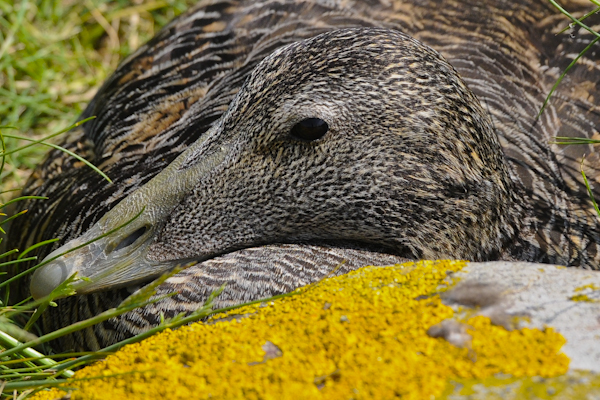
    That turned out to be an excellent decision, with  Saturday dawning dry, bright, sunny and with only a hint of a breeze.  We arrived in Seahouses just after 09:00 and were soon onboard Glad Tidings II, with William at the helm, on our way to Staple Island, passing groups of Grey Seals lazing in the sunshine.  Staple can be a difficult island to land passengers on, but it’s always worth the effort.  Puffins with beakfuls of sandeels were next to the landing and many photographers from our boat didn’t make it any further on to the island for quite some time.  Fulmars, Kittiwakes, Shags, Guillemots and Razorbills are all good photographic subjects, Puffins are the real stars of the island but there were some very accessible female Eiders incubating too. A frequent mantra that I try to instill into our photography clients is to choose their battles carefully – whatever focal length lens you have, there’s always the opportunity to take stunning images.  Don’t frustrate yourself by trying to over-reach the performance of your equipment.  I had a camera with a 70-200mm lens in my rucksack – not a long focal length, but enough when you’ve got a subject quite close.  We explored bits of the island looking for a spot that offered Puffins in flight at reasonable distance, and the best bit of the morning on Staple came during our lunch break, when  Puffins were flying so close overhead that you could hear the whirring of their wings, and everyone sat back, relaxed and tried to second-guess which direction each Puffin was going to fly 🙂  With a lovely group of clients, the day was a real pleasure, and we were soon on Glad Tidings IV, transferring to Inner Farne for the afternoon.  Inner Farne offers similar to Staple, but with the addition of Common, Arctic and Sandwich Terns and we explored the island in search of photographic subjects.  The first three images below are my own.  Puffinin flight, Black-headed Gull tussling with Puffin, Arctic Tern and Common Tern images are all (c) J. Spence.  Many thanks to John for letting us use his stunning images in this blog post 🙂

    Beautiful weather, great clients and the ‘Galapagos of the North’ – what a great end to the month, although for NEWT the month wasn’t quite over yet…

    Photography tuition Northumberland,photography courses Northumberland,bespoke photography Northumberland,Farne Islands,Northumberland

    Common Eider,Somateria mollissimma,Staple Island,Farne Islands,Northumberland,phtography courses Northumberland,photography tuition Northumberland,photography holidays Northumberland,

    Atlantic Puffin,Fratercula arctica,Staple Island,Farne Islands,Northumberland,photogarhy courses Northumberland,photography tuition Northumberland,photogarphy holidays Northumberland

    Atlantic Puffin,Fratercula arctica,Farne Islands,Northumberland,photography tuition Northumberland,bird photography Northumberland,photography courses Northumberland,photography Farne Islands

    Atlantic Puffin,Fratercula arctica,Black-headed Gull,Chroicocephalus ridibundus,Farne Islands,Northumberland,photography tuition Northumberland,bird photography Northumberland,photography courses Northumberland,photography Farne Islands

    Common Tern,Sterna hirundo,Farne Islands,Northumberland,photography tuition Northumberland,bird photography Northumberland,photography courses Northumberland,photography Farne Islands

    Arctic Tern,Sterna paradisaea,Farne Islands,Northumberland,photography tuition Northumberland,bird photography Northumberland,photography courses Northumberland,photography Farne Islands


  • Variety is the spice of life; Coastal safari 26/05/2014

    A brilliantly sunny Bank Holiday Monday is the only time you’re likely to encounter anything even remotely approaching crowds of people in Northumberland, but it does happen occasionally.

    I collected Marcus, Alison, Norman (Grandad) and Isobel from their holiday cottage in the shadow of the Wandylaw wind farm, and we set off for a day wildlife-watching.  With it being such a sunny morning, I thought it would be worth starting with one of our trickier animals; if it’s too cold they won’t be out and about, if it’s too warm they’ll already have slithered off somewhere cooler, and if they feel the ground vibrate as you approach they’ll beat a hasty retreat.  We know just the spot to see them when everything falls into place though; a warm, bare, stony patch of earth surrounded by tall grass.  At first we couldn’t see any sign, but I crept through the vegetation for a closer look.  Two Adders weren’t keen on this, and quickly slithered away into the long grass.  The third one was much more obliging though, and I motioned for Isobel to come a bit closer.  Incredibly, the snake remained coiled, and settled, for a few minutes.  It eventually lifted it’s head to fix us with a baleful reptilian glare for another minute before following it’s companions into the vegetation and out of sight.

    In the bright sunshine Kestrels hovered over roadside fields, Willow Warblers sang their silvery descending cadence, Chiffchaffs endlessly repeated their name, Chaffinches were proclaiming their territories (and Isobel had done a very impressive colouring of a Chaffinch picture), the scratchy rattle of Whitethroat song buzzed through the warm air, flotillas of goslings patrolled the water with their parents in close attendance and darting damselflies added a streak of azure to the lush green of the grass.  Down on the coast, dainty Avocets swept the water edge for morsels, Grey Plovers (probably my favourite wader, certainly when they’re in their summer finery) chased back and forth, Common andSandwich Terns roosted together, Fulmars rode the updraft of the warm breeze along the clifftops, Eiders were resplendent in the sunshine, and ‘wooly bear‘ caterpillars and cuckoo spitwere just the thing for a six year old to enjoy 🙂

    Most entertaining though, judging by the giggling, was a Rook that was rummaging through a bag of rubbish and found what it seemed to consider a suitable food item.  That item was a (full) dog-poo bag…  So disgusting that I almost titled the blog after it 🙂


  • Birdwatching in an iconic landscape; Lindisfarne 23/09/2013

    After two long hard days offshore (8hr pelagic on Saturday – blog post coming soon! – and 14hr offshore on Sunday for a North East Cetacean Project transect survey) today brought some light relief from the rolling swell of the North Sea as I headed north to Seahouses to collect Phil and Ann (who had won a morning out with NEWT in a competition on Visit Northumberland) and Rachael and Alex, who by happy coincidence were all staying at St Cuthbert’s House.

    In weather that was glorious, even by the high standards set during this year, we headed north towards Holy Island.  In the north of Northumberland, with a falling tide, it was looking like a good waders and wildfowl morning.  Mudflats were dotted with a mosaic of Mallard, Shelduck, Curlew, Dunlin, Lapwing, Redshank, Oystercatcher and Pink-footed Geese and, as we drove along the coastal road towards Holy Island, we had the treat of watching a Sparrowhawk as it flew just ahead of us, only inches above the road.  Ringed Plover and more Dunlin, Curlew and Redshank were feeding in the mud of Holy Island harbour, Pied Wagtails were, well, wagging their tails along the pebbly edge of the harbour, a flock of House Sparrows was engaged in stripping the seeds from grasses just above the tideline and House Martins and Swallows were sallying back and forth in search of insects in the warm autumn sunshine.  Flocks of waders in flight are a spectacle to rival any other and as we watched, and listened to, a group of Grey Seals that were hauled out on the sandbanks between the island and the mainland, the amorphous twisting turning shapes in the air high overhead resolved into flocks of Golden Plover and Bar-tailed Godwit.

    The final part of the plan for the morning was a short session of seawatching.  Sandwich and Common Terns were diving close to the shore, Gannets were a bit further out and the sea was dotted with the dark shapes of EidersTurnstones were perched on the top of rocky outcrops, a Harbour Porpoise proved elusive as it surfaced to breathe and an Arctic Skua raced south before everyone could get on to it.  Obligingly it came back north, settled on the sea for a little while and then continued steadily north before breaking off into a aerobatic attack on a Sandwich Tern with another skua joining in as the tern twisted and turned in an attempt to evade the pirates of the sea as they attempted to rob it of it’s recent catch.

    Lots of birds, lots of interesting wildlife behaviour to watch, and four clients who were all great fun to spend the morning with – if I ever suggest that I’m going to return to teaching, just point me in the direction of this blog post 🙂

  • Stumbling across a twitch

    Late August/early September is an exciting time on the Northumberland coast; wader passage is still ongoing, wintering wildfowl are arriving and you just never know what could turn up…

    I collected Andy and Lia from Alnwick and we set off for a day birdwatching on the Northumberland coast from Bamburgh to Druridge BayKnot, Turnstone, Oystercatcher, Curlew, Sanderling and some very elusive Purple Sandpipers started the day for us, as Linnets fluttered around in the long grass, Meadow and Rock Pipits were around the tideline, Gannets were soaring majestically by and Eider and Common Scoter were bobbing around just beyond the surf and a mixed flock of Common and Sandwich Terns were flushed by walkers before settling back on the rocks close to the breaking surf.  Offshore a small flock of birds grabbed my attention, and through the telescope resolved into one of Northumberland’s winter specialities; seven Pale-bellied Brent Geese steadily heading north were our first of the autumn.

    Further south, waders were still the main focus of our day;  Dunlin, Redshank, Greenshank, Snipe, Whimbrel, Black-tailed Godwit, Bar-tailed Godwit and Ruff were all pottering about in the water’s edge.  When we arrived at East Chevington to look for the Spotted Crake, there were a few local birders already there.  With an astonishing amount of luck, we’d arrived just as a White-rumped Sandpiper was being watched 🙂  Not the easiest of birds to identify, but as it wandered around a flock of sleeping Teal with Dunlin and Snipe alongside for comparison it stood out quite well.

    Another cracking day’s birdwatching, with a proper rarity to add a touch of the unusual 🙂

  • Whales, Waders and Wildfowl day (1 and) 2

    After getting back to Seahouses harbour at the end of our Whale and Dolphin Cruise, Sarah headed south back towards home, and myself and Bill followed the coast north to Holy Island.  The breeze had been strengthening while we were offshore, and around Holy Island it was close to unmanageable, with even a heavy stable tripod struggling to remain still enough to use the telescope.  We did find Bar-tailed Godwit, Ringed Plover and Dunlin around the harbour, but soon beat a hasty retreat – via the ice cream van 🙂

    Heading back down the coast in the shadow of Bamburgh Castle, we watched flocks of Eider loafing just offshore and a mixed flock of Common, Sandwich and Arctic Terns held a surprise in the shape of an adult Roseate Tern.

    Dinner at The Swan was followed by discussing the plans for the next day, and on Sunday we concentrated on Druridge Bay and south east Northumberland.  It turned out to be a good day for waders, with Ringed Plover, Little Ringed Plover, Dunlin, Curlew and plenty of Snipe.  Perhaps the wader highlight of the day though were flocks of Black-tailed Godwit and Ruff arriving from the north east, pausing briefly to drink and rest and then departing to the south west.  A bird that’s rarely seen made it’s way onto the trip list too, as the long-staying Spotted Crake at East Chevington wandered in and out of the reedbeds.  Goosander, more Eider and lots of Grey Herons were around the River Coquet and it was soon time to head off, collect Sarah and go into Morpeth to eat at the excellent Nadon Thai.  It was an excellent two days, with a client who was excellent company, a keen birdwatcher and knows a lot of sites in and around Norfolk, where we haven’t been for a few years now, really well.

    Whales? yes. Waders? yes. Wildfowl? yes.  It was the holiday that does exactly what it says on the tin 🙂

  • Northumberland coast birdwatching and Otter-spotting 16/07/13

    Sometimes I think that I’m lucky, sometimes I’m quite sure that I’m lucky, and sometimes I have absolutely no doubt…

    As the heat of the day began to cool, with increasing cloud cover, it was time to head out and collect the five clients for our Otter mini-Safari.  I picked Gabrielle and Michael up from Morpeth and then drove across to Church Point, where Andy had already met up with David and Rhian.

    Before we’d even got everyone in the car, there was chance for an ID session with a bird that everyone was aware of, but wasn’t quite sure how to identify; a very obliging adult Mediterranean Gull flew by, perched on a lamp post, flew by again, was joined by a 1st summer bird and then drifted off out over Newbiggin bay.

    As the evening passed we had some excellent birdwatching encounters; three Little Egrets were very welcome, Grey Herons were sitting around just about everywhere that we visited, two summer-plumaged Red Knot flew by, Little Gulls were deftly picking flies from the calm water’s surface as Sandwich and Common Terns took a slightly more forthright approach to the acquisition of food, two juvenile Marsh Harriers were testing out their wings low over a reedbed and an adult male, began quartering the sand dunes, Eiders swam close to us and Curlews, Lapwings and Oystercatchers were all roosting peacefully.

    Then, at the site that I’d thought would be the best place to complete our trip, David said the words that everyone was waiting to hear “I’m sure I’ve just seen an Otter“.  Making it’s way quickly along the edge of the pool, it took a few minutes before everyone had seen it.  Then it just got better – first we could track it’s progress by the expanding ring of Mallards, Gadwall and Tufted Ducks around it’s exact location, then by the ring of bright water each time it surfaced in the shadow of the reeds, before we suddenly had a stampede of ducks hurrying past just a few metres away from us.  Sure enough, the Otter was now making it’s way along the edge of the pool on the side where we were sitting, passing closely enough that binoculars weren’t necessary 🙂  As it overshot the ducks, the stampede reversed direction and the Otter made it’s way into the darkness of the reeds.

    With a request for Barn Owl from the back of the car, I knew which route we’d take back down the coast.  Sure enough, perched on a roadside wire, the ‘White Owl‘ might have well been waiting for us, before flying parallel to the road over the fields and into the night 🙂

  • Wildlife in the heat of the summer; Otter Safari 06/07/13

    After an enjoyable few hours watching the British & Irish Lions demolition of Australia, I loaded up the car, collected our picnics from The Swan and headed north to collect Jacky and Marcus from their holiday accommodation at the stunning St Cuthbert’s House.  A quick drive back down the coast and we collected Alice and John and embarked on our search of Druridge Bay, southeast Northumberland and the Northumberland coast.

    I’d identified a site where Otters have been active in the late afternoon, so that was our first port of call.  With Common Terns dip-feeding just in front of us, Canada and Greylag Geese with goslings, Gadwall with ducklings and lots of Sand Martins and Swallows there was plenty of birdwatching interest as we waited in hope for the possible appearance of our target species for the trip.  Jacky’s excited comment “there’s a…yes, it’s an Otter” marked the start of nearly an hour of Otter activity.  The initial animal turned out to be two together, and then eventually we were watching four of them as they swam back and forth, feeding, clambering on poolside rocks and play-fighting 🙂

    Lapwings, Curlew and a Greenshank were all evidence of post-breeding gathering/migration, Starlings were grouping into larger flocks as daylight faded, Sand Martins were swirling in a big pre-roost flock, a Barn Owl drifted on silent wings over a reedbed and, as the falling light levels finally rendered everything as a silhouette we headed back to the car with pipistrelles hawking just over our heads.