Last weekend was the Big Garden Birdwatch and we followed tradition by sitting in our kitchen with a mug of coffee, and a bacon and tomato sandwich, having topped up all of the feeders the evening before. An hour later, we’d racked up a list of 21 species; Blackbird 3, Jackdaw 2, Collared Dove 2, Robin 3, Chaffinch 20, Great Tit 3, Coal Tit 3, Magpie 1, Blue Tit 2, Dunnock 1, Goldfinch 8, Jay 1, Bullfinch 1, House Sparrow 1, Greenfinch 1, Woodpigeon 2, Redwing 1, Tree Sparrow 1, Song Thrush 1, Sparrowhawk 1, Brambling 2. Quite a successful hour, although most species weren’t present in the numbers we would have expected and, as usual, several species that had been visiting the garden in recent days (Marsh Tit, Willow Tit, Long-tailed Tit, Siskin, Great Spotted Woodpecker) failed to appear during the 1 hour of the survey. Easy birding, and part of a huge national survey. If you didn’t do it this year, give it a go in 2014 🙂
Tag: Chaffinch
-
North Pennines Wild Watch
We’ve had the first two bird ID sessions for the North Pennines WildWatch project already, and both have produced some excellent sightings during the ‘in the field’ bit of the course.
The first session, at Eggleston, produced one outstanding bird – at least for those in the group who weren’t impatiently hurrying back for their bread, cheese and soup…as a group of us watched a Song Thrush gathering food, I looked skywards (a good habit to get into, you never know what could be overhead) and there was an Osprey 🙂 Bird of the day/month/year for those who were lucky enough to see it.
One of my favourite species rounded off the first session, and the second session around Muggleswick as well, as we watched Woodcock roding and chasing each other. The end of the first session produced another exciting bird that was missed by the group that headed straight back to the cars, as a few of us heard, and then saw, a Tawny Owl.
Both sessions concentrated on identifying birds by song and call, with paticipants getting to grips with Chaffinch, Greenfinch, Blackbird, Blackcap, Willow Warbler, and Chiffchaff amongst others, and the third session, at Lambley, will have the same focus. I changed approach between the first two sessions, and I’m busy restructuring the course for the third session based on the teaching/learning experiences gained during the first two. I knew there was a reason we bought a parabolic microphone (there’s a reason for everything, we just don’t always realise it at the time…) 😉
-
(Man-made) Wilderness
On Saturday I had the pleasure of guiding a visit to Kielder (I still can’t bring myself to write Kielder Water and Forest Park…) for a group of Landscape Architecture students from the University of Michigan.
After collecting the group from Saughy Rigg (which will be the base for our ‘Autumn Colours’ photography holiday and ‘Winter Wonderland’ birdwatching holiday later this year) we headed up the North Tyne valley and began our tour of Kielder at the dam wall. With a stiff breeze blowing down the valley, we had a walk that would blow away any cobwebs. As I described the 2 extraordinary achievements that were the planting of the forest and the creation of the reservoir we watched Oystercatchers and Chaffinches and saw Crossbills and Siskins flying overhead. Coal Tits and Goldcrests were calling from the trees and the students enjoyed looking at some of the sculptures around the lake.
I devised a route back to Saughy Rigg that took in some open heather moorland, so that the group would have a good idea of what the Kielder area would have been like prior to the planting. Over that moorland we watched Curlews mobbing a Common Buzzard, and Lapwings were engaging in their apparently chaotic display flight.
After returning the group to Saughy Rigg, I drove eastwards, back towards southeast Northumberland, still birdwatching; just a few miles from home a flock of 150 Fieldfares were a reminder that winter is only just behind us, contrasting with the Chiffchaff that was singing in our garden.
Our Kielder Safaris this year will again include driving along tracks that are ‘off-limits’ to the public. With excellent views of Goshawk, Roe Deer and Red Fox along those tracks last year, and a real sense that you’re in a wilderness, it’s a very different wildlife experience. We’ve got a few spaces left, so give us a call and join us on a Safari through the forest.
-
Feeding time
I’ve never been good at sitting in the office and concentrating on one task for any length of time. Having an office window that looks out over the 76ha of mixed woodland of Choppington Woods LNR is a real blessing, allowing me to mix work and birdwatching. When I need to stretch my legs, a quick trip downstairs lets me open the patio door and turns the kitchen into a very comfortable and convenient bird photography hide.
Our garden is currently hosting at least 8 Bramblings, along with Greenfinches, Goldfinches, Chaffinches, Bullfinches, Blue, Great, Coal and Long-tailed Tits, occasional visits from Siskin, Redpoll and Treecreeper and regular fly-throughs by our local Sparrowhawks.
It’s a wonder I ever get any work done 🙂

Goldfinch 
Chaffinch 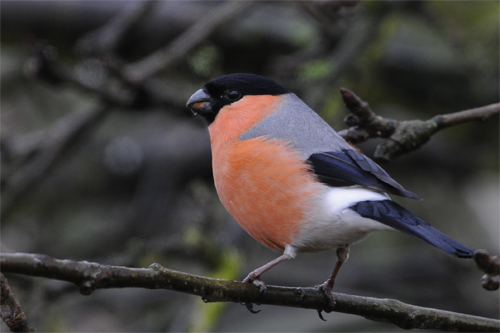
Bullfinch 
Brambling 
Brambling -
Early morning – Choppington Woods
Early morning, and the ground underfoot varies from frozen crunchy to treacherously boggy. The sky overhead is a deep blue, the first rays of sunlight yet to bathe the fields, hedgerows and woodland in that magical golden glow. Clattering wings herald the departure of nearly 1000 Woodpigeons from their overnight roost, and a Blackbird rustles through the vegetation in the hedge bottom. A menacing shape carves through the air just above the treetops; the menacing flap-flap-glide of our local male Sparrowhawk, beating the bounds of his territory in search of the wintering flocks of Siskins, Redpolls, Crossbills, Chaffinches and Bramblings. The pungent scent of a Red Fox marks an area that I’ll want to stake out with my camera on another day, and as I head back towards home a Roe Deer springs across the path just a few metres ahead of me and disappears into the plantation just behind our house. An excellent way to prepare for the day ahead 🙂
-
Another big freeze
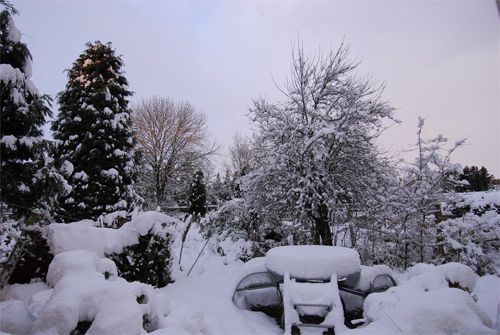
Here we go again… It’s hard to believe that we posted on the blog back in January about the big freeze last winter and here we are again in a similar position already before the end of November (although at least at the moment it isn’t so prolonged).
I went in to Newcastle last Wednesday for a seminar about the IMCORE project, and there was a bit of light snowfall. When I came out of the Ridley Building an hour later the world was white, and it’s just gone on from that point. After Sarah got home from work on Thursday evening the next time we used either of the cars was when we dug her car out of the snow this morning so she could go to work. We’ve made the most of the last few days though; walking the 2 miles there (and 2 miles back) each day to visit a friend who’s now in a residential care home, doing most of the admin in 3 days that we would usually do through the winter (including adding all of our 2011 trips to the website) and finalising a couple of projects that we’ve been working on.
Birdwatching in our little part of southeast Northumberland has been interesting for the last few days. We’ve got an ever-expanding flock of Coal, Great and Blue Tits, Dunnocks and Wrens are now ever present around the feeding station and a very optimistic pair of Collared Doves were mating at the top of the Apple tree earlier this morning. Two pairs of Bullfinches are regular visitors but other finches are in short supply; there’s just a single pair of Chaffinches, we’ve only had one visit from Goldfinches in the last few days and, particularly worrying, we haven’t seen any Greenfinches around the feeders at all. A Sparrowhawk is still regularly patrolling over Choppington Woods and a flock of 50-60 Redwings flies out from the woods each morning.
Now, after a morning of blue skies, it’s just started snowing again.
-
Birds in the mist
With a good breeze coming from the east and misty drizzle on the coast, conditions have been looking good for a fall of migrants since yesterday morning. Some of the most exciting birdwatching available on the Northumberland coast happens in conditions like these…
As we left the house last night to walk down to The Swan, Redwings could be heard overhead and the distinctive call of a Yellow-browed Warbler gave us a heard-only garden tick.
This morning we had to be out well before dawn to count Pink-footed Geese at East Chevington as part of the Icelandic Goose Census. The air over the dunes was filled with the calls of Redwings, Song Thrushes, Blackbirds, Chaffinches, Bramblings and Goldcrests. Eventually, nearly 3000 geese departed their overnight roost and we drove to Cresswell, ready for our second survey of the day. This time it was our regular WeBS count. After a brisk walk north along the beach of Druridge Bay we arrived at East Chevington for the second time this morning, where there were flocks of Chaffinches and Goldcrests in the hedgerows and Sarah spotted a ‘ringtail’ harrier, but it quickly passed through. After taking both cars back home, and deciding how to spend the rest of the weekend (although most of that is predetermined), Sarah’s just gone to do some shopping, and I’ve just had a call about a Red-flanked Bluetail at Newbiggin…decisions, decisions 🙂
Our October tours will concentrate on the coast and birdwatching will feature heavily. Give us a call on 01670 827465 to find out what’s on offer and what we can do to enhance your Northumberland birdwatching experience.
-
Setting the scene
Sunday started with a journey to inland Northumberland, birdwatching on some heather moorland in order to complete our final 2 ‘early season’ visits for the BTO Bird Atlas. Contrary to the forecast weather, it was cold, windy and drizzly. However, we set off and were eventually rewarded with a dramatic improvement as the sun came out and so did the birds. Alongside all of the Willow Warblers, Chaffinches, Skylarks and Meadow Pipits the highlights were at least 3 Spotted Flycatchers and a stunning male Whinchat. A pair of Curlew began alarming as we crossed the moorland, constantly changing position to draw us away from their nest location.
After a walk of just over 5 miles we headed home and decided that we would venture out towards dusk in search of badgers. We’ve got an Otter and Badger trip on Thursday so we needed to check on the current status of a couple of setts that we’ve been watching for some time. As we settled into position, with what appeared to be a horde of bats flying around, Blackbirds and Mistle Thrushes were alarming (as they often do late in the day). Soon, movement on the hillside opposite revealed our first badger of the evening. Very grey, with cream stripes, it came out of a sett, squatted on a patch of bare earth and then vanished into the undergrowth. A second animal quickly followed, much more gingery than the first, and then a third, starkly black and white. It really is a privilege to sit and watch these magnificent animals as they go about their business (no pun intended).
After such a successful evening, getting a ‘phone call earlier today “can you take us out to look for Red Squirrels, Otters and Badgers tomorrow please” was exactly what we wanted. Once upon a time I wouldn’t have been happy working on a Bank Holiday weekend, now it’s an enjoyable part of my career choice. Just over 2 years in, and I don’t regret even a tiny part of that decision.
-
A forest foray
After a Druridge mini-safari on Tuesday, which included a visit to the Common Crane near Eshott, yesterday was something completely different with a Kielder Safari.
After collecting Ruth and Diana from Stannington we took the scenic route up through Knowesgate to Bellingham, in the wilds of west Northumberland. That’s the point where we deviate from the public roads and follow a track that’s off-limits to the public. Along the way we saw a few Buzzards, but a superb male Goshawk, and an incredibly skittish Red Fox, were the highlights of the drive through the forest. Around the reservoir there were Crossbills and Siskins everywhere. Lunch just over the border in Scotland was followed by more birdwatching and the spectacle of a Common Buzzard catching, dismembering and consuming a vole. With lots of other buzzards up in the air whenever the sun came out, there was plenty to see. A stunning drake Mandarin brought a splash of garish colour to the afternoon and a long-distance ‘scope view of last year’s Osprey nest revealed a small white blob – probably the head of one of the pair that have returned to the site. As we headed back towards civilisation a large flock of Fieldfares and Redwings near Bellingham was a reminder that the winter is only just behind us.