Month: May 2013

  • Three stars

    I collected Zoe, Richard, Ella, Luke and Charlie from Alnmouth and we started our evening mini-safari around the Northumberland coast and Druridge Bay. It wasn’t too long before we were watching one of the birds that never fails to grab the attention of our clients; a beautiful, ghostly pale, Barn Owl was quartering the vegetation close to the water’s edge before plunging into a reedbed in pursuit of prey.  A Roe Deer played hide-and-seek with us, as it persistently walked out of sight behind a bush before reappearing, first to one side of the bush then the other and Sand Martins, House Martins, Swallows and Swifts were all hawking insects, allowing a detailed observation and discussion of these species that less-experienced birdwatchers often find confusing.  Black-headed Gulls and Little Gulls were watched at close quarters, with the Black-headed Gulls squabbling with each other like a group of children 🙂  Little Grebes were, well, just as cute as ever and two large Bats flew over, not echolocating, not feeding, just heading somewhere on a mission.

    Heading north, our 2nd Barn Owl of the evening was flying just ahead of us, and perched briefly in the lower branches of a roadside tree, Rabbits were scampering around on grassy banks and our 3rd Barn Owl was silhouetted in a bare tree like a sentinel guarding the road back to Alnmouth.
  • Head for the hills

    Away to the northwest of our base in southeast Northumberland is the skyline-dominating range of the Cheviot Hills.

    I collected Susan from Cheviot View and we headed towards the Harthope Valley via the ford at Coldgate Mill.  A stop along the road produced Redshank, Oystercatcher, Lapwing and the always impressive Brown Hare.  In glorious weather we walked for nearly five hours around various parts of the valley.  Curlews sang their eerie song from the heather clad slopes above, Tree Pipits delivered their challenge to rivals, and serenade to potential partners, the descending silvery cadence of Willow Warblers shimmered in the air around us, a Whinchat flitted from rock to heather, and back again, Grey Wagtails lived up to their name – wagging their tails from rocks and fence posts along our route – and the ‘swee-wee-wee-wee-wee’ of Common Sandpipers echoed around the sides of the swiftly flowing stream in the valley bottom.  As the afternoon wore on we watched as a Kestrel patrolled the steep valley sides, a Sparrowhawk soared across the valley and a Common Buzzard hovered over a distant plantation.

    Delivering peace, solitude and some excellent wildlife-watching opportunities, the hills are a great place to enjoy your wildlife and get some exercise too 🙂

  • Nature’s bounty

    After a day in the North Pennines, I had an hour at home before setting out for an evening mini-safari around Druridge Bay.  I couldn’t have anticipated that the evening would bring one of the most astonishing things I’ve seen…

    I collected Fiona and Damien from Morpeth and then headed north east to Amble to collect Mark and Mrs Blake.  The good weather of the earlier part of the day continued and we were soon watching four Avocets, and listening to a fifth, as a flock of Tree Sparrows foraged on a pile of rotting vegetation, a Grey Heron stalked along the edge of the pond and Black-headed Gulls hawked insects over nearby fields.  One of Northumberland’s long-standing Bird Race teams passed through and picked up Avocet and Little Gull for their day list.

    As we continued our journey north through the bay, it became obvious that there had been a huge hatch of insects.  Dense clouds of them were hanging around us and they were providing a feast for Black-headed Gulls (several hundred), at least eight Little Gulls and countless Swallows, Swifts, House Martins and Sand Martins.  With barely any breeze, and mirror-calm water, the birds were flying back and forth deftly picking insects from the water’s surface, and the swallows and martins were passing within a few feet of us.  The whirling, twisting mass of birds was breathtaking, and numbers had barely decreased by the time it was so dark that it was time for us to finish our evening.  Lovely clients, common birds, abundant insects and a memorable wildlife spectacle 🙂

  • Flying in for a day birdwatching in the North Pennines

    I always enjoy meeting up with our previous clients again, and Saturday morning found me at Newcastle Airport waiting to meet Jacob and Nancy as they arrived for a couple of days birdwatching in Northumberland.  They were going to be spending Sunday on the Farne Islands, but our destination on what was developing into a gloriously sunny Saturday was the North Pennines.

    Just 12 days earlier I’d been marvelling at the temperature of 1C at 10:30am but now Curlew, Lapwing and Oystercatcher were all flying around and calling noisily as we reached the higher ground southwest of Hexham, Skylarks were singing exuberantly against the azure sky, Meadow Pipits were ‘parachuting’ down at the end of their song flights and Common Snipe were calling from concealed positions in the grassland.  In the stunning light, Barn Swallows were eye-wateringly iridescent, a pair of Golden Plover flew in front of us and a pair of Red Grouse watched closely over eight chicks.  Red Grouse was a lifer for Jacob and Nancy and one male allowed a very close approach and provided a lot of photo opportunities for them.  Eyebrows, raised, eyebrows lowered, facing left, facing right, staring into the lens; he went through a veritable supermodel repertoire of poses before seemingly melting into the vegetation.

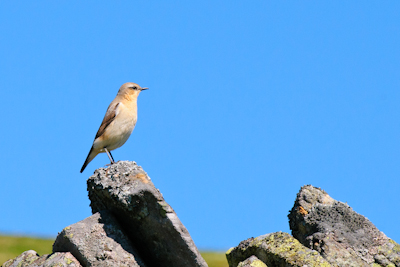
    As we travelled across a high moorland road, a Northern Wheatear posed obligingly for photographs.

    Northern Wheatear Oenanthe oenanthe,bird photography,bird photography holidays,bird photography courses,birdwatching holidays,Weardale,County Durham,North Pennines,www.northernexperienceimages.co.uk

    Skylarks and Meadow Pipits provided a memorable aural backdrop to our lunch stop, and a Golden Plover was silhouetted on top of a nearby ridge, keeping a close eye on it’s territory.  Near perfect weather, a gentle breeze, spectacular landscape and stunning birds; what more could you want from a day’s birdwatching?

  • Spring (Gentian) time in the hills

    The ‘quality over quantity’ birdwatching in the North Pennines has been the predominant feature of our days out with clients in the last two months, and a ‘phone enquiry on Tuesday saw me collecting David and Margaret on Wednesday morning for a day birdwatching in the hills.

    Red Grouse was the first of the upland specialities we encountered and, after a few single birds scattered across the moors we came across a pair with a brood of 10 chicks.  The adults watched us carefully as their offspring wandered about, completely unconcerned by our presence.  Lapwing and Curlew seemed to be everywhere and one Lapwing provided our only sighting of Snipe for the day, as it chased one over the road in front of us.  Oystercatcher, Redshank and Golden Plover were noisily displaying, Kestrels were stationary in the strong breeze and our first three Black Grouse were all seen distantly.  I was sure that we’d get much closer views of Blackcock and, sure enough, at the same spot where I photographed a displaying bird earlier this month, we came across what were probably the same two birds from that trip.

    A walk at Cow Green reservoir brought a non-avian highlight as Spring Gentians were in bloom.  If you’ve never seen one, this is what they look like 🙂

    Spring Gentian,Gentiana verna,Upper Teesdale,macro photography tuition,flower photography tuition,www.northernexperienceimages.co.uk

    Spring Gentian,Gentiana verna,macro photography tuition,flower photography tuition,Upper Teesdale,www.northernexperienceimages.co.uk

    After our walk we watched a small group of Blackcock as they engaged in their, slightly comical, lekking behaviour before heading back north east after another excellent day in the hills.

  • Looking for an angle

    Landscape photography is a bit of an oddity; unlike wildlife, landscapes tend to not move while you’re trying to photograph them (and if the landscape did start to move, I don’t think having to use a faster shutter speed would the greatest of your worries…).  Composition and light are the two factors that I always emphasise to clients on our landscape photography workshops and bespoke tuition sessions, and Tuesday afternoon gave me the opportunity to do that in one of Northumberland’s most iconic settings – the Holy Island of Lindisfarne.

    I met up with Pat mid-afternoon and we headed towards the harbour.  Perhaps a cliched location but with so many boats, so many viewpoints and the ever-changing sky and lighting conditions, there was plenty of scope for playing with exposure, composition and shooting angle.  As Pat took a series of images using her own lens and a couple of mine too (12-24mm f4 and 105mm f2.8) I scouted out different compositions and shooting angles for her to experiment with.

    Northumberland has so many iconic locations for landscape photography that you could visit a different location every day and never get bored or take the same image twice.  If you’re a relative beginner and want to learn how to use your camera equipment to the best of it’s ability, or a more experienced photographer and would like to explore Northumberland’s rich opportunities with a local guide, give us a call on 01670 827465 to see what we can do for you 🙂

    Lindisfarne Castle,Holy Island,Northumberland,landscape photography courses,landscape photography holidays,www.northernexperienceimages.co.uk

    Lindisfarne Castle,Holy Island,Northumberland,landscape photography courses,landscape photography holidays,www.northernexperienceimages.co.uk

    Lindisfarne Castle,Holy Island,Northumberland,landscape photography courses,landscape photography holidays,www.northernexperienceimages.co.uk

  • Waiting for the light

    In an ideal world, a bespoke photography day with a client involves arriving at our chosen location, discussing techniques that will be required to achieve the desired image and then waiting for the perfect light to fall on the subject…

    I arrived at Church Point on Sunday afternoon to collect Gareth for his bespoke photography trip.  My task was to deliver locations that would provide the opportunities for landscape or wildlife photography, and give advice on technique when needed.  In advance I’d planned a route through Druridge Bay, southeast Northumberland and the Northumberland coast that would provide a series of landscape opportunities.  So, discovering that visibility on the coast was poor was a bit of a spanner in the works 🙂  My backup plan was some nice close, obliging wildlife…swifts, swallows and martins were the ideal subject for the afternoon.  Difficult enough to test the abilities of most photographers, but usually obligingly consistent in their feeding, bathing and drinking behaviour.

    As Gareth honed his ‘birds in flight’ skills we had an unexpected bonus in the shape of four Otters!  A writhing sinuous mass of muscle and menace, they twisted and turned in the water before climbing onto the bank and one of them munched contentedly on the fruits of it’s labour – a large Eel.

    Displaying Redshank, typically unobliging Little Grebes and a ghostly Barn Owl drifting across a reedbed as dusk approached all added to the wildlife experience as Gareth shot lots of images of Swallows as they twisted, turned and stalled just a few feet away from us.  I managed a few shots myself, as we compared the effect of different camera settings, focal lengths etc.

    Common Redshank,Northumberland,photography courses,bird photography holidays,www.northernexperienceimages.co.uk

    Barn Swallow,Hirundo rustica,bird photography,Northumberland,bird photography courses,bird photography tuition,www.northernexperienceimages.co.uk

    Barn Swallow,Hirundo rustica,bird photography,Northumberland,bird photography courses,bird photography tuition,www.northernexperienceimages.co.uk

    Barn Swallow,Hirundo rustica,bird photography,Northumberland,bird photography courses,bird photography tuition,www.northernexperienceimages.co.uk

    Barn Swallow,Hirundo rustica,bird photography,Northumberland,bird photography courses,bird photography tuition,www.northernexperienceimages.co.uk

  • A chance encounter

    “The man sitting at Table 7 is walking the entire coastline of the mainland UK to raise money for the Alzheimers Society and Alzheimer Scotland”

    Chris’ comment as we arrived to spend Friday evening, as we do most Friday evenings, at The Swan suggested a customer with a fascinating repertoire of anecdotes… As Philip was about to head to his room, he came across to say goodnight to Chris and Kirsty, and we all got talking.  As he’s passionate about wildlife, fly-fishing, photography and sustainability there were plenty of shared interests to chat about 🙂  When we discovered that he hadn’t had much publicity for the Northumberland coast section of his walk, a flurry of texts and tweets (at 22:30 on Friday night) led to interviews on BBC Radio Newcastle and Radio Northumberland on Saturday as he walked from Cresswell to Blyth.  The other thing we could help him with was transport to Cresswell on Saturday morning, and some company for the first part of the walk.

    Martin collected Philip at 10:00 and accompanied him for a very wet five miles down the coast to Newbiggin.  Fulmars were soaring steeply above the clifftops, Gannets were heading north into the strong breeze and Skylarks sang overhead during interludes between showers.  As they reached Newbiggin a lady came out of her house and put some money into Philip’s collection tin – she had been keeping an eye out for him after hearing his interview on BBC Radio Newcastle!

    Philip’s a fascinating man, undertaking an amazing journey for a very worthy cause so if you can help him in any way, please do;  follow him on Twitter, donate via JustGiving or check the schedule for the rest of his walk and think if you can help in some way as he passes along your stretch of the coastline 🙂

  • Change of plan

    Snow on Monday, glorious weather on Tuesday…and torrential rain on Wednesday 🙁  When I arrived to collect David and Janet for their Prestige Tour in the Cheviot Valleys we quickly decided to head towards the Northumberland coast instead as that would offer the chance of plenty of birdwatching with the prospect of being able to shelter from the worst of the weather.

    Starting at Stag Rocks, we watched flocks of Eider and Common Scoter as they rolled up and over the substantial waves and a Grey Seal swam just beyond the breaking surf.  One thing that was immediately obvious was that there was a movement of Gannets; birds were flying over the rocks and more could be seen offshore.  Heading down the coast, the intensity of the rain increased and we had our second seawatch of the day, this time just south of Cresswell.  An almost continuous passage of Gannets was evident as they headed north, flocks of Kittiwakes and Guillemots were passing by, the occasional Fulmar arced up above the clifftops and a single Manx Shearwater easily outpaced the GannetsAvocets sat tight as the rain hammered down around them and, when the deluge finally ceased and blue sky and sunshine replaced the gloom, we watched a male Marsh Harrier as he quartered a nearby field before soaring heavenwards. A Great Crested Grebe sailed by serenely, a Whimbrel flew north, five Brown Hares were engaged in some half-hearted chasing and Swifts, Swallows, House Martins and Sand Martins all took advantage of the feast of insects that had been stirred to activity by the improvement in the weather.

    Even in poor weather, Northumberland can produce some excellent birdwatching 🙂

  • Glorious

    After the snow of last Monday, Tuesday brought two mini-safaris.  The first was a recce trip for a TV production company, assisting with checking out potential filming locations on the Northumberland coast.  The weather was glorious; beautiful blue sky, fluffy white clouds and a gentle breeze.  The peace and tranquility captured what Northumberland is all about – somewhere that you can relax and simply enjoy the countryside around you.

    The second trip of the day began as I collected Neil and Ann from The Swan, and we headed out on a journey along the coast.  Avocets were sitting on nests, Reed Warblers, Sedge Warblers and Reed Buntings were all singing and an incredibly bright Yellow Wagtail walked along the water’s edge.  With a bit of persistence we located a Grasshopper Warbler singing from a reedbed, body quivering as it delivered it’s ‘reeling’ song with it’s head turning slowly from side-to-side.  As we continued northwards we came across the first of three Barn Owls for the evening.  As dusk approached Roe Deer came out of hiding, a Red Fox ran across directly in front of us carrying prey, Common Pipistrelles flitted backwards and forwards against the darkening sky and the assembled ducks, geese and swans started acting very nervously.  I’d checked that site with Sarah two days earlier and watched a very obliging Otter as it fed.  Today though it remained hidden in the reeds, almost certainly the cause of panic amongst the wildfowl…