Tag: Wigeon

  • Every cloud has a silver(y) grey lining

    Our final full-day pelagic for 2012 was on Saturday and, although I was really looking forward to it, it’s always a shame when we reach the end of our offshore season.

    With strong winds on Thursday, and charter boats cancelling trips on Friday, I still felt that we’d be able to sail.  We gathered at Royal Quays just before 09:00 and boarded the SarahJFK.  Brian spotted a Great Spotted Woodpecker just after we set sail, and as we headed downstream we could see a little bit of swell and a few whitecaps offshore.  A skein of Pink-footed Geese high overhead were heading south, and we weren’t too far out of the river when we had our first skua of the day; and it was one of those ‘is it, isn’t it?’ moments as what was probably a dark Pomarine Skua flew north low over the waves.  Three Great Skuas were heading the same way, and another one later caused a ‘dread’ amongst the birds gathered round a fishing boat.  Fulmars and Kittiwakes were with us throughout most of the day and Gannets were soaring by on the breeze.  Our first Sooty Shearwater was in a raft of gulls behind a trawler, and we had at least five more during the day.

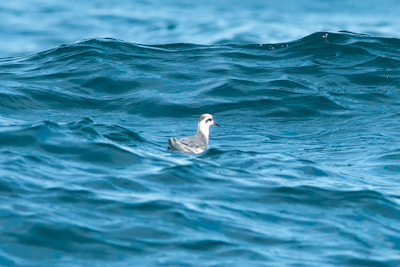
    As the swell began to ease slightly we were 8 miles off Cresswell, heading north west, when I saw two small waders flying up and over a wave crest.  As they dropped onto the sea I shouted “Grey Phalaropes!” and called to Allan to stop the boat.  Eventually we all had excellent views of these two tiny birds as they bobbed about in the swell.  They were the 2nd and 3rd that I’ve seen on pelagics I’ve organised, following the 1st out in the Farne Deeps in 2010.

    Grey Phalarope,Northumberland,bird photography,pelagic birdwatching trips,pelagic wildlife trips

    Grey Phalarope,Northumberland,bird photography,pelagic birdwatching trips,pelagic wildlife trips

    Grey Phalarope,Northumberland,bird photography,pelagic birdwatching trips,pelagic wildlife trips

    We headed towards the coast, and turned to make our way back towards Royal Quays.  Our only Manx Shearwater of the trip was followed soon after by a Pomarine Skua, found by Cain, six Red-throated Divers (including four flying south together), 42 Pale-bellied Brent Geese heading north, 20 Wigeon and 30 Common Scoter.  With only one Manx Shearwater, and no Arctic Skuas at all, this was quite an unusual pelagic but, if you like waders, and you like seabirds, then phalaropes are a dream bird 🙂

  • Autumn chill

    Friday was a trip that I’d been looking forward to for quite some time.  Emily had been on the bird ID course that I ran as part of North Pennines WildWatch and had then booked herself and her dad, Steve, onto an Otter Safari.

    I arrived at Church Point to collect them, and we set off up the coast.  With bright sunshine and a northerly wind, I predicted that our regular Little Owl would be sunning itself on the edge of its nest hole.  Sure enough, it was sitting in full view soaking up the rays 🙂  Waders featured throughout the afternoon, as they have done for over a month now, with Black-tailed Godwit, Curlew, Common Redshank, Common Snipe, Lapwing and very close views of Dunlin and Ringed PloverWigeon, Teal, Shoveler, Gadwall, Tufted Duck, Pochard and Mallard were all paddling around, Little and Great Crested Grebes were, as always, much admired, restless flocks of Greylag and Pink-footed Geese swirled from field to pool and back again, and several skeins of Pink-footed Geese passed south high overhead, their presence betrayed by their high-pitched calls.  A Grey Seal was loitering with intent in the Coquet Estuary, and a Grey Heron sat motionless by the water’s edge.

    We ended the day by a  moonlit river, under a starry sky.  A Grey Heron stalked through the riverside vegetation, and a group of Mallards stared intently into the shadows of the overhanging trees on the opposite bank, then scattered soon after the wake from an, otherwise unseen, animal caught our attention.  Darkness, and the chill night air, settled on the river as we made our way back to the car.

  • Enthusiasm

    Our Druridge mini-Safari with Karl and Linda featured some of those species that are at or near their northern limit in Britain; Avocets, a recent colonist of Northumberland, and Marsh Harriers, here for a few years longer, are always much appreciated and Newbiggin’s Mediterranean Gulls are an excellent example of a group of birds that is often overlooked or simply ignored by many.  Some of our commoner species go down well; Grey Heron, Curlew and Cormorant always get plenty of attention and Wigeon, Shelduck, Mallard, Red-breasted Merganser, Goldeneye, Teal and Great Crested Grebe all have their own attraction too.

    What I really enjoy about our trips is enthusiastic clients.  So long as we keep getting them, and Karl and Linda were no exception, I don’t think I’ll ever get jaded, no matter how much time I spend in the field.  A couple of frequent questions from our clients are ‘what do you do on your days off?’ and ‘what do you do when you’re away on holiday?’  For some reason, they never seem surprised when I give them the answer 😉

  • …and staying local

    After another day on Holy Island on Sunday (carrying out some contract survey work), I collected Jakob and Nancy from Royal Quays early on Monday for a day of birdwatching around the NEWT ‘local patch’; southeast Northumberland and Druridge Bay.

    We started with Mediterranean Gulls at Newbiggin.  Gulls may not be everyone’s bird of choice, but I defy anyone to tell me that adult Med Gulls aren’t stunningly beautiful 🙂  Sanderling, Redshank, Oystercatcher, Turnstone and Pied Wagtail were picking along the tideline as we watched the meds and we left them behind to continue our journey up the coast. Seawatching produced Guillemots, Razorbills, several Red-throated Divers, Fulmars using the breeze to soar incredibly close to the cliffsides and a possible ‘Northern’ Eider drifting south among the Common Eiders.  A Peregrine made its way south with those powerful, menacing wingbeats, Rock Pipits in small flocks danced about on the wind, and we left the sea (although not too far away!) and continued our journey.  Geese, which have characterised so much of our birding this winter are still around and we managed Greylag, Pink-footed, Canada, Barnacle, Taiga Bean and Eurasian White-fronted.  Goldeneyes are still around in good numbers, Teal, Shoveler, Gadwall, Wigeon, Red-breasted Merganser and Mallard were all resplendent (as most ducks tend to be in the late winter) and 2 Common Snipe circled several times before deciding that the pond wasn’t to their liking and heading off again.

    I returned Jakob and Nancy to the ferry terminal for their return journey to the Netherlands, and made the slightly shorter journey back to Scotland Gate myself.

  • Expect the unexpected

    Whenever we have a trip with clients who have been given gift vouchers, I always wonder what they expect.  Some will have chosen gift vouchers when asked what they would like, some will have been given them by our existing clients, and for some it must be a complete mystery tour.  When we get an enquiry we always try to determine exactly what our clients want, but at the start of a trip I’ll always enquire “is there anything you’re particularly keen to see while you’re in Northumberland?”  Then, the pressure is on to try and deliver that experience…

    I collected Patrick and Bronwyn from Amble yesterday morning for a day of birdwatching around Druridge Bay and southeast Northumberland.  As we set off it was a beautiful morning; sunny, calm and dry and I soon determined that one bird they would love to see was Bittern – they’ve visited sites where Bitterns breed and Bitterns overwinter but not, so far, anywhere where the aforementioned birds were obliging enough to come into view for them.  An hour into the trip and it was already windy, bitterly cold and spotting with rain but the birding was good.  2 Bewick’s Swans in a roadside field were very obliging, nibbling on the vegetation as we studied them, 12 Goosanders sailed majestically across a lake, Patrick’s sharp eyes picked out an immaculate male Sparrowhawk on a fence post and the air was filled with skeins of geese (Canada, Greylag, Pink-footed, White-fronted and Bean), a Skylark battled into the wind and Wigeon, Teal, Tufted Duck, Gadwall, Pochard, Mallard and Great-crested Grebe were picked out from the flock on the water.

    A brief visit to Newbiggin to track down a Mediterranean Gull (or four) was followed by lunch overlooking the North Sea. Heading up through the bay, Red-breasted Mergansers were displaying and a Short-eared Owl (the first of three for the afternoon) perched on a roadside fence-post.  Reedbeds were illuminated by that beautiful winter afternoon light (I wax lyrical about it frequently, but it really is a breathtaking backdrop to the wildlife and part of the experience).  As the afternoon light began to fade, Venus appeared overhead, a herd of Whooper Swans trumpeted their arrival for the evening roost and a Grey Heron shot out of one reedbed, flew across in front of us, landed just out of sight and flushed a Bittern that flew almost the reverse of the route taken by the heron, along the near edge of the pool directly in front of us and dropped into a reedbed and out of sight!  Wildlife may be unpredictable, but those days when it seems to perform to order leave me, and our clients, with a big grin 🙂  After that what more was there to do than spend the evening relaxing back at home with a glass of good red wine. Cheers 🙂

  • Here for the weather?

    Just as I arrived at Harkess Rocks to collect Andy and Helen for an afternoon of birdwatching around the Holy Island of Lindisfarne and the North Northumberland coast, the first drops of sleety rain began splattering on the windscreen.  We haven’t really had any sort of winter yet, apart from an hour of snow on December 16th, but yesterday afternoon did feel positively chilly.  Undaunted by the easterly wind and icy showers we enjoyed the wader and wildfowl spectacle that is the Northumberland coast in the winter.  Curlews  singing as they flew by must have a joie de vivre that lets them vent that emotional haunting call wherever they may be.  Other wading birds entertained as they probed, prodded and buried their bills face-deep in the mud; Grey Plovers, Bar-tailed Godwits, Redshanks and Oystercatchers were all making the most of the exposed mud at low tide.  A big flock of Yellowhammers, Chaffinches, Greenfinches, Goldfinches, Tree Sparrows, House Sparrows and Reed Buntings held our attention for a good while and wildfowl were well represented with Shelduck, Eider, Mallard, Teal, Wigeon, Goosander and Pintail.  As we watched a very obliging Dark-bellied Brent Goose, it was a sobering thought that our wintering birds are generally here because conditions in the areas where they breed are too harsh at this time of the year.  Mammals were braving the cold too; 7 Roe Deer, a Brown Hare and 5 Common Seals made a not too shabby mammal list for the afternoon.

    I often reflect on my decision to return to Northumberland from Arizona, and as we watched that lone Brent Goose, with the biting wind driving waves of showery rain, were my thoughts of the warmth and sunshine of Tucson?  No, what I was thinking was that this is the weather I came home for…and the reason that good outdoor clothing is a necessity 😉

  • It’s good to be back

    After a planned break from days out with clients, and regular exercise and ice-pack treatment for my knee, we had a mini-Safari on Wednesday afternoon.  Southeast Northumberland is our local patch, so I was getting back into the swing of things with something comfortingly familiar.

    I collected Alastair and Zoe from Church Point and we set out on an exploration of the River Wansbeck.  Stunning Red-breasted Mergansers and Goldeneye, and subtly attractive Little Grebes (amazing how many people still think of them as Dabchicks – a far nicer name!),  were diving along the edge of the river.  A handsome drake Goosander flew upstream and the first of the afternoon’s 4 Sparrowhawks drifted high overhead.  A flock of Long-tailed Tits, those noisy endearing pink and white fluffballs, made their way in procession from one side of the river to the other and Mallards began dropping out of the sky and following each other through the vegetation, quacking noisily.  As daylight faded a flock of Teal drifted backwards and forwards between a reedbed and open water, roosting Pheasants (my vote for most underrated bird in Britain) flushed from a Hawthorn hedge as we made our way back to the car in the dark, and it was time to return Zoe and Alastair to Newbiggin.

  • Winter Wonderland 28/11/11-01/12/11

    Last week was our Winter Wonderland birdwatching holiday, although as I arrived at Saughy Rigg I wondered if Windy Wonderland would be a better name for it 😉

    The original itinerary involved the Solway coast on Tuesday and the North Pennines on Wednesday, but a quick discussion with our guests on arrival meant that our coastal day was switched to Northumberland to avoid the poor weather in the west.

    The plan worked well, at least until mid-afternoon when the weather caught up with us and we had a couple of hours of dodging the showers.  The waders and wildfowl that winter here featured throughout the day and Greylag, Pink-footed, Pale-bellied Brent, Barnacle and Eurasian White-fronted Geese were all enjoying the mild weather on the Northumberland coast.  3 splendid drake Goosanders  were blown across Druridge Pools before battling their way back against the wind, and a Roe Deer was grazing in the gap between 2 reed beds.  As so often seems to happen, some of the best wildlife of the day saved its appearance until the light began to fade.  First a Short-eared Owl, with a strikingly white face, quartering backwards and forwards along the margins of a field, then 2 Water Rails, those small, secretive denizens of the reeds, stepped gingerly into view; prodding and poking and squealing like piglets as they vanished back into the gloom.  Then, as flocks of geese descended to roost, a Bittern flew from the reeds and headed south.

    Wednesday brought another breezy morning, and we headed into the hills.  Remarkable numbers of Red Grouse chuckled at us as we watched from the comfort of the car, and 7 Black Grouse were the first of no less than 75 that we found during the day.  The weather closed in all around us and, after a quick check of a lough wher Teal, Wigeon and Lapwing were roosting and Goldeneye were feeding, we finished the day at one of our favourite evening venues.  An unidentified raptor flew low across the heather moorland and out of sight over a ridge, Red Grouse burst from cover before settling again a short distance away and a lone Short-eared Owl battled into a brutal headwind as the evening faded to darkness.

    Winter Wonderland is one (in fact, two) of the holidays on our itinerary for 2012, so give us a call on 01670 827465 for more details or to book your place.

  • Hiding from the wind

    With a forecast for heavy rain today, we had one more client than expected yesterday for our Druridge Bay/southeast Northumberland tour.

    I c0llected Annie from High Weldon, Brian from Bedlington and then David from Warkworth before our first stop at one of our favourite birdwatching spots beside the River Coquet.  The first thing that was apparent was that there was a not inconsiderable wind-chill factor in play.  Thankfully our local area has plenty of reserves with north-facing hides, so plotting a route that would keep us out of the wind wherever possible was quite straightforward.

    It wasn’t a day for passerines, although Blue Tit and Goldcrest could be heard calling from deep inside coastal hedgerows, and we found ourselves in the middle of a big swirling flock of Starlings as we ate lunch overlooking the sea, so waders and wildfowl provided the main focus of the day.  Bar-tailed Godwit, Ruff, Dunlin and some very nice flocks of Golden Plover, Curlew, Knot and Lapwing were feeding, roosting and, at Cresswell, taking to the air in a panic as a Peregrine exuded menace as it passed over.  ‘Scope-filling views of Common Snipe always go down well, and there was an excellent array of wildfowl and waterbirds to enjoy; Gadwall, Mallard, Teal, Wigeon,Pochard, Goldeneye, Tufted Duck, Pintail, Little Grebe, Coot, Moorhen, and Pink-footed, Greylag and Barnacle Geese were all well appreciated, especially with a lot of the drake ducks out of eclipse plumage and looking quite stunning. especially when the sun broke through the clouds.

    When the autumn really starts to feel autumnal, I’m always optimistic 🙂

  • Arrivals

    The autumn regularly produces excellent birdwatching experiences, and our Friday afternoon Lindisfarne mini-safari was no exception.

    I collected Pat and Ian from Glororum and we headed north towards Holy Island.  With the tide falling, the newly exposed mud provided a veritable banquet for the massed waders and wildfowl.  As far as the eye could see the shoreline was lined with Pale-bellied and Dark-bellied Brent Geese, Barnacle Geese were arriving and the mud was a hive of activity with Wigeon, Teal, Bar-tailed Godwits, Curlews, Redshanks, Oystercatchers, Knot, Dunlin and Grey Plover all tucking in.  2 Carrion Crows were administering a warm welcome to a Peregrine, and a Little Egret flew in, landing beside another egret that was stalking around the edges of a pool on the mudflats.  As the afternoon wore on, we relocated to Bamburgh, and the rocks there produced excellent views of the waders we’d seen earlier as well as a few Purple Sandpipers.

    Then came one of those real experience moments.  Despite the strong offshore winds 3 Fieldfares were battling against the headwind, low over the waves.  They crossed the beach, flew by us and as they dropped towards the shelter of the coastal fields they were intercepted by 2 Sparrowhawks.  The final act of the encounter happened out of sight, but you can’t help thinking that it was a cruel end to a herculean effort.