Tag: White-beaked Dolphin

  • My lucky Tilley hat

    It protects my head from attack by Arctic Terns on trips to the Farne Islands, it prevents me getting sunburn, but now it seems to have developed an additional, almost mystical, power…

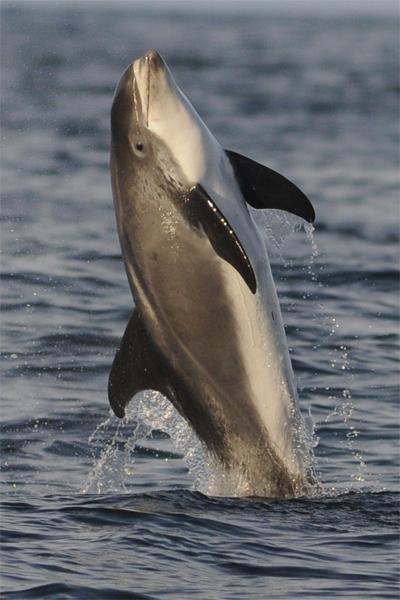
    With a spell of settled weather, and incredibly obliging sea conditions, I was full of optimism as I arrived at Seahouses Harbour for the first of this year’s Northern Experience Pelagics Farne Deeps trips.  We boarded Ocean Explorer and headed offshore, in search of Minke Whale and White-beaked Dolphin.  As always we found birds close to land, and then a period with little wildlife other than an occasional Gannet gliding by.  With land-based trips you learn to ‘read’ the habitat and weather conditions.  At sea, you don’t have that luxury; whatever the sea bed is like, the surface always looks pretty much the same 🙂  The wildlife itself provides the visual clues, and splashing in the distance simply didn’t look right for diving Gannets. Alan slowed the RIB and I scanned the horizon.  Again the same splashing, and it became obvious that there were lots of Gannets sitting on the sea in that area as well.  The first dorsal fins began to appear, and soon we could see a small pod of White-beaked Dolphins heading towards us.  Then more appeared…and more…and more.  Eventually we had between 60-100 dolphins bow-riding, breaching, feeding and generally providing excellent entertainment for all on board.

    White-beaked Dolphin [Lagenorhynchus albirostris],whale watching,dolphin watching,Northumberland

    White-beaked Dolphin [Lagenorhynchus albirostris],whale watching,dolphin watching,Northumberland

    White-beaked Dolphin [Lagenorhynchus albirostris],whale watching,dolphin watching,Northumberland

    White-beaked Dolphin [Lagenorhynchus albirostris],whale watching,dolphin watching,Northumberland

    White-beaked Dolphin [Lagenorhynchus albirostris],whale watching,dolphin watching,Northumberland

    The dolphins, Gannets and the fish they were feeding on drifted away so we sat with engines off and had our own meal break.  Just over half an hour later we encountered the dolphins again and they charged headlong towards the boat.  After another long session of breaching and bow-riding, we stopped the engines and let the dolphins head off to whatever they were planning to do next.

    We were heading back to shore at just over 30knots when my Tilley hat was lifted from my head by the breeze and landed in the wake 🙁  Now, one of the things about a Tilley hat is that if it falls in the water it floats.  Alan turned the boat and a few minutes later we recovered my hat 🙂  After nearly 4 hours of staying firmly on my head, it was a surprise that it had suddenly departed seawards…

    We’d just started heading again towards the shore when Sue said that she’d seen a fin and thought it might be a Harbour Porpoise.  Alan slowed the boat right down, and the fin surfaced again.  Much better than a porpoise though, it was a distant Minke Whale 🙂  We watched it surface several times, and then it became obvious that although everyone on board was watching a Minke Whale not everyone was looking in the same direction!  There were at least two, and possibly three, whales around us and, even though the dolphins were spectacular, there was something really special about watching these huge marine mammals as they surfaced with a stunning sunset, and the distant Northumberland coast, as a backdrop.

    The best pelagic that we’ve organised? Probably…

    We’re heading to the Farne Deeps again on August 15th (from Royal Quays) so give us a call on 01670 827465 to book your space before it sells out.

  • Elusive

    With our focus in late-July on the North Sea and its enigmatic wildlife, a land-based trip makes a pleasant change from riding the waves.  I collected Catherine, Mark, Jacob and Izzy from their holiday accommodation in Howick and we set off down the Northumberland coast towards Druridge Bay.

    We started at Newbiggin, following up a recent report of a small pod of White-beaked Dolphins. Only brief sightings of distant dorsal fins were possible, proving just what an elusive species this can be.  An adult Mediterranean Gull drifted close by with a few Black-headed Gulls, Jacob  concentrated on the flight identification of Common, Arctic and Sandwich Terns, and another short spell of seawatching just up the coast produced lots of Eiders, and a Gannet heading south.

    Cresswell Pond produced Little Gull, Black-tailed Godwit, Avocet, Curlew and lots of Lapwings, and then a real star performer as a Barn Owl quartered the dunes.  As is often the case, we had a particular target species for the evening and, as Mallards scattered from one section of a pond, and a small group of Teal suddenly became very alert, we concentrated on scanning that area.  Sure enough, the swishy, waving tail of an Otter was soon spotted near the Teal, and for a few minutes it gave brief views of it’s tail, head and body as it spread panic throughout the assembled wildfowl.  As darkness descended it vanished into the inky gloom and we headed back to the car, encountering Common Frog, Common Toad and Pipistrelles on the way.

  • Dark night

    This has been a difficult year for boat operators on the east coast, with unseasonable winds and frequent heavy rainfall making it unwise to head out to sea.

    Tuesday was the first of this year’s evening pelagics to survive the weather so, as we set out from Royal Quays on the SarahJFK, I was full of optimism.  Soon after leaving the mouth of the Tyne, Allan spotted a Harbour Porpoise, although it remained typically elusive.  Kittiwakes were following us throughout the evening, no doubt wondering if we were going to throw any scraps overboard, Gannets and Fulmars were passing by and, all around us, the sky looked heavy with something…

    I’d had a call earlier in the day to say that a small pod of dolphins were passing Newbiggin, so I took a guess on where they would be by mid-evening and asked Allan to plot a course that would take us through the area.  Sure enough, just where we expected them, 6 White-beaked Dolphins, including the smallest calf that I’ve seen in the ten years since we first found White-beaked Dolphins on one of our pelagic trips, appeared in front of the boat and then came in to bow-ride 🙂  They stayed with us for several minutes before heading south, probably to feed, and we continued north.    5 Manx Shearwaters were heading north, and a flock of 30 Common ScotersAll the while the weather around us was looking poor, and eventually we found ourselves in a heavy, misty drizzle as we headed back to port, and by the time we docked it was properly dark – not something we’d normally expect in mid-July.

    Glowering, oppressive weather conditions, remarkably good visibility, a sea state that was ideal for cetacean spotting, a boat full of enthusiastic clients and a pod of dolphins…perfect 🙂

  • Whalefest

    For some reason, everyone we know laughs when we tell them the name of the event where we’ll be on the first weekend in November…

    Whalefest is the first event of it’s kind in Europe; sort of a British Birdwatching Fair for cetacean watchers 😉  We’ll be there, promoting our pelagic trips and holidays and selling our new range of postcards, greetings cards, notelets and limited edition prints.  If you’re visiting Whalefest then please come along and say hello 🙂  We’re really looking forward to this; an opportunity to spread the word about how good Northumberland is and meet other operators, researchers and charities.  We’ve got a few exciting new projects that we’ll be discussing in meetings during Whalefest so watch this space…

    We’ve just added our 2012 dates to the calendar, including an expanded set of pelagic trips.  After excellent sightings of White-beaked Dolphins in 2010 and 2011, we’re looking forward to 2012 already.

  • A tale of 3 pelagics

    After our stunning pelagic on Friday, we had 3 more evening trips in 5 days, all concentrating on the southeast Northumberland coast.

    Saturday was a massive contrast with Friday; only 2 brief White-beaked Dolphins, but Gannets and Fulmars were in great abundance and 3 Great Skuas, 2 Manx Shearwaters and 5 Sooty Shearwaters added to the birdwatching interest.

    Northern Fulmar,Northumberland,bird photography courses,wildlife photography tuition

    Northern Gannet,Northumberland,bird photography tuition,wildlife photography tuition,pelagic trips

    Northern Gannet,Northumberland,bird photography courses,bird photography holidays,wildlife photography holidays,pelagic trips

    Monday was the day that the weather forecast was really, really wrong.  Just 20 minutes out of the Tyne, the heavens opened and most on board headed for the shelter of the wheelhouse.  With the North Sea appearing to be coming to the boil, fortune favoured the brave, and the 2 participants who stayed on deck with me during the deluge were the only ones lucky enough to see the White-beaked Dolphin that surfaced just a few metres away from us.  Manx Shearwaters, Arctic Skuas and lots of Gannets provided entertainment once the rain had ceased, but the dolphins remained elusive.

    That brings us to yesterday evening.  A very calm sea and cetacean reports from earlier in the day (12 unidentified dolphins south past Tynemouth at 06:30, porpoises just off Cullercoats from the SarahJFK and 2 White-beaked Dolphins in Newbiggin Bay at 17:15 all seemed to bode well).  We’d just passed between the Tyne piers and started to head north when we came across 8 White-beaked Dolphins and 3 Harbour Porpoises!  After enjoying several views of them, I explained to all on board that it isn’t usually that easy and we continued north.  Arctic Skuas were seen as we passed St Mary’s Island but the real entertainment began when Andy spotted a distant fin north of Blyth.  After a wait of several minutes the dolphins began to surface in ever-increasing numbers, eventually we were surrounded by over 30 animals bow-riding, breaching and milling about.  As the dolphins began to drift away, presumably to feed once they’d finished playing with our boat, we continued north into Newbiggin Bay.  Our return journey produced more dolphin sightings, including one animal repeatedly ‘spyhopping’, and some incredible views of animals swimming slowly around the boat.  The only downside (if there really was a downside) was the murky, overcast conditions made it seem like dusk almost from the moment we set sail.  We can choose times/dates appropriate to what our clients want to see, we can use our knowledge and fieldcraft to maximise the chances of encountering any desired species…but we can’t control the weather.  Wouldn’t it be a dull life if we could though?

    White-beaked Dolhin, Northumberland,dolphin watching trips,whale watching trips,wildlife photography holidays

    White-beaked Dolphin,Northumberland,dolphin watching trips,whale watching trips,wildlife photography holidays

  • White night

    After a couple of poor-weather weekends, the elements relented and we headed out from Royal Quays on the SarahJFK for a 4hr evening pelagic in the North Sea off southeast Northumberland.  Pomarine Skua, Manx Shearwater, Common Scoters and a summer-plumaged Red-throated Diver were the birdwatching highlights, but were eclipsed by what Stephen described as “the greatest wildlife experience of my life”.  We’ve got a busy programme of offshore wildlife trips over the coming months, and here a few images that show why they’re so popular;

    White-beaked Dolphin,dolphin watching trips,whale watching trips,Northern Experience Wildlife Tours

    White-beaked Dolphin,dolphin watching trips,whale watching trips,Northern Experience Wildlife Tours

    White-beaked Dolphin,dolphin watching trips,whale watching trips,Northern Experience Wildlife Tours

  • Deeply moving

    Yesterday brought a new product to the NEWT stable, as we launched our first RIB trip to the Farne Deeps on Ocean Explorer.

    As we headed southeast at a speed of 27knots Puffins, Guillemots, Razorbills, Gannets, Kittiwakes and Storm petrels were seen.  In less than an hour we were over the edge of the deep water, and the first cetaceans of the trip were spotted; 2 fins were seen, and just a few minutes later we found ourselves surrounded by White-beaked Dolphins 🙂  At least 6 animals, including a calf, came to investigate the boat – bow-riding, racing past within a few metres of us and, for the lucky crew member with the wetsuit and camcorder with underwater housing, performing like the stars that they are.  Eventually they vanished back into the deep as unexpectedly as they’d arrived, and we watched for a Minke Whale that surfaced to breathe just once.

    After an exhilarating ride around some of our offshore waters, we finished with something a little more familiar to most of our clients and a sailing around the Farne Islands.  Grey Seals watched us from the rocks as some impressive white surf rolled along the edges, and an Arctic Skua (the only one of the trip) harrassed terns as we headed back towards the harbour.

    We’re running 3hr evening trips on Ocean Explorer on August 2nd, 9th, 16th and 25th, searching down the coast to Dunstanburgh and back up to the Farne Islands for seabirds and cetaceans.  Give us a call on 01670 827465 to find out more and book your place, or click here to book now.

  • Highs and lows

    When I collected Charlie from Springhill Farm campsite, for a day’s birdwatching around Druridge Bay and southeast Northumberland, I could never have guessed that the day would bring such extremes of emotion and experience.

    As a wildlife tourism business we appreciate that the control of Grey Squirrels, in order to conserve our Red Squirrels, is a difficult issue for many people.  And so it should be; after all, that control involves the permanent removal from the population of Grey Squirrels.  We’ve shown Red Squirrels to lots of clients over the last three years, and we always explain the Red vs Grey issue in as much depth as we can.  It’s almost impossible to describe my feelings as we approached one of our favourite woodland glades, only to be greeted by the sight of a Grey Squirrel scampering up a tree trunk.

    The other end of the emotional scale came as we ate our lunch just south of Cresswell, and watched 3 adult White-beaked Dolphins, and a calf, breaching time and again.

    Two mammals, eliciting very different emotions.  Then again, watching wildlife should be an emotional experience…

  • Cetacean season

    As we approach July, there’s always a sense of anticipation when we’re close to the sea on a land-based trip, or at sea on one of our Northumberland Pelagics.  Good seawatching conditions over the next few months will see us gazing towards the east when the opportunity arises.  Seawatching may be one of the more specialised aspects of birdwatching, but it brings an element of unpredictability that can outweigh even our evening mammal trips.

    After good cetacean sightings in February and March, while carrying out transect surveys for the Northeast Cetacean Project (NECP), I was excited to receive 2 reports of land-based observations on Sunday and Tuesday;  a possible pod of 5 Orcas was seen heading south past Lynemouth on Sunday evening and then 4 White-beaked Dolphins were off the mouth of the River Wansbeck on Tuesday evening.  The second of these species is the one that we’re most interested in, after all it is the primary focus for the NECP, however Sunday’s report set the pulse racing; almost mythical off the Northeast coast, maybe the ultimate apex predator, right at the top of the list of our ‘most-wanted’.  Maybe this will be the year when we finally connect with it, and my dreams about our forthcoming Farne Deeps pelagics seem to involve something black and white 😉  We’ve still got spaces on those 2 trips so give us a call on 01670 827465 to book your place now.

  • Life begins at 40

    Friday was our long-awaited pelagic to the Farne Deeps.  We’d originally planned the trip for August 12th, but the weather put paid to that 🙁  Rescheduling to September 3rd meant that four of the original participants had to withdraw because of other commitments, but we were able to fill those places and have a reserve list.  Birdwatching from a boat in the North Sea, with the possibility of cetaceans as well, is always an enjoyable way to spend a day.

    When I arrived at Royal Quays just after 7.30 I was surprised to see that nine of the other eleven participants were already there; obviously eager to join Northern Experience on our ‘voyage into the unknown’.

    As we left the Tyne we soon began to began to find Guillemots, Razorbills and Puffins on the sea; all 3 species featuring regularly throughout the day.  Gannets, Fulmars and Kittiwakes were all seen in good numbers (Kittiwakes in particular) and we continued to head north northeast, getting further offshore from the Northumberland coast.

    I was watching the depth plotter carefully as we approached the edge of the deep water and, as I stepped out of the wheelhouse, thinking that things could get very interesting quite soon, almost collapsed as Allan shouted “Dolphin!”.  Within a minute we’d got two stunning White-beaked Dolphins bow-riding.  They stayed with us for 40 minutes, and during that time there were at least another three a little distance from the boat.  I managed to get ‘a bit’ of video footage 🙂

    As if all the excitement of having the dolphins around the boat wasn’t enough, Geoff Morgan spotted a Grey Phalarope (Red Phalarope for any readers in the US).  After Geoff’s initial call it was 4 mins before the bird was relocated; sitting on the sea in front of the boat as we continued along with the dolphins.  The phalarope, as well as an excellent bird to see in early September, was a milestone as it’s the 40th ‘seabird’ (defined as those covered by Peter Harrison’s excellent ‘Seabirds: an identification guide’) to be found on pelagic trips off Northumberland since the first NTBC organised trip in 1987.

    As well as the birds mentioned previously we also found;

    Manx Shearwater 4

    Sooty Shearwater 4

    Arctic Skua 4

    Great Skua 9

    Typically, the Manx Shearwaters and Arctic Skuas stayed well away from the boat but the Sooty Shearwaters  and Great Skuas were much more obliging 🙂

    By the end of the day, nearly everyone on board had enjoyed lifers; the White-beaked Dolphins were a much sought-after species for Joanne and the result of a lot of effort 🙂  With the battalion of long lenses on the boat, there’ll be plenty of good quality images for the White-beaked Dolphin identification catalogue that forms part of the Northeast Cetacean Project.  We’ll be running at least two trips out to the Farne Deeps next year (date and cost tbc) so get in touch soon to register your interest.  With only 12 places available they’ll fill quickly.

    After the 10hr marathon of the Farne Deeps, our 8hr pelagic on Saturday was just like a pleasure cruise 🙂  Again we had good numbers of Kittiwake, Gannet and Fulmar,  as well as some very obliging Sooty Shearwaters.  With some of South Tyneside’s finest on board, I was half-hoping that one of them would point his camera at the sky and randomly photograph a Cape Gannet 🙂  Sadly, it wasn’t to be.  Never mind, there’s always next week…and the week after…and next year.