Tag: Water Rail

  • Dread; Otter Safari 15/10/2015

    The great thing or the worst thing (depending on your point of view…) with watching wildlife is the sheer unpredictability of it.  There’s always something to watch though, and if you watch for long enough it just gets even less predictable…

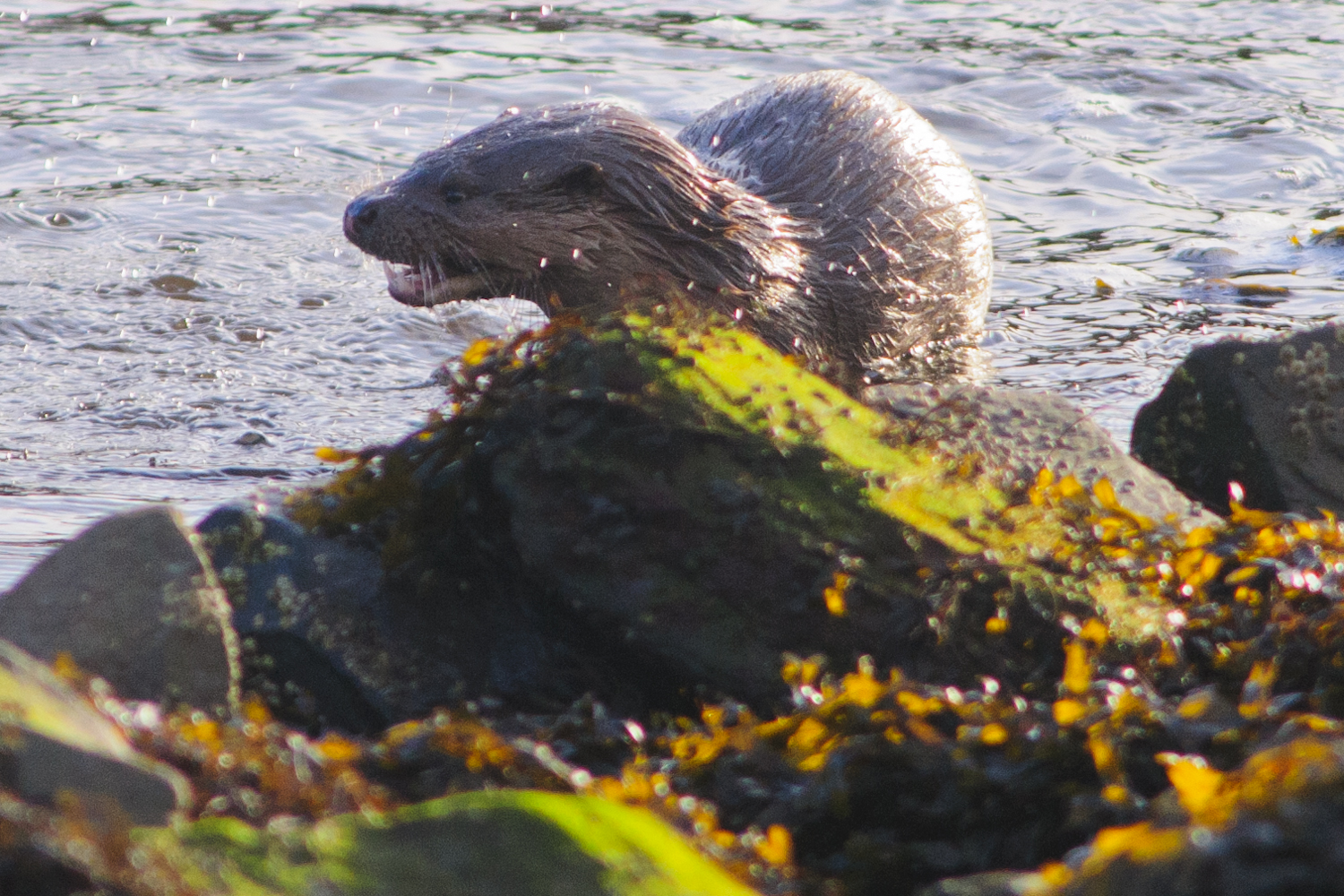
    I collected Neil and Julia from Newbiggin and we headed towards Druridge Bay for an afternoon and evening searching for Otters.  Anybody who reads our blog regularly will know that Northumberland is a great place to look for Otters, but it usually involves some effort and patience.  45mins into the afternoon and Black-headed and Common Gulls rose in a ‘dread’ then started circling.  The only logical place to look was directly under them…and there was an Otter 🙂  We watched it for nearly an hour, until it eventually caught a huge Eel and vanished into the reeds.  During that hour there was a mass exodus of Wigeon, Teal, Mallard, Shoveler, Little Grebe and Gadwall from one reedbed…and a Fox peered out from the reeds before coming out into the open.

    The rest of the afternoon was a study of fascinating wildlife; Dippers were fighting with the victor eventually bursting into song, although not before it had been seen off itself by a Kingfisher, Hawthorns were dripping with Goldcrest, a Hebe bush was a mass of Peacock, Small Tortoiseshell and Red Admiral Butterflies and Buff-tailed Bumblebees, a second Kingfisher flew by before perching obligingly on a fence post, Grey Herons were stalking patiently in shallow water, a Little Egret perched high in a tree, a Little Owl fixed us with a withering stare and the afternooon headed towards sunset.  In beautiful orange light from the setting sun, Lapwing, Golden Plover, Curlew, Black-tailed Godwit, Turnstone, Redshank and Oystercatcher roosted as Dunlin busied themselves along the water’s edge, Snipe probed in the mud next to a reedbed and a Water Rail emerged from the gloom of the reeds into the gloom of dusk before slipping back out of sight.
  • Signals; Otter Safari 04/10/2015

    I collected Lizzie and Tom from Church Point and we set out to explore Druridge Bay and southeast Northumberland in search of Otters.

    We’ve been mainly concentrating on three sites this year; Site A was great early in the year, and we’d had an Otter there in mid-September, Site B opened our 2016 Otter account on New Year’s Day and has been producing Otter sightings for the last few weeks and Site C has been great, and really, really great this year 🙂  Sites A and B produced skeins of migrating Pink-footed Geese, and agitated Mallards, Gadwall, Little Grebe, Tufted Duck, Teal, Wigeon, Grey Heron and Little Egret but no sign of the cause of their agitation.  As daylight started to fade, we headed to Site C.  Roosting Lapwings suddenly flushed in panic, forming a twisting, turning, amorphous mass worthy of a Starling murmuration.  Greylag and Canada Geese began descending noisily towards the water as Grey Herons stalked the margins and engaged in angry disputes over the best feeding spots.  Only two Greylag and one Canada Goose landed though, the rest vanished into the gloom.  Then the assembled wildfowl all stretched their heads up; always an encouraging sign.  Concentrate on the one part of the pool that seems to be bird-free…and there’s an Otter 🙂  Swimming across in front of us, sinuous and stealthy, it graced us with it’s presence before vanishing into a reedbed that was soon ringing with the calls of Water Rail and Moorhen.  The focused gaze of a Grey Heron gave a clue as to the Otter’s whereabouts in the reeds as daylight faded to darkness.

  • New Year, quality wildlife; Otter Safari 22/01/2015

    During quiet periods of the year, we keep going out and checking excellent wildlife sites all around Northumberland.  Although we can never predict exactly what we’ll see, and where, those days out on our own are the basis of successful days out with clients…

    I arrived at Church Point to collect Gordon and Michelle and we set off in search of Otters.  I love the pressure of a client being obsessed with Otters but never having seen one in the wild, it keeps me focused 🙂  Soon we were watching a distant Otter as it fed in mirror calm water!  A slow, steady approach took us much closer and then another two Otters appeared, eventually coming so close that we could hear a splash, each time they dived in search of fish, and the crunching, munching sound of them devouring their catch 🙂  We’ve been watching this group of Otters since mid-December, so we’ve got a few images of them…

    Eurasian Otter,Lutra lutra,Northumberland,otter watching,otter safari,otter photography

    Eurasian Otter,Lutra lutra,Northumberland,otter watching,otter safari,otter photography workshops

    Eurasian Otter,Lutra lutra,otter watching.otter safari,otter photography workshops

    After 90 minutes they’d moved on and so did we.  Our next wildlife star of the day was another one that we’ve been watching and photographing over the last few weeks – a Little Owl.

    Liite Owl,Athene noctua,Northumberland,birdwatching Northumberland,wildlife sfaris UK,wildlife tours UK,wildlife photography,wildlife photography workshops,

    As the afternoon passed, and the cold damp air held us in it’s icy grip, more stunning wildlife put on a show that demonstrated just how good Northumberland is during the winter.  An array of wildfowl in breeding finery is a highlight of the winter months; Teal, Wigeon, Gadwall, Mallard, Goldeneye, Tufted Duck, Red-breasted Merganser, Eider and a Long-tailed Duck.  A Barn Owl, ghostly white, bringing death on silent wings to unsuspecting mice and voles is always a crowd pleaser while Kestrels, Buzzards and a brief view of a Hen Harrier were the reward for a session of raptor watching as dusk approached.  Another ghostly white winter speciality put in a typically fleeting appearance – a Stoat in ermine 🙂  Possibly my favourite land mammal, here’s an image of one from last winter.

    Stoat,Mustela erminea,Northumberland,wildlife sfaris UK,wildlife tours UK,

    Finally, as the light faded to the point where it was getting difficult to see anything and flocks of Pink-Footed and Greylag Geese peppered the sky, one of our most elusive birds wandered out into the open and entertained us.  Probing and prodding at the marshy ground between two reedbeds, the Water Rail gave obligingly prolonged views.  Surprisingly small, remarkably beautiful, and a great way to end the day with clients who’ve persuaded me (almost…) that there are destinations so spectacular that I really need to get on a ‘plane at some point next year…

  • Mid-summer Murmuration Madness; Druridge Bay 26/06/2014

    Thursday was Peter’s second day out with NEWT, this time around our local patch of Druridge Bay and southeast Northumberland.  Avocets bickered and quarrelled, a Water Rail sunned itself on the edge of a reedbed,  dainty Little Gulls were sleeping in amongst relatively huge Sandwich Terns, Black-tailed Godwits probed the soft mud in the shallows and Peter photographed Common Spotted Orchid, Common Twayblade, Marsh Helleborine and Lesser Butterfly Orchid in nice evening light.

    We settled to watch over Druridge Pools, as daylight began to fade, and female Gadwall and Tufted Duck quacked in alarm at an unseen threat and the well-grown Gadwall ducklings came out of the water on to the poolside as the little Tufties scattered in a radiating semi-circle from the spot that their mother had just flown from.  Then a flock of Starlings flew by.  You don’t need a huge murmuration to appreciate the synchronised twists and turns of these gregarious birds in flight, but they were soon joined by another flock..then another…and another.  Ipin was watching from the top of the dunes and estimated 7000 birds in the flock 🙂  That’s an impressive murmuration, but from our position it was extraordinary.  The birds were swirling around the hide, so close that we could hear the roar of 14000 beating wings from all around us and, as they twisted and turned in the light of the setting sun, they alternated between black, brown and gold.  I’m 48 and I’ve been watching wildlife for as long as I can remember, but new experiences still keep coming 🙂

  • Five star birdwatching; Northumberland Coast 20/02/14

    Our fourth trip this week was a day birdwatching with Simon, who was back again after previous trips including a stunning Farne Deeps pelagic in 2012.  We’d spoken in advance of the trip and Simon was keen to add a few of Northumberland’s wintering birds to his life list; divers, grebes, Purple Sandpiper and Brambling were all mentioned as desirable.

    When I arrived to collect him on Thursday morning, I was still wrestling with the challenge of heading inland for Brambling, yet leaving plenty of time to explore the Northumberland coast.  That worry was quickly taken away, as putting a feeder up outside the holiday cottage meant that Simon had found one of the species on his wish list himself 🙂  Covering most of the coast from north to south produced five lifers;  Red-throated Divers just beyond the surf, Long-tailed Ducks including a breathtakingly beautiful drake, Purple Sandpipers unobtrusively poking around in rock pools, displaying Goldeneye rivaling the attractiveness of the Long-tailed Ducks and, as the afternoon light faded and the rain finally arrived, a very obliging Water RailTwite, Stonechat, Yellowhammer, Reed Bunting, Skylark, Marsh Harrier, Slavonian, Little and Red-necked Grebes, Shelduck, Bar-tailed Godwit, Dunlin, Grey and Golden Plover, Lapwing, Gannet, Curlew, Teal, Mallard and Wigeon may have been reduced to a supporting role for the day, but all combined to produce an excellent day’s birdwatching on the Northumberland coast 🙂

  • A trio of Grebes and a splash in the gloom

    Tuesday and Wednesday were mini-safaris for one family, but different participants each day; Sue, Phil, Sandra and Inez on Tuesday and Sue (again), Jacqui, Paul and Hannah on Wednesday.

    Both days featured lots of waders and wildfowl; Redshank, Common Snipe, Curlew, Lapwing, Dunlin, Bar-tailed Godwit, Goldeneye, Pintail, Tufted Duck, Gadwall, Mallard, Teal, Wigeon and Red-breasted Merganser were all very obliging, with the ducks particularly stunning, and the Goldeneye engaging in their quite captivating display.  Moorhens picking scraps off a skeleton at the edge of Cresswell Pond were described as ‘totally gross’ by Inez, and it isn’t easy to argue with that summation 🙂

    Although the two days were similar, there were some notable differences; Tuesday produced Slavonian and Red-necked Grebes, alongside the Little Grebes that we saw on both days, and Wednesday featured Water Rail and Roe Deer.  Wednesday also produced a very brief Otter encounter, as a dark shape rolled at the surface in the deepening gloom, crossed the river and rolled again as the local Mallards stared in terror into the darkness.

  • Eye to eye with the predator; Bespoke Photography 21/10/2013

    The chilly morning air was biting as I arrived in Seahouses to collect Peter, Caroline and Aidan.  With camera gear loaded into the back of the car we headed down the Northumberland coast with two species in particular on our target list for the day – one relatively easy, one slightly less so…

    I’d planned the morning to take in a couple of sites for Red Squirrel, and the early afternoon to stake out a regular Otter spot.  So, Red Squirrel is the relatively easy species out of those two…but the first rule of wildlife photography should be ‘wildlife doesn’t perform to order’ and both sites we visited, which have healthy populations of Red Squirrel, didn’t produce any sightings.  That’s often the case though when it’s damp, cool and breezy, so we headed on in search of our second target for the day.  After a brief stake out of a handsome male Stonechat we made our way to the edge of a pond, and were told by another birdwatcher who was there that he’d seen an Otter just 15mins earlier, and it had headed across the pond.  I looked across in the direction he thought it had gone…and the entire bank was lined with ducks and geese.  A good sign; the Otter had obviously spooked them out of the water but it must be still somewhere in the pond, as all of the birds were staring intently.  I couldn’t see any disturbance in the water in that direction though and I was just remarking that I thought the Otter could still be nearby, when it surfaced in front of us 🙂  For the next couple of hours we were treated to regular feeding sorties as the sinuous mustelid caught fish after fish, including at least one large FlounderCormorants and Grey Herons were fishing too, a Water Rail put in a couple of typically fleeting appearances, Common Snipe were prodding, probing and miraculously vanishing in short vegetation, Lapwing, Curlew and Redshank were roosting, calling and occasionally flushing, Mallard and Teal kept standing to attention every time the Otter was close by, a murmuration of Starlings away to the north disbanded into smaller flocks that flew straight over our heads and seven Little Gulls danced their dainty flight back and forth over the pond.  Perhaps the moment of the day though, was when the Otter appeared around the edge of a reedbed and started straight into Aidan’s camera lens.  The second rule of wildlife photography should be ‘…and sometimes it does’ 🙂

  • Call of the wild; Druridge Bay 17/09/2013

    I’ve lost count of how many times I’ve been asked to describe my favourite wildlife experience…and how many times I’ve said that I don’t think it’s possible to narrow it down to just one choice.  There are a few though, that would make a great ‘top five’ (or ‘top ten”)…

    I collected David and Sue from their holiday accommodation and we headed north along the Northumberland coast.  The plan for the afternoon was to search some of our regular Otter sites, and have a good look at the other wildlife that was around.  There’s really only one weather condition that I’m not keen on for wildlife-watching, and unfortunately we got it yesterday afternoon.  A stiff wind is not ideal for finding wildlife; insects are likely to stay deep in vegetation and mammals and birds are more likely to find somewhere sheltered and have a nap than subject themselves to the ravages of the wind.  One bird that seemed to be everywhere we went was Kestrel; we must have seen seven or eight of these small falcons hovering in the breeze during the afternoon.

    As we watched Wigeon, Teal, Mallard and Mute Swan a rarely seen denizen of our reedbeds put in a brief appearance.  In just a few seconds the Water Rail ran out of one reedbed, quickly crossed a patch of open mud and vanished into the depths of another reedbed.  Wader passage was still evident, with Black-tailed and Bar-tailed Godwit, Ruff, Lapwing, Curlew and Dunlin.  One bizarrely comical moment was caused by a Starling flying into the middle of the wader flock to bathe.  We can only guess at what the roosting waders thought it was, but it caused a ripple of alarm that could be traced through the flock as it flew in.

    Then, drifting on the breeze, a high-pitched yapping marked the beginning of one of my favourite wildlife experiences.  First a flock of Pink-footed Geese came in low and splashed down on the water.  Soon after a flock of Greylag Geese arrived, then more Pink-feet, a large flock of Canada Geese and four very endearing, but obviously escaped, Bar-headed Geese.  More geese followed, and then a flock of Pink-feet, heralded by those yapping calls, could be seen as tiny specks high against the clouds overhead.  These birds were surely just arriving from far-flung parts, to join the wintering goose flocks around Druridge Bay.  Suddenly birds took to the air; Dunlin first, then Lapwing, followed by ducks and then geese.  Too much panic, surely, for an Otter?  What the birds had seen, and we eventually spotted as it drifted high against the clouds above us, was a Marsh Harrier.  Making it’s way steadily north west, it eventually drifted out of sight and the birds settled back down.

    As dusk approached , the breeze finally relented and, with the backdrop of a stunning sunset, both Noctule and pipistrelle bats flew by.  The cause of a sudden panic amongst the assembled ducks was caused remained unseen, and as the light faded to the point where it was time to head back, we could still hear the geese – over a mile away from where we were.  The dark of the night brought one last wildlife experience though, as a Badger trotted along the road just in front of the car.

  • Wading through August

    August is always a stressful month for NEWT.  As well as leading our regular safari days, it’s British Birdwatching Fair month, and the week leading up to the Bird Fair is always frantic; checking that we’ve got everything for the stand, mounting a new series of limited edition prints for sale, liaising with all of the other Birdwatching Northumberland partners to make sure that everybody knows exactly which aspects of the project they’re  responsible for, and making sure that we’ve got a supply of local beer for the 4pm ‘free bar’ on our stand 🙂

    Then, after a busy three days, it’s all over and we head north…this year to the thankfully cooler temperatures of Northumberland.  From leaving Rutland at 6pm on Sunday to arriving back in Northumberland just after 10pm, the temperature drop was an impressive 14C.

    Yesterday was our first post-BirdFair trip, a day of birdwatching around Druridge Bay and southeast Northumberland.  I collected Alex from Church Point, and we started with a good scan of the beach. 4 Mediterranean Gulls were close by and a small group of waders contained Oystercatcher, Common Redshank, Sanderling and Ringed Plover. Waders proved to be a theme for the day and we added Common Sandpiper, Spotted Redshank, Lapwing, Ruff, Dunlin, Knot, Curlew Sandpiper, Curlew, Greenshank, Black-tailed Godwit, Turnstone, Wood Sandpiper, Common Snipe, Golden Plover and Avocet to the day list as we made our way around NEWT’s local area.  With an impressive supporting cast that included Water Rail, 3 Little Egrets and a Spoonbill it was a great day to be watching the edges of our local ponds, and a real education in just how much inward and outward movement of birds there is from the feeding and roosting wader flocks that grace southeast Northumberland at this time of the year.  It was a great day too, to appreciate just how friendly and helpful local birdwatchers are in Northumberland – many thanks to Len and Gill for pointing us in the direction of the Wood Sandpiper, and Gill’s sharp eyes picked out the Spotted Redshank which then vanished without trace soon after being found and appreciated 🙂

  • Winter Wonderland 28/11/11-01/12/11

    Last week was our Winter Wonderland birdwatching holiday, although as I arrived at Saughy Rigg I wondered if Windy Wonderland would be a better name for it 😉

    The original itinerary involved the Solway coast on Tuesday and the North Pennines on Wednesday, but a quick discussion with our guests on arrival meant that our coastal day was switched to Northumberland to avoid the poor weather in the west.

    The plan worked well, at least until mid-afternoon when the weather caught up with us and we had a couple of hours of dodging the showers.  The waders and wildfowl that winter here featured throughout the day and Greylag, Pink-footed, Pale-bellied Brent, Barnacle and Eurasian White-fronted Geese were all enjoying the mild weather on the Northumberland coast.  3 splendid drake Goosanders  were blown across Druridge Pools before battling their way back against the wind, and a Roe Deer was grazing in the gap between 2 reed beds.  As so often seems to happen, some of the best wildlife of the day saved its appearance until the light began to fade.  First a Short-eared Owl, with a strikingly white face, quartering backwards and forwards along the margins of a field, then 2 Water Rails, those small, secretive denizens of the reeds, stepped gingerly into view; prodding and poking and squealing like piglets as they vanished back into the gloom.  Then, as flocks of geese descended to roost, a Bittern flew from the reeds and headed south.

    Wednesday brought another breezy morning, and we headed into the hills.  Remarkable numbers of Red Grouse chuckled at us as we watched from the comfort of the car, and 7 Black Grouse were the first of no less than 75 that we found during the day.  The weather closed in all around us and, after a quick check of a lough wher Teal, Wigeon and Lapwing were roosting and Goldeneye were feeding, we finished the day at one of our favourite evening venues.  An unidentified raptor flew low across the heather moorland and out of sight over a ridge, Red Grouse burst from cover before settling again a short distance away and a lone Short-eared Owl battled into a brutal headwind as the evening faded to darkness.

    Winter Wonderland is one (in fact, two) of the holidays on our itinerary for 2012, so give us a call on 01670 827465 for more details or to book your place.