Tag: Teal

  • When the wind blows; Whales, waders and wildfowl 4-7/09/2015

    Last weekend was our ‘Whales, waders and wildfowl’ mini-break, with an extension to include our Farne Deeps pelagic.

    Day -1 (Friday 04/09/15).  A late cancellation left Sandra and Linda as the only guests on the holiday, and with conditions unsuitable for being offshore, we headed to the far north of the county.  Fulmars and Gannets were battling into the stiff breeze and Eiders were riding the deep troughs and towering crests of the waves that were pounding the shoreline.  Bar-tailed Godwit busied themselves along the water’s edge and the eerie moaning of Grey Seal and haunting cries of Curlew, carried on the rushing wind, enveloped us in the atmosphere of Holy Island in the early autumn.  By mid-afternoon, the wind had died down and the sea was calming – had the forecasters got it wrong…

    Day 1 (Saturday 05/09/15).  04:00 and I wake up to the sound of a strengthening northerly 🙂  Throughout the day, we were close to the sea and could see the amount of swell close to the shore.  Linnets, Goldfinches, Meadow Pipits and Greenfinches were tossed like leaves on the breeze as they ventured from the cover of bushes along the dunes, a stunning male Stonechat looked equally uncomfortable and Lapwing, Redshank, Curlew, Oystercatcher, Dunlin and Black-tailed Godwit were roosting facing into the wind as Grey Herons sat motionless and a Little Egret still radiated elegance as it’s feathers were disarranged by the now rather stiff wind.  Always impressive, a male Marsh Harrier flew by before vanishing over a distant ridge, and the day finished with Wigeon, Teal, Gadwall, Mallard, Ruff, Black-tailed Godwit and 30 Little Grebes.

    Day 2 (Sunday 06/09/15).  No breeze, bright warm sunshine 🙂  An extraordinary contrast to the preceding days, and with close views of Cormorant and Eider as they dived in calm water.  The Cormorants spent a lot of time standing with wings spread in heraldic pose, drying them before heading back into the water, always an impressive sight.  Wigeon, Gadwall, Mallard, Teal, Tufted Duck, Little Grebe and Mute Swan were swimming lazily around in the afternoon sunshine and a huge flock of gulls, roosting, bathing and following the plough, exploded into the air like a burst eiderdown as a Common Buzzard drifted over.  Dinner at the excellent Ashianna in Bedlington ended the holiday after three great days with Sandra and Linda 🙂

    Our next holiday is Winter Wonderland in early December, so give us a call on 01670 827465 to find out more and to book your place now 🙂
  • Weasily identifiable; Lindisfarne Safari 20/04/2015

    April is when we start to spend more time visiting our inland areas, but the coast can still deliver real quality, and quantity, at this time of the year too.

    I collected Sue and Colin from Beadnell and we headed north to Holy Island.  Crossing the causeway we paused to watch Eider and Red-breasted Merganser in the channel under the road.  The mudflats produced Redshank, Oystercatcher, Curlew, Grey Plover and Bar-tailed Godwit, as well as a lot, and it really was a lot, of Grey Seals.  Close to 2000 were hauled out and soon began their eerie moaning.  Black-tailed Godwit and Teal were sleeping by the edge of the Rocket Pool, a lone Brent Goose was kept company by a herd of sheep, Meadow Pipits, Goldfinches and Skylarks were hurrying back and forth, a Redwing was foraging on the ground close to the field edge, a Sedge Warbler was singing it’s repetitive song from the reeds by the Lough as a Common Snipe put in a typically brief appearance and 12 Roe Deer were grazing near the Straight Lonnen.  Then we struck gold…walking slowly along the Hawthorns, a bird flushed from beside us.  The views were only brief but the white breast band, and silvery wing flashes, identified the bird as a male Ring Ouzel.  We continued walking slowly along the lonnen, and the bird kept a few metres ahead of us.  Then we lost track of it but stopped to watch two Blackbirds grubbing about in the undergrowth…and the ouzel called from a tree we’d already passed.  We turned as it flew out of hiding…followed by another, then another, and another and finally, a fifth male Ring Ouzel 🙂

    Over on the mainland we had our picnic lunch as the eerie calls of Curlew floated through the heat haze across the mudflats and Sue spotted a Weasel.  It was running in and out of the vegetation so I started pishing…and it popped up and began running in our direction, sitting up on its hindlegs and staring straight at us 🙂  Eventually it got back on with whatever it was doing, and it put in repeat appearances for a few minutes.  A Brown Hare gave tantalising close views before vanishing into the crops and we finished in the shadow of Bamburgh Castle with Sand Martins hawking insects over the beach, Eiders bobbing in the gentle swell, a pair of Common Scoter slightly further from the shore, more Grey Seals, plunge-diving Sandwich Terns and lines of Gannets heading, mainly, north.  Not a bad range of wildlife for seven hours in mid-April 🙂

  • Breezy; Otter Safari 28/03/2015

    With the end of March approaching I was hoping for less breezy weather than we’ve been having recently.  Not my lucky day though…

    I collected Melissa, Graham and Marjorie and we set off to spend the day exploring Druridge Bay and southeast Northumberland.  Hormones coursing through the veins of Red-breasted Merganser, Shelduck, Mute Swan, Canada Goose, Goldeneye, Teal and Mallard meant there was a lot of activity everywhere we went.  Cormorants were doing their very best Otter impressions, Little Grebes kept catching the eye as they dived beneath the waves and then, finally, the sign I’d been watching for.  A pair of Mallards sitting in the edge of a reedbed suddenly sat very upright, staring intently into the same corner of the pool that had produced an Otter on our previous Otter Safari.  This time though the wind had lifted the water’s surface into a series of rolling waves that could have hidden the Loch Ness Monster itself, and the cause of the duck’s distress remained unseen by our eyes.

    After a run of successful Otter Safaris, with some days where conditions really weren’t favourable, there was bound to be a day when they didn’t play ball…

  • New Year, quality wildlife; Otter Safari 22/01/2015

    During quiet periods of the year, we keep going out and checking excellent wildlife sites all around Northumberland.  Although we can never predict exactly what we’ll see, and where, those days out on our own are the basis of successful days out with clients…

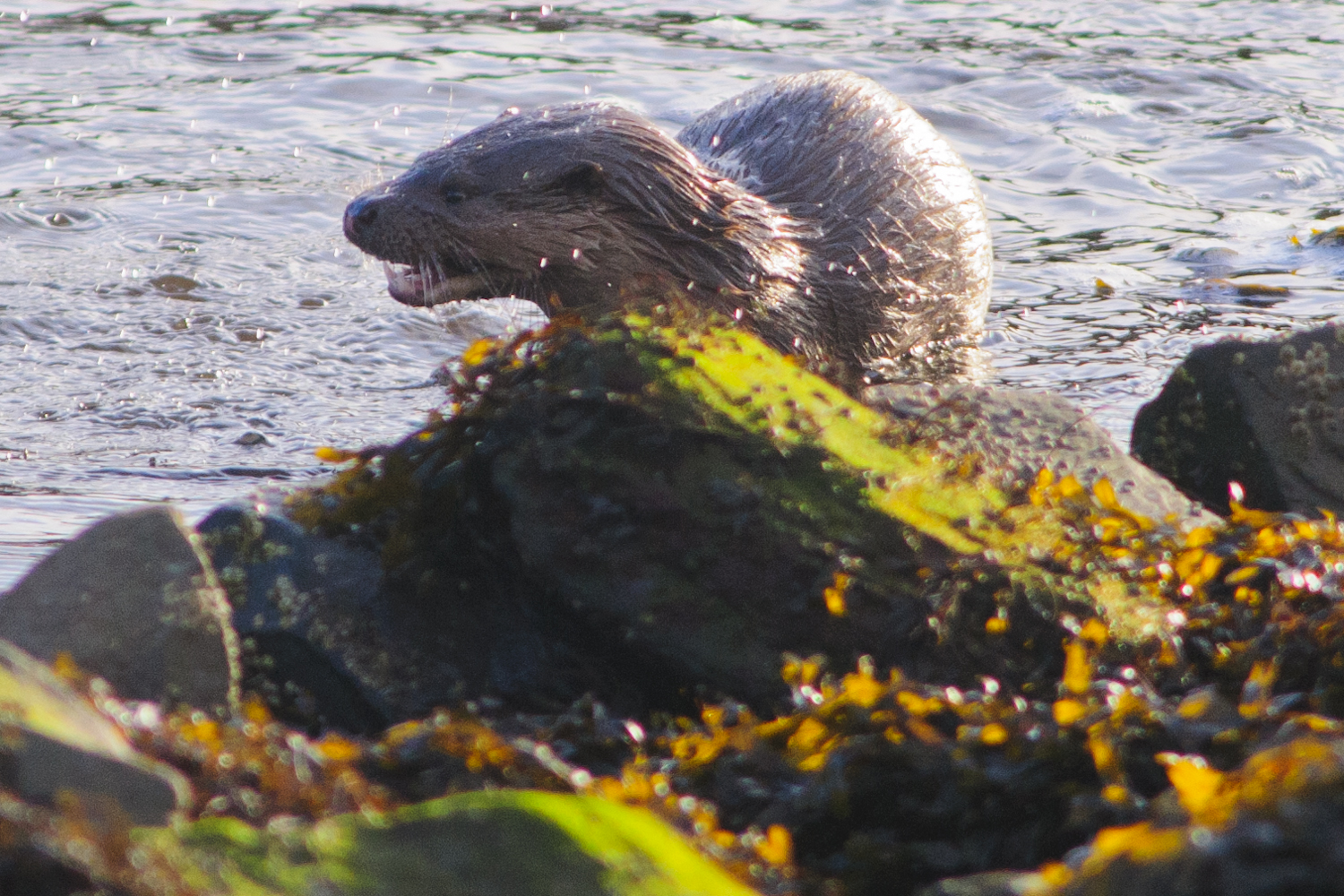
    I arrived at Church Point to collect Gordon and Michelle and we set off in search of Otters.  I love the pressure of a client being obsessed with Otters but never having seen one in the wild, it keeps me focused 🙂  Soon we were watching a distant Otter as it fed in mirror calm water!  A slow, steady approach took us much closer and then another two Otters appeared, eventually coming so close that we could hear a splash, each time they dived in search of fish, and the crunching, munching sound of them devouring their catch 🙂  We’ve been watching this group of Otters since mid-December, so we’ve got a few images of them…

    Eurasian Otter,Lutra lutra,Northumberland,otter watching,otter safari,otter photography

    Eurasian Otter,Lutra lutra,Northumberland,otter watching,otter safari,otter photography workshops

    Eurasian Otter,Lutra lutra,otter watching.otter safari,otter photography workshops

    After 90 minutes they’d moved on and so did we.  Our next wildlife star of the day was another one that we’ve been watching and photographing over the last few weeks – a Little Owl.

    Liite Owl,Athene noctua,Northumberland,birdwatching Northumberland,wildlife sfaris UK,wildlife tours UK,wildlife photography,wildlife photography workshops,

    As the afternoon passed, and the cold damp air held us in it’s icy grip, more stunning wildlife put on a show that demonstrated just how good Northumberland is during the winter.  An array of wildfowl in breeding finery is a highlight of the winter months; Teal, Wigeon, Gadwall, Mallard, Goldeneye, Tufted Duck, Red-breasted Merganser, Eider and a Long-tailed Duck.  A Barn Owl, ghostly white, bringing death on silent wings to unsuspecting mice and voles is always a crowd pleaser while Kestrels, Buzzards and a brief view of a Hen Harrier were the reward for a session of raptor watching as dusk approached.  Another ghostly white winter speciality put in a typically fleeting appearance – a Stoat in ermine 🙂  Possibly my favourite land mammal, here’s an image of one from last winter.

    Stoat,Mustela erminea,Northumberland,wildlife sfaris UK,wildlife tours UK,

    Finally, as the light faded to the point where it was getting difficult to see anything and flocks of Pink-Footed and Greylag Geese peppered the sky, one of our most elusive birds wandered out into the open and entertained us.  Probing and prodding at the marshy ground between two reedbeds, the Water Rail gave obligingly prolonged views.  Surprisingly small, remarkably beautiful, and a great way to end the day with clients who’ve persuaded me (almost…) that there are destinations so spectacular that I really need to get on a ‘plane at some point next year…

  • Mud, glorious mud; Lindisfarne Safari 28/11/2014

    The Northumberland coast in the late autumn is a birdwatching destination that I’ll never tire of.  Even in weather that could best be described as inclement, there’s a wealth of wildlife to enjoy.

    I collected Mike and Janet from the Dunstanburgh Castle Hotel and we headed north for a day birdwatching around Lindisfarne and the North Northumberland coast.  Starting with a walk around Holy Island village, a harsh chuckling call betrayed the presence of a Fieldfare in a small tree. Two others joined it, before they all departed noisily.  Then more chuckling Fieldfare, and the high seee calls of Redwing, carried through the air from high overhead and we could make out, in the mist, a mixed flock of these thrushes arriving high from the north east and bypassing the island on their way across to the mainland.  A Sparrowhawk raced by, hedge-hopping and swerving out of sight behind The Heugh, as thousands of Pale-bellied Brent Geese flew out onto the exposed mud of the wildfowl refuge area and Shag, Eider and Red-breasted Merganser dived just offshore.  A couple of very obliging Rock Pipits showed the subtle, dusky beauty that can only be appreciated with close views and Bar-tailed Godwit, Curlew, Redshank, Oystercatcher and Grey Plover were reaping the rich bounty of the mud, as Dark-bellied Brent Geese settled in the newly exposed mud of the harbour, and the high whistling calls of drake Teal carried across to us from the Rocket Field, a Little Auk flew along the main street through the village.  Crossing back to the mainland, a Little Egret was stalking through the shallows along the roadside and Curlew and Oystercatcher were so close we could have almost reached out of the car and touched them.  As the falling tide exposed sandbars, Grey Seals were moaning eerily and splashing about in shallow water.  Suddenly, there were thousands of Wigeon and Golden Plover in the air.  They settled but then flushed again so I started a methodical check of every rock that I could see on the mud.  Then I found what I was looking for – a rock that was just too vertical…and the view through our ‘scope revealed the impressive muscular menace of a female Peregrine 🙂  She shuffled around and took off, only to settle on another rock closer to us.  Our attention was drawn to a charm of Goldfinches feeding nearby, and the Peregrine departed while we weren’t looking.

    As the weather moved through in waves of varying grot, we watched a group of three Roe Deer grazing in a roadside field, and then headed a bit further down the coast.  Dusk was approaching rapidly as we watched more waders feeding busily as the tide rose, Lapwings flew over like giant bats and thousands of Black-headed and Common Gulls arrived to roost.  Wave after wave of mist and drizzle, wave after wave of birds, wave after wave of  waves 🙂

  • Charming; Bespoke Birdwatching 10/11/2014

    Even after 40+ years birdwatching, there are times when I’m not sure whether the thing that excites me the most is a lone rarity, a life or death interaction involving one of the predators we encounter, or an impressive flock of something common…

    I collected David and Dot from Gosforth and we made our way across to the coast for a day of mid-November birdwatching.  This proved to be a day of flocks; Pink-footed Geese rose then dropped in nearby fields, peppering the sky and cutting through the autumn air with their yapping calls.  Mini-murmurations of  Starlings twisted, turned, bunched and swirled, demonstrating that they don’t just reserve that spectacle for the fading light of evening.  Common Snipe were sitting in the vegetation close to the water’s edge, extraordinarily well camouflaged when asleep and only really betraying their presence once they woke up and started probing in the soft mud of the shallows.  Oystercatcher, Turnstone, Redshank, Curlew and Eider are almost a given on the coast in the winter, a lone Sanderling hurried back and forth in a flock of Ringed Plover and Teal, Wigeon and Goldeneye are eyecatching whether in flocks or alone.  Elegant Pintail glided by and Stonechats flicked their tails nervously perched in the tops of bushes in the dunes along the coast.  One isolated tree brought a memorable spectacle, with a charm of Goldfinches, and a lone Greenfinch.  For a couple of years now, a lot of our clients have reported increasing numbers of Goldfinch, and a tremendous decrease in Greenfinch.  No matter how numerous Goldfinch become, it’s hard to imagine that we could ever become blase about them; strikingly patterned, with their red face, black and white head and yellow wing flashes, and with liquid, twittering songs and calls, they really are quite charming 🙂

  • Battling the elements; Otter Safari 06/11/2014

    Last Thursday was Sue’s second Otter Safari with us this year, after an unsuccessful search in early July…a trip that was followed by five consecutive successful Otter Safaris for other clients!  I was really looking forward to this trip – Sue is great company and pleasure to be out birdwatching with – but the added pressure of already having one Otter Safari not produce our target species had me planning, re-planning and then planning some more…

    I’d got two sites lined up that I was confident would produce Otter sightings, but the one spanner in the works was the weather forecast.  If it was accurate (and, as it turned out, it was) we’d got three hours of good weather, and four of poor, ahead of us.  As I drove to Church Point, I was mulling over the options for the two sites, and decided to go with the one that’s been our most reliable this year during the good weather, and then head to the other one towards dusk.  Then I thought about it again – would the reliable site, where I can usually predict to within a few metres where the Otter will first put in an appearance,  be better in the poor weather just before dark?  I decided to trust to my first instinct and we were soon watching over the water as the wind strengthened and the first drops of rain were carried towards us on the breeze.  As Goldeneye and Cormorant dived in the ruffled water I noticed a dark shape in the corner of my field of vision.  It might have been nothing, but I held my concentration on that spot and just over a minute later an Otter cub surfaced in front of us 🙂  Twisting, turning, porpoising, diving and feeding, it kept us entertained for 90 minutes before slipping out of sight as the next wave of raindrops stung our faces on the now howling wind.

    We retreated to the car and sat eating lunch overlooking the North Sea, as a distant speck heading towards us over the waves revealed itself to be a Blackbird that paused for a few minutes on the cliff face before continuing its migration inland.  Then a Wheatear came ‘in-off’, and soon after that three Redwings arrived, following what must have been an arduous sea crossing, as the rain intensified.  As dusk approached, and the rain somehow became even heavier, we watched flocks of Teal and Wigeon, Common Snipe and Dunlin probing in soft mud, Curlew appearing as if from out of nowhere, Starlings and Jackdaws heading to roost, and Blackbirds, Robins, Fieldfare and more Blackbirds, and more Blackbirds 🙂

  • Under a darkening sky; Northumberland Coast 27/10/2014

    Yesterday was a safari day on the Northumberland coast, with a plan to enjoy the birdwatching around our regular Otter sites and then a stargazing session in Druridge Bay.

    I collected John and Pam from home in Cullercoats and we drove up the coast.  As we ate our picnic lunch in the shadow of Bamburgh Castle, we could see Gannets diving offshore, beyond the rafts of Common Eider that were surfing the gentle swell.  Kestrels were seen throughout the afternoon and a real ‘from the car’ bonus came in the shape of three Roe Deer.  As so often happens as we approach the winter, wildfowl dominated the birdwatching.  As well as the Eiders, with males resplendent in their breeding finery, Teal, Mallard and Goldeneye looked at their best.  As a Grey Wagtail perched on a mid-stream rock, and fish swirled and leapt from the water, a male Kingfisher perched on a branch overhanging the river, flocks of geese peppered the sky wherever we were, and a flock of Greylag Geese began to flush as the search and rescue helicopter passed noisily overhead.  Whooper Swans looked as stunning as ever, flocks of Lapwing and Golden Plover swirled in the stiff breeze  and, as dusk approached, Pink-footed Geese began arriving to roost.  Flock after flock of Pink-feet appeared out of the gloom, announcing their imminent arrival with their yapping calls, eventually in near darkness when they were just a black speckling against the dark grey brooding clouds.

  • Once Bittern; Druridge Bay mini-Safari 22/10/2014

    Yesterday afternoon brought quite different conditions to Tuesday evening; still cold and windy, but the clear skies had been replaced by gloomy cloud as I collected Charlotte, Ali, Ben and Thomas from Newbiggin for their second NEWT trip in two days.

    In difficult light, and occasional rain, we didn’t manage to find an Otter, but there was a wealth of birdlife to enjoy; a Cormorant was drying it’s wings as Little Grebe, Shoveler, Mallard, Teal, Wigeon, Gadwall, Tufted Duck, Moorhen and Mute Swan fed nearby, flushed briefly by a Sparrowhawk that landed on a small rock in the water before heading off to menace something else.  As dusk approached, although it was hard to discern any difference from mid-afternoon, Starlings began a murmuration, Greylag and Pink-footed Geese arrived noisily to roost, Whooper Swans were whooping loudly and there was the ‘is it a heron, is it an owl?’ moment as a Bittern flew lazily from the reeds, passing by us on it’s way to another reedbed 🙂

  • Halcyon Days; Otter Safari 13/10/2014

    Monday was a day around Druridge Bay and the southeast Northumberland coast, and an extraordinary contrast with Sunday’s summery weather…

    I collected Trish and Carol from Dunstan and we headed south along the coast.  Kingfisher is always a spectacular sight, and one flew under a bridge beneath our feet, adding a touch of sparkle to a day that was developing into cold, windy and gloomy.  Ducks are, for the most part, out of eclipse plumage now and Wigeon, Teal, Tufted Duck and Gadwall were all looking resplendent.  Little Grebes were engaged in non-stop fish catching, Curlew flew noisily by and a Little Egret was stalking elegantly along the River Coquet.  We were joined for the latter part of the day by Michael and Fiona and we settled into position to search for Otters.  In such gloomy windy conditions even my eternal optimism was dampened slightly, and although there were occasional panicky moments among the ducks, which included a beautifully elegant Pintail, the enigmatic predator didn’t put in an appearance.  What we did get though was a Starling murmuration so close we could hear the wingbeats, thousands and thousands of Pink-footed Geese flying to roost and flock after flock of Golden Plover and Lapwing appearing out of the gloom of the dusk sky and dropping into nearby fields.  Dusk is still my favourite time of the day, and if you’ve never experienced it surrounded by wildlife you really should give it a go, even the common birds are transformed by numbers and there’s always the chance of a mammal or two 🙂