Tag: Sand Martin

  • Arrivals

    As I pulled into the car park at The Swan, Peter and Elizabeth were sitting in the bright sunshine.  There was still a cold edge to the breeze though, and we set out to explore Druridge Bay, south east Northumberland and the Northumberland coast.

    Masses of frogspawn was evidence that our amphibians were getting on with business as usual, regardless of the weather, and a newt rose to the surface of a small pond to take a gulp of air before sinking out of sight back into the murky depths.  Chaffinches, Robins, Song Thrushes and Blackbirds were singing, and a Chiffchaff was a welcome sound – we’d normally expect to start hearing them in mid-March, but this was our first this year.  A flock of Redwings were blown by like scraps of paper on the strengthening breeze and, just south of Cresswell, Fulmars glided effortlessly by, riding the updraft of the wind seemingly perilously close to the cliffs.

    Another amphibian joined the day list, as a Common Toad walked along the path towards us, realised we were there, then retreated to the edge of the path and tucked all of it’s legs in so that it resembled a stone and waited for us to pass by.  A Greylag Goose was incubating and I mentioned that the same site usually held a pair of Mute Swansand one appeared, but we didn’t see where from.  The mystery was solved a few minutes later as it’s mate walked out of a reedbed, straight over the incubating Greylag and paddled across the water.  Incredibly the Greylag barely gave the swan a second glance, but just sat tight on it’s nest.

    A Brown Hare sat haughtily in a roadside field, and a Sparrowhawk flew just ahead of the car for over 100m, before perching on a hedgerow and staring menacingly at us as we drove by.  By early evening the wind had really stiffened again and it started raining.  This didn’t dissuade a sub-adult male Marsh Harrier from hunting over a reedbed close to our position, and he eventually dropped into the reeds and onto prey; judging by the squealing he may have caught a Water Rail. Sand Martin, Swallow and House Martin in one flock were additions to the year list, 18 Red-breasted Mergansers were displaying, a few Goldeneye were busy feeding and, as we finished our day, along one of NEWT’s favourite rivers, a dark shape moving slowly along the water’s edge caused some excitement.  Was this our quarry, the sinuous predator that terrorises fish, birds and small mammals?  No, it was a Moorhen…
  • Druridge Bay 01/05/2012

    We often find ourselves, usually when we’re at the British Bird Fair, explaining that Northumberland isn’t a particularly rainy county, in fact it’s very much the opposite.  It is sometimes cold and windy though…but all you need to do is wrap up warm 😉

    I collected Philip and Pauline from Outchester and we headed south towards Druridge Bay for a day’s birdwatching on the coast of southeast Northumberland.  A brief search around Woodhorn for the Great Grey Shrike that had been there until the day before proved fruitless, and we continued to follow the road up the coast.  With a bitterly cold northerly wind I guessed where our regular Little Owl would be sunning itself – and it performed like the star that it is; peering inquisitively at us and then craning it’s neck to look at something on the ground far below.  Our lunch stop, overlooking the North Sea, was as spectacular as ever with rolling surf and plenty of ‘white horses’.  Cresswell produced some of the best birds of the day, with a pair of Great Crested Grebes, Hooded Crow, 5 Northern Wheatears, 5 Avocets and 2 Little Ringed Plovers being the highlights.  East Chevington provided very close views of a  Roe Deer, a female Marsh Harrier, Skylarks singing on the breeze and a mixed flock of Swallow, House Martin, Sand Martin and Swift.

    With clients from the town of my birth and an enthusiasm for cetaceans like my own, as well as a keen eye for the locations used in popular television series, it seemed that the day was over very quickly and I dropped them back at Outchester in the early evening, stopping for a few minutes to look at Pauline’s hydrophone.  Gadget geek?  No, not me 😉

  • Birdwatching; more than just a Hobby

    Our two Druridge Bay mini-safaris last Wednesday both featured one of my favourite birds; Black-tailed Godwit.  A group of eight flying N at dusk in torrential rain may have included the five that we saw at lunchtime.  With plenty of Curlew, Lapwing and Dunlin, as well as a few Ruff and Common Sandpipers there was a ‘busy’ feel to birdwatching the coastal pools.  Common Frog and Common Toad were perhaps to be expected in the damp conditions.

    Thursday featured more torrential rain, although all of it whilst we were travelling between sites in Druridge Bay.  After collecting two clients individually from Alnmouth we headed south.  Dave had a day to remember with no less than five ‘lifers’; Little Owl, Dipper, Hobby, Scaup and Arctic Tern.  The Hobby was one of those classic moments.  I was watching a group of Sand Martins when they all suddenly rose high above the water.  As I opened my mouth to suggest that there was a raptor about, Dave said “What’s this?”…and there it was, a first-summer Hobby, heading straight towards us low over the pool.  A Whimbrel flew by, giving it’s distinctive call, and the transition from the occasionally difficult birding of mid-summer to the more productive time of mid-July is well underway.

    Saturday was spent covering another three tetrads for the Bird Atlas and then on Sunday we had a few hours in our study area, searching for any sign of Hobby or Honey Buzzard.  With heavy overcast conditions, occasional light rain, and a cold breeze very few raptors were in evidence; just a Common Kestrel and a Common Buzzard to show for our efforts.

  • Wildlife photography in focus

    After a busy week I was looking forward to a couple of days catching up on admin and housework (no, really, I was looking forward to doing some housework…).  Then, on Saturday morning, the ‘phone rang and we took a booking for Sunday; a photographer visting the area was frustrated by the weather leading to sailing cancellations (Farne Islands, Isle of May, Coquet Island) so could we take him out and show him some of the better locations for wildlife and birdwatching photography in southeast Northumberland and Druridge Bay?

    We pride ourselves on being flexible so a meeting point was arranged, camera kit was cleaned, memory cards loaded, batteries charged.  Some excellent views of Red Squirrel, so close that only head shots were possible, were followed by a few hours in the birdwatching mecca that is Druridge Bay.

    Here are a few of my favourite images from Sunday and Monday.

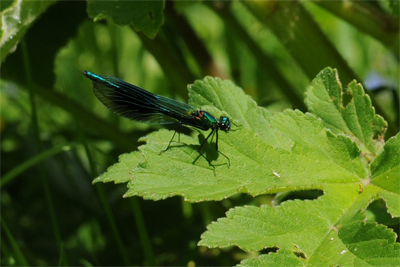
    Banded Demoiselle, River Blyth, Northumberland 20/06/2010
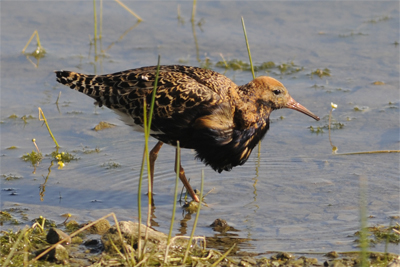
    Ruff, with a ruff, Druridge Pools, Northumberland 21/06/2010
    Sand Martin, Druridge Pools, Northumberland 21/06/2010

  • mid-April magic

    After a couple of days in the office (although I’m not complaining; I spent those two days finalising details for two new projects and taking bookings for group photography trips and a Northumberland birdwatching holiday) it was good to get out with clients this morning.  Our three clients became just one though, due to the Icelandic volcano, and I collected Ellen from Newbiggin by the Sea for a tour of southeast Northumberland and Druridge Bay.  We started with a search for Mediterranean Gulls.  None of the nice, ghostly white-winged adults were around but there was a 2nd year bird amongst the Black-headed Gulls.  It made a good identification subject, as the lack of obvious white wings meant that it was possible to focus on structure rather than just plumage, although the obvious wing-bar ensured that a discussion of wing topography was easy to relate to what we could see flying in front of us.

    Under deep blue skies with fluffy white clouds this was a beautiful morning, although the bitingly cold, howling northwesterly meant that hats and gloves were in order.  At Cresswell we admired our bird of the day; a stunning male Black-headed Wagtail.  I’d never seen one before, and as Ellen is from the southwestern US it was a lifer for her as well.  The geographical connection to where I spent 6 months in 1999/2000 focused conversation on two of my favourite topics; birdwatching and Mexican food.  Summer visitors were evident, with Swallow and Sand Martin flying over all the coastal pools, Willow Warblers singing their silvery, descending cadence sheltered from the wind, a nervous Common Sandpiper just a few metres away from us and, best of all one of the best looking ducks to have ever dabbled around Druridge Pools, Garganey, was another lifer for Ellen.  A pair of Stonechats perched in a bare hawthorn were a welcome sight, after a winter that will have surely decimated their population.  The three hours passed incredibly quickly and I dropped a happy birdwatcher in Morpeth to continue the next leg of her journey through Northumberland.