Tag: Pink-footed Goose

  • Bittern by the birdwatching bug; Druridge Bay 01/10/2013

    The cold wind that had developed during Monday was still whipping across the Northumberland coast as I collected Sara from Church Point for an afternoon birdwatching around Druridge Bay.  Newbiggin Bay was an impressive mass of rolling swell and white water as we headed along the coast.

    Damp, cold and misty were the conditions for the afternoon, but there were plenty of birds to hold our attention.  with Ruff, Black-tailed Godwit, Curlew, Dunlin, Lapwing, Curlew Sandpiper and Golden Plover still around from the day before it was good to find another wader species; a small flock of Dunlin flying by caught my eye, not so much because they were Dunlin, but because there were two smaller birds flying with them.  Small enough to only be stints of some description, they resolved through the telescope into Little Stints and, as Sara watched them through the ‘scope, I sent a text to Ipin, so that he could get them on his patch list for the year…and he repaid me by describing me as Scotland Gate’s second best wildlife tour leader 🙂

    In the increasing murk we headed to East Chevington and had two Bramblings flying overhead and calling.  A reported Corncrake didn’t show itself, but there was an odd call, that I’ve never heard before, coming from a patch of rank grass just a few metres away from us…

    Probably the bird of the afternoon was an unexpected surprise; as Sara watched the assembled waders through the ‘scope, and skeins of Pink-footed Geese lifted from nearby fields with calls rising to a crescendo as they approached the pool, I was scanning around the water’s edge…and a Bittern walked out of the reeds and into full view 🙂  For a few minutes we were treated to excellent views of this strange skulking heron.  It seemed to be confused as to where it was in relation to the reeds as it suddenly stood upright and stretched it’s head and neck skyward in the classic ‘bitterning’ pose.  When it finally took flight, it was mobbed by a flock of Lapwings before dropping out of sight into a reedbed…where it was soon joined by the members of a Starling murmuration 🙂

  • Stoats, Sandpipers, Starlings and Sparrowhawks; Druridge Bay birdwatching 30/09/2013

    With a brisk southeasterly wind rattling the Northumberland coast, I arrived in Alnmouth on Monday morning to collect John, Annie and Steve for a day of bespoke birdwatching.

    Starting with a seawatch, Gannets were streaming south , occasionally pausing to circle and then plunge into the sea, and Common Scoter were dotted amongst the rafts of Eider, appearing for brief periods as they rode up and over the considerable swell.

    Heading south to Druridge Bay produced the expected crop of passage waders; Redshank, Curlew, Black-tailed Godwit, Dunlin, Lapwing and Ruff were expected and two Curlew Sandpipers were a nice find.  Teal, Mallard, Wigeon, Tufted Duck, Gadwall, Goosander and Pintail provided wildfowl interest and skeins of Canada, Greylag and Pink-footed Geese, which we’d seen earlier in the afternoon as they fed in nearby fields, began to arrive at their overnight roosts.  A Stoat was all energy as it raced backwards and forwards, exploring every nook and cranny along the edge of the water and, as dusk approached, we watched one of the great wildlife spectacles as a murmuration of Starlings swirled above a reedbed before dropping in to roost.  The mass of birds attracted the attention of a Sparrowhawk, and the female raptor made several low passes through the tops of the reeds above the roosting Starlings.  They weren’t going to be tricked into flying out and becoming an easier target though, and the Sparrowhawk soon settled on a fence post.  Then a second Sparrowhawk appeared, this time a male, and the two birds perched on adjacent fence posts, allowing an excellent comparison of their gender differences.  As we headed off, in the fading light and bitterly cold wind, it looked like they would be going without their supper…

  • The Kill; Druridge Bay birdwatching 24/09/2013

    Through the thickening mist, just inches above the ground, the Sparrowhawk maneuvered it’s way at speed around bushes and the edge of a reedbed.  From that position it couldn’t see any possible targets.  Of course, that meant it couldn’t be seen either…

    I’d collected Laura and Barry from Church Point at midday. for an afternoon birdwatching around Druridge Bay and southeast Northumberland.  Unlike the stunning sunshine and warmth of Monday, conditions were rather overcast.  On a walk through woodland, we came across a roving tit flock.  Goldcrests could be heard high in the trees, and a quick session of pishing soon had one just a few feet away from us as it descended to investigate where the squeaking noise was coming from.  Our lunch stop, overlooking the length of Druridge Bay, gave us the opportunity for a spot of seawatching although, with the lack of any substantial breeze, there wasn’t a great deal of movement offshore.  Eider were dotted here and there, Cormorants were flying along the coast, a few Swallows  were catching insects low over the clifftop vegetation and flocks of Goldfinch and Linnet were noisily flitting about.  Lapwings, Curlew, Dunlin, Ruff, Snipe, Ringed Plover and Redshank, the latter in what seemed to be a state of perpetual motion, were working their way along exposed mud as Grey Herons stalked with an imperceptibly slow motion that  spells danger to fish, frogs and ducklings everywhere.  As the afternoon continued, we were suddenly confronted with heavy mist.  Then the rain started.  Thinking this would clear the mist proved a forlorn hope, and we watched a flock of Dunlin make several low passes over the mud in front of us before they vanished into the mist.  Eiders and Cormorants were diving repeatedly on the River Coquet near Amble and Salmon were leaping from the water – a real joy to watch when all three of us in the car are keen flyfishers.  With dusk approaching, although this wouldn’t differ too much from the rest of the afternoon, the yapping of Pink-footed Geese could be heard from behind the grey impenetrable curtain of mist.  Growing louder, and with the calls of Greylag and Canada Geese intermingled, the flock appeared on the edge of the mist.  Just beyond the limit of clarity, the amorphous mass of several hundred geese dropped onto the water and then upped the volume of their calls.  As another flock arrived they were greeted noisily by the birds already on the water.

    …accelerating on powerful wings, following an approach of supreme stealth, the Sparrowhawk exploded from a gap in the reeds, still just inches from the ground.  Lapwings and Starlings took to the air in panic, but the predator quickly fixed it’s baleful stare on the three closest birds to the edge of the reeds.  The Dunlin took flight, but the concealed approach by the Sparrowhawk had given it the edge that it needed in the game of life and death that was playing out in front of us.  With lightning quick reflexes it plucked the Dunlin deftly from the air, turned back through the channel in the reeds, and settled to devour it’s catch out of sight.  Not out of sight from us though 🙂

  • Birdwatching in an iconic landscape; Lindisfarne 23/09/2013

    After two long hard days offshore (8hr pelagic on Saturday – blog post coming soon! – and 14hr offshore on Sunday for a North East Cetacean Project transect survey) today brought some light relief from the rolling swell of the North Sea as I headed north to Seahouses to collect Phil and Ann (who had won a morning out with NEWT in a competition on Visit Northumberland) and Rachael and Alex, who by happy coincidence were all staying at St Cuthbert’s House.

    In weather that was glorious, even by the high standards set during this year, we headed north towards Holy Island.  In the north of Northumberland, with a falling tide, it was looking like a good waders and wildfowl morning.  Mudflats were dotted with a mosaic of Mallard, Shelduck, Curlew, Dunlin, Lapwing, Redshank, Oystercatcher and Pink-footed Geese and, as we drove along the coastal road towards Holy Island, we had the treat of watching a Sparrowhawk as it flew just ahead of us, only inches above the road.  Ringed Plover and more Dunlin, Curlew and Redshank were feeding in the mud of Holy Island harbour, Pied Wagtails were, well, wagging their tails along the pebbly edge of the harbour, a flock of House Sparrows was engaged in stripping the seeds from grasses just above the tideline and House Martins and Swallows were sallying back and forth in search of insects in the warm autumn sunshine.  Flocks of waders in flight are a spectacle to rival any other and as we watched, and listened to, a group of Grey Seals that were hauled out on the sandbanks between the island and the mainland, the amorphous twisting turning shapes in the air high overhead resolved into flocks of Golden Plover and Bar-tailed Godwit.

    The final part of the plan for the morning was a short session of seawatching.  Sandwich and Common Terns were diving close to the shore, Gannets were a bit further out and the sea was dotted with the dark shapes of EidersTurnstones were perched on the top of rocky outcrops, a Harbour Porpoise proved elusive as it surfaced to breathe and an Arctic Skua raced south before everyone could get on to it.  Obligingly it came back north, settled on the sea for a little while and then continued steadily north before breaking off into a aerobatic attack on a Sandwich Tern with another skua joining in as the tern twisted and turned in an attempt to evade the pirates of the sea as they attempted to rob it of it’s recent catch.

    Lots of birds, lots of interesting wildlife behaviour to watch, and four clients who were all great fun to spend the morning with – if I ever suggest that I’m going to return to teaching, just point me in the direction of this blog post 🙂

  • Wild Geese and small predators; Druridge Bay 20/09/2013

    After a damp morning around Druridge Bay on Thursday, Friday looked much more promising.  I collected Simeon and Kathy from their holiday accommodation in Warkworth and we set off down the coast for an afternoon around Druridge Bay and southeast Northumberland.  Late summer/early autumn trips often feature plenty of waders and wildfowl and this was no exception.  Common Snipe were playing ‘hard-to-spot’ as they slept in sparse clumps of reed, Dunlin, Ruff, Ringed Plover, Black-tailed Godwit, Lapwing and Golden Plover were all either roosting or sticking their beaks into the mud and a lone Greenshank was sitting on the periphery of a big flock of Lapwing.  On slow deep wingbeats a Sparrowhawk flew low across the water towards us, pulling sharply up and over us at the last minute.  Over a coastal reedbed a juvenile Marsh Harrier drifted lazily along, swooping down towards the water and scattering the Mallard and Teal that had been dozing contentedly there.

    Mid-afternoon we were treated to the spectacle of the sky filled with skein after skein of geese; mainly Pink-footed, but with small groups of Greylag and Canada interspersed amongst the yapping flocks of one our favourite Icelandic winter visitors.  Our next magic moment came courtesy of a mustelid.  Not the Otter that we were searching for, but instead the beautiful little predator that has featured on so many of our trips in the last few weeks.  For several minutes we watched as a Stoat ran backward and forwards along the water’s edge, perched on rocks, had a good look at a Moorhen and finally bounded away through the poolside vegetation.  Another small predator provided the next wildlife experience.  Lapwing, Golden Plover, Ruff, Black-tailed Godwits, Dunlin, Teal, Mallard, Gadwall and Starling all took to the air; had they spotted an Otter lurking in the reeds?  maybe a Fox?  No, what was coming was the Grim Reaper on tiny pointed wings.  A Merlin was suddenly amongst the scattered birds in the air.  Twisting and turning, the tiny falcon had singled out a Dunlin from the multitude of possible targets in front of it.  The chase was on and could be easily followed by watching the path carved through the tightly bunched Lapwings that had taken to the air in alarm.  As the Dunlin made a final bid for freedom, the Merlin gave up the chase and settled, out of sight, in a hawthorn bush in the dunes.  It didn’t have long to catch it’s breath before it was disturbed by a dog walker and flew into a dune slack away from disturbance.  Simeon’s comment after this life and death chase echoed those of many of our clients previously “it’s gripping, but I was really willing the Dunlin to get away”.

    As the evening progressed and the Sun dropped below the western horizon, geese began arriving to roost, bats were flitting back and forth across our field of view and, as the light finally faded to black and we headed back to Warkworth, a Barn Owl flew low over the car.

  • Call of the wild; Druridge Bay 17/09/2013

    I’ve lost count of how many times I’ve been asked to describe my favourite wildlife experience…and how many times I’ve said that I don’t think it’s possible to narrow it down to just one choice.  There are a few though, that would make a great ‘top five’ (or ‘top ten”)…

    I collected David and Sue from their holiday accommodation and we headed north along the Northumberland coast.  The plan for the afternoon was to search some of our regular Otter sites, and have a good look at the other wildlife that was around.  There’s really only one weather condition that I’m not keen on for wildlife-watching, and unfortunately we got it yesterday afternoon.  A stiff wind is not ideal for finding wildlife; insects are likely to stay deep in vegetation and mammals and birds are more likely to find somewhere sheltered and have a nap than subject themselves to the ravages of the wind.  One bird that seemed to be everywhere we went was Kestrel; we must have seen seven or eight of these small falcons hovering in the breeze during the afternoon.

    As we watched Wigeon, Teal, Mallard and Mute Swan a rarely seen denizen of our reedbeds put in a brief appearance.  In just a few seconds the Water Rail ran out of one reedbed, quickly crossed a patch of open mud and vanished into the depths of another reedbed.  Wader passage was still evident, with Black-tailed and Bar-tailed Godwit, Ruff, Lapwing, Curlew and Dunlin.  One bizarrely comical moment was caused by a Starling flying into the middle of the wader flock to bathe.  We can only guess at what the roosting waders thought it was, but it caused a ripple of alarm that could be traced through the flock as it flew in.

    Then, drifting on the breeze, a high-pitched yapping marked the beginning of one of my favourite wildlife experiences.  First a flock of Pink-footed Geese came in low and splashed down on the water.  Soon after a flock of Greylag Geese arrived, then more Pink-feet, a large flock of Canada Geese and four very endearing, but obviously escaped, Bar-headed Geese.  More geese followed, and then a flock of Pink-feet, heralded by those yapping calls, could be seen as tiny specks high against the clouds overhead.  These birds were surely just arriving from far-flung parts, to join the wintering goose flocks around Druridge Bay.  Suddenly birds took to the air; Dunlin first, then Lapwing, followed by ducks and then geese.  Too much panic, surely, for an Otter?  What the birds had seen, and we eventually spotted as it drifted high against the clouds above us, was a Marsh Harrier.  Making it’s way steadily north west, it eventually drifted out of sight and the birds settled back down.

    As dusk approached , the breeze finally relented and, with the backdrop of a stunning sunset, both Noctule and pipistrelle bats flew by.  The cause of a sudden panic amongst the assembled ducks was caused remained unseen, and as the light faded to the point where it was time to head back, we could still hear the geese – over a mile away from where we were.  The dark of the night brought one last wildlife experience though, as a Badger trotted along the road just in front of the car.

  • Flight calls

    I collected Brian from Newbiggin on Saturday for a one-to-one photography afternoon around southeast Northumberland.  It was good to find a photographer with the mantra of ‘wait, watch, wait some more’ and we settled among the trees in a dappled woodland.  Nuthatch, Treecreeper and Great Spotted Woodpecker all entertained us, Jays were chasing through the trees and Redwings passed overhead, their ‘seee’ calls still resonate deep inside me, nearly 40 years since I first heard them over our school field and then found a bundle of soft feathers where one had fallen prey to the local Kestrel.

    We had a brief spell of reasonable light, but the afternoon was mainly characterised by drizzle and gloom; not ideal for photography, but an atmospheric background for the birds that were moving about pre-roost.  Then, more calls from the skies as we sat close to a small pond.  First, Pink-footed Geese, yapping distantly before coming into view like a distant swirl of smoke as they headed to roost.  Then a group of 8 Whooper Swans, heading north.  As they vanished into the gloom, the rain increased and brought dusk forward.

  • Stormy weather

    November is generally a quiet month for NEWT; the half-term rush in late October has come and gone, thoughts are turning to Christmas…and the weather can be a bit suspect.  We had a Safari Day around Druridge Bay and Southeast Northumberland at the end of last week that could have succumbed to the elements but, as it turned out, a combination of excellent birdwatching sites that could be watched from the Land Rover, clients with a real interest in natural history (and expertise in wildlife sound recording)and a badger-watching spot where the trees sheltered us from the rain, made it an enjoyable afternoon.  The flock of Waxwings in Ashington delighted yet again.  Who could fail to be impressed by them? After a spell of birdwatching that was then characterised by ‘lovely weather for ducks’ (Teal, Wigeon, Mallard, Gadwall, Goosander, Goldeneye and Pochard were all seen), and some good flocks of Lapwing, Golden Plover, Redshank and Pink-footed Goose, we headed inland to the steep, wooded hillside that has produced some excellent views of Badgers on our Safaris in recent months.  Only one Badger came wandering along – perhaps the others that we’ve watched so often this year were indulging in that particularly human pastime of curling up somewhere nice and warm out of the wind and the rain.

    Since then it’s been a busy week, mainly with planning and preparation for 2011 but also giving 2 presentations about the Northeast Cetacean Project.  The first was to a group of postgrad students and lecturers at Newcastle University and then last night, to the Northumberland & Tyneside Bird Club.  Both presentations produced some interesting questions, and some potentially excellent volunteers to assist with our ongoing survey work.

    Now it’s Friday morning, the howling westerly winds are bringing waves of rain and then sunshine, there’s an intense rainbow visible from our office window and a flock of Redwings are being blown about like autumn leaves.  No matter what the weather throws at us, Northumberland is still a superb county for wildlife and birdwatching; you just need to know how to enjoy it 🙂

  • Northumberland; Birdwatching on the high sea

    Yesterday was our final full-day pelagic for the year.  With a couple of late cancellations, ten of us boarded the SarahJFK and headed out to sea.  Before we reached the end of the Tyne piers there was already a bit of swell…

    Once we were out and heading offshore it was exhilarating, with an often icy westerly breeze and long rolling waves from the north.  Small groups of Pale-bellied Brent Geese passed by during the day and a small group of Greylag Geese and Pink-footed Geese as well – a sure sign that the autumn is here.  There was an almost complete absence of Fulmars, leading to speculation about what these enigmatic seabirds are doing when we can’t find them, and only one Manx ShearwaterArctic Skuas were a bit thin on the ground, but we did find a good pelagic prize – a sub-adult Pomarine Skua that passed by with two Great Skuas.  Excellent views of the latter species, and some stunning Sooty Shearwaters were the highlight of the day, and there were lots of Kittiwakes and Gannets, although that accolade could have gone to the 2 White-beaked Dolphins that were seen briefly on 3 occasions late in the afternoon.

    Northumberland birdwatching, pelagic, Great Skua
    Great Skua or 'Bonxie'
    Pelagic, Birdwatching Northumberland, Sooty Shearwater
    Sooty Shearwater

    Pelagic Birdwatching Northumberland Sooty Shearwater
    Sooty Shearwater – the epitome of grace
    The swell proved a bit too much for some participants so, in between scanning for birds and cetaceans, I spent some time providing sympathy and advice for the worst of the stricken 🙂  Don’t let that put you off signing up for any of next-year’s pelagics though; it’s actually quite unusual for anyone to be really seasick on one of our pelagics, but the big swell (probably originating a few days ago from the near the north west coast of Norway) combined with a strengthening westerly breeze was a freak combination of conditions that managed to hinder the enjoyment of all the birds around the boat for a couple of the girls.  I was once asked, by someone who was a self-professed non-sailor, why I would spend so much time on a small boat in the North Sea…I think that now I would just send them a link to the images in this post and the videos in my Farne Deeps trip report

    We’ve got one more pelagic this year, around the Farne Islands, Holy Island and the Skate Road on Saturday December 4th, so give us a call on 01670 827465 for further details or to book.

  • A Rosy outlook

    Saturday saw a change in our normal Safari routine, and an early afternoon start.  I collected Gareth and Ruth from the Red Lion at Alnmouth and we drove south.  The hot, sunny weather had brought out hundreds of people to Plessey Woods but we still found a peaceful, undisturbed glade where we could listen to the birds singing and we watched a female Great Spotted Woodpecker; at least we were able to watch her until she realised that we were!  Cresswell Pond produced a real avian soap opera as a Mute Swan defended his pond against two interlopers, racing across the pond like the Spanish Armada.  A Little Gull was as cute and dimunitive as ever, alongside Black-headed, Common and Herring Gulls.  Druridge Pools was hosting some obviously confused geese; amongst the expected flock of Greylags there were single Pink-footed and Barnacle Geese as well.  A late finish concluded with a beautiful, ghostly Barn Owl and at least 3 different species of bat along the River Coquet at dusk.

    Sunday was a day for doing whatever we felt like.  With temperatures still soaring, a day inland, doing survey work for the BTO Bird Atlas, was considered then rejected in favour of a visit to the coast.

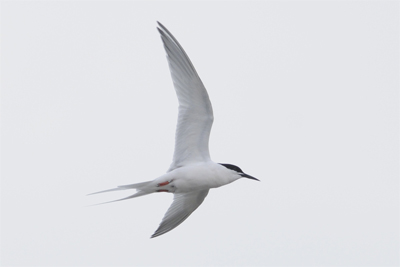
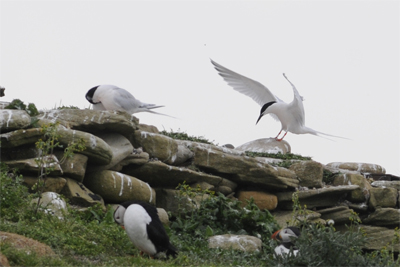
    Sarah had the excellent idea of taking a boat trip around Coquet Island, which I was really enthusiastic about.  When myself and Tom Cadwallender from the Northumberland Coast AONB were designing the backdrop for this year’s Birdwatching Northumberland stand at the Bird Fair we chose eight species that we felt symbolised Northumberland birding; Curlew, Eider, Pale-bellied Brent Goose, Golden Plover, Black Grouse, Roseate Tern, Dipper and Puffin.  A mix of everything that’s good about birdwatching in Northumberland; inland, coastal, summer and winter.  I had images of seven of those species, but the Roseate Tern is the one that I haven’t photographed during the digital age.  Hence, my enthusiasm for a trip around Coquet Island; with 35-40 Rosies already back at their Northumberland colony I was hopeful that photo opportunities would arise.  As we sailed across to the island onboard Shokwave, there was a strengthening NNE breeze and the temperature began to decrease rapidly.  Once Dennis manouvered the boat into the jetty, we could see Roseates sitting on their nest boxes.  They were a bit distant for photography so I waited patiently until I heard the distinctive ‘choo-it’ call and a bird flew by the boat.

    Britain's rarest breeding seabird

    Grey Seals popped their heads above the water to look at the boat, Puffins whizzed past at breakneck speed and more Roseates were busy displaying around the boxes.

    Roseate Tern

    After a pleasant Sunday morning cruise it was time to return home. En route, we stopped off to check a Little Owl nest site and one of the adult birds sat staring at us from the roof of a derelict building.  Finalising the paperwork for a forthcoming project was followed by a wonderful evening sitting on our patio, drinking wine and working on part of our bonsai collection as Blackbirds were singing from our trees and Coal Tits collected food to take to the noisy, and hungry, nestlings that we could hear.  Now, that’s my idea of heaven 🙂