Tag: Pale-bellied Brent Goose

  • The Island; Lindisfarne Safari 12/10/2014

    After a break from work and blogging, and our first proper holiday in quite a while, I got back into the swing of things on Sunday with a visit to probably my favourite mid-October location…

    Crossing the causeway to Holy Island is always accompanied by a sense of anticipation, and when I collected Graham and Joan from the Manor House they mentioned that Yellow-browed Warblers had been seen the day before.  Checking the bushes and trees in the Vicar’s Garden didn’t produce any sight or sound of the Siberian speciality, but everywhere was heaving with Robins – presumably recent arrivals from the continent – and Grey Plover, Pale-bellied Brent Goose, Bar-tailed Godwit and Grey Seal could be seen, and heard, by turning through 90 degrees from the trees.  After checking other suitable spots around the village, and finding a couple of Goldcrest, we crossed to the mainland and down to Bamburgh.  Oystercatcher, Turnstone, Curlew, Purple Sandpiper and Knot were around the rocks as Eider and Guillemot rose and fell with the gentle swell of the sea and Gannet and Sandwich Tern plunged into shoals of fish offshore in conditions that wouldn’t have been out of place in mid-June.  We made our way slowly back up the coast, taking in vast flocks of Wigeon over the mudflats and a Weasel that responded obligingly to my imitation of a dying mouse (the sound, rather than a visual imitation!).  Little Egrets and Shelduck were exploiting the food supply on the exposed mud and we crossed back on to the island…only to learn that a White-tailed Eagle had been soaring high inland of us while we were watching the Weasel 🙁  We headed down to the causeway, to see if the eagle would make a reappearance, as flocks of Sanderling, Dunlin, Knot, Bar-tailed Godwit, Pale-bellied Brent Goose and Golden Plover concentrated on the rapidly diminishing areas of mud above the rising tide and a Peregrine powered across our field of view before it was time for me to cross back to the mainland and head south.

  • Winter Wonderland Day One 04/12/2013

    As I met up with David for breakfast at The Swan on Wednesday morning, ahead of two days on the Northumberland coast, we’d already switched our itinerary round.  The plan to visit Holy Island on Thursday looked as though it might be slightly impacted by the weather, so we switched Druridge Bay to that day instead.

    The drive north on the A1 was in glorious weather, with Common Buzzards soaring low over plantations in the chill of the early morning and we were soon on Holy Island in a stiffening breeze, carefully stalking towards a flock of Dark-bellied Brent Geese that posed for David’s camera.  Bar-tailed Godwits, and a lone Black-tailed Godwit were probing the exposed mud of the harbour at low tide and Wigeon and Teal were on the Rocket Pool.  A Common Kestrel was hovering nearby and, as the tide turned, we headed to the causeway to see what would be pushed towards us by the advancing water.  Redshank, Curlew, Dunlin, Bar-tailed Godwit, Shelduck and a Little Egret all fed along the swelling channels

    Eurasian Curlew,Numenius arquata,Northumberland,birdwatching holidays,photography holidays,Holy Island,Lindisfarne

    and then a mass of Pale-bellied Brent Geese flew in from the south.  As the water began to lap at the edge of the causeway we drove back on to the mainland, and headed to a quiet stretch of shoreline where I knew David could use the cover of a hedgerow to approach a flock of Pale-bellied Brents whilst avoiding detection.

    Pale-bellied Brent Geese,Branta bernicla hrota,Holy Island,Lindisfarne,Northumberland,photography holidays,birdwatching holidays

    Using the car as a photographic hide (something of a theme  for the holiday!) we got very close views of a flock of Wigeon,

    Eurasian Wigeon,Anas penelope,Holy Island,Lindisfarne,Northumberland,birdwatchinf holidays,photography holidays,northern experience wildlife tours

    and then we settled in the iconic shadow of Bamburgh Castle and scanned the sea in temperatures that were now bone-chilling 🙂  Purple Sandpipers, Turnstones, Oystercatchers and Redshank were roosting just above the water line and beyond the rafts of Eider were flocks of Common Scoter, with one large group of females looking stunningly orange in the beautiful late afternoon sunlight.  Long-tailed Ducks played hide and seek, utilising their propensity for diving, and the developing swell, to keep me on my toes as I located a group with the ‘scope so that David could see them.  Scanning the scoter flocks paid dividends as a female Velvet Scoter rose up and over one advancing wave crest, Red-throated Divers cruised along in their eternal search for fish and a last scan before we headed back down the coast produced a Slavonian Grebe.  As it turned dark, the clear sky afforded excellent ‘scope views of the crescent Venus, and the thinnest sliver of crescent Moon.  So soon after New Moon would be a spring tide, and the one forecast for the following day was predicted to be a big one…

  • The enchanting isle; Lindisfarne Safari 29/11/2013

    After a planned 5 week break to recover from surgery I headed to Bamburgh, to collect Laura and Richard for a mini-Safari around Lindisfarne, brimming over with enthusiasm to be back and doing what I love.

    Starting in the shadow of Bamburgh Castle, we watched Purple Sandpiper, Turnstone, Redshank and Oystercatcher as they flew from wave-blasted rock to wave-blasted rock with Eiders appearing and disappearing in the swell just beyond them.  A flock of Twite rose briefly from the weedy fields and, sitting on a ridge in adjacent field was the largest Peregrine that I’ve ever seen.  As we neared Holy Island a flock of Pale-bellied Brent Geese were making their way along the shoreline and Grey Plover, Ringed Plover and Bar-tailed Godwit were exploring the recently uncovered mud as a Greenshank slept with it’s head tucked between its wings.  We were using two cars, as Laura and Richard thought it would make more sense then transferring their three dogs to my car.  As we headed across the causeway a Merlin chased a flock of Snow Buntings, but they were up and over the dunes before the second car reached them 🙁

    As daylight faded we enjoyed excellent ‘scope views of a crescent Venus in the western sky, and then I was on my way back down the coast to get ready for a full day trip on Saturday 🙂

  • Never mind the Balearics…

    …here’s the Bonxies.

    Watching the weather forecast during the week, and having a day on Holy Island on Thursday with Malcolm (trip report to come soon!), convinced me that there was somewhere I needed to be at dawn on Friday.  Arriving at Church Point in the half-light there were a few cars already parked, and a wander along to the point with Mike H found the owners of those cars already intently scanning the angry-looking sea.  Andy McL, Tim C., Eric B., David D. and Jimmy S. were all clustered around the ‘seawatching hut’.

    It would be good to be able to report that I’m thoroughly domesticated and house-trained and, after the few hours I’d planned to spend seawatching, I went home, via the supermarket to do the grocery shopping, and did all of the housework.  However, back in what Sarah refers to as ‘the world according to Martin’ that couple of hours to see if there was any movement of seabirds turned into a plan to stay until 12:00…then mid-afternoon…and finally, as the light faded to the point where you could hallucinate the sort of sightings that Ellington’s second best birdwatcher * was enjoying a few miles to the north of us, I gave up just after 18:00.  11 hours on Church Point, but a not-too-shabby day list;

    Black Guillemot 1

    Great Crested Grebe 1

    Pale-bellied Brent Goose 20

    Dark-bellied Brent Goose 2

    Long-tailed Duck 4

    Goldeneye 9

    Velvet Scoter 15

    Shoveler 24

    Red-throated Diver 24

    Black-throated Diver 3

    Great Northern Diver 7

    Manx Shearwater 53

    Sooty Shearwater 62

    Balearic Shearwater 2

    Great Skua 261

    Pomarine Skua 3

    Long-tailed Skua 3

    Arctic Skua 8

    Red-breasted Merganser 7

    Little Gull 3

    Arctic Tern 1

    ‘blue’ Fulmar 12

    Short-eared Owl 1

    *Ellington’s best birdwatcher is, and it really goes without saying, Iain’s better half, Janet 🙂

  • Stumbling across a twitch

    Late August/early September is an exciting time on the Northumberland coast; wader passage is still ongoing, wintering wildfowl are arriving and you just never know what could turn up…

    I collected Andy and Lia from Alnwick and we set off for a day birdwatching on the Northumberland coast from Bamburgh to Druridge Bay.  Knot, Turnstone, Oystercatcher, Curlew, Sanderling and some very elusive Purple Sandpipers started the day for us, as Linnets fluttered around in the long grass, Meadow and Rock Pipits were around the tideline, Gannets were soaring majestically by and Eider and Common Scoter were bobbing around just beyond the surf and a mixed flock of Common and Sandwich Terns were flushed by walkers before settling back on the rocks close to the breaking surf.  Offshore a small flock of birds grabbed my attention, and through the telescope resolved into one of Northumberland’s winter specialities; seven Pale-bellied Brent Geese steadily heading north were our first of the autumn.

    Further south, waders were still the main focus of our day;  Dunlin, Redshank, Greenshank, Snipe, Whimbrel, Black-tailed Godwit, Bar-tailed Godwit and Ruff were all pottering about in the water’s edge.  When we arrived at East Chevington to look for the Spotted Crake, there were a few local birders already there.  With an astonishing amount of luck, we’d arrived just as a White-rumped Sandpiper was being watched 🙂  Not the easiest of birds to identify, but as it wandered around a flock of sleeping Teal with Dunlin and Snipe alongside for comparison it stood out quite well.

    Another cracking day’s birdwatching, with a proper rarity to add a touch of the unusual 🙂

  • Northumberland at its best

    As we walked home from The Swan on Friday night, serenaded by the tremulous song of a Tawny Owl, the air was damp and chilly.  With a Lindisfarne mini-safari on Saturday morning I was hoping that the weather would be fine, and the forecast suggested it would be…

    So, when the alarm went off and I looked out of the window, I was quite surprised that there was a good covering of snow.  A few minutes later the snow started again, and I wondered what conditions would be like in the north of the county.  It turned out that we were near the northern edge of the snow, and as soon as I was through Morpeth and on the A1 there was just an occasional light flurry, and no snow on the ground.

    I collected Emily and Warren from St Cuthbert’s House and we headed straight for Holy Island so that we would be on the island for a couple of hours before the tide encroached onto the causeway.  Dark-bellied Brent Geese were roosting and bathing in the Rocket Pools, Curlews were feeding in the fields by the Crooked Lonnen and a lone Fieldfare hopped along the track ahead of us.  We could see that the weather was doing something ‘interesting’ out beyond the Farne Islands, and the icy wind coming in off the sea made it a day to really appreciate the resilience of our wintering birds.  As we left the island, flocks of Lapwings were being blown on the breeze, Pale-bellied Brent Geese and Bar-tailed Godwits were working their way along the edge of the incoming tide and Eider and Long-tailed Duck were in the South Low, competing for the title of ‘most attractive duck of the day’.  Kestrels were a regular feature of the morning, and we enjoyed good views of nine very obliging Roe Deer.

    Driving back down the coast, I could see that the ‘interesting’ weather seemed to be over Bamburgh Castle and Seahouses, so it was no surprise that snow started to fall as we passed Budle Bay.  Then it got heavier…and heavier.  Eventually, as we reached Stag Rocks, there was an incredible blizzard coming in off the North Sea, reducing visibility to only as far as the shore.  Emily jumped out of the car as soon as we’d stopped, revelling in the snowfall; I’m not the only one who enjoys the winter and really loves snow 🙂  As the blizzard passed over us and made its way inland, the Farne Islands gradually faded into view and we made our way back to Seahouses.

  • Roost

    Friday was our fourth Druridge Bay/southeast Northumberland safari of the week, and it was a real pleasure to meet up with Lawrie and Linda, 2 of our returning clients from last year.

    We started with a specific request; Brown Hare.  In the strong wind, persistent drizzle and biting cold they were keeping their heads down…all except for one which raised it’s ears, and then it’s head, above the stubble before demonstrating a remarkable vanishing act.

    In Newbiggin Bay, with a big menacing sea breaking in the background, a flock of Pale-bellied Brent Geese flew north as we watched the Turnstones, Ringed Plover, Redshanks and Sanderling on the edge of the surf.

    Fields of Curlew, and fighting cock Pheasants, provided additional entertainment as we drove down the coast.  I’d decided on East Chevington as our final destination of the trip and, as we arrived and began walking down to the North Pool, it looked as though the weather might get the better of us.  The wind was strengthening and the first few drops of rain began to fall as a juvenile Merlin raced across the fenceline in front of us looking, in the fading light, like an oversized hirundine.  The evening roost on the pool was building and hundreds of Great Black-backed, Lesser Black-backed, Herring, Black-headed and Common Gulls were sitting in the shallow water with Sandwich Terns, Lapwings, Knot, Teal, Mallard, Wigeon, Shoveler, Coot, Moorhen and Canada and Greylag Geese.  Then Pink-footed Geese and more Greylag Geese began arriving, and the 4 Snow Geese that we saw last Sunday flew in to join the throng.  A wave of panic spread through the roost, and many of the birds lifted into the air as a Bittern flew from one reedbed to another.  Eventually, even the silhouettes began to merge into the darkness and the birds began to settle as we left the hide and braved the driving rain.  With the footpaths and roads now covered in puddles the walk to the car, and the drive back to Alnwick, featured lots of Common Frogs and Common Toads, as well as a Tawny Owl that was perched on a fence post next to a line of trees.

    It was a great experience to enjoy some pretty awful weather, and some superb wildlife, with Lawrie and Linda. I’ll never get fed up with what we do, and the weather is all a par tof the tapestry of that.

    Thanks for the chocolates 🙂

  • A matter of timing

    Being in the right place at the right time is so critical to everything we do; if we’re searching for Otters we need to be there when they rise from their slumber and become active, if Badgers are the target for the trip then arriving the correct length of time before sunset is important, and if we’re visiting Holy Island then timing is a real key to success.

    I set off up the A1 with Jo on board, and collected Paul from Bamburgh.  The plan for the day was a simple one; spend a few hours birdwatching on Holy Island, then leave as the tide was rising and check sites down the coast towards Bamburgh.  From the top of the Heugh, we scanned across the sandflats whilst listening to the ghostly moaning of a group of Grey Seals.  An Arctic Skua was harassing the roosting terns and gulls, Curlew and Bar-tailed Godwits were probing along the water’s edge, Grey Plover, many of them still in their incredibly beautiful breeding plumage, seemed to be everywhere that we looked and a Kestrel chased a Peregrine through the dunes around Snook House.  Back on the mainland we found a Whimbrel in a group of Curlew, our second Peregrine of the day beat a menacing path along the shoreline and there was a real surprise in the shape of 5 Pale-bellied Brent Geese.  Budle Bay produced a Little Egret, a flock of 150+ Grey Plover and a distant feeding frenzy of Gannets that could be seen above the breaking surf.  Finally, as the tide begin to crash against the dunes in the shadow of Bamburgh Castle, we watched as a flock of Knot, Turnstone, Oystercatcher, Redshank, Sanderling and Dunlin braved the onrushing waves for longer than the human visitors to the beach 🙂

  • Northumberland; Birdwatching on the high sea

    Yesterday was our final full-day pelagic for the year.  With a couple of late cancellations, ten of us boarded the SarahJFK and headed out to sea.  Before we reached the end of the Tyne piers there was already a bit of swell…

    Once we were out and heading offshore it was exhilarating, with an often icy westerly breeze and long rolling waves from the north.  Small groups of Pale-bellied Brent Geese passed by during the day and a small group of Greylag Geese and Pink-footed Geese as well – a sure sign that the autumn is here.  There was an almost complete absence of Fulmars, leading to speculation about what these enigmatic seabirds are doing when we can’t find them, and only one Manx Shearwater.  Arctic Skuas were a bit thin on the ground, but we did find a good pelagic prize – a sub-adult Pomarine Skua that passed by with two Great Skuas.  Excellent views of the latter species, and some stunning Sooty Shearwaters were the highlight of the day, and there were lots of Kittiwakes and Gannets, although that accolade could have gone to the 2 White-beaked Dolphins that were seen briefly on 3 occasions late in the afternoon.

    Northumberland birdwatching, pelagic, Great Skua
    Great Skua or 'Bonxie'
    Pelagic, Birdwatching Northumberland, Sooty Shearwater
    Sooty Shearwater

    Pelagic Birdwatching Northumberland Sooty Shearwater
    Sooty Shearwater – the epitome of grace
    The swell proved a bit too much for some participants so, in between scanning for birds and cetaceans, I spent some time providing sympathy and advice for the worst of the stricken 🙂  Don’t let that put you off signing up for any of next-year’s pelagics though; it’s actually quite unusual for anyone to be really seasick on one of our pelagics, but the big swell (probably originating a few days ago from the near the north west coast of Norway) combined with a strengthening westerly breeze was a freak combination of conditions that managed to hinder the enjoyment of all the birds around the boat for a couple of the girls.  I was once asked, by someone who was a self-professed non-sailor, why I would spend so much time on a small boat in the North Sea…I think that now I would just send them a link to the images in this post and the videos in my Farne Deeps trip report

    We’ve got one more pelagic this year, around the Farne Islands, Holy Island and the Skate Road on Saturday December 4th, so give us a call on 01670 827465 for further details or to book.

  • A Rosy outlook

    Saturday saw a change in our normal Safari routine, and an early afternoon start.  I collected Gareth and Ruth from the Red Lion at Alnmouth and we drove south.  The hot, sunny weather had brought out hundreds of people to Plessey Woods but we still found a peaceful, undisturbed glade where we could listen to the birds singing and we watched a female Great Spotted Woodpecker; at least we were able to watch her until she realised that we were!  Cresswell Pond produced a real avian soap opera as a Mute Swan defended his pond against two interlopers, racing across the pond like the Spanish Armada.  A Little Gull was as cute and dimunitive as ever, alongside Black-headed, Common and Herring Gulls.  Druridge Pools was hosting some obviously confused geese; amongst the expected flock of Greylags there were single Pink-footed and Barnacle Geese as well.  A late finish concluded with a beautiful, ghostly Barn Owl and at least 3 different species of bat along the River Coquet at dusk.

    Sunday was a day for doing whatever we felt like.  With temperatures still soaring, a day inland, doing survey work for the BTO Bird Atlas, was considered then rejected in favour of a visit to the coast.

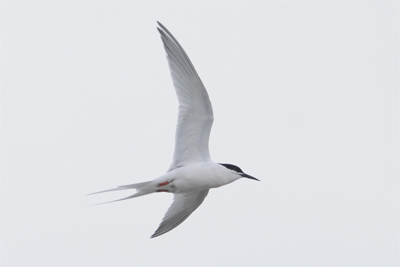
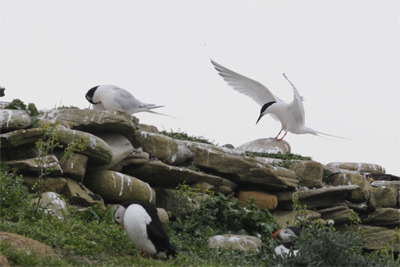
    Sarah had the excellent idea of taking a boat trip around Coquet Island, which I was really enthusiastic about.  When myself and Tom Cadwallender from the Northumberland Coast AONB were designing the backdrop for this year’s Birdwatching Northumberland stand at the Bird Fair we chose eight species that we felt symbolised Northumberland birding; Curlew, Eider, Pale-bellied Brent Goose, Golden Plover, Black Grouse, Roseate Tern, Dipper and Puffin.  A mix of everything that’s good about birdwatching in Northumberland; inland, coastal, summer and winter.  I had images of seven of those species, but the Roseate Tern is the one that I haven’t photographed during the digital age.  Hence, my enthusiasm for a trip around Coquet Island; with 35-40 Rosies already back at their Northumberland colony I was hopeful that photo opportunities would arise.  As we sailed across to the island onboard Shokwave, there was a strengthening NNE breeze and the temperature began to decrease rapidly.  Once Dennis manouvered the boat into the jetty, we could see Roseates sitting on their nest boxes.  They were a bit distant for photography so I waited patiently until I heard the distinctive ‘choo-it’ call and a bird flew by the boat.

    Britain's rarest breeding seabird

    Grey Seals popped their heads above the water to look at the boat, Puffins whizzed past at breakneck speed and more Roseates were busy displaying around the boxes.

    Roseate Tern

    After a pleasant Sunday morning cruise it was time to return home. En route, we stopped off to check a Little Owl nest site and one of the adult birds sat staring at us from the roof of a derelict building.  Finalising the paperwork for a forthcoming project was followed by a wonderful evening sitting on our patio, drinking wine and working on part of our bonsai collection as Blackbirds were singing from our trees and Coal Tits collected food to take to the noisy, and hungry, nestlings that we could hear.  Now, that’s my idea of heaven 🙂