Tag: Northumberland

  • On the trail of the otter…and then some

    Yesterday was the first of several forthcoming days where we’re running multiple trips on the same day, and with 6 clients during the day, and 2 of them joining us for an evening safari as well, it was a day that could go really well, or not…

    The primary target species for everyone was our old favourite, Otters. We started with a spot of birdwatching, and excellent views of the Little Owl that we should probably be adding to the NEWT payroll 😉  Our first Otter site didn’t produce the goods, although 2 Brown Hares chasing each other around a nearby field provided good entertainment.  Once we’d been there as long as I’d decided in advance of the trip, I had a hunch that another site, that has disappointed for several months now, might just produce the goods.  As we arrived I pointed out the location of a holt and suggested that the area around that was a good place to check.  Within a minute, Anthea had found 2 Otters, and we watched them for 75 mins as they fed, played, paddled along the surface, dodged in and out of the reeds and eventually vanished, probably to have an afternoon nap after their marathon feeding session.  A bit more birdwatching further up the coast produced excellent views of Common and Sandwich Terns and then it was time to return Liz & James and Kate & Take (pronounced Tarka – the most appropriate name for any participant in a NEWT trip so far) to their respective holiday locations and start the second trip of the day with Andy and Anthea.

    Anthea is an Australian with a fascination for British wildlife and the day out was part of a target list that she has for a 3 month trip around Britain and Europe.  Red Squirrel was next on the list and patience and persistence paid off as we settled ourselves close to a feeding area and eventually had excellent views of at least 3 squirrels, and some very close Jays, Great Spotted Woodpeckers  and a Nuthatch.

    With such a long day, sustenance came in the form of a meal at The Swan before we were on our way again.  Myriads of Rabbits were along the roads and we made our way along the heavily wooded valley of a small stream and got into position opposite a Badger sett.  A Red Fox walked along the hillside before vanishing into the undergrowth and causing consternation in all of the birds that were settling to roost.  It re-appeared just up the track from where were sitting and ran up the hill behind us, then a 2nd Fox crossed the hillside.  Soon we were treated to the sight of not one, not two, but three Badgers crossing a clearing.  As the light levels in the wood dropped to unmanageable we relocated to a feeding area that’s popular with Badgers and Foxes where we watched another Fox as it stalked along an edge, apparently invisible to the Rabbits that were sitting on the grass.  As we walked back to the Land Rover we added mammals #7 and #8 to the day list; Common Pipistrelle and Daubenton’s Bat.  A long day, but a really, really excellent one 🙂
  • Birdwatching; Northumberland in the rain

    I’ve always maintained that, whatever the weather (with the possible exception of a howling gale), it’s always possible to have a really good day birdwatching in Northumberland.  Yesterday’s forecast didn’t promise too much in the way of good weather though and, as it turned out, we had to contend with drizzly rain for the whole day.

    I collected Reg and Val from Newcastle and we set off towards the Harthope Valley.  This is one of NEWT’s favourite locations; spectacular scenery, excellent birdwatching and the all important absence of crowds.  A holiday group from another birdwatching company were in the valley as well, though.  Just before we reached the turning for Langleeford, a Brown Hare was sitting in a roadside field.  As we’re in June, and all of the trees are in leaf, a lot of our birding was done by ear.  Grasshopper Warbler was a nice find, Oystercatchers were chasing each other up and down the valley, a Cuckoo flew past, pursued by Meadow Pipits, the shivering trill of a Wood Warbler could be heard over the running water and Grey Wagtail, Common Sandpiper  and Dipper were all along the water’s edge.  Willow Warblers were singing from all around, Siskin and Redpoll were picked up on call and then eventually gave excellent views, Snipe were displaying over a recently planted area on the opposite side of the valley, Curlews were singing their haunting song (so much more appropriate on windswept, remote moorland than on the coast) and then I heard it; a call that is familiar in the winter, but not in the Cheviot valleys in June.  I was still trying to convince myself that I’d misheard the call, when the bird appeared in front of us – unmistakeable really, there was a Twite. I looked, looked away, looked again;  no, I wasn’t imagining it.  It’s a species that’s suspected to breed in tiny numbers in Northumberland, although there seems to be a lack of confirmed records for the breeding season.  Perhaps it was passing through, or maybe, just maybe, there is a breeding site in the Cheviots.

    After the excitement of such an unexpected find, we had one major target species left for the day.  Ring Ouzel is another bird that you may find on coastal headlands in the autumn, and there are sporadic wintering records as well, but the place to see them is surely the remote upland valleys where they breed.  As we made our way up a steep-sided valley we had excellent views of a recently fledged Dipper, and I could hear an ouzel singing.  We continued and then the bird appeared overhead, flying from one side of the valley to the other, singing as it crossed.  It dropped out of sight, still singing, before retracing it’s route over the valley again.  This time we knew where it had landed so we crept along a track towards it.  Patience and persistence paid off (as they so often do) and we enjoyed prolonged views of the bird as it sang from a clump of heather on the skyline.  The rain was becoming colder and more persistent so we headed back to the car and then down the A697 back to civilisation.

  • Badger watching people birdwatching

    Yesterday’s Druridge Bay/Southeast Northumberland trip was focussed on coastal birdwatching and, particularly, mammals.  We’re moving more and more towards early starts and/or late finishes on our Safaris; some of our clients like the 9-5 sort of day out which slots easily into their daily routine whereas others are more adventurous and a mid-afternoon start means that we’re still out at what is, in my opinion, the best time of the day…

    It’s near to dusk and we’re sitting on a hillside in a shaded wood.  Opposite us is an area of open ground that will, I hope, provide a longed-for lifer for my clients.  Pipistrelles are racing backwards and forwards around our heads and everyone is following their pre-trip instructions to the letter; no movement, no sound, make sure there’s something behind you to break up your silhouette.

    We’ve already had an excellent afternoon in the stunning weather;  a Little Owl sat and watched us without any concern – perhaps it recognises our Land Rover after a few visits, and realises that we aren’t a threat?  A Barn Owl flew close by, taking prey back to the nest and a Reed Bunting sang from a reedbed just a few meters away, it’s simple song drowned out by the extraordinary performance of a Sedge Warbler.  Now though, we’re approaching the culmination of the trip and there’s a strong sense of anticipation.  A movement on the hillside opposite, and there’s our first Badger of the evening 🙂  Trotting along a track near the top of the hill, we get just a few seconds as it’s clearly on a mission.  Everyone sits still and silent; discipline indeed after the appearance of the day’s main target.  A Red Fox came down off the hillside then walked past us and up the bank we were sitting against, as unconcerned as the Little Owl by our presence.  Patience pays off a few minutes later when two young Badgers appear low down on the hillside.  After a few minutes of playing around behind a tree trunk, and only being visible briefly, one of them comes out into the open; snuffling and foraging it’s way across the clearing, these are the views of wildlife that make what we do so much fun.  A brief pause, and it turned to face us, lifting it’s head high.  Have we been spotted?  A lot of succesful wildlife encounters depend on not being seen, or at least not appearing to be a threat.  As it returns to happily foraging on the hillside I breathe a sigh of relief, knowing that we’d got it right, and once it had vanished into the undergrowth we retreat silently from our watchpoint, treading carefully; after all, we’ve managed to watch these iconic animals without disturbing them, it would be a real shame to cause them distress as we leave.

  • A lazy summer afternoon

    It’s that time of year again.  Bright sunshine, insects are on the wing and in Southeast Northumberland, birdwatching is taken at a steady pace.

    On yesterday’s Druridge Bay trip  Common Blue  and Blue-tailed Damselflies were flitting about in front of us and every so often would stop and rest, giving everyone an opportunity to see just how stunning they are.  Butterflies were around in good numbers as well and we had close views of one of my personal favourites, Small Copper.  Other wildlife was taking advantage of the sun as well; a Brown Hare crouched by a fence with flies buzzing around it’s nose and a very obliging Little Owl was sitting in the entrance to it’s nest.  A quick stare to check us out and then it dozed off again. Grey Herons flapped by, Lapwings were calling and trying to distract attention away from their chicks, Dunlin, resplendent in breeding plumage, probed the mud around the edge of Cresswell Pond and, in what seemed like next to no time, the day was done and we were heading back to Newbiggin.

  • 2 out of 3

    As the damp, dreary weather of yesterday was giving way to brighter conditions I found myself heading up the coast to collect clients from Craster.  Our targets for the evening were Red Squirrel, Otter and Badger; in that order of priority, so an evening safari in Southeast Northumberland had been planned to try and encompass all three species.  A walk along the River Blyth produced what could well be a ‘must see’ for natural history enthusiasts over the coming years.  Scampering along branches and leaping through the canopy, our first target entertained as it made it’s way through the trees – causing agitation in two Great Spotted Woodpeckers which had been feeding quietly before the squirrel’s appearance.  A Jay allowed us an unusually close approach before it vanished into the trees and Dippers were zipping back and forth along the river as we returned to the Land Rover, and we set out to search for Otters.  It wasn’t to be, although some compensation came in the shape of a Barn Owl, drifting along the dunes and then catching a vole before revealing the location of it’s nest by taking the food back to the waiting mouths.  That’s the great thing about running birdwatching and wildlife tours; it may be unpredictable, but there’s always something to enjoy and appreciate.

    With heavy drizzle hampering visibility, we made our way to a site where Badgers would hopefully be out and about.  Sure enough, James spotted one as soon as we arrived, and a second movement on the hillside was probably another one, although it slipped out of sight in the undergrowth soon after being spotted.

    Finding 2 out of 3 elusive mammals that we were looking for was a good success rate and, with some new sites for Otters  that we’ve been monitoring, our bespoke ‘multi-mammal’ trips are sure to prove popular this summer.

  • Setting the scene

    Sunday started with a journey to inland Northumberland, birdwatching on some heather moorland in order to complete our final 2 ‘early season’ visits for the BTO Bird Atlas.  Contrary to the forecast weather, it was cold, windy and drizzly.  However, we set off and were eventually rewarded with a dramatic improvement as the sun came out and so did the birds.  Alongside all of the Willow Warblers, Chaffinches, Skylarks and Meadow Pipits the highlights were at least 3 Spotted Flycatchers and a stunning male Whinchat.  A pair of Curlew began alarming as we crossed the moorland, constantly changing position to draw us away from their nest location.

    After a walk of just over 5 miles we headed home and decided that we would venture out towards dusk in search of badgers.  We’ve got an Otter and Badger trip on Thursday so we needed to check on the current status of a couple of setts that we’ve been watching for some time.  As we settled into position, with what appeared to be a horde of bats flying around, Blackbirds and Mistle Thrushes were alarming (as they often do late in the day).  Soon, movement on the hillside opposite revealed our first badger of the evening.  Very grey, with cream stripes, it came out of a sett, squatted on a patch of bare earth and then vanished into the undergrowth.  A second animal quickly followed, much more gingery than the first, and then a third, starkly black and white.  It really is a privilege to sit and watch these magnificent animals as they go about their business (no pun intended).

    After such a successful evening, getting a ‘phone call earlier today “can you take us out to look for Red Squirrels, Otters and Badgers tomorrow please” was exactly what we wanted.  Once upon a time I wouldn’t have been happy working on a Bank Holiday weekend, now it’s an enjoyable part of my career choice.  Just over 2 years in, and I don’t regret even a tiny part of that decision.

  • Early to rise

    4am, and the insistent ringing of the alarm prises me out of bed.  Stagger down the stairs, get dressed, find binoculars/hat/gloves and head out into the chill early morning Southeast Northumberland air.  The Dawn Chorus is in full flow; Blackbirds are leading the way, and dominating the soundscape around our house, Chiffchaffs are singing from the churchyard and I make a mental note to do this again tomorrow to get some sound recordings.

    Walking along the River Wansbeck I can see a pointed snout sticking out of the water distantly.  Closer inspection reveals a Grey Seal.  A Grey Heron flies by, croaking and screeching as a pair of Carrion Crows harrass it until it turns through 180 and heads away from the annoyance.  I move on as well, heading towards Druridge Bay.  With ethereal mist rising from a coastal pool, Sedge Warblers are singing from the bushes around me, and I’m concentrating on the mimicry that they employ, when a group of Rabbits suddenly scatter and Lapwings, Black-headed Gulls and Common Terns begin circling and alarming.  A movement in the grass reveals itself as a Red Fox; wary, immaculate and healthy – this isn’t the urban scrounger so familiar to many people, but rather what a recent client described as “that’ll be one of those rural foxes then”. 

    Then, one of those moments that take me back the best part of four decades; a Cuckoo starts calling.  My first Cuckoo, all those years ago, was on an early morning birdwatching cycle ride to a site several miles from home.  With nobody else anywhere to be seen, and all of the sounds of the early morning to myself, that haunting sound carried from nearby trees before the pointy-winged long-tailed shape of the bird raced across my field of view.  I stand and marvel at the bird.  It’s fascinating breeding ecology and migration still grip me the way that birdwatching did when I was a little lad.  Perhaps I need to start setting the alarm for very early every morning 🙂

  • A Rosy outlook

    Saturday saw a change in our normal Safari routine, and an early afternoon start.  I collected Gareth and Ruth from the Red Lion at Alnmouth and we drove south.  The hot, sunny weather had brought out hundreds of people to Plessey Woods but we still found a peaceful, undisturbed glade where we could listen to the birds singing and we watched a female Great Spotted Woodpecker; at least we were able to watch her until she realised that we were!  Cresswell Pond produced a real avian soap opera as a Mute Swan defended his pond against two interlopers, racing across the pond like the Spanish Armada.  A Little Gull was as cute and dimunitive as ever, alongside Black-headed, Common and Herring Gulls.  Druridge Pools was hosting some obviously confused geese; amongst the expected flock of Greylags there were single Pink-footed and Barnacle Geese as well.  A late finish concluded with a beautiful, ghostly Barn Owl and at least 3 different species of bat along the River Coquet at dusk.

    Sunday was a day for doing whatever we felt like.  With temperatures still soaring, a day inland, doing survey work for the BTO Bird Atlas, was considered then rejected in favour of a visit to the coast.

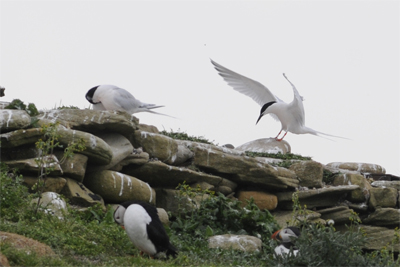
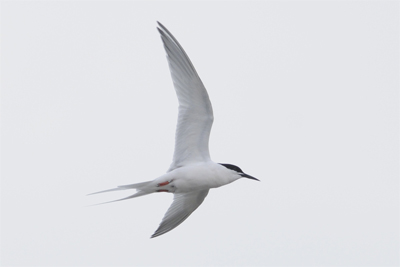
    Sarah had the excellent idea of taking a boat trip around Coquet Island, which I was really enthusiastic about.  When myself and Tom Cadwallender from the Northumberland Coast AONB were designing the backdrop for this year’s Birdwatching Northumberland stand at the Bird Fair we chose eight species that we felt symbolised Northumberland birding; Curlew, Eider, Pale-bellied Brent Goose, Golden Plover, Black Grouse, Roseate Tern, Dipper and Puffin.  A mix of everything that’s good about birdwatching in Northumberland; inland, coastal, summer and winter.  I had images of seven of those species, but the Roseate Tern is the one that I haven’t photographed during the digital age.  Hence, my enthusiasm for a trip around Coquet Island; with 35-40 Rosies already back at their Northumberland colony I was hopeful that photo opportunities would arise.  As we sailed across to the island onboard Shokwave, there was a strengthening NNE breeze and the temperature began to decrease rapidly.  Once Dennis manouvered the boat into the jetty, we could see Roseates sitting on their nest boxes.  They were a bit distant for photography so I waited patiently until I heard the distinctive ‘choo-it’ call and a bird flew by the boat.

    Britain's rarest breeding seabird

    Grey Seals popped their heads above the water to look at the boat, Puffins whizzed past at breakneck speed and more Roseates were busy displaying around the boxes.

    Roseate Tern

    After a pleasant Sunday morning cruise it was time to return home. En route, we stopped off to check a Little Owl nest site and one of the adult birds sat staring at us from the roof of a derelict building.  Finalising the paperwork for a forthcoming project was followed by a wonderful evening sitting on our patio, drinking wine and working on part of our bonsai collection as Blackbirds were singing from our trees and Coal Tits collected food to take to the noisy, and hungry, nestlings that we could hear.  Now, that’s my idea of heaven 🙂

  • Maximising our chances

    So far this year, tracking down Otters has proved slightly more difficult than it did last year.  That’s one of the drawbacks of working with animals 😉  They’re generally not predictable.  That’s what makes a wildlife tour so much fun though, you just never know what you’re going to experience.

    However, after a brief sighting on Thursday evening, I was happy that we’re still visiting the right areas of Northumberland to maximise our clients’ chances of connecting with this elusive, graceful predator.  I arrived at Newbiggin at 10am yesterday to collect Derek and Jacky for a mini-safari in Druridge Bay.  After our usual commentary on the industry and landscape of the area, as we drove towards Cresswell, it was time to settle and be patient.  I’d just finished explaining the two types of bird behaviour that usually accompany the appearance of an Otter, when there was a good example of the first; eight Tufted Ducks scattered from the edge of the pond.  Sure enough, it was less than 20 seconds before I spotted the tell-tale dark back breaking the surface and for the next few minutes we watched an adult Otter as it surfaced, dived and fed, all the while with a flock of Black-headed Gulls circling above it.  After a minute or two without any further sign I was sure it had disappeared into a channel in the reeds, probably going to rest after feeding.  The gulls began moving around the pond randomly; clearly they’d lost sight of the Otter as well.  Further entertainmant was provided by 3 Herons that were following each other around, and a Carrion Crow that was foolhardy enough to fly over several pairs of nesting Lapwings.

    After the morning seemed to just fly past, I took Derek and Jacky back to Newbiggin and then returned to the office, before heading out in the evening to check another new Otter site and enjoy some relaxed birdwatching.  But that’s another story for another day…

  • A day in the Bay, Birdwatching Northumberland (part 2)

    Our second day out with the winners of last year’s Birdwatching Northumberland  competition, was a day in Druridge Bay.  It provided a real contrast with our earlier trip to the Harthope Valley.

    After collecting Jean and Andy from the Bamburgh Castle Inn we headed down to Embleton to collect Helen, our third client on this trip, pausing for a few minutes to watch a very obliging Brown Hare in a field near Chatton.  As we toured our usual sites the weather was more like the caribbean than Northumberland 🙂  Tufted Ducks, Shovelers, Herons, Mute Swans, Lapwings and Coots were around the coastal pools, Sedge, Reed and Willow Warblers, Whitethroats and Reed Buntings were singing from hedgerows, sedges, reeds and willows and Fulmars were arcing gracefully along the cliffs at Cresswell.  On a woodland walk along the River Blyth we heard more than we saw (as you would expect in mid-May) with Nuthatch, Chiffchaff and Great Spotted Woodpecker all being particularly vocal.  Eventually the two days of the Birdwatching Northumberland prize were over and I returned all of our clients to their respective holiday accommodation.

    The day wasn’t finished for NEWT though; as dusk approached we were out on the coast, at separate locations, checking for Otters.  I did have one brief sighting, and on the journey home we began the process of redeveloping our Otter Safaris to make them an even better experience than they already are.