We’d planned to do some survey work this morning, but the prospect of walking along the beach from Cresswell to East Chevington into a stiff northerly with heavy rain and temperatures only hovering just above freezing wasn’t too tempting.
Instead we opted for some southeast Northumberland birdwatching with a walk along the River Wansbeck near Morpeth. Our local river is a real gem in some parts and we walk several of them regularly. In the gloom and wet of this morning we still enjoyed the Mallards and Moorhens on the river, the flocks of Coal Tits and Long-tailed Tits in the trees and, best of all, the iridescent electric blue of a Kingfisher as it perched on a tree overhanging the water. An afternoon spent working (on the Northeast Cetacean Project and a business plan that we’ve been preparing) will be followed (we hope!) by a relaxing Sunday evening and then a busy week ahead; finalising and submitting the business plan, bringing the Northeast Cetacean Project database up to date, drafting a couple of articles that Martin’s writing and meeting up with some old friends (and new ones) as we put together next year’s itinerary for NEWT. Oh, there’ll be a few blog posts as well 🙂
We had back-to back birdwatching trips earlier this week, covering two of our favourite areas.
On Tuesday afternoon I collected Keith and Jen from home in Monkseaton and we headed northwards up the Northumberland coast. Our destination was the Holy Island of Lindisfarne, one of the birding hot-spots of the entire country. The strong winds were the only downside to the afternoon, but the birdwatching was good. After checking out a large group of Grey Seals we covered the area around the harbour and the Rocket Field. Bar-tailed Godwits, Common Redshank and lots of Ringed Plover were along the shoreline and a delightful charm of Goldfinches were around the Heugh. A distant group of Lapwings, Starlings and Golden Plover took to the air and the cause of their alarm was glimpsed briefly, although too briefly and too distant to make a positive ID. Holy Island birdwatching stalwart Ian Kerr put us on to a Little Stint and, as we headed back through the village, groups of Golden Plover passed overhead. Re-tracing our route back down the coast and checking the Budle Bay on the rising tide, we were just discussing the indications of the presence of predators when a huge number of birds lifted from the mud. As well as the gulls and waders, Jackdaws, Rooks and Woodpigeons joined the throng as they came out of adjacent fields and trees. This time the culprit was seen and identified; a Peregrine, that most majestic of raptors and one of the highlights of any birdwatching day on the Northumberland coast in the autumn and winter. A quick seawatch produced Sandwich Terns feeding, and Gannets soaring effortlessly on the breeze.
Wednesday was a full day out around Druridge Bay and Southeast Northumberland. I collected Jayne and Andrew from Seahouses, and then Hilary and John from Alnmouth, before beginning our tour of some of the best birdwatching spots in our local area. While we were watching Lapwings, Redshanks, Greenshanks, Ruff, Herons and Cormorants on the River Wansbeck I could hear a rough ‘sreee’ call from high overhead. The strong breeze meant that it wasn’t straightforward to locate the bird, but eventually I picked it out. It was an unfamiliar call, but a familiar species; a juvenile Common Cuckoo. The walk back along the river produced a nice flock of Long-tailed Tits. After lunch we stopped off at Cresswell Pond. Hilary and John mentioned that they’d visited Cresswell once before – when they noticed a large group of birders and stopped, managing to see a Buff-breasted Sandpiper.
Buff-breasted Sandpiper and Ruff, Cresswell Pond, Northumberland 12/09/2008With luck like that, we joked about what this visit could produce...
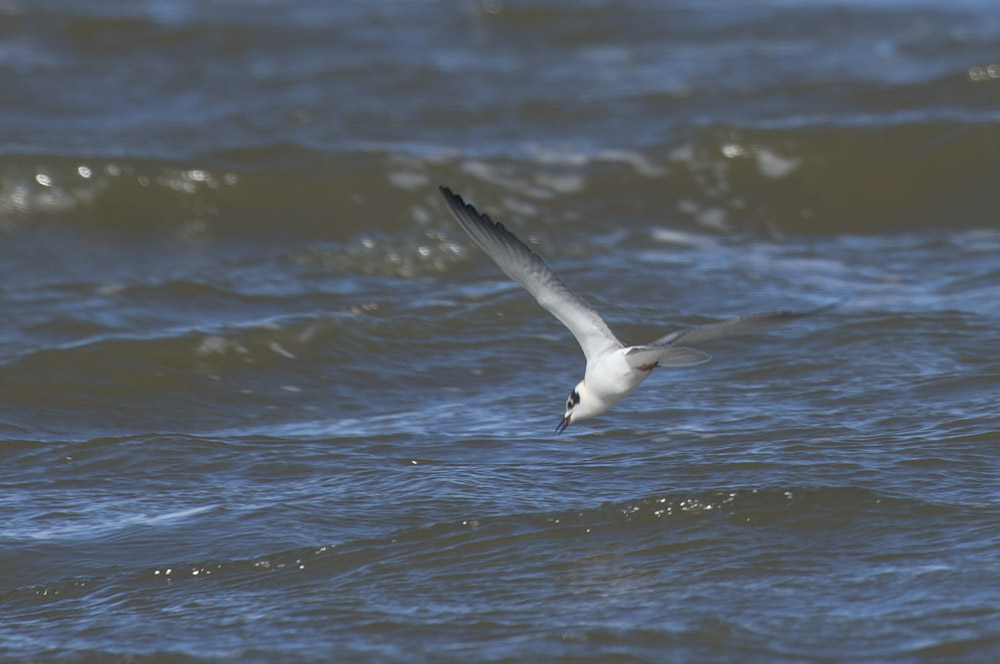
When we arrived at the hide, Jaybee mentioned that he’d had a juvenile Sandwich Tern. I scanned the pond but couldn’t see the tern anywhere and we settled to enjoying the quite remarkable views of Common Snipe that were available. After checking through the assembled ducks, gulls and waders I scanned across the pond again and spotted a tern dip-feeding near the causeway. The bird’s behaviour, combined with it’s very dark back, white rump and silver-grey wings caused me to get rather excited. White-winged Black Tern is a very special bird, and a personal highlight as it’s the third Chlidonias tern that I’ve found in Northumberland. Whiskered Tern is very rare and Black Tern is always a nice bird to see but White-winged Black Tern is such a beautiful species. Jaybee kindly sent me some images to use 🙂
White-winged Black Tern, Cresswell Pond, Northumberland 15/09/2010White-winged Black Tern, Cresswell Pond, Northumberland 15/09/2010
White-winged Black Tern, Cresswell Pond, Northumberland 15/09/2010As other birders began to arrive to enjoy the fruit of our good fortune we continued up the coast. Eiders and a Goosander, as well as some very obliging Grey Herons, were seen as we stopped by the River Coquet. A superb couple of day’s birdwatching, a beautiful rarity and clients who were excellent company.
Although our Cheviot Valleys and North Pennines safaris are concentrated in the springtime, we run a few trips to those inland areas in the late summer and early autumn. The final day of August was a trip to the Cheviots, and it could hardly have been better; the weather was wonderful, there were hardly any other people to be seen anywhere and the wildlife was, well, as good and varied as we would expect.
After collecting Hamish and Vanessa we drove past Morpeth then up the A697 and through the ford at Coldgate Mill. The Happy Valley was deserted and peaceful; a Slow Worm was basking in the dappled light between gorse bushes, Small Copper butterflies (a personal favourite) were feeding and sunning themselves and there were even a few Silver Y moths. We get these migrants in our trap occasionally, and I’ve seen them in profusion on the coast, but these were well inland.
Camera-shy Silver YGoldcrests were calling, and eventually spotted, Spotted Flycatchers, Treecreepers and Long-tailed Tits were all found in one tree, Robins seemed to be everywhere we went and the first of the day’s Common Buzzards, rising rapidly in a thermal, suggested that searching skywards could be productive for birdwatching.
After lunch we walked along the far end of the valley. Red Grouse were cackling hysterically on one side of the valley, at the same time as we could hear a shooting party on the other. Siskins and Lesser Redpolls were feeding around the treetops, although they did pause briefly so we had a chance to look at them. The warm sunshine and excellent visibility mean that it did turn out to be a raptor day; as well as Common Buzzards there were regular Common Kestrels and a Sparrowhawk then, as we walked back to the car park, a Peregrine soared majestically and menacingly against the blue sky overhead. Sadly our only Adder of the day was roadkill, although it had gathered an interesting collection of flies and beetles.
One thing that our safaris have proved to be is a break from the hustle and bustle of everyday life. If you need to get away from it all then give us a call, or if you know somebody who would benefit from a day of chilled out wildlife watching then our gift vouchers could be just the thing they need 🙂
Hamish kindly provided some images from the day (including the Silver Y that really didn’t want to be photographed) and my own favourites are here;
Mother Nature ages trees better than any bonsai artist can!
We had a leisurely hour of birdwatching yesterday morning. With all of the feeders stocked with top class bird food from Poltross, and a bacon and egg butty and a mug of coffee in hand, we settled down into our respective positions on either side of the kitchen. With commentary on the dismantling of Andy Murray in the background, binoculars were trained on the feeders, the ground, the shrubbery and the Ash tree. After a slow start, things began to gather pace and we finished with 76 birds of 20 species;
Collared Dove 4
Wood Pigeon 2
Jackdaw 1
Carrion Crow 1
House Sparrow 1
Starling 7
Blue Tit 2
Great Tit 3
Coal Tit 7
Willow Tit 2
Long-tailed Tit 3
Chaffinch 14
Greenfinch 5
Goldfinch 2
Bullfinch 4
Goldcrest 1
Robin 6
Dunnock 2
Blackbird 5
Redwing 4
There were a few absentees as well, all seen regularly in the days leading up to the Big Garden Birdwatch;
Jay
Great Spotted Woodpecker
Sparrowhawk
Siskin
Maybe 25 species in 1hr is a target to aim for in our garden next year.
OK, not quite, but since December 31st we’ve had about a foot of snow in total. I cancelled our Otter Safari on Tuesday for safety reasons. That decision proved to be the right one as we had heavy snowfall on Tuesday afternoon, making the roads even more hazardous than they already were. I drove to Wallsend to collect Sarah from work, and the 13 miles took 80 minutes – and that was mainly on 3 of Northumberland’s major roads (A1068, A19 and A1058). Cars were sliding from one lane to the next and I’m amazed that I didn’t witness any collisions. We’ve been using the Landrover for the last couple of weeks so when Sarah wanted her car to drive to work yesterday we had to dig it out of the snow. I can’t recall having to do that in the 17 years that we’ve lived up here.
For the last day and a bit I’ve had a throat infection so I’ve stayed in the house. That hasn’t been a huge burden though as it’s allowed me to spend a lot of time watching (and filming) the birds around our feeding station. For as long as I can remember, birdwatching has been something that’s always been an option when I’m unwell. The Brambling that Sarah found on Sunday is still around, Long-tailed Tits are visiting much more frequently than they ever have before, the Blackbird count has risen to 9, at least 5 Robins are trying to hold dominion over the patio and flocks of Siskin and Lesser Redpoll are patrolling the edge of Choppington Woods and the bottom of our allotment. Yesterday even a Goldcrest joined the chirping masses around the apple tree. With niger seed, peanuts, fat balls, mixed seed and windfall apples our garden is like an all-you-can-eat buffet. The one notable absentee from our usual list of visitors is Great Spotted Woodpecker, although we did see one in the woods on New Year’s Day. Has one of our neighbours set up a more attractive feeding station? We’d better raise our game, just in case.
The feeders in our garden have been busier in the last couple of days than at any time during this winter. No less than 6 Blackbirds have taken up residence, 3 or 4 Robins are posturing and defending territories, a steady stream of Blue, Great and Coal Tits, along with our 2 regular Willow Tits, are emptying the feeders rapidly and a flock of 8 Long-tailed Tits are putting in daily appearances. Chaffinch numbers are way down on previous winters, but Greenfinches are now almost ever-present during daylight hours and three pairs of Bullfinches are never far away. It’s interesting that, even on a very short-distance scale, there’s such a noticeable movement of birds from their ‘normal’ habitat (Choppington Woods) to the gardens around the edge of the woods whenever the weather turns colder. Birdwatching doesn’t get any easier than sitting in the kitchen, glass of port in one hand and a slice of Christmas cake in the other 🙂
First thing this morning everything was frozen solid again. However, by lunchtime when Martin took Dad to the railway station there was a noticeable thaw – even though the thermometer was showing the temperature having only just crept above freezing. Then it started to rain and most of the remaining patches of ice and snow vanished. The birds were still around in the numbers of recent days though and, if the weather forecasts are anything to go by, we’re in for some more very hard winter weather at the end of this year and the start of the new one. Wrap up warm.