Tag: Lapwing

  • Flying in for a day birdwatching in the North Pennines

    I always enjoy meeting up with our previous clients again, and Saturday morning found me at Newcastle Airport waiting to meet Jacob and Nancy as they arrived for a couple of days birdwatching in Northumberland.  They were going to be spending Sunday on the Farne Islands, but our destination on what was developing into a gloriously sunny Saturday was the North Pennines.

    Just 12 days earlier I’d been marvelling at the temperature of 1C at 10:30am but now Curlew, Lapwing and Oystercatcher were all flying around and calling noisily as we reached the higher ground southwest of Hexham, Skylarks were singing exuberantly against the azure sky, Meadow Pipits were ‘parachuting’ down at the end of their song flights and Common Snipe were calling from concealed positions in the grassland.  In the stunning light, Barn Swallows were eye-wateringly iridescent, a pair of Golden Plover flew in front of us and a pair of Red Grouse watched closely over eight chicks.  Red Grouse was a lifer for Jacob and Nancy and one male allowed a very close approach and provided a lot of photo opportunities for them.  Eyebrows, raised, eyebrows lowered, facing left, facing right, staring into the lens; he went through a veritable supermodel repertoire of poses before seemingly melting into the vegetation.

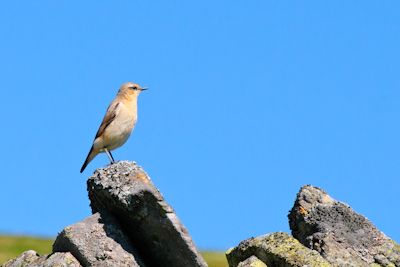
    As we travelled across a high moorland road, a Northern Wheatear posed obligingly for photographs.

    Northern Wheatear Oenanthe oenanthe,bird photography,bird photography holidays,bird photography courses,birdwatching holidays,Weardale,County Durham,North Pennines,www.northernexperienceimages.co.uk

    Skylarks and Meadow Pipits provided a memorable aural backdrop to our lunch stop, and a Golden Plover was silhouetted on top of a nearby ridge, keeping a close eye on it’s territory.  Near perfect weather, a gentle breeze, spectacular landscape and stunning birds; what more could you want from a day’s birdwatching?

  • Spring (Gentian) time in the hills

    The ‘quality over quantity’ birdwatching in the North Pennines has been the predominant feature of our days out with clients in the last two months, and a ‘phone enquiry on Tuesday saw me collecting David and Margaret on Wednesday morning for a day birdwatching in the hills.

    Red Grouse was the first of the upland specialities we encountered and, after a few single birds scattered across the moors we came across a pair with a brood of 10 chicks.  The adults watched us carefully as their offspring wandered about, completely unconcerned by our presence.  Lapwing and Curlew seemed to be everywhere and one Lapwing provided our only sighting of Snipe for the day, as it chased one over the road in front of us.  Oystercatcher, Redshank and Golden Plover were noisily displaying, Kestrels were stationary in the strong breeze and our first three Black Grouse were all seen distantly.  I was sure that we’d get much closer views of Blackcock and, sure enough, at the same spot where I photographed a displaying bird earlier this month, we came across what were probably the same two birds from that trip.

    A walk at Cow Green reservoir brought a non-avian highlight as Spring Gentians were in bloom.  If you’ve never seen one, this is what they look like 🙂

    Spring Gentian,Gentiana verna,Upper Teesdale,macro photography tuition,flower photography tuition,www.northernexperienceimages.co.uk

    Spring Gentian,Gentiana verna,macro photography tuition,flower photography tuition,Upper Teesdale,www.northernexperienceimages.co.uk

    After our walk we watched a small group of Blackcock as they engaged in their, slightly comical, lekking behaviour before heading back north east after another excellent day in the hills.

  • North Pennines Birdwatching 13/05/13

    I collected Andreas ahead of a day of birdwatching in the North Pennines with two things in mind; Andreas’ target list for the day (Red Grouse, Black Grouse, Ring Ouzel) and the weather forecast (sleet and snow showers, temps as low as 7C)…

    Glorious and breezy weather accompanied our journey southwest and we were soon at the first of our regular Black Grouse sites.  We arrived there just ahead of the first of the day’s snow showers – which saw the temperature plummet all the way down to 1C!  We soon found our first Red Grouse of the day, as Curlews displayed overhead, and a third of Andreas’ target list had been achieved.  An unexpected find by Andreas was a Woodcock, tucked into the vegetation as we made our way across from Allendale to Weardale.

    Eurasian Woodcock,Scolopax rusticola,Martin Kitching,www.northernexperienceimages.co.uk,bird photography courses,Northumberland,North Pennines,bird photography holidays

    Soon after the Woodcock we came across a displaying Common Snipe, and then our first Black Grouse of the day; a male sitting on a drystone wall, iridescent blue in the sunshine, followed by this bird, half-heartedly displaying while another one fed close by.  Two out of three…

    Black Grouse,Tetrao tetrix,Martin Kitching,www.northernexperienceimages.co.uk,Northumberland,North Pennines,bird photography courses,bird photography holidays

    Brilliant sunshine was followed by snow, was followed by brilliant sunshine, was followed by snow, and that pattern continued throughout the rest of the day.

    As we headed for our regular lunch spot, Andreas spotted a female Ring Ouzel, and completed his target list for the day 🙂  As the sunshine bathed the landscape around us, a very confiding Lapwing allowed some easy photography.

    Northern Lapwing,Vanellus vanellus,Martin Kitching,www.northernexperienceimages.co.uk,Northumberland,North Pennines,bird photography courses,bird photography holidays

    After watching two Blackcock lekking, with seven other birds pottering about nearby, we headed northeast.  The heaviest snow of the day accompanied our journey out of the hills, a reminder that conditions on high ground can be poor at any time…but the reward for braving our remotest landscapes is some really high quality birdwatching.

  • Watching the drama unfold

    Towards the end of a day in the North Pennines with Tony and Caroline, I suggested that we should head back to a Black Grouse lek where we’d watched two Blackcock pottering about in the early afternoon…

    Everything had been performing well.  Red Grouse and Black Grouse playing hide-and-seek-and-run-away-a-bit, Curlew, Redshank, Oystercatcher, Lapwing, Golden Plover and Snipe all displaying, Skylark and Meadow Pipit singing as they ascended skywards, a Wheatear on a midstream rock doing a credible impersonation of a Dipper and the mystery bird of last week’s trip revealed to be a Starling…with a pale crescent on it’s breast!

    Now, we were overlooking a lek site that we regularly visit on our North Pennines trips.  Two hours earlier there had been just two Blackcock visible, now there were nine, or ten, or five, or two…every scan produced a different total as birds stopped feeding, sat down in the long vegetation and simply vanished.  A few minutes later they all stood up, started feeding and wandered about for a little while before repeating the process.  After another cycle of ‘feed-hide-reappear’, a minor skirmish developed in amongst the feeding birds.  Two Blackcock squared up to each other; wings spread, tails raised, leaping into the air and lashing out at each other.  All of the other birds suddenly became very alert, and then the fight stopped and they took flight to the nearby area of low vegetation where we’re used to seeing them display.  Other birds, previously unseen, arrived and soon there were 14 of them; arranged in pairs they began the dance that characterises the early mornings of the North Pennines, each bird facing one adversary, strutting around, leaping and cooing (although the wind was carrying that evocative song away from our ears).  Four pairs stopped, and adopted a much more relaxed posture, then two more pairs followed suit.  Soon only two birds were still displaying…and, bizarrely, the other 12 were standing in the exact positions where they’d been when they gave up, like an odd game of musical statues.  Finally one of the remaining combatants pulled his wings in, lowered his tail and raised his head.  The final lekking bird stopped soon after, and we assumed that he was the afternoon’s winner.  As the gladiatorial contest ended, all of the other birds came out of the trance that they appeared to be in and began feeding.  The defeated bird from the final pairing made a half-hearted attempt at resuming the battle, but soon desisted when the reigning champion headed menacingly in his direction.

    Sometimes a wildlife experience is just breathtaking, and watching the lek, from the trigger that kicked it all off to the final mystifying tableau, has crashed into my all-time Top 5 🙂

  • Moorland meanderings

    As I collected Jenny and Rob for a day in the North Pennines, the weather looked promising, although a little breezy, and we were quickly in the hills.  The song of Lapwing, Curlew, Snipe, Redshank, Golden Plover and Oystercatcher carried on the breeze as we found our first Black Grouse of the day – a Blackcock and two Greyhens.  Red Grouse seemed to be filling every available bit of moorland and we had an ‘is it or isn’t it?’ moment with an upright, backlit, black bird on an old barn that seemed to show a pale crescent on the throat/breast.  It flew out of sight and we were left wondering (I’ve been back and do know what it is, but you’ll have to wait for my next blog post…).

    Our afternoon finished with eight Blackcocks lekking, but probably the stars of the day were one of our smaller moorland birds, as we came across a succession of Wheatears.  Strikingly handsome male, and subtly beautiful female, Northern Wheatears are always a pleasure to see, but the real surprise was a group of six birds together.  Big, upright, and flushed underneath with pinky-orange, these birds were Greenland Wheatears.  Migration doesn’t happen only on the coast 🙂

  • Black Grouse Bonanza Day 1; Nothing to grouse about

    As I drove to Peth Head Cottage on Thursday afternoon, the rain was hammering against the car windscreen.  Friday’s forecast was good though so, after a meal at The Travellers Rest in Slaley, I reminded Derek and Deirdre that we would have an early start the next morning.

    19/04/2013 05:00…the incessant ringing of the alarm pierced the depths of my sleep and I jumped out of bed, showered and opened my bedroom window.  The dawn chorus, mainly Blackbirds, Robins and Song Thrushes, was deafening, and the last remnants of rain were pattering down as we set off across the moors to a Black Grouse lek.  Roe Deer were watching us from a roadside field and a Tawny Owl flew across in front of us, no doubt heading for a secluded daytime roosting site.  First lek site, no birds, second lek site two Greyhens and a distant altercation between two Blackcock along a drystone wall as Curlew, Snipe, Oystercatcher and Lapwing displayed nearby and a Common Buzzard lumbered its way across the horizon.  A third site produced the goods though as, adjacent to a field filled with summer-plumaged Golden Plover, two Blackcock were strutting their stuff for the benefit of three Greyhens…who watched them with what appeared to be complete indifference 🙂

    After returning to Peth Head for a delicious, and very filling, breakfast (accompanied by Great Spotted Woodpeckers, Siskins, Robins, Dunnocks and a Reed Bunting on the feeders just outside the dining room window) we set out again.  By now, the sun was up, bathing the moors in sublime warm tones, and Derek spotted the tell-tale white flash of a displaying Blackcock.  This bird was strutting around next to two Greyhens, head down, tail up, pausing occasionally to stand bolt upright before jumping in the air and singing.  Just beyond the lekking lothario, a Short-eared Owl was quartering the moor.  Backwards and forwards on long narrow wings, the owl flew closer to our position, until eventually binoculars were put down when the field of view was completely filled with yellow-eyed menace as the owl flew over the bonnet of the car before veering away just inches from the windscreen.

    Deeper into the North Pennines AONB, over moorland liberally sprinkled with pairs of Red Grouse, flocks of Golden Plover flying around and giving their plaintive call, with a Dunlin easily picked out in one flock by it’s small size, and farmland with Brown Hares chasing each other, Derek’s sharp eyes picked out a bird on telegraph wires…and we had our first Ring Ouzel of the trip.  Singing it’s simple song, this could well have been the bird that I watched with Sarah in late March. A pair of Ring Ouzels followed soon after, staying just ahead of the car as we traversed a narrow road high above Weardale.  Deirdre spotted several displaying Blackcock and we passed from Weardale into Upper Teesdale.  Walking the remote moors produced close views of Red Grouse, Golden Plover, Wheatear, Skylark and Meadow Pipit before a completely unexpected find; for a second I wasn’t sure what I was watching, as a large brown and white bird drifted over the moor with deep lazy wingbeats, but as I lifted my binoculars I could barely contain my excitement as I let Derek and Deirdre know that there was an Osprey flying by!  We watched the bird as it hovered and then dived into a nearby reservoir, but it’s departure route took it out of sight so we didn’t see if it was successful in its hunt.  A pair of Goosander were feeding along the reservoir edge and, as they eventually crossed the open water, they picked up a Tufted Duck for company.

    I had a hunch that Black Grouse would be lekking late afternoon, so we returned to a site that had held just one resting Blackcock earlier in the day.  Sure enough, ‘the boys’ had gathered for a bit of a barney; 15 of them had turned up – seven obvious pairs of combatants and one bird sitting off to one side holding his wings, head and tail in the typical display posture but just standing still and watching the series of duels that were taking place in front of him.  A couple of them broke out into physical fights, and all of the birds were calling as the lek reached a crescendo before, as if someone had flicked a switch, they suddenly lowered their undertail coverts, lifted their heads, folded their wings back in and started nonchalantly pottering around the gladiatorial arena as if nothing had happened.  Just as exciting though, was what was going on above the lek.  In my field of view I could see a Curlew drop almost vertically before heading skyward again.  I raised my binoculars to follow it’s path and as it dropped again it was harassing, with the assistance of a flock of Black-headed Gulls, a male Goshawk! Open moorland may not be typical habitat for this fearsome inhabitant of our upland forests, but it isn’t the first time we’ve seen one out of context in late April.

    Back across the moors to Hexhamshire we saw more Red Grouse, more Black Grouse and, after a quick stop back at Peth Head we headed out to eat at the Dipton Mill Inn.  We followed that with a drive into Slaley Forest for Woodcock and Tawny Owls then, before retiring to bed, I stood in the dark outside the cottage and listened as at least four Tawny Owls called from close by.  A superb end to an excellent day 🙂
  • In the grip of winter…in late March

    Sunday saw the two of us heading southwest into the North Pennines to carry out some recce work for a press trip that Martin was leading.  As soon as we were up above the level of the Tyne valley there was snow laying, which got deeper as we gained altitude.  Lapwings, Curlew and Oystercatcher were all displaying, Common Kestrels were hovering over the few clear areas of vegetation and Common Buzzards soared by.  With a white landscape, Red Grouse and Black Grouse were easy to find and a few Red Grouse were close enough to make it worthwhile getting the camera out.

    Red Grouse,bird photography,bird photography tuition,Northumberland

    Red Grouse,bird photography,bird photography tuition,Northumberland

    Red Grouse,bird photography,photography tuition,Northumberland

    The highlight of the day came just over the border in County Durham with a stunning male Ring Ouzel, close to a nest site, being harrassed by a Mistle Thrush. The ‘Mountain Blackbird’ just seemed to be in exactly the right place in the wintry hills in deep snow.

  • Northumberland at its best

    As we walked home from The Swan on Friday night, serenaded by the tremulous song of a Tawny Owl, the air was damp and chilly.  With a Lindisfarne mini-safari on Saturday morning I was hoping that the weather would be fine, and the forecast suggested it would be…

    So, when the alarm went off and I looked out of the window, I was quite surprised that there was a good covering of snow.  A few minutes later the snow started again, and I wondered what conditions would be like in the north of the county.  It turned out that we were near the northern edge of the snow, and as soon as I was through Morpeth and on the A1 there was just an occasional light flurry, and no snow on the ground.

    I collected Emily and Warren from St Cuthbert’s House and we headed straight for Holy Island so that we would be on the island for a couple of hours before the tide encroached onto the causeway.  Dark-bellied Brent Geese were roosting and bathing in the Rocket Pools, Curlews were feeding in the fields by the Crooked Lonnen and a lone Fieldfare hopped along the track ahead of us.  We could see that the weather was doing something ‘interesting’ out beyond the Farne Islands, and the icy wind coming in off the sea made it a day to really appreciate the resilience of our wintering birds.  As we left the island, flocks of Lapwings were being blown on the breeze, Pale-bellied Brent Geese and Bar-tailed Godwits were working their way along the edge of the incoming tide and Eider and Long-tailed Duck were in the South Low, competing for the title of ‘most attractive duck of the day’.  Kestrels were a regular feature of the morning, and we enjoyed good views of nine very obliging Roe Deer.

    Driving back down the coast, I could see that the ‘interesting’ weather seemed to be over Bamburgh Castle and Seahouses, so it was no surprise that snow started to fall as we passed Budle Bay.  Then it got heavier…and heavier.  Eventually, as we reached Stag Rocks, there was an incredible blizzard coming in off the North Sea, reducing visibility to only as far as the shore.  Emily jumped out of the car as soon as we’d stopped, revelling in the snowfall; I’m not the only one who enjoys the winter and really loves snow 🙂  As the blizzard passed over us and made its way inland, the Farne Islands gradually faded into view and we made our way back to Seahouses.

  • Winter birdwatching

    With the cessation of the rain that plagued Sunday, Monday and Tuesday, Wednesday dawned cold and breezy; almost ideal for a day out on the birdwatching paradise that is the Northumberland Coast in the Winter.

    As I collected Ele and Lisa from their holiday cottage in the shadow of Bamburgh Castle, the icy northerly wind cut through the multiple layers that I’d put on before leaving the house.  We started our day’s birdwatching at Budle Bay, where the wind somehow seemed even icier, and Oystercatchers, Redshank and Curlew were probing the oozing mud as a distant Peregrine flushed flocks of Lapwing and Golden Plover. Eiders were surfing the top of the impressive swell on the open coast and we headed south towards Druridge Bay. Mediterranean Gulls drifted overhead, ghostly pale, as Oystercatchers, Curlew, Turnstone, Redshank and Sanderling worked along the edge of the surf.  Among all the immaculate ducks, two species really stood out; Goosander sleek and menacing, and Red-breasted Merganser drakes all trying to out do each other in their attempts to attract the ladies. A flock of Pink-footed Geese fed in a nearby field

    As daylight faded a flock of Waxwings were in the distant tree tops and two species that are always a pleasure to see put in an appearance.  Short-eared Owl and Barn Owl drifted along the edges of the reedbeds; death on silent wings.  Here are a couple of pictures of them from earlier this year (in better light and a gentler breeze!).

    Short-eared Owl,Asio flammeus,Northumberland,bird photography courses


    Barn Owl,Birdwatching Northumberland,bird photography holidays,bird photography courses,Northern Experience Images

  • Dragons

    Our returning clients theme continued last week, when I collected Elaine and Sue for an Otter Safari, concentrating mainly around Druridge Bay and southeast Northumberland.  We first met between Christmas and New Year 2008 when they joined myself and Sarah on a guided walk on Holy Island.  On that day Elaine photographed this stunning Stonechat

    Common Stonechat,bird photography,bird photography tuition,Northumberland

    and we also had a brief view of a Jack Snipe as it flushed ahead of us.

    Last Wednesday we set off up the coast, stopping to check our favourite Little Owl site.  Elaine spotted the bird, as it was mobbed by no less than six Magpies.  It fixed it’s tormentors with what can only be described as a look of utter contempt and they gradually drifted away.  Cresswell Pond produced a persistently-bobbing Jack Snipe, tucked in amongst the reeds and much more obliging than our 2008 bird on Holy Island, and plenty of Common Snipe like this one, again photographed by Elaine.

    Common Snipe,Northumberland,bird photography,bird photography courses,bird photography holidays

    Curlew, Golden Plover, Lapwing, Dunlin, Redshank and Oystercatcher were all roosting around pool edges and the change out of eclipse plumage was very noticeable among the ducks, with drake Teal looking particularly good.  As the warm autumn sunshine bathed the landscape around us, the air was suddenly filled with dragonflies and Elaine captured this portrait of a stunning Migrant Hawker.

    dragonfly,Migrant Hawker,Northumberland,macro photography,macro photography workshop,insect photography,insect photography workshop

    There’s something captivating about dragonflies and, as myself and Sue concentrated on scanning reed edges for any indication that an Otter was lurking, Elaine returned to the spot where the dragonfly had been earlier.  Within a matter of minutes the temperature fell slightly and insect activity ceased.I’m not sure we have any finer insect than Migrant Hawker, and you can see from Elaine’s photo what a stunner it is.

    As sunset neared and we searched for any sign of our quarry, we watched a Starling murmuration developing as a herd of Whooper Swans flew between distant fields.  Just before it got dark the Whoopers appeared overhead, giving their eerie call and dropping into their overnight roost site.  After a really enjoyable day out, we returned to our starting point and I looked forward (with good reason!) to seeing Elaine’s images from the day, which I’m really happy to be able to post in our blog – thank you Elaine :-).