Tag: Great Spotted Woodpecker

  • Whistle while you work

    Yesterday was one of what are rapidly becoming our favourite trips; afternoon/evening safaris.  I collected Claire and Stuart from their holiday cottage near Brinkburn Priory and we headed towards the coast.

    Our regular Little Owl watched us imperiously, before turning tail and scuttling out of sight as a dog walker came along the track.  The coastal pools along Druridge Bay are hosting an ever increasing number of waders; Dunlin, Turnstone, Redshank, Knot, Ruff, Oystercatcher, Lapwing, Common Sandpiper and Curlew were all roosting, a Spotted Redshank called but remained frustratingly out of sight behind a reedbed, and Greenshank and Whimbrel both responded to imitations of their calls.  Then, that most majestic of waders graced the air in front of us, although only briefly; a Black-tailed Godwit flew low over the roost, everything panicked, and a Peregrine carved through the flock before heading out over the sea and then away high to the north.  Little Grebes and Grey Herons were both well appreciated, then it was time to check some of southeast Northumberland’s finest mammal sites.

    Red Squirrels always go down well with our clients, and the one we watched feeding was no exception.  A juvenile Great Spotted Woodpecker was equally obliging and we watched it for a while before moving on to our favourite site for Badger watching.  Probably the biggest Badger we’ve seen so far trotted across the hillside opposite us and a much smaller animal (maybe a young cub) made it’s way through the undergrowth just over the stream from our position.  As darkness approached we found ourselves on a hilltop with a Tawny Owl calling ‘ke-wick’ from the woodland below us.  After whistling at waders during the afternoon I imitated the quavering hoot of a male Tawny Owl and waited.  The bird called from closer.  I called again, and it came closer still.  Eventually it flew up into a bare tree, silhouetted against the final glow of daylight in the sky, only 20m away from us.  I switched to copying the bird’s ‘ke-wick’ call and it turned to face us directly, ready to challenge this impertinent intruder.  I remained silent, not provoking any further response, and the bird flew to a nearby tree, screeching defiantly as we made our way back down the hillside.  Common Pipistrelles and Daubenton’s Bats were picked up on the bat detector and seen as they flitted back and forth.  The final wildlife of the evening though was close to the cottage at Brinkburn, and was another piece of Northumberland magic; a doe Roe Deer and her fawn ran along the road in front of us.

    As Autumn approaches evening safaris mean finishing at a quite amenable hour, so give us a call on 01670 827465 to find out how you can share in these memorable experiences with us.
  • Thursday (part 1); summer morning birdwatching

    An early start on Thursday saw us close to home, birdwatching in southeast Northumberland.  6am at Church Point as I collected Mick and Helen was sublime; warm, still and very quiet.  Starting with a woodland walk we had excellent views of Red Squirrel and Great Spotted Woodpecker.  In the bright sunshine our regular Little Owl was sitting at the entrance to it’s nest.  These conditions at this time of the year mean that insects feature prominently in our safaris; Blue-tailed Damselflies  and Silver Ground Carpet moths seemed to be everywhere that we walked.  Sedge Warblers  and  Reed Buntings were singing from the reedbeds and Grey Herons stalked patiently along the edges of coastal ponds.  The quality of conversation made the morning seem to fly past; environment, conservation, sustainability and renewable energy are all important things to NEWT and it’s always a pleasure to share our love of the northeast and it’s wildlife with clients who know the area and the countryside so well.  Mick’s keenness on video recording and photography of the wildlife he sees was enjoyable, and Helen managed to photograph a Sedge Warbler using her mobile ‘phone.  All too soon, Thursday (part 1) was over…

  • On the trail of the otter…and then some

    Yesterday was the first of several forthcoming days where we’re running multiple trips on the same day, and with 6 clients during the day, and 2 of them joining us for an evening safari as well, it was a day that could go really well, or not…

    The primary target species for everyone was our old favourite, Otters. We started with a spot of birdwatching, and excellent views of the Little Owl that we should probably be adding to the NEWT payroll 😉  Our first Otter site didn’t produce the goods, although 2 Brown Hares chasing each other around a nearby field provided good entertainment.  Once we’d been there as long as I’d decided in advance of the trip, I had a hunch that another site, that has disappointed for several months now, might just produce the goods.  As we arrived I pointed out the location of a holt and suggested that the area around that was a good place to check.  Within a minute, Anthea had found 2 Otters, and we watched them for 75 mins as they fed, played, paddled along the surface, dodged in and out of the reeds and eventually vanished, probably to have an afternoon nap after their marathon feeding session.  A bit more birdwatching further up the coast produced excellent views of Common and Sandwich Terns and then it was time to return Liz & James and Kate & Take (pronounced Tarka – the most appropriate name for any participant in a NEWT trip so far) to their respective holiday locations and start the second trip of the day with Andy and Anthea.

    Anthea is an Australian with a fascination for British wildlife and the day out was part of a target list that she has for a 3 month trip around Britain and Europe.  Red Squirrel was next on the list and patience and persistence paid off as we settled ourselves close to a feeding area and eventually had excellent views of at least 3 squirrels, and some very close Jays, Great Spotted Woodpeckers  and a Nuthatch.

    With such a long day, sustenance came in the form of a meal at The Swan before we were on our way again.  Myriads of Rabbits were along the roads and we made our way along the heavily wooded valley of a small stream and got into position opposite a Badger sett.  A Red Fox walked along the hillside before vanishing into the undergrowth and causing consternation in all of the birds that were settling to roost.  It re-appeared just up the track from where were sitting and ran up the hill behind us, then a 2nd Fox crossed the hillside.  Soon we were treated to the sight of not one, not two, but three Badgers crossing a clearing.  As the light levels in the wood dropped to unmanageable we relocated to a feeding area that’s popular with Badgers and Foxes where we watched another Fox as it stalked along an edge, apparently invisible to the Rabbits that were sitting on the grass.  As we walked back to the Land Rover we added mammals #7 and #8 to the day list; Common Pipistrelle and Daubenton’s Bat.  A long day, but a really, really excellent one 🙂

  • 2 out of 3

    As the damp, dreary weather of yesterday was giving way to brighter conditions I found myself heading up the coast to collect clients from Craster.  Our targets for the evening were Red Squirrel, Otter and Badger; in that order of priority, so an evening safari in Southeast Northumberland had been planned to try and encompass all three species.  A walk along the River Blyth produced what could well be a ‘must see’ for natural history enthusiasts over the coming years.  Scampering along branches and leaping through the canopy, our first target entertained as it made it’s way through the trees – causing agitation in two Great Spotted Woodpeckers which had been feeding quietly before the squirrel’s appearance.  A Jay allowed us an unusually close approach before it vanished into the trees and Dippers were zipping back and forth along the river as we returned to the Land Rover, and we set out to search for Otters.  It wasn’t to be, although some compensation came in the shape of a Barn Owl, drifting along the dunes and then catching a vole before revealing the location of it’s nest by taking the food back to the waiting mouths.  That’s the great thing about running birdwatching and wildlife tours; it may be unpredictable, but there’s always something to enjoy and appreciate.

    With heavy drizzle hampering visibility, we made our way to a site where Badgers would hopefully be out and about.  Sure enough, James spotted one as soon as we arrived, and a second movement on the hillside was probably another one, although it slipped out of sight in the undergrowth soon after being spotted.

    Finding 2 out of 3 elusive mammals that we were looking for was a good success rate and, with some new sites for Otters  that we’ve been monitoring, our bespoke ‘multi-mammal’ trips are sure to prove popular this summer.

  • A Rosy outlook

    Saturday saw a change in our normal Safari routine, and an early afternoon start.  I collected Gareth and Ruth from the Red Lion at Alnmouth and we drove south.  The hot, sunny weather had brought out hundreds of people to Plessey Woods but we still found a peaceful, undisturbed glade where we could listen to the birds singing and we watched a female Great Spotted Woodpecker; at least we were able to watch her until she realised that we were!  Cresswell Pond produced a real avian soap opera as a Mute Swan defended his pond against two interlopers, racing across the pond like the Spanish Armada.  A Little Gull was as cute and dimunitive as ever, alongside Black-headed, Common and Herring Gulls.  Druridge Pools was hosting some obviously confused geese; amongst the expected flock of Greylags there were single Pink-footed and Barnacle Geese as well.  A late finish concluded with a beautiful, ghostly Barn Owl and at least 3 different species of bat along the River Coquet at dusk.

    Sunday was a day for doing whatever we felt like.  With temperatures still soaring, a day inland, doing survey work for the BTO Bird Atlas, was considered then rejected in favour of a visit to the coast.

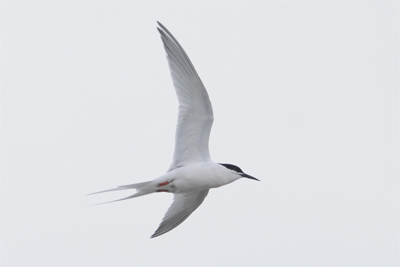
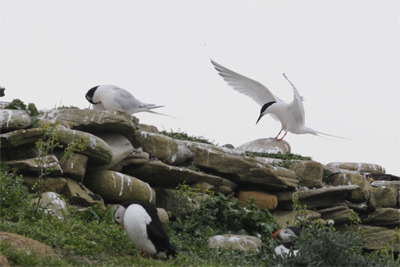
    Sarah had the excellent idea of taking a boat trip around Coquet Island, which I was really enthusiastic about.  When myself and Tom Cadwallender from the Northumberland Coast AONB were designing the backdrop for this year’s Birdwatching Northumberland stand at the Bird Fair we chose eight species that we felt symbolised Northumberland birding; Curlew, Eider, Pale-bellied Brent Goose, Golden Plover, Black Grouse, Roseate Tern, Dipper and Puffin.  A mix of everything that’s good about birdwatching in Northumberland; inland, coastal, summer and winter.  I had images of seven of those species, but the Roseate Tern is the one that I haven’t photographed during the digital age.  Hence, my enthusiasm for a trip around Coquet Island; with 35-40 Rosies already back at their Northumberland colony I was hopeful that photo opportunities would arise.  As we sailed across to the island onboard Shokwave, there was a strengthening NNE breeze and the temperature began to decrease rapidly.  Once Dennis manouvered the boat into the jetty, we could see Roseates sitting on their nest boxes.  They were a bit distant for photography so I waited patiently until I heard the distinctive ‘choo-it’ call and a bird flew by the boat.

    Britain's rarest breeding seabird

    Grey Seals popped their heads above the water to look at the boat, Puffins whizzed past at breakneck speed and more Roseates were busy displaying around the boxes.

    Roseate Tern

    After a pleasant Sunday morning cruise it was time to return home. En route, we stopped off to check a Little Owl nest site and one of the adult birds sat staring at us from the roof of a derelict building.  Finalising the paperwork for a forthcoming project was followed by a wonderful evening sitting on our patio, drinking wine and working on part of our bonsai collection as Blackbirds were singing from our trees and Coal Tits collected food to take to the noisy, and hungry, nestlings that we could hear.  Now, that’s my idea of heaven 🙂

  • Life through a (hand) lens

    Monday was the second classroom session of the NHSN Lichens and Bryophytes course.  On Sunday, while I was out with Sarah on a walk through three atlas tetrads in Harwood, we found some interesting colonies of Cladonias lichens on the upturned root edges of some windblown Spruce.  As the lichens course is currently looking at Heath and Moorland, and specifically at Cladonias, this was a chance to put the classroom practice into a fieldwork context.  The two most frequent species were C. macilenta (‘Devils Matches’), and C.sulphurina (‘Greater Sulphur-cup’).  Unfortunately, the weather was a bit on the harsh side, so it wasn’t possible to take any photographs of the lichens in the field.  Never mind, that’s just a reason to go back and have another look on a brighter day 😉

    The atlassing itself was a bit esoteric.  During the entire 9  miles through the forest we only came across 6 different species;

    Common Buzzard 3

    Sparrowhawk 1

    Goshawk 1

    Great Spotted Woodpecker 2

    Goldcrest 5

    Common Crossbill 103

    With temperatures hovering around freezing and 8″ of snow still covering over a mile of the footpaths and tracks, it was no great surprise that there were so few birds.  Also unsurprising, throughout those 9 miles of beautiful, windswept, snow-covered Northumberland we didn’t encounter any other walkers.  They don’t know what they were missing 🙂

  • Big Garden Birdwatch

    We had a leisurely hour of birdwatching yesterday morning.  With all of the feeders stocked with top class bird food from Poltross, and a bacon and egg butty and a mug of coffee in hand, we settled down into our respective positions on either side of the kitchen.  With commentary on the dismantling of Andy Murray in the background, binoculars were trained on the feeders, the ground, the shrubbery and the Ash tree.  After a slow start, things began to gather pace and we finished with 76 birds of 20 species;

    Collared Dove 4

    Wood Pigeon 2

    Jackdaw 1

    Carrion Crow 1

    House Sparrow 1

    Starling 7

    Blue Tit 2

    Great Tit 3

    Coal Tit 7

    Willow Tit 2

    Long-tailed Tit 3

    Chaffinch 14

    Greenfinch 5

    Goldfinch 2

    Bullfinch 4

    Goldcrest 1

    Robin 6

    Dunnock 2

    Blackbird 5

    Redwing 4

    There were a few absentees as well, all seen regularly in the days leading up to the Big Garden Birdwatch;

    Jay

    Great Spotted Woodpecker

    Sparrowhawk

    Siskin

    Maybe 25 species in 1hr is a target to aim for in our garden next year.

  • A bit of this…

    The last few days have been fairly quiet, although quite varied.  On Thursday I was at the North Northumberland Tourism Association AGM at Paxton House.  On arrival the car park was close to full, with just a couple of spaces not occupied.  I reversed my Mondeo into one of them, thinking that the snow sounded very crunchy, and went into the meeting.  For me the highlight of the event was a talk by Laurie Campbell, covering things that he’s photographed in and around North Northumberland.  Returning to my car and the inevitable…it wouldn’t move anywhere with the wheels spinning on the snow.  Luckily Chris Calvert from Bamburgh Castle was leaving at the same time and, along with Verity from the Grace Darling Museum, he helped to push the car clear of the snow.  I wouldn’t have had that problem in the Landrover…

    On Friday I chaired a committee meeting of the Southeast Northumberland Tourism Association.  As a new project, all of the committee are putting in a lot of effort and our AGM will be in February, the website should be up and running soon and we’re designing a leaflet to highlight the tourist attractions in our area.

    On Sunday we carried out our WeBS count (a week late but the Birdwatching Northumberland Press Trip coincided with the scheduled count date).  Northeasterly winds at the start of the month have deposited huge volumes of sand a long way up the beach (and along the footpath in Cresswell village) almost to the height of the dunes in some places.  The highlight was a loose group of divers on the sea, 15 Red-throated, 2 Great Northern and 1 Black-throated.  As we approached the Chibburn mouth, the end of our survey section, Sarah commented on the sheer walls of sand next to the Chibburn as it wound it’s way down the beach.  Not surprisingly, Sarah took the sensible approach and walked well away from the edge…at least I earned some brownie points by removing Sarah’s ‘scope and tripod from my shoulder and throwing it clear as the sand gave way beneath my feet.

    Now I’ve got a day in the office and it’s gloomy and overcast.  Two Jays and a Great Spotted Woodpecker are in the apple tree and Siskins have started visiting the feeders (after merely flirting with the boundary of our garden earlier in the winter).  Lesser Redpolls are still around the edge of Choppington Woods.  Can we set a new high total for our garden when it’s the Big Garden Birdwatch next weekend?

  • Layer upon layer of food glorious food

    No, not a post about the culinary delight I conjoured up yesterday for Sarah (butternut squash stuffed with bacon, blue cheese, garlic, creme fraiche and honey) although that was a bit of a milestone in my domestication 😉

    No, it’s a post about an unexpected bounty that our garden birds are reaping currently.  I usually try to fill all of our bird feeders just as it’s getting dark, that way the birds don’t get disturbed (not that it seems to bother some of them – Coal Tits will often just move to slightly higher branches in the apple tree, Robins seem to have no problem sitting just a few feet away).  Inevitably some seed gets spilled.  There’s also a reasonable amount of seed on the ground because the Coal Tits will sit on the feeders and discard anything they don’t fancy at the time.  With several days of snowfall over the last few weeks this was creating something that I hadn’t realised; layers of food sandwiched between each successive snowfall.  Now that the thaw is well under way, although there is still plenty of snow down here on the low ground, these layers of chilled bird seed are being exposed.  30 Chaffinches have been under the tree for most of today, and 8 Greenfinches have been around as well.   After a complete absence of sightings in recent weeks, a Great Spotted Woodpecker has returned to the garden.  At least one Brambling is still making sporadic appearances and the Blue, Coal and Great Tits are almost too numerous to count.  As we’re feeding in parts of Choppington Woods, and some of our neighbours have well-stocked bird feeders we might expect numbers to decrease but we’ve got more birds now than in the depths of the snow and ice last week.  Time to refill the feeders and dream of a rare thrush, bunting or accentor 🙂

  • Snowbound

    OK, not quite, but since December 31st we’ve had about a foot of snow in total.  I cancelled our Otter Safari on Tuesday for safety reasons.  That decision proved to be the right one as we had heavy snowfall on Tuesday afternoon, making the roads even more hazardous than they already were.  I drove to Wallsend to collect Sarah from work, and the 13 miles took 80 minutes – and that was mainly on 3 of Northumberland’s major roads (A1068, A19 and A1058).  Cars were sliding from one lane to the next and I’m amazed that I didn’t witness any collisions.  We’ve been using the Landrover for the last couple of weeks so when Sarah wanted her car to drive to work yesterday we had to dig it out of the snow.  I can’t recall having to do that in the 17 years that we’ve lived up here.

    For the last day and a bit I’ve had a throat infection so I’ve stayed in the house.  That hasn’t been a huge burden though as it’s allowed me to spend a lot of time watching (and filming) the birds around our feeding station.  For as long as I can remember, birdwatching has been something that’s always been an option when I’m unwell.  The Brambling that Sarah found on Sunday is still around, Long-tailed Tits are visiting much more frequently than they ever have before, the Blackbird count has risen to 9, at least 5 Robins are trying to hold dominion over the patio and flocks of Siskin and Lesser Redpoll are patrolling the edge of Choppington Woods and the bottom of our allotment.  Yesterday even a Goldcrest joined the chirping masses around the apple tree.  With niger seed, peanuts, fat balls, mixed seed and windfall apples our garden is like an all-you-can-eat buffet.  The one notable absentee from our usual list of visitors is Great Spotted Woodpecker, although we did see one in the woods on New Year’s Day.  Has one of our neighbours set up a more attractive feeding station?  We’d better raise our game, just in case.