As the start of the main season approaches, it’s been a busy few weeks for NEWT. I attended the latest Netgain meeting, as this important part of the North Sea Marine Conservation Zones project nears its conclusion, plans are developing for the Birdwatching Northumberland stand at this year’s British Birdwatching Fair, Tourism fairs/leaflet distribution days gave us a chance to catch up with a lot of the accommodation providers we work with, final preparations are in hand for a big group holiday we’re running in May and 2 smaller holidays in July, and days out with clients are increasing in frequency.
Yesterday we had a Lindisfarne Safari; Pale-bellied Brent Geese, Bar-tailed and Black-tailed Godwits, Grey Plover, Wigeon, Teal, Golden Plover and Dunlin were still around in good numbers, Skylarks and Meadow Pipits were singing literally everywhere that we walked, and Long-tailed Ducks were displaying their breeding finery. When discussing bird songs and calls with clients, I always mention The Sound Approach, which I’ve always found to be such an inspirational book, so was really pleased to learn that Brenda has a copy of the book, and an interest in how different people describe the same bird sounds.
At the end of a really enjoyable trip, I made the long drive to Otterburn Mill for a meeting with the Chair’s of some of Northumberland’s other tourism associations. Some strong, and often conflicting, views were expressed but we all agreed that what is best for Northumberland is for us all to move in the same direction. So we will…
Yesterday morning I decided to set out from home nice and early, so that I could spend a few hours in the North Pennines before exhibiting at the Tourism Fair in Hexham.
Birdwatching in Northumberland’s southwestern reaches is (almost always) about quality rather than quantity. Although it may seem sacrilegous, I prefer the dawn chorus on the moors to the one in our woodlands and gardens. Meadow Pipits (in almost overwhelming numbers after the dearth of sightings during the winter), Skylarks, Curlew, Lapwing, ‘drumming’ Snipe and the beautiful haunting calls of Golden Plover all contribute to a near sensory overload.
Raven and Merlin were both top-quality birds for the morning (both, frustratingly, between my position and the Sun, so only allowing record shots). Two species that always bring a particular quality to birdwatching, and photography, in the North Pennines are the two perpetually controversial/contentious species; Red Grouse and Black Grouse. We’ve been taking clients to see and photograph these two species since we first started NEWT, and the opportunity to wander the moors with my camera yesterday, enveloped by birdsong, was the sort of experience that our clients appreciate so much. Our North Pennines Safari Days rarely fail to encounter both grouse species, and we organise bespoke photography packages and holidays in the area as well, so give us a call and join us on one of our tours to this remarkable area of southwest Northumberland.
Saturday evening saw me in the far southwest of Northumberland, with a potentially tricky assignment…’in 2 hours, show a visiting journalist, and her husband, the best birdwatching in the North Pennines‘.
So, we stealthily approached four of our favourite Black Grouse sites, enjoying unbelievably close views of 9 Blackcocks, travelled across bleak, exposed, moorland roads, marvelling at the luminosity of the red eyebrows of an almost endless succession of Red Grouse, watched Curlew, Oystercatcher and Lapwing displaying and gazed, awestruck, at the incredible beauty of breeding-plumaged Golden Plover. The 2 grouse species were so close that Jo-anne was able to practice her wildlife photography using a small compact camera with a quite limited zoom. The big open landscapes, and birds perched on tussocks in the heather, lend themselves well to an ‘un-British’ style of wildlife photography; one that I’m planning to work on whenever the time, and opportunity, arises this year.
I’d planned the route to take in a Short-eared Owl breeding site at sunset. They’ve been a bit thin on the ground (and in the air) at some of their traditional Northumberland wintering sites so it was a long-shot, and meant going beyond the 2 hour time limit although, unsurprisingly, this went down quite well with our guests 🙂 Fortune favours the brave and, after 2 hours of guided birdwatching that, I’m assured, delivered what I’d been asked to, the ghostly shape crossing the moors in the twilight, and the cryptic plumage and staring yellow eyes as the bird perched obligingly on a fence post just metres away from us, was rightly described as “the icing on the cake”.
We just had an all too infrequent ocurrence; both of us at home and able to go out and about together for a whole weekend 🙂
On Saturday we decided to concentrate on our local area. Southeast Northumberland offers some excellent wildlife and birdwatching opportunities and, with bookings for the rest of this year coming thick and fast, we’re checking over our Safari Day routes whenever we get the chance so that we hit the ground running once the season gets properly underway.
If our morning excursion is the shape of things to come then it’s going to be an excellent Spring 🙂 Little Owl, Roe Deer (including a handsome buck with velvet antlers, who watched us between the trees as we trained our binoculars on him), Red Squirrel, point-blank views of Treecreeper, Nuthatch and Great Spotted Woodpecker and lots of fresh Otter spraint all combined into a memorable morning.
As dusk approached we were out and about again. We monitor a few Badger setts regularly and the activity around the sett we checked on Saturday evening was exactly what we’d expect in early March. Another successful outing 🙂
Yesterday we were doing something completely different (although birdwatching featured again, of course). We set out for the southwestern border of Northumberland, and beyond, as we pre-walked the route that Martin will be leading for the North Pennines AONB ‘Know Your North Pennines’ course on Wednesday. Journeying to Upper Teesdale gave us the chance to check out some of our favourite Black Grouse sites en route (you’ll be pleased to know that the species hasn’t vanished from Northern England!) and enjoy the sight of Lapwings displaying and flocks of Golden Plover in the fields. Our photography holiday in late October ‘Autumn Colours’ is based in the North Pennines and we finished the day with a visit to one of the area’s gems.
November is generally a quiet month for NEWT; the half-term rush in late October has come and gone, thoughts are turning to Christmas…and the weather can be a bit suspect. We had a Safari Day around Druridge Bay and Southeast Northumberland at the end of last week that could have succumbed to the elements but, as it turned out, a combination of excellent birdwatching sites that could be watched from the Land Rover, clients with a real interest in natural history (and expertise in wildlife sound recording)and a badger-watching spot where the trees sheltered us from the rain, made it an enjoyable afternoon. The flock of Waxwings in Ashington delighted yet again. Who could fail to be impressed by them? After a spell of birdwatching that was then characterised by ‘lovely weather for ducks’ (Teal, Wigeon, Mallard, Gadwall, Goosander, Goldeneye and Pochard were all seen), and some good flocks of Lapwing, Golden Plover, Redshank and Pink-footed Goose, we headed inland to the steep, wooded hillside that has produced some excellent views of Badgers on our Safaris in recent months. Only one Badger came wandering along – perhaps the others that we’ve watched so often this year were indulging in that particularly human pastime of curling up somewhere nice and warm out of the wind and the rain.
Since then it’s been a busy week, mainly with planning and preparation for 2011 but also giving 2 presentations about the Northeast Cetacean Project. The first was to a group of postgrad students and lecturers at Newcastle University and then last night, to the Northumberland & Tyneside Bird Club. Both presentations produced some interesting questions, and some potentially excellent volunteers to assist with our ongoing survey work.
Now it’s Friday morning, the howling westerly winds are bringing waves of rain and then sunshine, there’s an intense rainbow visible from our office window and a flock of Redwings are being blown about like autumn leaves. No matter what the weather throws at us, Northumberland is still a superb county for wildlife and birdwatching; you just need to know how to enjoy it 🙂
We had back-to back birdwatching trips earlier this week, covering two of our favourite areas.
On Tuesday afternoon I collected Keith and Jen from home in Monkseaton and we headed northwards up the Northumberland coast. Our destination was the Holy Island of Lindisfarne, one of the birding hot-spots of the entire country. The strong winds were the only downside to the afternoon, but the birdwatching was good. After checking out a large group of Grey Seals we covered the area around the harbour and the Rocket Field. Bar-tailed Godwits, Common Redshank and lots of Ringed Plover were along the shoreline and a delightful charm of Goldfinches were around the Heugh. A distant group of Lapwings, Starlings and Golden Plover took to the air and the cause of their alarm was glimpsed briefly, although too briefly and too distant to make a positive ID. Holy Island birdwatching stalwart Ian Kerr put us on to a Little Stint and, as we headed back through the village, groups of Golden Plover passed overhead. Re-tracing our route back down the coast and checking the Budle Bay on the rising tide, we were just discussing the indications of the presence of predators when a huge number of birds lifted from the mud. As well as the gulls and waders, Jackdaws, Rooks and Woodpigeons joined the throng as they came out of adjacent fields and trees. This time the culprit was seen and identified; a Peregrine, that most majestic of raptors and one of the highlights of any birdwatching day on the Northumberland coast in the autumn and winter. A quick seawatch produced Sandwich Terns feeding, and Gannets soaring effortlessly on the breeze.
Wednesday was a full day out around Druridge Bay and Southeast Northumberland. I collected Jayne and Andrew from Seahouses, and then Hilary and John from Alnmouth, before beginning our tour of some of the best birdwatching spots in our local area. While we were watching Lapwings, Redshanks, Greenshanks, Ruff, Herons and Cormorants on the River Wansbeck I could hear a rough ‘sreee’ call from high overhead. The strong breeze meant that it wasn’t straightforward to locate the bird, but eventually I picked it out. It was an unfamiliar call, but a familiar species; a juvenile Common Cuckoo. The walk back along the river produced a nice flock of Long-tailed Tits. After lunch we stopped off at Cresswell Pond. Hilary and John mentioned that they’d visited Cresswell once before – when they noticed a large group of birders and stopped, managing to see a Buff-breasted Sandpiper.
Buff-breasted Sandpiper and Ruff, Cresswell Pond, Northumberland 12/09/2008With luck like that, we joked about what this visit could produce...
When we arrived at the hide, Jaybee mentioned that he’d had a juvenile Sandwich Tern. I scanned the pond but couldn’t see the tern anywhere and we settled to enjoying the quite remarkable views of Common Snipe that were available. After checking through the assembled ducks, gulls and waders I scanned across the pond again and spotted a tern dip-feeding near the causeway. The bird’s behaviour, combined with it’s very dark back, white rump and silver-grey wings caused me to get rather excited. White-winged Black Tern is a very special bird, and a personal highlight as it’s the third Chlidonias tern that I’ve found in Northumberland. Whiskered Tern is very rare and Black Tern is always a nice bird to see but White-winged Black Tern is such a beautiful species. Jaybee kindly sent me some images to use 🙂
White-winged Black Tern, Cresswell Pond, Northumberland 15/09/2010White-winged Black Tern, Cresswell Pond, Northumberland 15/09/2010
White-winged Black Tern, Cresswell Pond, Northumberland 15/09/2010As other birders began to arrive to enjoy the fruit of our good fortune we continued up the coast. Eiders and a Goosander, as well as some very obliging Grey Herons, were seen as we stopped by the River Coquet. A superb couple of day’s birdwatching, a beautiful rarity and clients who were excellent company.
The North Pennines may not have the highest species density of any of the areas that we visit but, in terms of peace, tranquility and solitude, it takes some beating.
On Friday morning I drove to Corbridge to collect Lesley and David, two of our Prestige clients, for a day of birdwatching around Northumberland’s remote border. As we headed southwest the landscape became wilder and with less of any obvious human influence. Curlew, Lapwing, Golden Plover and Snipe may be common sights on the coast in the winter but, on remote moorland in the spring, they’re transformed into something other-worldly.
Some of the North Pennines flowers are quite stunning as well; Mountain Pansy, Scottish Asphodel, swathes of Cotton Grass waving in the breeze and, my own favourite, Spring Gentian. we found no less than 20 gentians, including a group of 11 at a spot where last year there were only 4. As we used a hand lens to admire the remarkable structures of lichens on the rocks in a deep narrow gorge, the bird species that are typical of that habitat type entertained us; a family of Dippers were feeding in the fast-flowing water, with the juveniles clearly hesitant to take the plunge, Grey Wagtails were flycatching and a Ring Ouzel flew from a pile of boulders. The afternoon continued with a family of Red Grouse and then a small group of Black Grouse. As is often the case these were all Blackcock, engaging in some half-hearted lekking in the afternoon sunshine.
After returning Lesley and David to their holiday cottage, stumbling across a Hobby mobbed by hirundines on the way, I headed home, then out to a 30th birthday party (Happy Birthday Kerry!), then to The Swan before going home, checking everything in readiness for Saturday’s 2 Safaris, and hitting the pillow.
Saturday saw a change in our normal Safari routine, and an early afternoon start. I collected Gareth and Ruth from the Red Lion at Alnmouth and we drove south. The hot, sunny weather had brought out hundreds of people to Plessey Woods but we still found a peaceful, undisturbed glade where we could listen to the birds singing and we watched a female Great Spotted Woodpecker; at least we were able to watch her until she realised that we were! Cresswell Pond produced a real avian soap opera as a Mute Swan defended his pond against two interlopers, racing across the pond like the Spanish Armada. A Little Gull was as cute and dimunitive as ever, alongside Black-headed, Common and Herring Gulls. Druridge Pools was hosting some obviously confused geese; amongst the expected flock of Greylags there were single Pink-footed and Barnacle Geese as well. A late finish concluded with a beautiful, ghostly Barn Owl and at least 3 different species of bat along the River Coquet at dusk.
Sunday was a day for doing whatever we felt like. With temperatures still soaring, a day inland, doing survey work for the BTO Bird Atlas, was considered then rejected in favour of a visit to the coast.
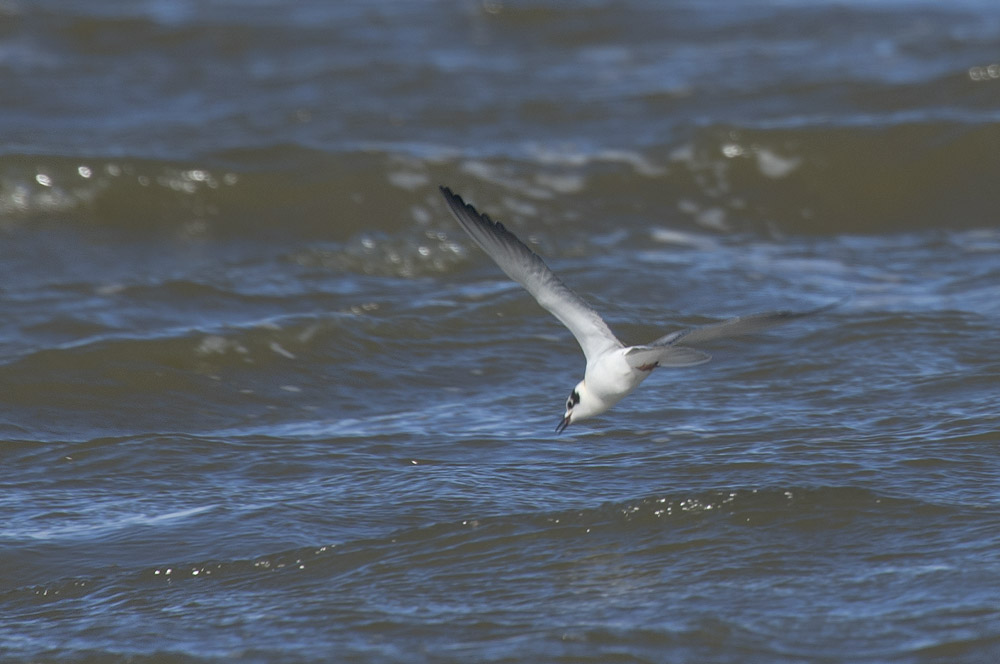
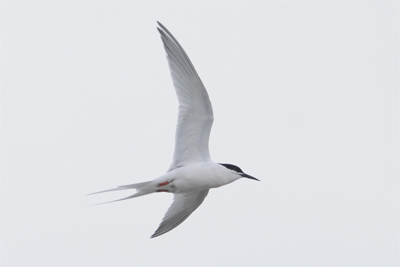
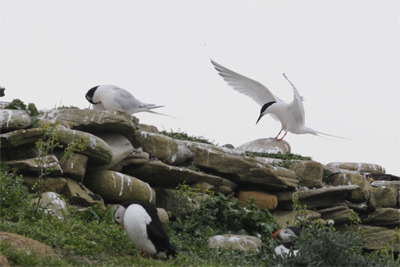
Sarah had the excellent idea of taking a boat trip around Coquet Island, which I was really enthusiastic about. When myself and Tom Cadwallender from the Northumberland Coast AONB were designing the backdrop for this year’s Birdwatching Northumberland stand at the Bird Fair we chose eight species that we felt symbolised Northumberland birding; Curlew, Eider, Pale-bellied Brent Goose, Golden Plover, Black Grouse, Roseate Tern, Dipper and Puffin. A mix of everything that’s good about birdwatching in Northumberland; inland, coastal, summer and winter. I had images of seven of those species, but the Roseate Tern is the one that I haven’t photographed during the digital age. Hence, my enthusiasm for a trip around Coquet Island; with 35-40 Rosies already back at their Northumberland colony I was hopeful that photo opportunities would arise. As we sailed across to the island onboard Shokwave, there was a strengthening NNE breeze and the temperature began to decrease rapidly. Once Dennis manouvered the boat into the jetty, we could see Roseates sitting on their nest boxes. They were a bit distant for photography so I waited patiently until I heard the distinctive ‘choo-it’ call and a bird flew by the boat.
Britain's rarest breeding seabird
Grey Seals popped their heads above the water to look at the boat, Puffins whizzed past at breakneck speed and more Roseates were busy displaying around the boxes.
Roseate Tern
After a pleasant Sunday morning cruise it was time to return home. En route, we stopped off to check a Little Owl nest site and one of the adult birds sat staring at us from the roof of a derelict building. Finalising the paperwork for a forthcoming project was followed by a wonderful evening sitting on our patio, drinking wine and working on part of our bonsai collection as Blackbirds were singing from our trees and Coal Tits collected food to take to the noisy, and hungry, nestlings that we could hear. Now, that’s my idea of heaven 🙂
Today was the first of two Prestige Tours organised as a 40th birthday surprise. With our destination being the North Pennines, the tour where we cross the border from Northumberland into Upper Teesdale, the mist, drizzle and general murk first thing this morning didn’t look too promising. Sometimes, though, the less promising days prove to be the really memorable ones…
Checking one of our favourite Black Grouse sites there were no birds in the field close to the road. However, after watching that site for the last two years I guessed that the birds were probably at a lek site away across the moor. Sure enough, we soon found three birds sitting around, another two flew in a few seconds later and then the lek started. The cold wind and icy rain was barely noticeable as the birds postured around the clumps of rush. More sightings of Black Grouse followed, including birds at two sites where I hadn’t seen them before; one of them producing excellent views of a Blackcock sitting near the road, and a rather more shy and retiring Greyhen. Across in Upper Teesdale the views of Blackcock got even better, and were accompanied by drumming Snipe and displaying Curlew.
The walk to Cauldron Snout can seem bleak and devoid of wildlife but it is there; watching from amongst the heather were Red Grouse, some more Red Grouse, stunning Golden Plover and even more Red Grouse. Meadow Pipits flitted back and forth, Snipe were calling, Curlew were singing their eerie song over the moorland and Lapwings demonstrated that their display flight and calls both defy belief.
One of the best days we’ve had in two years of NEWT.
Yesterday I led our first Safari Day of this week, to Lindisfarne and the North Northumberland coast. Although I really enjoy trips where the main quarry is Red Squirrel/Badger/Otter/Fox/Roe Deer my lifelong love affair has been with birdwatching. Northumberland is a top-quality destination for a winter birdwatching trip; just ask any of the writers/photographers who we’ve taken to the wilds of our home county during the cold(er) bits of the year.
Yesterday was one of those days where you couldn’t wish for better conditions; clear blue sky, warm sunshine (although with sub-zero air temperatures for much of the day), no rain and only a very gentle breeze. I collected Phil and Barbara from their holiday cottage near Guyzance and we followed the coast all the way to Lindisfarne. Small groups of Pale-bellied Brent Geese beside the causeway were a novelty for birdwatchers from the southeast, who are used to seeing Dark-bellied Brents during the winter, and they commented immediately about just how black-and-white the Svalbard birds look. Scanning the fields on the island we located a flock of ~800 Pale-bellied Brents, with a few Dark-bellied mixed in, allowing a direct comparison of the two. The field was also shared by 200+ Curlew and smaller numbers of Redshank, Lapwing and Golden Plover. Panic among a group of Starlings was traced to a 1st-Winter Merlin that helpfully perched on a post at the back of the Rocket Field. It’s amazing how quickly time passes and after 2 hours we headed back towards the mainland among the general exodus that occurs as the end of safe-crossing approaches. Another Merlin beside the causeway allowed even closer views so we stopped for a few more minutes of appreciation of this small predator.
Our picnic spot, overlooking the mudflats between Holy Island and the mainland, provided excellent views of flocks of Lapwing and Golden Plover in the air as well as lots of Shelduck, Eider, Pintail and more PB Brents. We enjoyed all of these in the company of Tom Cadwallender, Natural and Cultural Heritage Officer for the Northumberland Coast AONB, who was supposed to be meeting a camera crew from Inside Out. When we left Tom, they were already 20mins late…
Continuing down the coast, a very obliging Common Buzzard pranced around a field, presumably looking for worms. The Skate Road held well over 1000 Common Scoter, 90+ Purple Sandpipers were huddled on the rocks as the incoming tide washed against their feet and a careful scan produced a few pairs of Long-tailed Ducks (Barbara’s 2nd lifer in a matter of minutes). Red-throated and Great Northern Divers were, well diving mainly, and Slavonian Grebes were bobbing about just beyond the surf.
Our final destination for the day was Newton, and the decision to detour from the coast route down the dead-end road to Low Newton proved to be an inspired one. As dusk approached the assembled ducks on the pool (Teal, Goldeneye, Mallard, Gadwall) all provided entertainment as they called to each other. Then, just a few feet in front of us, a Long-eared Owl silently hunting. We all held our breath as it approached and then it veered away as silently as it had arrived. The walk back to the Landy was to provide probably the best bird of the day, and one of those Northumberland birdwatching moments that was quite simply sublime; against an increasingly starry sky and crescent moon, with an impressive amount of Earthshine, a Bittern flew low over our heads and out over the bay.