This has been one of our busiest weeks since we started NEWT, and I’ve only just got around to finding the time to sit in our office and blog about the last few days.
Tuesday saw Mike, one of our returning clients, coming for his second day out with NEWT, including some photography tuition in the Northumberland Coast AONB and a birdwatching trip across to the Farne Islands.
After a session on exposure theory, covering topics such as exposure values, ND filters and average metering (the bane of photographers everywhere) and a bit of practice with slow shutter speeds to creatively blur the rising tide it was time to head across to Inner Farne.
No matter how many times I visit the Farne Islands, I’m always awestruck by just how good the experience is; Grey Seals, Common, Sandwich and Arctic Terns, Eiders, Kittiwakes, Fulmars, Guillemots, Puffins and Razorbills all offer excellent photo opportunities so plenty of memory cards are a must.
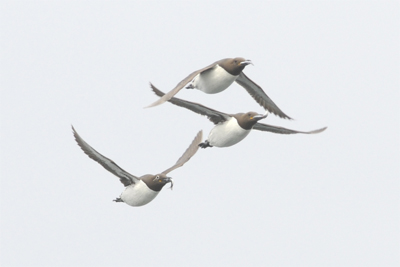
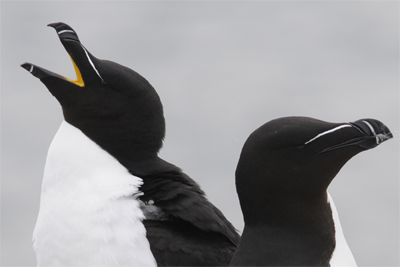
Common Guillemots (including a 'bridled' Guillemot) after a successful fishing tripRazorbills
Saturday saw a change in our normal Safari routine, and an early afternoon start. I collected Gareth and Ruth from the Red Lion at Alnmouth and we drove south. The hot, sunny weather had brought out hundreds of people to Plessey Woods but we still found a peaceful, undisturbed glade where we could listen to the birds singing and we watched a female Great Spotted Woodpecker; at least we were able to watch her until she realised that we were! Cresswell Pond produced a real avian soap opera as a Mute Swan defended his pond against two interlopers, racing across the pond like the Spanish Armada. A Little Gull was as cute and dimunitive as ever, alongside Black-headed, Common and Herring Gulls. Druridge Pools was hosting some obviously confused geese; amongst the expected flock of Greylags there were single Pink-footed and Barnacle Geese as well. A late finish concluded with a beautiful, ghostly Barn Owl and at least 3 different species of bat along the River Coquet at dusk.
Sunday was a day for doing whatever we felt like. With temperatures still soaring, a day inland, doing survey work for the BTO Bird Atlas, was considered then rejected in favour of a visit to the coast.
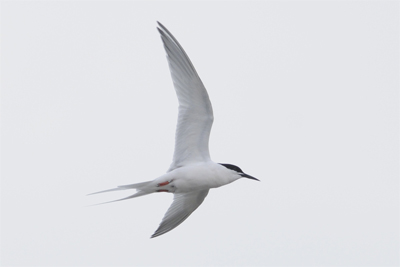
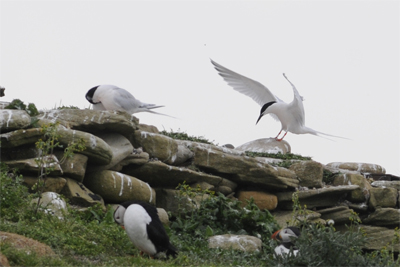
Sarah had the excellent idea of taking a boat trip around Coquet Island, which I was really enthusiastic about. When myself and Tom Cadwallender from the Northumberland Coast AONB were designing the backdrop for this year’s Birdwatching Northumberland stand at the Bird Fair we chose eight species that we felt symbolised Northumberland birding; Curlew, Eider, Pale-bellied Brent Goose, Golden Plover, Black Grouse, Roseate Tern, Dipper and Puffin. A mix of everything that’s good about birdwatching in Northumberland; inland, coastal, summer and winter. I had images of seven of those species, but the Roseate Tern is the one that I haven’t photographed during the digital age. Hence, my enthusiasm for a trip around Coquet Island; with 35-40 Rosies already back at their Northumberland colony I was hopeful that photo opportunities would arise. As we sailed across to the island onboard Shokwave, there was a strengthening NNE breeze and the temperature began to decrease rapidly. Once Dennis manouvered the boat into the jetty, we could see Roseates sitting on their nest boxes. They were a bit distant for photography so I waited patiently until I heard the distinctive ‘choo-it’ call and a bird flew by the boat.
Britain's rarest breeding seabird
Grey Seals popped their heads above the water to look at the boat, Puffins whizzed past at breakneck speed and more Roseates were busy displaying around the boxes.
Roseate Tern
After a pleasant Sunday morning cruise it was time to return home. En route, we stopped off to check a Little Owl nest site and one of the adult birds sat staring at us from the roof of a derelict building. Finalising the paperwork for a forthcoming project was followed by a wonderful evening sitting on our patio, drinking wine and working on part of our bonsai collection as Blackbirds were singing from our trees and Coal Tits collected food to take to the noisy, and hungry, nestlings that we could hear. Now, that’s my idea of heaven 🙂
After the changeable weather during the Birdwatching Northumberland press trip culminated in excellent conditions on Monday, I hoped that we would get more of the same on Tuesday for a Lindisfarne Safari that I was leading. It looked good; at home we had a heavy frost and clear blue skies. Yet just a few miles down the road, as I headed to Gosforth to collect our client, there was a bank of thick fog. Not to worry, conditions might be better on Holy Island…they weren’t, in fact the fog was even thicker. As we stood on the Heugh it was eerie. A bitingly cold southeasterly wind and visibility down to just a few metres. Oystercatchers, Redshanks and Herring Gulls could all be heard through the mist and we continued our journey around the island. Song Thrushes lifted from each clump of grass as we walked towards the harbour and slightly improved visibility allowed us to look closely at Teal, Bar-tailed Godwits and Curlew. Lichens and mosses came under great scrutiny (remarkable structures when viewed under a hand lens). Off the island we found Pale-bellied Brent Geese, small groups of Whooper Swans, a field with lots of Greylag and Pink-footed Geese (and a ‘Canalag’ hybrid), several Kestrels, an incredibly obliging Common Buzzard, a mixed thrush flock (Redwing, Fieldfare, Mistle Thrush, Song Thrush and Blackbird), plenty of waders and, finally, as the mist returned and brought steady rainfall with it, Common Scoter, Shag and Eider on the sea. As we drove back down the A1 the worsening weather made it seem likely that we’d had better conditions than back at home. There’s always something to see, whatever the weather.