Tag: Cetaceans

  • Pilot Whales

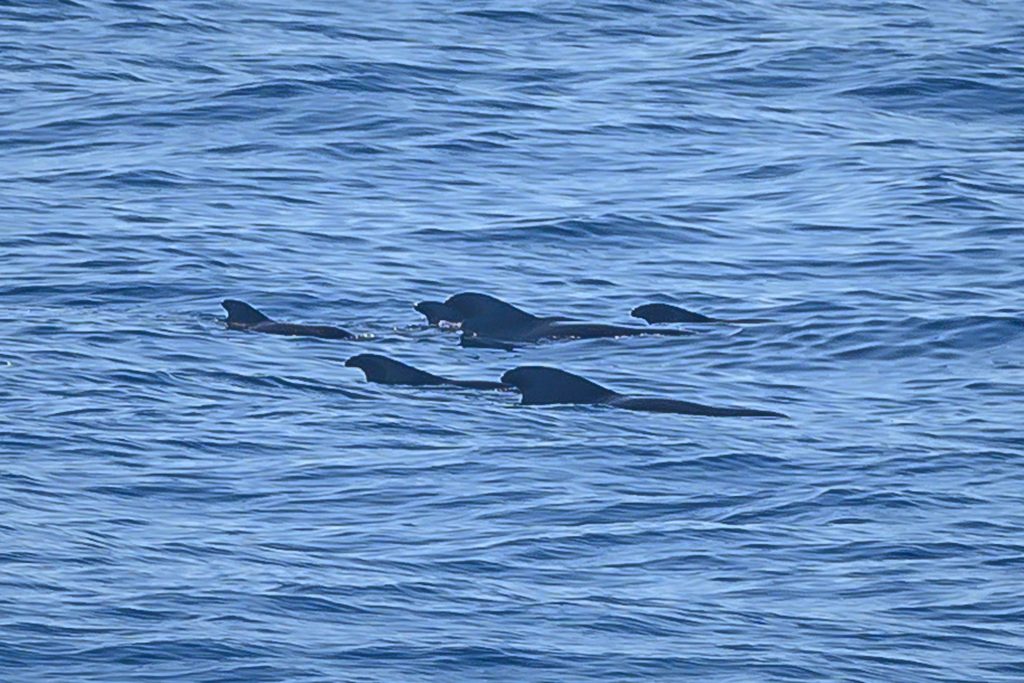
    You’ve probably seen news articles about the pod of Pilot Whales that found themselves in the very out-of-range location of Amble, on the Northumberland coast, last Sunday.

    The NEWT team were having a day out walking on the coast just north of there when they had a ‘phone call to say there was a group of at least 20 near the mouth of the river Coquet, so plans for the rest of the day were quickly abandoned and they found themselves on the top of a dune at Warkworth, then on the dunes at Amble Links, as part of a volunteer monitoring effort observing what turned out to be in excess of 40 whales.

    Sadly, on Monday morning, a small number of animals were stranded/stranding near the southern tip of Coquet Island. Two were confirmed dead by marine mammal medics from British Divers Marine Life Rescue, and that total rose to six on Tuesday morning while Martin was on Amble quayside being interviewed for BBC Look North. That was followed by a trip to the BBC Radio Newcastle studios on Wednesday morning for another interview.

    Comments on social media posts about the interviews have highlighted that people don’t necessarily know what to do, so here’s the official advice for England and Wales from the gov.uk website:

    If you find a dead whale, dolphin, porpoise, seal, shark, or marine turtle, on a beach please report it to the UK Cetacean Strandings Investigation Programme 0800 6520333.

    If you see an animal that is injured, distressed, stranded or entangled, do not approach it, touch it or attempt to return it to the sea. Please report the incident by calling the British Divers Marine Life Rescue hotline 01825 765546

    In Scotland you can report a dead whale, dolphin, porpoise or seal to the Scottish Marine Animal Stranding Scheme by calling or texting 07979 245893 or emailing reports@strandings.org
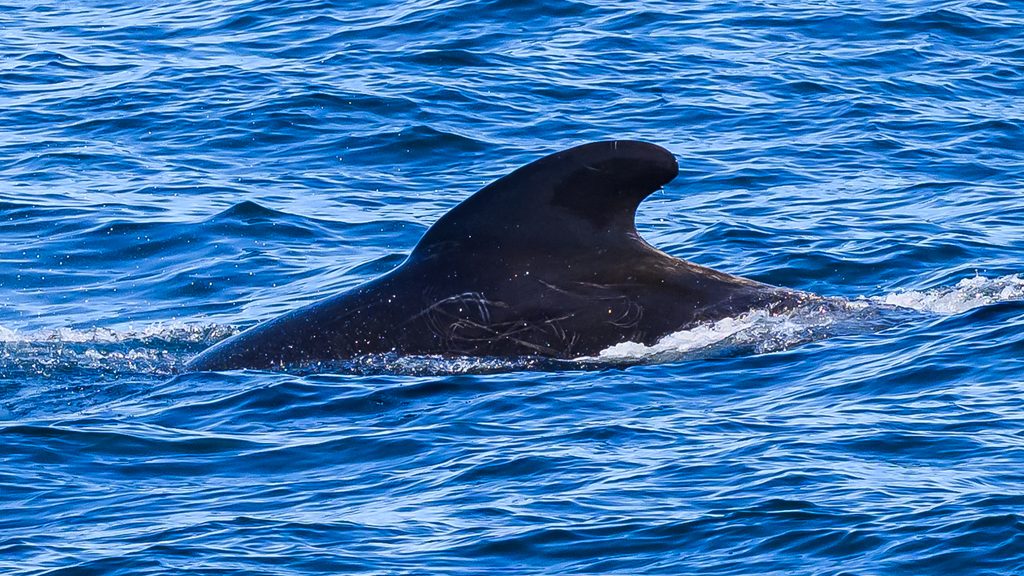
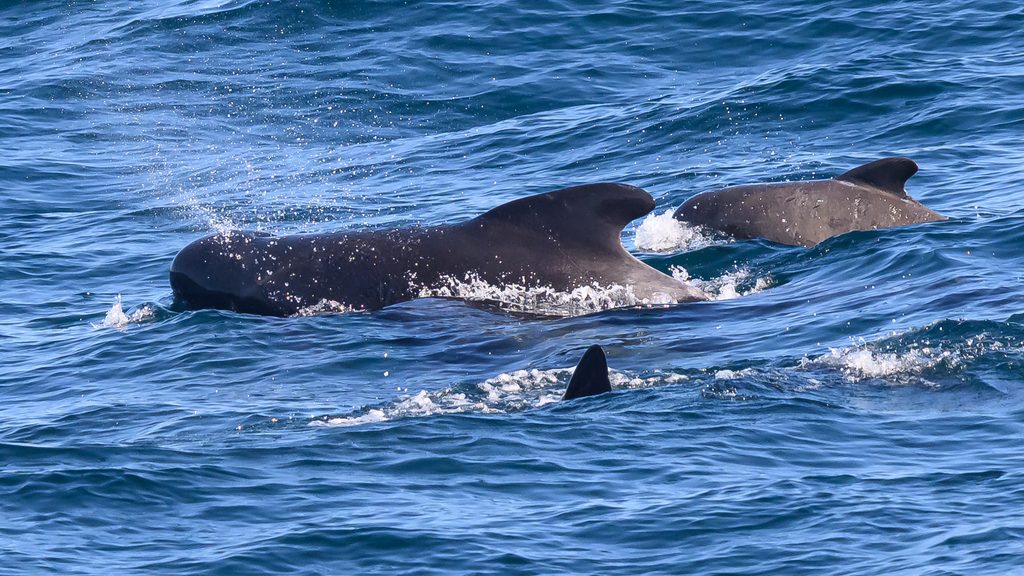
    Long-finned Pilot Whale Globicephala melas, Iceland-Faroe Ridge 13/07/25 (c)NorthernExperienceImages
    Long-finned Pilot Whale Globicephala melas, Iceland-Faroe Ridge 13/07/25 (c)NorthernExperienceImages
    Short-finned Pilot Whale Globicephala macrorhynchus, Santa Cruz de Tenerife 11/01/25 (c)NorthernExperienceImages
  • What does my office look like?

    Occasionally I find myself pondering that question.  On Wednesday I left home early to drive to Seahouses and collect Carolyn and Brian, two clients who we first met last year.  As we headed up the coast through Bamburgh and towards the Lindisfarne NNR for a day of birdwatching, we stopped at each promising area.  Before we reached Holy Island itself we’d already had excellent views of 4 Harbour Porpoises, good views of three Whimbrel (alongside a Curlew for comparison) and a Brown Hare as well as the growing numbers of House Martins and Swifts.  A Sedge Warbler perched helpfully on top of a stunted Hawthorn as he belted out his song, a Whitethroat was elusive before eventually showing off the bright white throat feathers that give it it’s name and a Wheatear hopped along a drystone wall.  On the island we watched a Heron as it preened whilst hidden in a reed bed, listened to another Sedge Warbler and tried to locate a calling Water Rail.  Skylarks and pipits were unobtrusive in a sheep field that also contained at least 6 Wheatears and, once we’d left the island we watched over 1000 Grey Seals as they relaxed in the bright sunshine.

    After dropping Carolyn and Brian back in Seahouses, I headed home, packed my bag and drove down the A1, out of Northumberland, to my sister’s house.  04:30 Thursday morning and I was on the road again, this time travelling to King’s Lynn.  Two days of being a student were relaxing and enjoyable, studying the acoustic signals used by cetaceans being my own personal highlight, before the north beckoned.  Finally, just before 10pm yesterday, I arrived back at home, headed to the ‘beer fridge’, sat down to a delicious Chinese meal with Sarah and then collapsed into bed.  With tomorrows “Beginners Birdwatching; Songs and Calls” being close to home we don’t have a really early start so this afternoon is a chance (something that’s going to happen less and less over the next few months) to catch up with e-mails, ‘phone calls and product planning/development.  It’s the great paradox of running your own business; many people choose that option in order to have more free time…but if your business is successful there’s a period, certainly during rapid growth/expansion, when 9 to 5 doesn’t look so bad after all.  Would I go back to that? What do you think? 😉

  • Deskbound

    Not something I particularly enjoy but I’m currently trying to juggle at least four separate projects ahead of the ‘busy season’ starting in February.  That means a lot of time in the office and birdwatching limited to our garden and the edge of Choppington Woods.  After a couple of months of the Chaffinch flock containing almost exclusively male birds (the species scientific name Fringilla coelebs means ‘Bachelor Finch’ – a reference to the habit of male and female birds wintering separately in parts of it’s range).  now though, the girls are back.  The party’s over, boys.

    This morning has seen the Press Release about an exciting offshore survey project that NEWT is a partner in.  Working with Natural England and Marinelife, with additional support  from the Northumberland and Tyneside Bird Club, we’re furthering the existing knowledge of seabird and cetacean distribution in the North Sea.

    As I look out of the window this morning there’s a howling northerly and it’s snowing.  Back to the wintry weather 🙂 and a weekend of birdwatching, photography and filming wildlife ahead for all three NEWT guides.

  • Masters of all we survey?

    I’ve just finished my 3rd consecutive day of survey work (ok, today was just a couple of hours around dawn, but you get the idea).

    Friday and Saturday saw me up to 20 miles offshore, leading a survey team of Alan Tilmouth, Ross Ahmed, Allan Skinner (our boat skipper) and Jimmy (erstwhile SarahJFK crew member and very diligent data-recorder).  Friday didn’t look promising as we drove to Royal Quays in thick fog, and the marina was mired in the gloom as well as we met up with Tom Brereton from Marinelife.  However, once out of the Tyne we quickly passed out of the fog bank and into some stunning weather.

    Martin and Tom scanning for cetaceans
    Martin and Tom scanning for cetaceans

    Ross, Alan and Tom observing and recording seabird distribution and abundance
    Ross, Alan and Tom observing and recording seabird distribution and abundance

     On the return there was a superb sunset but the fog had extended to almost 6 miles offshore and we had one of those real pelagic experiences.

    Tom scanning ahead of the SarahJFK for cetaceans
    Tom scanning ahead of the SarahJFK for cetaceans

    Ross still recording, Alan looking cheerful as we approach a fog bank
    Ross and Alan still recording as we approach the fog bank that ended Friday's survey

    Tom, Martin, Ross and Alan heading home
    Tom, Martin, Ross and Alan heading home

    Yesterday had overall better visibility but slighty lumpier seas, as we covered the area from Blyth to Druridge Bay.  Having completed about 80 miles of transect surveys in 2 days we’ve already gathered a lot of seabird data.  The North Sea (which is relatively small) seems pretty big when you’re far enough offshore to not be able to see any land.  When 3 experienced seawatchers look around and say “we don’t really have a clue what’s out here do we?” then it hammers home the importance of what we’re doing.  Having found Puffins on both surveys so far, and five Little Gulls on Saturday, we’re all eagerly anticipating the rest of our winter surveys.  We’ve got a few spaces on most of the survey trips (which will run when the weather allows us the opportunity) which are available for a contribution of £20/person/trip (a much lower rate than our commercial pelagics trips in July-September).  Give us a call, wrap up warm and join us on a journey into the unknown.

    On dry (well, drier) land, Sarah and myself set out this morning for the December Icelandic Goose Census.Two Barn Owls were a bonus in the bone-chilling temperatures.  Last month I drew a blank with our goose monitoring and this month was hardly any better; just 3 Greylag Geese at the roost site that is designated as part of the census.  Looks like we’ll be out again at dusk, trying to locate the birds as they fly to roost.