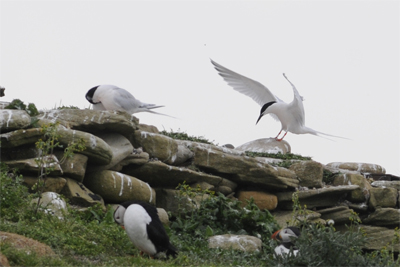
Tag: Black-headed Gull

  • Early to rise

    4am, and the insistent ringing of the alarm prises me out of bed.  Stagger down the stairs, get dressed, find binoculars/hat/gloves and head out into the chill early morning Southeast Northumberland air.  The Dawn Chorus is in full flow; Blackbirds are leading the way, and dominating the soundscape around our house, Chiffchaffs are singing from the churchyard and I make a mental note to do this again tomorrow to get some sound recordings.

    Walking along the River Wansbeck I can see a pointed snout sticking out of the water distantly.  Closer inspection reveals a Grey Seal.  A Grey Heron flies by, croaking and screeching as a pair of Carrion Crows harrass it until it turns through 180 and heads away from the annoyance.  I move on as well, heading towards Druridge Bay.  With ethereal mist rising from a coastal pool, Sedge Warblers are singing from the bushes around me, and I’m concentrating on the mimicry that they employ, when a group of Rabbits suddenly scatter and Lapwings, Black-headed Gulls and Common Terns begin circling and alarming.  A movement in the grass reveals itself as a Red Fox; wary, immaculate and healthy – this isn’t the urban scrounger so familiar to many people, but rather what a recent client described as “that’ll be one of those rural foxes then”. 

    Then, one of those moments that take me back the best part of four decades; a Cuckoo starts calling.  My first Cuckoo, all those years ago, was on an early morning birdwatching cycle ride to a site several miles from home.  With nobody else anywhere to be seen, and all of the sounds of the early morning to myself, that haunting sound carried from nearby trees before the pointy-winged long-tailed shape of the bird raced across my field of view.  I stand and marvel at the bird.  It’s fascinating breeding ecology and migration still grip me the way that birdwatching did when I was a little lad.  Perhaps I need to start setting the alarm for very early every morning 🙂
  • A Rosy outlook

    Saturday saw a change in our normal Safari routine, and an early afternoon start.  I collected Gareth and Ruth from the Red Lion at Alnmouth and we drove south.  The hot, sunny weather had brought out hundreds of people to Plessey Woods but we still found a peaceful, undisturbed glade where we could listen to the birds singing and we watched a female Great Spotted Woodpecker; at least we were able to watch her until she realised that we were!  Cresswell Pond produced a real avian soap opera as a Mute Swan defended his pond against two interlopers, racing across the pond like the Spanish Armada.  A Little Gull was as cute and dimunitive as ever, alongside Black-headed, Common and Herring Gulls.  Druridge Pools was hosting some obviously confused geese; amongst the expected flock of Greylags there were single Pink-footed and Barnacle Geese as well.  A late finish concluded with a beautiful, ghostly Barn Owl and at least 3 different species of bat along the River Coquet at dusk.

    Sunday was a day for doing whatever we felt like.  With temperatures still soaring, a day inland, doing survey work for the BTO Bird Atlas, was considered then rejected in favour of a visit to the coast.

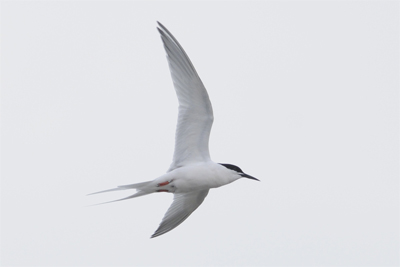
    Sarah had the excellent idea of taking a boat trip around Coquet Island, which I was really enthusiastic about.  When myself and Tom Cadwallender from the Northumberland Coast AONB were designing the backdrop for this year’s Birdwatching Northumberland stand at the Bird Fair we chose eight species that we felt symbolised Northumberland birding; Curlew, Eider, Pale-bellied Brent Goose, Golden Plover, Black Grouse, Roseate Tern, Dipper and Puffin.  A mix of everything that’s good about birdwatching in Northumberland; inland, coastal, summer and winter.  I had images of seven of those species, but the Roseate Tern is the one that I haven’t photographed during the digital age.  Hence, my enthusiasm for a trip around Coquet Island; with 35-40 Rosies already back at their Northumberland colony I was hopeful that photo opportunities would arise.  As we sailed across to the island onboard Shokwave, there was a strengthening NNE breeze and the temperature began to decrease rapidly.  Once Dennis manouvered the boat into the jetty, we could see Roseates sitting on their nest boxes.  They were a bit distant for photography so I waited patiently until I heard the distinctive ‘choo-it’ call and a bird flew by the boat.

    Britain's rarest breeding seabird

    Grey Seals popped their heads above the water to look at the boat, Puffins whizzed past at breakneck speed and more Roseates were busy displaying around the boxes.

    Roseate Tern

    After a pleasant Sunday morning cruise it was time to return home. En route, we stopped off to check a Little Owl nest site and one of the adult birds sat staring at us from the roof of a derelict building.  Finalising the paperwork for a forthcoming project was followed by a wonderful evening sitting on our patio, drinking wine and working on part of our bonsai collection as Blackbirds were singing from our trees and Coal Tits collected food to take to the noisy, and hungry, nestlings that we could hear.  Now, that’s my idea of heaven 🙂

  • Maximising our chances

    So far this year, tracking down Otters has proved slightly more difficult than it did last year.  That’s one of the drawbacks of working with animals 😉  They’re generally not predictable.  That’s what makes a wildlife tour so much fun though, you just never know what you’re going to experience.

    However, after a brief sighting on Thursday evening, I was happy that we’re still visiting the right areas of Northumberland to maximise our clients’ chances of connecting with this elusive, graceful predator.  I arrived at Newbiggin at 10am yesterday to collect Derek and Jacky for a mini-safari in Druridge Bay.  After our usual commentary on the industry and landscape of the area, as we drove towards Cresswell, it was time to settle and be patient.  I’d just finished explaining the two types of bird behaviour that usually accompany the appearance of an Otter, when there was a good example of the first; eight Tufted Ducks scattered from the edge of the pond.  Sure enough, it was less than 20 seconds before I spotted the tell-tale dark back breaking the surface and for the next few minutes we watched an adult Otter as it surfaced, dived and fed, all the while with a flock of Black-headed Gulls circling above it.  After a minute or two without any further sign I was sure it had disappeared into a channel in the reeds, probably going to rest after feeding.  The gulls began moving around the pond randomly; clearly they’d lost sight of the Otter as well.  Further entertainmant was provided by 3 Herons that were following each other around, and a Carrion Crow that was foolhardy enough to fly over several pairs of nesting Lapwings.

    After the morning seemed to just fly past, I took Derek and Jacky back to Newbiggin and then returned to the office, before heading out in the evening to check another new Otter site and enjoy some relaxed birdwatching.  But that’s another story for another day…