Tag: Black Grouse

  • Sights and sounds; North Pennines 10/05/2011

    With a run of 3 North Pennines trips in 6 days, I’m going to be seeing a lot of what is rapidly becoming my favourite birdwatching location (outside of the Northumberland coast in mid-October of course…).

    05:30 and the incessant ringing of the alarm clock lets me know that it’s time to be up and about.  Within an hour I’m on my way to Hebburn and then heading west with Kathleen and Brian, 2 of our Prestige Clients, in the car.

    The elements aren’t playing fair; a biting cold wind just adds to the ‘feel’ of the North Pennines, but even the stinging raindrops don’t dampen the enthusiasm.  An imperious Blackcock, taking shelter from the wind behind a dry stone wall, allows a prolonged view (we weren’t to know that he was the first of no less than 21 Black Grouse that we were going to enjoy, including 7 birds lekking as we had our lunch).  Red Grouse popped up like Meerkats from the heather as we passed, Lapwing, Curlew and Snipe were all calling over their territories, Skylarks were singing a song that was carried far on the wind and a Golden Plover called plaintively as its little shockingly yellow chicks bobbed up and down around it.  A Stoat dashing across the road in front of us, quickly vanished into the heather; the predator’s route signposted by the string of Meadow Pipits flushing as it passed.

    One down, two to go…and I might go there early on Thursday myself when I’m in the area for a Northern Experience Holidays business meeting.  Addicted?

  • North Pennines Beauty

    All of the areas we visit with our clients have something special about them, but the North Pennines is often our choice for a day out on our own.  The area is vast, with open landscapes, big skies and narrow valleys, and there’s always a feeling that this is somewhere really special.

    A 7am start heralded the first part of the prize (a trip into the North Pennines to photograph Black Grouse) for the under 13 category winner in the Northumberland Wildlife Trust photography competition.  Driving through dense fog all the way to beyond Haydon Bridge didn’t inspire confidence, but visibility at our first stop revealed a flock of Golden Plover, Curlews displaying over the moors and a Brown Hare.  As we headed over a road that I always expect to produce memorable sightings, we weren’t disappointed; Jonathan spotted a bird perched on a dry stone wall, and it turned out to be a Greyhen.  Now, we see lots of Blackcocks on our North Pennines trips, but greyhens much less often.  This one was sitting there with a purpose, as 2 Blackcocks were lekking in an adjacent field.  Strutting, cooing and displaying their undertail coverts they somehow added an even more ethereal note to the sun-bathed moorland surrounded by mist-filled valleys.  The air was drenched with the song of Skylarks, Snipe were calling, Lapwings were doing that thing that they do (I’ve tried to put it into words…but I can’t do it justice!) and a nearby field contained at least 16 Wheatears.  On over the moors, Red Grouse bobbed their heads up and down, watching our progress, and we had the closest views of a Blackcock that I’ve ever had; iridescent and imperious in the morning sunlight.  It may be just about the best place in the world 🙂

  • Pressing on

    It started with a question from Sheelagh Caygill at Northumberland Tourism “Martin, we’ve got a journalist staying in Northumberland during the Easter holidays.  He’s interested in wildlife.  What could you do for him and his family?”

    Which is how,  yesterday afternoon, I found myself trying to deliver the interesting wildlife double of Black Grouse and Otter, combining the ‘quality over quantity’ birdwatching opportunities of the North Pennines with the close to home familiarity of Druridge Bay and southeast Northumberland .  Once the article is published, I’ll link to it…

  • The hills are alive…

    …with the sound of Meadow Pipits.

    Yesterday morning I decided to set out from home nice and early, so that I could spend a few hours in the North Pennines before exhibiting at the Tourism Fair in Hexham.

    Birdwatching in Northumberland’s southwestern reaches is (almost always) about quality rather than quantity.  Although it may seem sacrilegous, I prefer the dawn chorus on the moors to the one in our woodlands and gardens.  Meadow Pipits (in almost overwhelming numbers after the dearth of sightings during the winter), Skylarks, Curlew, Lapwing, ‘drumming’ Snipe and the beautiful haunting calls of Golden Plover all contribute to a near sensory overload.

    Raven and Merlin were both top-quality birds for the morning (both, frustratingly, between my position and the Sun, so only allowing record shots).  Two species that always bring a particular quality to birdwatching, and photography, in the North Pennines are the two perpetually controversial/contentious species; Red Grouse and Black Grouse.  We’ve been taking clients to see and photograph these two species since we first started NEWT, and the opportunity to wander the moors with my camera yesterday, enveloped by birdsong, was the sort of experience that our clients appreciate so much.  Our North Pennines Safari Days rarely fail to encounter both grouse species, and we organise bespoke photography packages and holidays in the area as well, so give us a call and join us on one of our tours to this remarkable area of southwest Northumberland.

    Red Grouse, bird photography, wildlife photography tuition, wildlife photography holidays, wildlife photography courses

    Red Grouse, bird photography, wildlife photography tuition, wildlife photography holidays, wildlife photography courses

    Black Grouse, bird photography, wildlife photography tuition, wildlife photography holidays, wildlife photography courses

    Black Grouse, bird photography, wildlife photography tuition, wildlife photography holidays, wildlife photography courses

    Black Grouse, bird photography, wildlife photography tuition, wildlife photography holidays, wildlife photography courses

  • Pressing the right buttons

    Saturday evening saw me in the far southwest of Northumberland, with a potentially tricky assignment…’in 2 hours, show a visiting journalist, and her husband, the best birdwatching in the North Pennines‘.

    So, we stealthily approached four of our favourite Black Grouse sites, enjoying unbelievably close views of 9 Blackcocks,  travelled across bleak, exposed, moorland roads, marvelling at the luminosity of the red eyebrows of an almost endless succession of Red Grouse, watched Curlew, Oystercatcher  and Lapwing displaying and gazed, awestruck, at the incredible beauty of breeding-plumaged Golden Plover.  The 2 grouse species were so close that Jo-anne was able to practice her wildlife photography using a small compact camera with a quite limited zoom.  The big open landscapes, and birds perched on tussocks in the heather, lend themselves well to an ‘un-British’ style of wildlife photography; one that I’m planning to work on whenever the time, and opportunity, arises this year.

    I’d planned the route to take in a Short-eared Owl breeding site at sunset.  They’ve been a bit thin on the ground (and in the air) at some of their traditional Northumberland wintering sites so it was a long-shot, and meant going beyond the 2 hour time limit although, unsurprisingly, this went down quite well with our guests 🙂  Fortune favours the brave and, after 2 hours of guided birdwatching that, I’m assured, delivered what I’d been asked to, the ghostly shape crossing the moors in the twilight, and the cryptic plumage and staring yellow eyes as the bird perched obligingly on a fence post just metres away from us, was rightly described as  “the icing on the cake”.

  • I wish I could remember…

    …the clever title I’d thought of for this blog post 😉

    Just at the moment the pace of life and work is starting to really accelerate.  Last week I had a day of meetings, a day in the office, a day distributing leaflets (and getting the graphics applied to our new vehicle), a day in the North Pennines AONB, and a day out with my camera close to the office.

    The North Pennines day was interesting; giving a talk, and a guided walk, as part of the Know Your North Pennines training programme.  Birdwatching in hail, snow and howling wind all featured during the day.  The bit in the snow came while I was still on my journey to the training session; leaving home in plenty of time had given me the opportunity to check out some potential sites for Black Grouse photography.  I really wish I’d had my camera with me as I found a field with 6 adult Blackcocks in it.  We’ll be checking the site over the next few weeks, but it has the potential to produce even better photo opportunities than the sites where I photographed the birds pictured in this blog post from last year.

    The morning spent close to home in southeast Northumberland had one focus; get a photograph of a Treecreeper.  Not any photograph though; the one I was picturing in my mind was with the bird vertical on a tree trunk, with a dark background.  I even knew exactly where I was going to get the shot – we’ve been baiting an area in some local woodland for quite a while now, and the effort we’ve put into choosing the location and baiting it regularly is starting to pay off.  With some exciting wildlife and landscape photography holidays coming up later this year, our clients can benefit from the work we’re doing year-round as well.

    Red Squirrels were visiting our feeding station;

    Red Squirrel, mammal photography, photography tuition, photogarphy courses, photography holidays

    Nuthatches are always entertaining, active and vocal;

    Nuthatch, bird photography, photography tuition, photography courses, photography holidays

    and the target for the morning put in an appearance 🙂  For whatever reason, it’s a species that I’ve struggled to capture to my satisfaction previously.  I’m fairly happy with this shot…but the shadows could have been lessened using a reflector.  At least that gives me an excuse to spend another morning at the feeding station 🙂

    Treecreeper, bird photography, photography tuition, photography courses, photography holidays

  • Getting ready

    We just had an all too infrequent ocurrence; both of us at home and able to go out and about together for a whole weekend 🙂

    On Saturday we decided to concentrate on our local area.  Southeast Northumberland offers some excellent wildlife and birdwatching opportunities and, with bookings for the rest of this year coming thick and fast, we’re checking over our Safari Day routes whenever we get the chance so that we hit the ground running once the season gets properly underway.

    If our morning excursion is the shape of things to come then it’s going to be an excellent Spring 🙂  Little Owl, Roe Deer (including a handsome buck with velvet antlers, who watched us between the trees as we trained our binoculars on him), Red Squirrel, point-blank views of Treecreeper, Nuthatch and Great Spotted Woodpecker and lots of fresh Otter spraint all combined into a memorable morning.

    As dusk approached we were out and about again.  We monitor a few Badger setts regularly and the activity around the sett we checked on Saturday evening was exactly what we’d expect in early March.  Another successful outing 🙂

    Yesterday we were doing something completely different (although birdwatching featured again, of course).  We set out for the southwestern border of Northumberland, and beyond, as we pre-walked the route that Martin will be leading for the North Pennines AONB ‘Know Your North Pennines’ course on Wednesday.  Journeying to Upper Teesdale gave us the chance to check out some of our favourite Black Grouse sites en route (you’ll be pleased to know that the species hasn’t vanished from Northern England!) and enjoy the sight of Lapwings displaying and flocks of Golden Plover  in the fields.  Our photography holiday in late October ‘Autumn Colours’ is based in the North Pennines and we finished the day with a visit to one of the area’s gems.

    North Pennines,Photography Holidays,Northumberland,Photography Tuition
    Low Force
  • British Birdwatching Fair 2010

    We’ve been away for a few days, as part of the Birdwatching Northumberland consortium at the British Birdwatching Fair 2010.

    Thursday started very early for Martin, with a North Pennines Prestige Tour for clients who were staying at Wallfoot in Carlisle.  Managing to avoid the worst of the weather, avian highlights included Merlin, Goldcrest, Nuthatch, Red Grouse, Black Grouse, Whinchat and Wheatear.  The long drive down the M6 didn’t, unfortunately, miss the heavy rain.  However, a late arrival at the White Lion in Whissendine, and a few beers in the bar with such luminaries as Ipin set Martin up nicely for an early start on Friday.

    Sarah was at work (in her ‘proper’ job) so, apart from attending a couple of lectures, Martin was on the Birdwatching Northumberland stand for all of the first day.

    Saturday we planned to work ‘split’ shifts, but with Martin again spending most of his time on the stand; apart from another couple of lectures and one or two chats with clients, colleagues, suppliers, competitors and collaborators (both old and new).

    Another excellent curry at the White Lion, and a ‘few’ beers, on Sataurday night was followed by the dawning of the final day of Bird Fair 2010.  One of us was a bit ‘under the weather’ but perked up in time to give his talk ‘The North Sea – a new birding frontier’ at 3.30pm.  What could have been a bit of a graveyard shift managed to generate a lot of interest, with 134 bird fair attendees making their way to the lecture marquee to enjoy a brief history of the Northumberland pelagics.  There were a few questions at the end of the lecture, then Martin was stopped and asked some more, for the next 10 minutes, as he headed back to the stand – where other people who had been in the lecture were waiting to ask more questions.

    After three days at the Bird Fair we’d made a lot of new contacts, renewed some old acquaintances and we’ll shortly be entering exciting partnerships with some big names in the birding world.  Just a few very busy weeks to come first…

    A final night in the midlands was followed by the journey north on Monday, and then a Prestige Tour yesterday.  Beginning with  an actively feeding Dipper was a good start then, with a particular request for wading birds, it was good to strike a rich vein on the coast; Green and Common Sandpipers, Greenshank, Redshank, Spotted Redshank, Curlew, Whimbrel, Oystercatcher, Lapwing, Dunlin and Ruff.  What seemed to go down better than all of the other birds though were the always impressive Grey Herons.

  • Remote birdwatching on Northumberland’s borders

    The North Pennines may not have the highest species density of any of the areas that we visit but, in terms of peace, tranquility and solitude, it takes some beating.

    On Friday morning I drove to Corbridge to collect Lesley and David, two of our Prestige clients, for a day of birdwatching around Northumberland’s remote border.  As we headed southwest the landscape became wilder and with less of any obvious human influence.  Curlew, Lapwing, Golden Plover and Snipe may be common sights on the coast in the winter but, on remote moorland in the spring, they’re transformed into something other-worldly.

    Some of the North Pennines flowers are quite stunning as well; Mountain Pansy, Scottish Asphodel, swathes of Cotton Grass waving in the breeze and, my own favourite, Spring Gentian.  we found no less than 20 gentians, including a group of 11 at a spot where last year there were only 4.  As we used a hand lens to admire the remarkable structures of lichens on the rocks in a deep narrow gorge, the bird species that are typical of that habitat type entertained us; a family of Dippers were feeding in the fast-flowing water, with the juveniles clearly hesitant to take the plunge, Grey Wagtails were flycatching and a Ring Ouzel flew from a pile of boulders.  The afternoon continued with a family of Red Grouse and then a small group of Black Grouse. As is often the case these were all Blackcock, engaging in some half-hearted lekking in the afternoon sunshine.

    After returning Lesley and David to their holiday cottage, stumbling across a Hobby mobbed by hirundines on the way, I headed home, then out to a 30th birthday party (Happy Birthday Kerry!), then to The Swan before going home, checking everything in readiness for Saturday’s 2 Safaris, and hitting the pillow.

  • A Rosy outlook

    Saturday saw a change in our normal Safari routine, and an early afternoon start.  I collected Gareth and Ruth from the Red Lion at Alnmouth and we drove south.  The hot, sunny weather had brought out hundreds of people to Plessey Woods but we still found a peaceful, undisturbed glade where we could listen to the birds singing and we watched a female Great Spotted Woodpecker; at least we were able to watch her until she realised that we were!  Cresswell Pond produced a real avian soap opera as a Mute Swan defended his pond against two interlopers, racing across the pond like the Spanish Armada.  A Little Gull was as cute and dimunitive as ever, alongside Black-headed, Common and Herring Gulls.  Druridge Pools was hosting some obviously confused geese; amongst the expected flock of Greylags there were single Pink-footed and Barnacle Geese as well.  A late finish concluded with a beautiful, ghostly Barn Owl and at least 3 different species of bat along the River Coquet at dusk.

    Sunday was a day for doing whatever we felt like.  With temperatures still soaring, a day inland, doing survey work for the BTO Bird Atlas, was considered then rejected in favour of a visit to the coast.

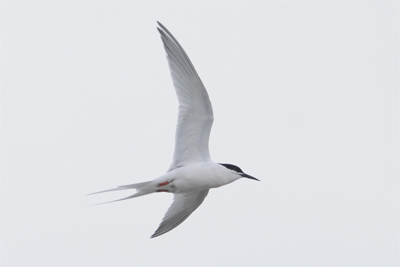
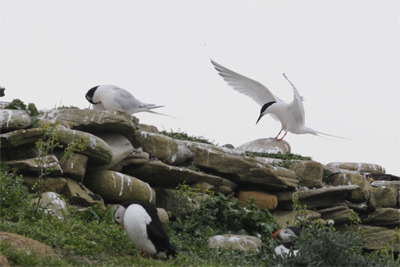
    Sarah had the excellent idea of taking a boat trip around Coquet Island, which I was really enthusiastic about.  When myself and Tom Cadwallender from the Northumberland Coast AONB were designing the backdrop for this year’s Birdwatching Northumberland stand at the Bird Fair we chose eight species that we felt symbolised Northumberland birding; Curlew, Eider, Pale-bellied Brent Goose, Golden Plover, Black Grouse, Roseate Tern, Dipper and Puffin.  A mix of everything that’s good about birdwatching in Northumberland; inland, coastal, summer and winter.  I had images of seven of those species, but the Roseate Tern is the one that I haven’t photographed during the digital age.  Hence, my enthusiasm for a trip around Coquet Island; with 35-40 Rosies already back at their Northumberland colony I was hopeful that photo opportunities would arise.  As we sailed across to the island onboard Shokwave, there was a strengthening NNE breeze and the temperature began to decrease rapidly.  Once Dennis manouvered the boat into the jetty, we could see Roseates sitting on their nest boxes.  They were a bit distant for photography so I waited patiently until I heard the distinctive ‘choo-it’ call and a bird flew by the boat.

    Britain's rarest breeding seabird

    Grey Seals popped their heads above the water to look at the boat, Puffins whizzed past at breakneck speed and more Roseates were busy displaying around the boxes.

    Roseate Tern

    After a pleasant Sunday morning cruise it was time to return home. En route, we stopped off to check a Little Owl nest site and one of the adult birds sat staring at us from the roof of a derelict building.  Finalising the paperwork for a forthcoming project was followed by a wonderful evening sitting on our patio, drinking wine and working on part of our bonsai collection as Blackbirds were singing from our trees and Coal Tits collected food to take to the noisy, and hungry, nestlings that we could hear.  Now, that’s my idea of heaven 🙂