Tag: Barn Owl

  • 2 out of 3

    As the damp, dreary weather of yesterday was giving way to brighter conditions I found myself heading up the coast to collect clients from Craster.  Our targets for the evening were Red Squirrel, Otter and Badger; in that order of priority, so an evening safari in Southeast Northumberland had been planned to try and encompass all three species.  A walk along the River Blyth produced what could well be a ‘must see’ for natural history enthusiasts over the coming years.  Scampering along branches and leaping through the canopy, our first target entertained as it made it’s way through the trees – causing agitation in two Great Spotted Woodpeckers which had been feeding quietly before the squirrel’s appearance.  A Jay allowed us an unusually close approach before it vanished into the trees and Dippers were zipping back and forth along the river as we returned to the Land Rover, and we set out to search for Otters.  It wasn’t to be, although some compensation came in the shape of a Barn Owl, drifting along the dunes and then catching a vole before revealing the location of it’s nest by taking the food back to the waiting mouths.  That’s the great thing about running birdwatching and wildlife tours; it may be unpredictable, but there’s always something to enjoy and appreciate.

    With heavy drizzle hampering visibility, we made our way to a site where Badgers would hopefully be out and about.  Sure enough, James spotted one as soon as we arrived, and a second movement on the hillside was probably another one, although it slipped out of sight in the undergrowth soon after being spotted.

    Finding 2 out of 3 elusive mammals that we were looking for was a good success rate and, with some new sites for Otters  that we’ve been monitoring, our bespoke ‘multi-mammal’ trips are sure to prove popular this summer.
  • A Rosy outlook

    Saturday saw a change in our normal Safari routine, and an early afternoon start.  I collected Gareth and Ruth from the Red Lion at Alnmouth and we drove south.  The hot, sunny weather had brought out hundreds of people to Plessey Woods but we still found a peaceful, undisturbed glade where we could listen to the birds singing and we watched a female Great Spotted Woodpecker; at least we were able to watch her until she realised that we were!  Cresswell Pond produced a real avian soap opera as a Mute Swan defended his pond against two interlopers, racing across the pond like the Spanish Armada.  A Little Gull was as cute and dimunitive as ever, alongside Black-headed, Common and Herring Gulls.  Druridge Pools was hosting some obviously confused geese; amongst the expected flock of Greylags there were single Pink-footed and Barnacle Geese as well.  A late finish concluded with a beautiful, ghostly Barn Owl and at least 3 different species of bat along the River Coquet at dusk.

    Sunday was a day for doing whatever we felt like.  With temperatures still soaring, a day inland, doing survey work for the BTO Bird Atlas, was considered then rejected in favour of a visit to the coast.

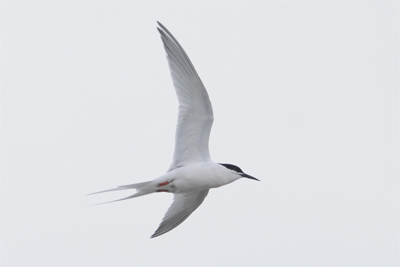
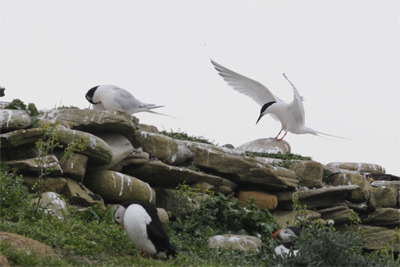
    Sarah had the excellent idea of taking a boat trip around Coquet Island, which I was really enthusiastic about.  When myself and Tom Cadwallender from the Northumberland Coast AONB were designing the backdrop for this year’s Birdwatching Northumberland stand at the Bird Fair we chose eight species that we felt symbolised Northumberland birding; Curlew, Eider, Pale-bellied Brent Goose, Golden Plover, Black Grouse, Roseate Tern, Dipper and Puffin.  A mix of everything that’s good about birdwatching in Northumberland; inland, coastal, summer and winter.  I had images of seven of those species, but the Roseate Tern is the one that I haven’t photographed during the digital age.  Hence, my enthusiasm for a trip around Coquet Island; with 35-40 Rosies already back at their Northumberland colony I was hopeful that photo opportunities would arise.  As we sailed across to the island onboard Shokwave, there was a strengthening NNE breeze and the temperature began to decrease rapidly.  Once Dennis manouvered the boat into the jetty, we could see Roseates sitting on their nest boxes.  They were a bit distant for photography so I waited patiently until I heard the distinctive ‘choo-it’ call and a bird flew by the boat.

    Britain's rarest breeding seabird

    Grey Seals popped their heads above the water to look at the boat, Puffins whizzed past at breakneck speed and more Roseates were busy displaying around the boxes.

    Roseate Tern

    After a pleasant Sunday morning cruise it was time to return home. En route, we stopped off to check a Little Owl nest site and one of the adult birds sat staring at us from the roof of a derelict building.  Finalising the paperwork for a forthcoming project was followed by a wonderful evening sitting on our patio, drinking wine and working on part of our bonsai collection as Blackbirds were singing from our trees and Coal Tits collected food to take to the noisy, and hungry, nestlings that we could hear.  Now, that’s my idea of heaven 🙂

  • Snow on the sand

    I’m lucky enough to not suffer from SAD (Seasonal Affective Disorder).  In fact I look forward to the winter months – I’m a bit dysfunctional in very hot weather (that’s one of the reasons I live in the north of England, and why I enjoy winter holidays in northwest Scotland so much).

    Our very wintry Lindisfarne Safari on Monday was just about my ideal day out; bitterly cold, inspirational winter light, hardly another person to be seen anywhere and plenty of wildlife.

    That inspiration manifested itself in a repeat visit to the Lindisfarne NNR yesterday.  I had two goals in mind; photograph Pale-bellied Brent Geese, and capture an image of Bamburgh Castle as the light faded.

    The geese were some distance away, due to the state of the tide, but I managed to capture the distant birds in the shadow of Lindisfarne Castle, and a small group as they flew along the tideline.

    Lindisfarne Castle and Pale-bellied Brent Geese
    Lindisfarne Castle and Pale-bellied Brent Geese
    Pale-bellied Brent Geese (Branta bernicla hrota) (c)Martin Kitching/Northern Experience Images
    Pale-bellied Brent Geese

    The light was fading rapidly so I drove to Bamburgh, along roads that resembled a ski run, and made my way down to the beach.  Frozen rock-pools and a beach dusted with snow aren’t a frequent occurence so it was an unusual opportunity to photograph the castle in these conditions.  The big, thick gloves that were keeping my hands nice and toasty were too bulky to let me operate the camera so I had to suffer for the image.  And it was suffering; just a few seconds with my gloves off and my hands were protesting at the cold.

    Bamburgh Castle in the snow 22/12/09
    Bamburgh Castle in the snow 22/12/09
    The Moon, high over Bamburgh 22/12/09
    The Moon, high over Bamburgh 22/12/09

    20 miles back down the road, with gloves on and the car heater on full, my fingers began to warm through…so I decided to extend the journey home and check some of our favourite owl sites, even though that would require some very, very careful driving.  A Barn Owl perched on a stack of hay bales was justification enough for that decision and two Little Owls, perched in trees just a hundred metres apart were the icing on the cake.

  • Masters of all we survey?

    I’ve just finished my 3rd consecutive day of survey work (ok, today was just a couple of hours around dawn, but you get the idea).

    Friday and Saturday saw me up to 20 miles offshore, leading a survey team of Alan Tilmouth, Ross Ahmed, Allan Skinner (our boat skipper) and Jimmy (erstwhile SarahJFK crew member and very diligent data-recorder).  Friday didn’t look promising as we drove to Royal Quays in thick fog, and the marina was mired in the gloom as well as we met up with Tom Brereton from Marinelife.  However, once out of the Tyne we quickly passed out of the fog bank and into some stunning weather.

    Martin and Tom scanning for cetaceans
    Martin and Tom scanning for cetaceans
    Ross, Alan and Tom observing and recording seabird distribution and abundance
    Ross, Alan and Tom observing and recording seabird distribution and abundance
     On the return there was a superb sunset but the fog had extended to almost 6 miles offshore and we had one of those real pelagic experiences.
    Tom scanning ahead of the SarahJFK for cetaceans
    Tom scanning ahead of the SarahJFK for cetaceans
    Ross still recording, Alan looking cheerful as we approach a fog bank
    Ross and Alan still recording as we approach the fog bank that ended Friday's survey
    Tom, Martin, Ross and Alan heading home
    Tom, Martin, Ross and Alan heading home

    Yesterday had overall better visibility but slighty lumpier seas, as we covered the area from Blyth to Druridge Bay.  Having completed about 80 miles of transect surveys in 2 days we’ve already gathered a lot of seabird data.  The North Sea (which is relatively small) seems pretty big when you’re far enough offshore to not be able to see any land.  When 3 experienced seawatchers look around and say “we don’t really have a clue what’s out here do we?” then it hammers home the importance of what we’re doing.  Having found Puffins on both surveys so far, and five Little Gulls on Saturday, we’re all eagerly anticipating the rest of our winter surveys.  We’ve got a few spaces on most of the survey trips (which will run when the weather allows us the opportunity) which are available for a contribution of £20/person/trip (a much lower rate than our commercial pelagics trips in July-September).  Give us a call, wrap up warm and join us on a journey into the unknown.

    On dry (well, drier) land, Sarah and myself set out this morning for the December Icelandic Goose Census.Two Barn Owls were a bonus in the bone-chilling temperatures.  Last month I drew a blank with our goose monitoring and this month was hardly any better; just 3 Greylag Geese at the roost site that is designated as part of the census.  Looks like we’ll be out again at dusk, trying to locate the birds as they fly to roost.