Category: Farne Islands

  • To intervene in nature…or not?

    We were watching Autumnwatch yesterday evening and one discussion between the presenters, concerning intervention when you’re filming/photographing an animal in distress, was particularly pertinent to the mini-safari that Martin led earlier yesterday evening…but back to that later in this post.

    The half-term week was busy, as expected, and included some fantastic wildlife watching; Salmon leaping up a weir on the River Coquet, Starlings massing and swirling above a coastal reedbed before dropping to roost, 2000+ Pink-footed Geese filling the sky overhead, as they left their feeding sites and headed for the overnight safety of the water, and Grey Seals around the Farne Islands as they approach the height of their breeding season.

    Yesterday brought an evening mini-safari in southeast Northumberland.  Damp gloomy conditions and increasingly glowering clouds weren’t making things look too promising.  Our walk along the River Blyth produced a Nuthatch, and a Kingfisher called as it flew along the swollen, muddy river.  Two birdwatching gems, but quality rather than quantity was the order of the evening.  A Sparrowhawk provided some entertainment as it swooped repeatedly down towards the trees, flushing flocks of Woodpigeon with each descent, before finally vanishing into the canopy.  We continued our walk and, as we rounded a bend in the path, we found the reason for the Sparrowhawk’s disappearance; flapping lamely in the undergrowth was a Woodpigeon with a nasty head wound.  The predator had presumably flushed as we approached.  We’ve seen similar before and the question from clients is always “what are we going to do?”.  The answer may seem quite cold and heartless but we do nothing.  The pigeon was mortally wounded and would provide a meal either for the hawk or possibly a Red Fox would come along and make off with it.  Nature really is ‘red in tooth and claw’ and we shouldn’t interfere in the everyday life (and death) of our wildlife where we can avoid doing so.

    Our next destination was what is rapidly becoming our favourite Badger sett.  As we watched quietly (and we really have to congratulate the 6-year old in our group for remaining so very quiet) over the open area close to the sett, a Red Fox crossed the track ahead of us, we could hear scuffling in the undergrowth and then two stripy black-and-white faces appeared out of the gloom.  After a withering stare in our direction the two cubs trotted along the hillside and were joined by a third before vanishing into the night.  The final leg of the trip was a search for owls.  Local knowledge paid off, as the ghostly figure of a Barn Owl floated through the beam of our headlights just where we expected it to.  There was still time for more wildlife though and the application of our bat detector revealed a Common Pipistrelle feeding on the rich bounty of moths.  After the recent frosts it was good to find bats still active, and our final event for this October is a Bat Walk at Bamburgh Castle tomorrow evening.  Give us a call on 01670 827465 to book your place for what should be an evening of family fun.

  • Frenetic Friday

    Yesterday involved a real mixture of my favourite places, and a wide range of activities.

    Starting just after 07:00 I checked the 12 Longworth traps that we set on pre-bait in Choppington Woods earlier in the week.  With 9 of the 12 having been emptied of food, the small mammals we’re interested in had obviously found the bait.  The one slight problem was that initially I could only find 11 traps!  Despite having a GPS location for each, and marking adjacent vegetation with tags, it took 20 minutes to locate one of them.  Veronica Carnell, who is supervising me while I gain sufficient experience to run a trapping programme on my own, had warned me that this would happen 🙂

    Then I had a short drive across to Blyth for the second day of the Netgain regional hub meeting.  It’s been incredibly educational to listen to the views and concerns of other stakeholders, who don’t necessarily approach things from a conservation point of view.  Equally, it was impressive to see such wide and varied viewpoints coalescing into a concensus by the end of the meeting.  Although I have an interest in the project from a nature tourism angle, my main input was on the distribution and seasonality of cetaceans and seabirds off the Northumberland coast.  The protection of the marine habitat is so important to us that, as a business, we’ll keep making my time available for Netgain meetings until the conclusion of the project.

    After the meeting I drove to Seahouses and collected a journalist from the Edinburgh Evening News, for a trip across to the Farne Islands.  We occasionally run press trips where the journalist will be accompanied by wife/husband/partner, but 2 adults, a 6-year old, a 3-year old and a baby was pretty much a first (apart from a guy from a local paper in Cumbria who managed to blag a free holiday, for himself and his family, from accommodation providers, activity providers and attractions in Northumberland in 2008…and then never wrote the article that was used as the hook for getting all the freebies – ah well, live and learn).  The trip across to the Farnes was everything I would expect in late October; breezy, cold and a fantastic wildlife experience.  The Grey Seal pups were predictably cute, and at least 3 Peregrines were hunting the Feral Pigeons that live on the islands.  We’ve got a Seal Safari next Friday, which includes a trip around the Farne Islands (weather permitting), a Landrover safari and picnic so give us a call on 01670 827465 for more details or to book (especially if you are a family – it’s 1/2 term week so we’re offering generous discounts on family bookings).  With 5 trips out with clients over the next 5 days (including 2 days where we’re fully booked already) it’s going to be  a busy week.

    All of that would have a been a busy day…but there was one thing left, and it was something that I was really looking forward to.  As Newcastle University graduates, myself and Sarah both have an emotional attachment to the Hancock Museum (or Great North Museum:Hancock as it’s now named…but you won’t find either of us, or many other local naturalists, calling it that).  So, yesterday evening I felt quite honoured to be standing in the Clore Learning Centre at the museum giving a lecture about the Northeast Cetacean Project to the Natural History Society of Northumbria.  With an attendance of over 100 at the lecture it’s a subject that people are really interested by.  One of the question asked at the end of the talk was “how will the data be used?  what value does it have?”.  Which took us nicely back round the loop to the day and a half of Netgain meetings.

  • Birdwatching by boat off the Northumberland coast

    Now, you shouldn’t need to read too many of my blog posts to realise that seabirds and cetaceans occupy a special place in my heart, and that I’m in my element once I’m on a boat off the Northumberland coast.

    Saturday was our annual ‘Whale and Dolphin Cruise’ on Glad Tidings V, out of Seahouses.  With 36 participants, including the other NEWT guides (Sarah and Andy), all safely on board we set off down the coast.  We were soon enjoying views of two Arctic Skuas and then panic on the deck as our eagle-eyed skipper spotted two Sooty Shearwaters off to one side and everyone rushed to see them.  These ocean wanderers are one of the great sights of pelagic seabirding in the North Sea at this time of the year.  For one participant though the real excitement was the bird sitting beside the shearwaters; a Puffin 🙂  It’s a few weeks too late to see them at their breeding colonies, but I’d told Sam that we had a good chance of coming across one.  Throughout the day we found a few more, as well as plenty of Fulmars, Kittiwakes, Guillemots  and a few Razorbills.  Perhaps the best entertainment of the day was provided by several feeding groups of Gannets, throwing fountains of water into the air as they hit the sea.  There was clearly a lot of fish for them to eat, and it was real mystery to myself, Sarah, Andy and John that there were no cetaceans feeding in the same areas.  Oh well, if they weren’t so mysterious it wouldn’t be such an adrenaline rush when we do find them I suppose.  A lone Manx Shearwater avoided the boat, as they tend to do, and we headed northwards to the Farne Islands, hoping to see the White-tailed Eagle that has been there for the last week.  We were in radio contact with other boats so we knew it had just killed a Shag and was eating it.  As we neared the islands our one cetacean for the day appeared, a Harbour Porpoise just to one side of the wake of the boat.  Just as we arrived, the eagle crept into a cleft between a grassy bank and some rocks so only one or two people managed to get a glimpse of it’s head as it dropped out of sight.  Grey Seals were playing, splashing and racing around and we headed back into the harbour, after a marathon effort by our skipper and everyone on board.  We’ve already set the date for the 2011 Whale and Dolphin Cruise – Saturday September 10th so put it in your diaries and give us a call on 01670 827465 to book your place.

    Blue skies, calm sea, what more could you wish for?
  • Damsels in the sunshine

    I’m sitting in the office writing this , and the rain is hammering down outside.  We had a Prestige Photography trip yesterday in brilliant sunshine, but first a quick catch-up (hard to believe but sometimes there are other things to do that are more important than blogging…).

    Kirsty and Sarah continued their running plan by competing in the Sunshine Run last Wednesday, with yours truly again acting as pack animal.  I’m seriously considering taking up running,  as everyone seems to enjoy it so much.  They both bettered their personal best times for 5km, so a big well done to them from me 🙂

    On Sunday we had something quite different; a photography tuition afternoon with a group of ‘looked-after’ children.  We had planned to visit the Farne Islands but the strengthening wind meant that the afternoon sailings were cancelled, so instead we walked along a section of the North Northumberland coast and looked at techniques for creative landscapes and birds in flight.

    Yesterday was a wildlife photography tour of Druridge Bay.  I collected Eileen and Dave from Warkworth and we visited our favourite southeast Northumberland sites.  Damselflies, butterflies and moths featured heavily throughout the day, as might be expected on a sunny day in mid-July, although with it being so warm they were a bit skittish.  As ever, patience paid off.

    Ringlet, Druridge Bay, Northumberland 13/07/2010
    Narrow-bordered Five-spot Burnet, Druridge Bay, Northumberland 13/07/2010
    Latticed Heath, Druridge Bay, Northumberland 13/07/2010
    Blue-tailed Damselfly, Druridge Bay, Northumberland 13/07/2010
    Common Blue Damselfly, Druridge Bay, Northumberland 13/07/2010
  • Deja vu

    Wednesday was our second consecutive Farne Islands trip.  I collected Steve and Sarah from Belford and after we’d visited a couple of NEWT’s favourite coastal locations it was time to catch the Glad Tidings across to Inner Farne to enjoy some of the best birdwatching Northumberland has to offer.  The sense of anticipation, heightened once the first Puffins, Guillemots  and Razorbills begin to fly by, beaks filled with fish, blends with the clean sea breeze and all of the passengers on board start to get excited.  After the cruise around the islands we landed on Inner Farne and the Arctic Terns went on the offensive.  This year I bought a new hat, after taking a bit of a beating in 2009 🙂  Even though the island is quite small the hour that we spent on there seemed to fly past.  Probably the highlight of the islands this time was just how close some of the Puffins came to where we were standing.  Back on the mainland we walked through the dunes near Low Newton, where there were lots of Small Heath butterflies, more Arctic Terns and plenty of Meadow Pipits.  With the glorious summer weather, it was a really relaxing day.  What would Thursday bring?

  • Landscape photography and birdwatching on the Northumberland coast

    This has been one of our busiest weeks since we started NEWT, and I’ve only just got around to finding the time to sit in our office and blog about the last few days.

    Tuesday saw Mike, one of our returning clients, coming for his second day out with NEWT, including some photography tuition in the Northumberland Coast AONB and a birdwatching trip across to the Farne Islands.

    After a session on exposure theory, covering topics such as exposure values, ND filters and average metering (the bane of photographers everywhere) and a bit of practice with slow shutter speeds to creatively blur the rising tide it was time to head across to Inner Farne.

    No matter how many times I visit the Farne Islands, I’m always awestruck by just how good the experience is;  Grey Seals, Common, Sandwich and Arctic Terns, Eiders, Kittiwakes, Fulmars, Guillemots, Puffins and Razorbills all offer excellent photo opportunities so plenty of memory cards are a must.

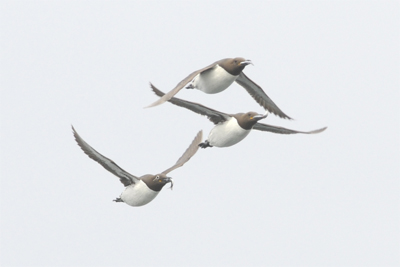
    Common Guillemots (including a 'bridled' Guillemot) after a successful fishing trip
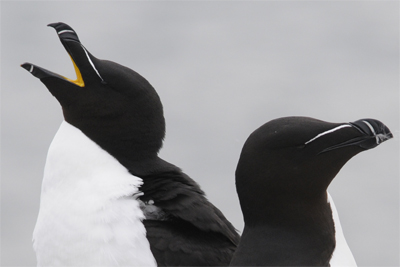
    Razorbills
  • The dawning of the “season”

    After a cold, wet day surveying one of our inland tetrads for the Bird Atlas, we had a very early start on Sunday for our Dawn Chorus walk at Lee Moor Farm.  Ian was, as always, an entertaining host for the event and we walked around the farm, enjoying the songs of Willow Warbler, Song Thrush and Sedge Warbler, excellent views of Brown Hare and Roe Deer and then a delicious breakfast.  Our next event at Lee Moor is a bat walk, moth trapping demonstration and BBQ on Saturday May 15th.

    Monday saw us out on Atlas work again, this time much closer to home as we are covering the tetrads that are immediately north and south of our house.  The highlight was a reeling Grasshopper Warbler, and the closest Tree Sparrows to home that we’ve found so far.

    Yesterday was our first Farne Islands Safari of the year.  With excellent views of Sandwich, Common and Arctic terns, Eiders, Guillemots, Razorbills, Puffins, Shags, Gannets, a very obliging Wheatear and Grey Seals it was everything we would expect the Farnes to be.  There’s a good reason that the islands will be the venue for days out with 3 of our photography clients over the next few weeks.

    Now, it’s Wednesday morning and I’m just packing the Landy ready for a migrant hunt on Lindisfarne with 2 of our returning clients.  Wish us luck 🙂

  • Seal of approval

    Saturday was scheduled for our “Seal And Seaduck Special”  (sounds like a really bad curry concocted by the Farnes wardens to see them through the ‘hard times’, is in fact a 4 hour NEWT cruise around the Farne Islands and Holy Island).

    The weather forecast hadn’t been particularly promising (that’s not entirely true – it had been promising…heavy rain and howling southeasterlies) but a ‘phone call to William on Friday raised the possibility that we would be able to run the trip.  As we arrived at Seahouses Harbour we could see Glad Tidings VI approaching with the wardens safely on board and their zodiac towed behind.  We had time to welcome David Steel back onto the mainland and then we all boarded and set out into a noticeable swell. 

    The trip had a really good social event feel to it (as all of our pelagic trips tend to do); all three NEWT guides were on board, one of our clients was on her 5th trip with us (this time bringing two of her friends, for a trip they’ll probably never forget – for all the right reasons) and our friends Tim and Vera from Cottingburn House in Morpeth were among the other passengers.  Once we were across at the islands there were a lot of seals, and many of them were ‘singing’ their mournful song; surely the source of many legends of sea-monsters and mermaids.  1347 pups have been born on the islands this year and most of them have departed or moulted out of their cute baby fur already.  A Peregrine Falcon entertained everyone on board as it perched on the Pele Tower on Inner Farne before being pursued towards the Wideopens by a Herring Gull.  The next leg of our journey took us up to Holy Island and several Red-throated Divers flew by and a Great Northern Diver was on the water near Guile Point.  The weather changed at this point and sunlight illuminated Lindisfarne Castle.  We then began a slow run down the coast in search of seaduck.  Flocks of Common Scoter scattered well ahead of our arrival but Sarah managed to get some good images, showing the typical appearance of a flock of flying scoters;

    Common Scoters (Melanitta nigra)
    Common Scoters (Melanitta nigra)
    Common Scoters (Melanitta nigra)
    Common Scoters (Melanitta nigra)

    We also encountered one of the most beautiful birds that winters off Northumberland – Long-tailed Duck.  Camera shy?  These birds made the scoters look like they were hogging the limelight;

    Long-tailed Duck, the 'Stag Light' and St Aidan's Church
    Long-tailed Duck, the 'Stag Light' and St Aidan's Church

    The increasingly choppy seas were making photography frustrating but Sarah stuck gamely to it.  As she was using my camera, and a lens that she wasn’t familiar with, it was even more challenging than pelagic photography usually is.  As we passed by Bamburgh Castle (as impressive from the sea, if not more so, than it is from land) and then Monk’s House the tide turned the last 10 minutes of the cruise into a real experience.  That’s always the point when somebody on board reveals that they usually feel seasick on the boating lake in their local park…

    Nobody was adversely affected by the swell, everyone saw plenty of seals, and the flocks of seaduck flying around us added up to a real winter pelagic treat.  We couldn’t have asked for more from our final journey into the North Sea for 2009.

  • A harrowing story…

    of suffering and depravation. That’s the ongoing tale of heroics, kelp crisps and seal milk over on the Farne Islands blog. I’ve always been impressed by the majesty of the North Sea, particularly when it’s crashing against the east coast in the early winter. It can’t be much fun for the lads out on the Farnes though, with food supplies almost exhausted and beer just a distant memory…

    I was once asked to list my top 5 birdwatching experiences and the Farne Islands are right near the top of that list. The islands feature regularly on the NEWT itinerary; between April-October we run Seal Safaris, from May-July we include landing trips, and in November and December we have our exclusive ‘Tystie Trek’ and ‘Seal and Seaduck Special’ cruises.

    A seabird colony at the height of the breeding season is a thing of great wonder. One of our trips this year was for a journalist from Coast magazine, who we took across to the islands to give her the experience of our beginners birdwatching courses and we arranged an interview with the Head Warden, David Steel, for her as well. At this time of year the birds (well most of them anyway) may be gone but the seals are there. There can’t be many creatures more resilient…but the Farne islands wardens are giving it a go.

  • Like a millpond

    Today featured two very unusual occurences; a mid-November boat trip and all three of the Northern Experience guides on one trip together.

    Watching the weather forecasts for the last few days meant that we were confident the trip would go ahead; and our confidence wasn’t misplaced. Twelve enthusiastic participants gathered at Seahouses harbour at 10am and we boarded the Glad Tidings VI. Heading across to the Farne Islands, the sea was calm and blue, visibility was excellent for many, many miles around and it was just cold enough to make it a proper pelagic experience. Shags and Eiders were around all of the islands but the main entertainment was provided by the Grey Seals and the many pups that they have produced so far this year; little white bundles of fur, marked with bright orange, yellow or red so that the wardens know if a pup has already been counted in their regular surveys of the breeding colony. A seal falling off a jetty in to the sea had several of our participants laughing so hard it’s a wonder they didn’t join it for an impromptu dip. The photographers on board had frame-filling opportunities to fill the memory cards in their cameras.

    Searching around the Gun Rock and the Megstone failed to produce any sightings of Black Guillemot (a rare winter visitor in Northumberland) but a majestic Great Northern Diver flew close past the bow of the boat as we headed back towards Seahouses. Back on dry land we arranged an otter safari for tomorrow with two of today’s participants and answered a few queries about our next boat trip; an exclusive winter cruise taking in the Farne Islands Grey Seal colony, Holy Island and the seaduck of the Skate Road.