On our photography tours I carry my camera with me, particularly when delivering photography tuition, but on our other trips I don’t; our clients deserve, and receive, my full attention. When I’m out on my own I don’t always carry a camera either – sometimes it would just be inconvenient (scrambling up trees, crags and dunes isn’t always compatible with having a heavy camera bag on your back). Occasionally, though, there are times when a camera would come in quite handy. These are nearly always stunning sunsets, and a quick shot with my Blackberry records the scene…and is then forgotten about 😉 I was downloading the images from the Outdoor Leisure Show yesterday when I realised that there were a few sunset shots sitting on the memory card;
And then a couple of images from May last year, after our clients had been safely returned to their b&b, showing how light (or the camera’s perception of it) changes so quickly; these two images were taken only a minute apart.
Finishing a mini-safari at dusk combines two of my greatest pleasures; showing our clients the wildlife and landscape of Northumberland, and still being outside as it gets dark.
I met up with Alastair, Roz, Keith and Marian mid-afternoon last Thursday for a few hours of wildlife and birdwatching around Druridge Bay and Southeast Northumberland. As I got out of our Landrover in the car park at Church Point, it occurred to me that it was so cold and misty that I’d be really quite excited if it was mid-October 🙂 Even so, in mid-February a mini-safari finishing at dusk is still exciting.
Beside the River Coquet, a wave of panic rippled through the Jackdaws and Woodpigeons. No sign of any cause though. Then another wave of panic and a Sparrowhawk raced by, narrowly missing a Black-headed Gull perched on a fence post. A group of Roe Deer were spotted by Marian, walking along a ridge opposite us and vanishing behind the bushes before reappearing and then vanishing again. At least 28 Goldeneye were displaying on the river, the comical contortions of the drakes providing good entertainment. Almost as good as the entertainment provided by the sense of humour of all 4 clients 🙂
A flock of 25 Goldfinches was well appreciated, as were all of the tiny lambs in the fields nearby and no fewer than 9 Grey Herons all sitting around one small pool. A pair of Pintail were dabbling, as dabbling ducks do, and Alastair’s sharp eyes provided a Barn Owl for the list as it ghosted it’s way through the sky above the flooded meadows.
Dusk beside a pool with a wader roost is almost indescribable; Lapwing, Curlew and Dunlin all huddled close together is quite a sight but the thing that takes almost everybody by surprise is the noise. The level of vocalisation between the birds is extraordinary, and then the Lapwings fall silent as they begin to fly off to feeding areas. Then, as the light faded to a level where binoculars, and even our eyes, weren’t really sufficient anymore, the trumpeting of 24 Whooper Swans coming to roost rounded the day off.
January is a quiet month for NEWT as far as days out with clients go, but it’s been an incredibly busy month for other reasons.
The threat to tourism services in Northumberland, following public sector spending cuts and the impending closure of One Northeast, have occupied a lot of my time. As Chair of SENTA (Southeast Northumberland Tourism Association) and also Outdoors Northumberland (until last Monday when I stepped down at our AGM), as well as being part of Northumberland Tourism’s ‘Ambassadors’ group, I’ve been involved in meetings and discussions about where we go from this point on. I’m not going to go into great detail here, as there are many issues to deal with before the position that will be adopted by Northumberland’s tourism businesses is resolved enough to be made public.
The other big meeting this week was the latest NE regional hub meeting for Netgain (the North Sea Marine Conservation Zones Project). Along the Northumberland Coast, and in our offshore waters, we have some stunning wildlife and habitats. The Farne Islands and Druridge Bay are places that we’ve enjoyed so much wildlife with our clients and the North Sea itself has produced encounters with rare, elusive and iconic creatures on our pelagic trips for many years now. With so many different interests represented on the regional hub, there were always going to be conflicts (of ideology and interests, rather than personal conflict between hub members thankfully). The only way forward will be through concensus and that requires a certain amount of give and take by everyone involved. The Netgain team have done a fantastic job of managing the discussions, providing the mapping data that hub members have asked for and answering some often difficult, and contentious, questions.
I care passionately about tourism in Northumberland, and I’m sure that any regular reader of our blog will know my feelings about the North Sea, so I’ll keep doing all I can to help move both of those projects towards a sensible solution. Ultimately though, we’re a conservation-minded tourism business so I’ll be seeking solutions that have the best interests of tourism businesses and the marine environment at their core.
I even managed a couple of hours birdwatching earlier this week as well; a successful trip to see the Hawfinch at Mitford was followed by a walk across some exposed moorland where I was entertained by 2 Red Foxes as they bounded through a patch of heather like a couple of spring lambs. Invigorating and stimulating, and across the coastal plain of central and southeast Northumberland I could see the sea with the full moon rising over it. A truly magical moment that reminded me where my passion comes from.
Our first blog post of 2011 has been slightly delayed by some technical difficulties, but we’re up and running again 🙂
We decided that the first few days of the year would be spent birdwatching around southeast Northumberland. New Year’s Day saw us spending a couple of relaxed hours around Druridge Bay, producing 63 different bird species…followed by a very cold, windswept seawatch from Snab Point as we waited for the Humpback Whale found by Mark Newsome and Steve Addinall at Whitburn. It didn’t pass by us (at least not at the sea surface) but hopefully it will herald another excellent year for cetacean sightings off the northeast coast. With the cetacean species accounts for ‘Mammals of the Northeast’ to write, Martin will be hoping for more additions to the already comprehensive Northeast Cetacean database as the year progresses.
Sunday was a family and friends day at the christening, and then birthday party, for Annabel, Sarah’s god-daughter. The only new bird for the year was our garden speciality Willow Tit.
Another relaxed birdwatching day yesterday produced, amongst others, a Waxwing, 5 Goosanders, 2 Grey Wagtails and 2 Nuthatches. All very attractive birds, that brought a warm glow to a cold winter’s day.
Now the working week starts again, and we’re busy dealing with enquiries, bookings and 3 major projects that we’re going to be involved in this year. There’s always time for a spot of birdwatching or photography though 🙂
When Sarah arrived home from work at 19:30 yesterday, I suggested a spot of nocturnal motorised birdwatching.
We headed north past Ellington and up to Widdrington before turning towards the coast and down through Druridge. With the thermometer hitting -7C, the ungritted roads were a bit of a challenge. Following some recent big counts of Woodcock it was no great surprise that they flushed regularly from the roadside as we passed. Our main target for the drive was Barn Owl, and we eventually found one perched on a post beside the Spine Road near Blyth. Bird of the evening though was a stunning Long-eared Owl, on a fence post by the edge of the road. As we passed slowly, on the skating rink of a road surface, it turned it’s head imperiously, following us with those piercing orange eyes. Over the last 3 years we’ve shared views of all of Northumberland’s regularly occurring owls with our clients, but for sheer ‘other-worldliness’ you really can’t beat Long-eared Owl.
November is generally a quiet month for NEWT; the half-term rush in late October has come and gone, thoughts are turning to Christmas…and the weather can be a bit suspect. We had a Safari Day around Druridge Bay and Southeast Northumberland at the end of last week that could have succumbed to the elements but, as it turned out, a combination of excellent birdwatching sites that could be watched from the Land Rover, clients with a real interest in natural history (and expertise in wildlife sound recording)and a badger-watching spot where the trees sheltered us from the rain, made it an enjoyable afternoon. The flock of Waxwings in Ashington delighted yet again. Who could fail to be impressed by them? After a spell of birdwatching that was then characterised by ‘lovely weather for ducks’ (Teal, Wigeon, Mallard, Gadwall, Goosander, Goldeneye and Pochard were all seen), and some good flocks of Lapwing, Golden Plover, Redshank and Pink-footed Goose, we headed inland to the steep, wooded hillside that has produced some excellent views of Badgers on our Safaris in recent months. Only one Badger came wandering along – perhaps the others that we’ve watched so often this year were indulging in that particularly human pastime of curling up somewhere nice and warm out of the wind and the rain.
Since then it’s been a busy week, mainly with planning and preparation for 2011 but also giving 2 presentations about the Northeast Cetacean Project. The first was to a group of postgrad students and lecturers at Newcastle University and then last night, to the Northumberland & Tyneside Bird Club. Both presentations produced some interesting questions, and some potentially excellent volunteers to assist with our ongoing survey work.
Now it’s Friday morning, the howling westerly winds are bringing waves of rain and then sunshine, there’s an intense rainbow visible from our office window and a flock of Redwings are being blown about like autumn leaves. No matter what the weather throws at us, Northumberland is still a superb county for wildlife and birdwatching; you just need to know how to enjoy it 🙂
October ended with a Prestige Tour around Druridge Bay and Southeast Northumberland. I collected Christine and Mark from Stannington and we headed across to the coast. Flocks of Linnets. Lapwings and Grey Partridges were close to the road and we settled to check one of our regular Otter sites. All of the assembled Mallard, Teal, Wigeon, Gadwall and Coot were concentrated in one area of the pool and clearly nervous about one particular corner. We weren’t fortunate enough to catch a glimpse of any predators, but the behaviour of the waterfowl was typical of the type of indication you get that there’s an Otter about. Our lunch spot for the day was beside the River Coquet and, along with the Cormorants and GreyHerons that were patrolling the water’s edge, an Atlantic Salmon provided some spectacular entertainment as it launched itself vertically out of the water, three times in rapid succession, just a few metres away from us.
As we walked along the River Wansbeck after lunch, via a detour around the north edge of Ashington to enjoy the spectacle of 90+ Waxwings gorging themselves on Rowan berries, skeins of Pink-footed Geese passed overhead and, as the sun sank towards the horizon, it was time to seek out the wildlife that occupies that magical time of day. As we settled into position near one of our favourite badger-watching spots there was an incredible commotion from the trees on the other side of the stream. Blackbirds, Song Thrushes, Wrens, Robins and Magpies were all alarming loudly. The mobbing was too intense, and too stationary, to be the mild alarm that a Red Fox or Badger often triggers and shortly after one Tawny Owl flew through the trees opposite, a second bird finally got fed up with the mobbing and flew from it’s perch. An unwelcome sighting was a Grey Squirrel, in a woodland that until recently still held Red Squirrels. Our first Badger of the evening was a big adult, trotting across the top of the clearing. Then, after a few minutes of near silence, two Badger cubs came crashing through the undergrowth. They crossed the stream beneath a fallen tree, paused briefly rising on their haunches like stripy black-and-white meerkats, and then headed uphill behind us. Our fourth Badger of the evening followed the same route before we headed back to the Landrover and civilisation.
I dropped Christine and Mark back at Stannington and there was time for one last piece of magic as a Barn Owl floated lazily from a fence post as I drove back towards the A1.
Throughout the late autumn and winter we’ll be scheduling most of our trips to finish in darkness. Druridge Bay and Lindisfarne are both excellent locations through the winter, and as darkness descends, so give us a call on 01670 827465 to find out how we can bring that experience to you.
With a good breeze coming from the east and misty drizzle on the coast, conditions have been looking good for a fall of migrants since yesterday morning. Some of the most exciting birdwatching available on the Northumberland coast happens in conditions like these…
As we left the house last night to walk down to The Swan, Redwings could be heard overhead and the distinctive call of a Yellow-browed Warbler gave us a heard-only garden tick.
This morning we had to be out well before dawn to count Pink-footed Geese at East Chevington as part of the Icelandic Goose Census. The air over the dunes was filled with the calls of Redwings, Song Thrushes, Blackbirds, Chaffinches, Bramblings and Goldcrests. Eventually, nearly 3000 geese departed their overnight roost and we drove to Cresswell, ready for our second survey of the day. This time it was our regular WeBS count. After a brisk walk north along the beach of Druridge Bay we arrived at East Chevington for the second time this morning, where there were flocks of Chaffinches and Goldcrests in the hedgerows and Sarah spotted a ‘ringtail’ harrier, but it quickly passed through. After taking both cars back home, and deciding how to spend the rest of the weekend (although most of that is predetermined), Sarah’s just gone to do some shopping, and I’ve just had a call about a Red-flanked Bluetail at Newbiggin…decisions, decisions 🙂
Our October tours will concentrate on the coast and birdwatching will feature heavily. Give us a call on 01670 827465 to find out what’s on offer and what we can do to enhance your Northumberland birdwatching experience.
We had back-to back birdwatching trips earlier this week, covering two of our favourite areas.
On Tuesday afternoon I collected Keith and Jen from home in Monkseaton and we headed northwards up the Northumberland coast. Our destination was the Holy Island of Lindisfarne, one of the birding hot-spots of the entire country. The strong winds were the only downside to the afternoon, but the birdwatching was good. After checking out a large group of Grey Seals we covered the area around the harbour and the Rocket Field. Bar-tailed Godwits, Common Redshank and lots of Ringed Plover were along the shoreline and a delightful charm of Goldfinches were around the Heugh. A distant group of Lapwings, Starlings and Golden Plover took to the air and the cause of their alarm was glimpsed briefly, although too briefly and too distant to make a positive ID. Holy Island birdwatching stalwart Ian Kerr put us on to a Little Stint and, as we headed back through the village, groups of Golden Plover passed overhead. Re-tracing our route back down the coast and checking the Budle Bay on the rising tide, we were just discussing the indications of the presence of predators when a huge number of birds lifted from the mud. As well as the gulls and waders, Jackdaws, Rooks and Woodpigeons joined the throng as they came out of adjacent fields and trees. This time the culprit was seen and identified; a Peregrine, that most majestic of raptors and one of the highlights of any birdwatching day on the Northumberland coast in the autumn and winter. A quick seawatch produced Sandwich Terns feeding, and Gannets soaring effortlessly on the breeze.
Wednesday was a full day out around Druridge Bay and Southeast Northumberland. I collected Jayne and Andrew from Seahouses, and then Hilary and John from Alnmouth, before beginning our tour of some of the best birdwatching spots in our local area. While we were watching Lapwings, Redshanks, Greenshanks, Ruff, Herons and Cormorants on the River Wansbeck I could hear a rough ‘sreee’ call from high overhead. The strong breeze meant that it wasn’t straightforward to locate the bird, but eventually I picked it out. It was an unfamiliar call, but a familiar species; a juvenile Common Cuckoo. The walk back along the river produced a nice flock of Long-tailed Tits. After lunch we stopped off at Cresswell Pond. Hilary and John mentioned that they’d visited Cresswell once before – when they noticed a large group of birders and stopped, managing to see a Buff-breasted Sandpiper.
Buff-breasted Sandpiper and Ruff, Cresswell Pond, Northumberland 12/09/2008With luck like that, we joked about what this visit could produce...
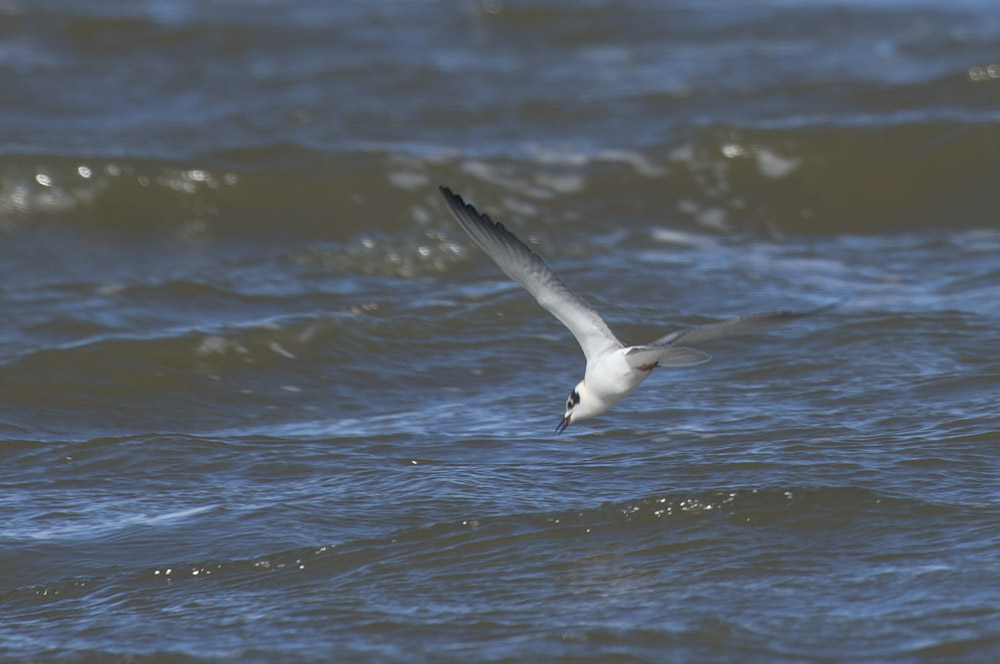
When we arrived at the hide, Jaybee mentioned that he’d had a juvenile Sandwich Tern. I scanned the pond but couldn’t see the tern anywhere and we settled to enjoying the quite remarkable views of Common Snipe that were available. After checking through the assembled ducks, gulls and waders I scanned across the pond again and spotted a tern dip-feeding near the causeway. The bird’s behaviour, combined with it’s very dark back, white rump and silver-grey wings caused me to get rather excited. White-winged Black Tern is a very special bird, and a personal highlight as it’s the third Chlidonias tern that I’ve found in Northumberland. Whiskered Tern is very rare and Black Tern is always a nice bird to see but White-winged Black Tern is such a beautiful species. Jaybee kindly sent me some images to use 🙂
White-winged Black Tern, Cresswell Pond, Northumberland 15/09/2010White-winged Black Tern, Cresswell Pond, Northumberland 15/09/2010
White-winged Black Tern, Cresswell Pond, Northumberland 15/09/2010As other birders began to arrive to enjoy the fruit of our good fortune we continued up the coast. Eiders and a Goosander, as well as some very obliging Grey Herons, were seen as we stopped by the River Coquet. A superb couple of day’s birdwatching, a beautiful rarity and clients who were excellent company.
Even though we live in southeast Northumberland, we’ll never tire of getting out and about searching for new experiences for our clients. Days out with clients are always exciting as well, because we never know exactly what we’ll see or what it will be doing.
Last Thursday we had a Southeast Northumberland/Druridge Bay safari with clients from a fairly wide geographical area; Jeff and Jean from Huddersfield, Lawrie and Linda from Glasgow and Yvonne from southwest Northumberland. Starting at Newbiggin we managed a brief view of a Mediterranean Gull on the beach, and a small flock of Sanderling. These little grey, white and black ‘clockwork toys’ are always entertaining as they scurry back and forth along the water’s edge. The River Wansbeck was our next destination. As expected there was a good sized flock of Lapwing roosting and Cormorants and Herons were doing what they do; standing with their wings out and just sort of standing respectively. All of a sudden a wave of panic spread through the Lapwings. We all scanned backwards, forwards, skywards but couldn’t see any cause. Perhaps it was just a false alarm? The birds settled but were up again within a minute, gradually settling back down with a great deal of conversation between them all. Greenshanks flew by calling and the Lapwings were becoming increasingly jittery. Even birds from distant streams were high in the air, forming the quite tight flocks that indicate the presence of a predator, something that creates anticipation wherever we’re birdwatching. Eventually we found a distant Peregrine, and a big female Sparrowhawk slid menacingly through the trees opposite our watchpoint. One or both of them was presumably the cause for concern. Even the Great Black-backed Gulls flushed and flew overhead, giving calls of consternation.
Among the coastal waders, perhaps the best were three Common Snipe, unusually confiding and just a few metres away from us. The fall of passerine migrants earlier in the week had left a few goodies behind. Spotted and Pied Flycatchers were quite elusive, sallying forth and then back into cover, Willow Warblers and Chiffchaffs were picking their way through willows beside the path and, providing a visual feast to rival the gaudiest of birds from elsewhere in the world, six male Common Redstarts were along one short stretch of hedge. There really is little to rival the beauty of these birds.
At the conclusion of our journey up the coast a bird as lacking in colour as the Redstart is bathed in it was a final wonderful sighting. As we watched two Grey Herons perched in trees overhanging the River Coquet, a Little Egret flew by before returning and perching high in the treetops in a spot where we could watch it through the ‘scope. There can’t be many better places to be birdwatching than the Northumberland coast in September 🙂