Author: martin

  • Another big freeze

    Here we go again…

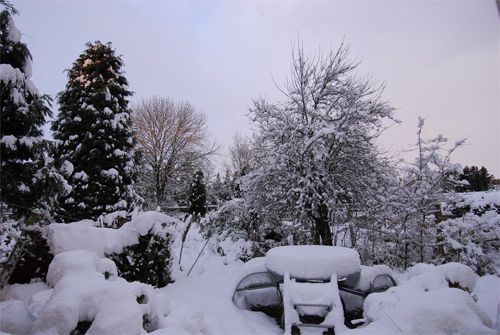
    It’s hard to believe that we posted on the blog back in January about the big freeze last winter and here we are again in a similar position already before the end of November (although at least at the moment it isn’t so prolonged).

    I went in to Newcastle last Wednesday for a seminar about the IMCORE project, and there was a bit of light snowfall.  When I came out of the Ridley Building an hour later the world was white, and it’s just gone on from that point.  After Sarah got home from work on Thursday evening the next time we used either of the cars was when we dug her car out of the snow this morning so she could go to work.  We’ve made the most of the last few days though; walking the 2 miles there (and 2 miles back) each day to visit a friend who’s now in a residential care home, doing most of the admin in 3 days that we would usually do through the winter (including adding all of our 2011 trips to the website) and finalising a couple of projects that we’ve been working on.

    Birdwatching in our little part of southeast Northumberland has been interesting for the last few days.  We’ve got an ever-expanding flock of Coal, Great and Blue Tits, Dunnocks and Wrens are now ever present around the feeding station and a very optimistic pair of Collared Doves were mating at the top of the Apple tree earlier this morning.  Two pairs of Bullfinches are regular visitors but other finches are in short supply; there’s just a single pair of Chaffinches, we’ve only had one visit from Goldfinches in the last few days and, particularly worrying, we haven’t seen any Greenfinches around the feeders at all.  A Sparrowhawk is still regularly patrolling over Choppington Woods and a flock of 50-60 Redwings flies out from the woods each morning.

    Now, after a morning of blue skies, it’s just started snowing again.

  • Stormy weather

    November is generally a quiet month for NEWT; the half-term rush in late October has come and gone, thoughts are turning to Christmas…and the weather can be a bit suspect.  We had a Safari Day around Druridge Bay and Southeast Northumberland at the end of last week that could have succumbed to the elements but, as it turned out, a combination of excellent birdwatching sites that could be watched from the Land Rover, clients with a real interest in natural history (and expertise in wildlife sound recording)and a badger-watching spot where the trees sheltered us from the rain, made it an enjoyable afternoon.  The flock of Waxwings in Ashington delighted yet again.  Who could fail to be impressed by them? After a spell of birdwatching that was then characterised by ‘lovely weather for ducks’ (Teal, Wigeon, Mallard, Gadwall, Goosander, Goldeneye and Pochard were all seen), and some good flocks of Lapwing, Golden Plover, Redshank and Pink-footed Goose, we headed inland to the steep, wooded hillside that has produced some excellent views of Badgers on our Safaris in recent months.  Only one Badger came wandering along – perhaps the others that we’ve watched so often this year were indulging in that particularly human pastime of curling up somewhere nice and warm out of the wind and the rain.

    Since then it’s been a busy week, mainly with planning and preparation for 2011 but also giving 2 presentations about the Northeast Cetacean Project.  The first was to a group of postgrad students and lecturers at Newcastle University and then last night, to the Northumberland & Tyneside Bird Club.  Both presentations produced some interesting questions, and some potentially excellent volunteers to assist with our ongoing survey work.

    Now it’s Friday morning, the howling westerly winds are bringing waves of rain and then sunshine, there’s an intense rainbow visible from our office window and a flock of Redwings are being blown about like autumn leaves.  No matter what the weather throws at us, Northumberland is still a superb county for wildlife and birdwatching; you just need to know how to enjoy it 🙂

  • In a dark wood

    October ended with a Prestige Tour around Druridge Bay and Southeast Northumberland.  I collected Christine and Mark from Stannington and we headed across to the coast.  Flocks of Linnets. Lapwings and Grey Partridges were close to the road and we settled to check one of our regular Otter sites.  All of the assembled Mallard, Teal, Wigeon, Gadwall and Coot were concentrated in one area of the pool and clearly nervous about one particular corner.  We weren’t fortunate enough to catch a glimpse of any predators, but the behaviour of the waterfowl was typical of the type of indication you get that there’s an Otter about.  Our lunch spot for the day was beside the River Coquet and, along with the Cormorants and Grey Herons that were patrolling the water’s edge, an Atlantic Salmon provided some spectacular entertainment as it launched itself vertically out of the water, three times in rapid succession, just a few metres away from us.

    As we walked along the River Wansbeck after lunch, via a detour around the north edge of Ashington to enjoy the spectacle of 90+ Waxwings gorging themselves on Rowan berries, skeins of Pink-footed Geese passed overhead and, as the sun sank towards the horizon, it was time to seek out the wildlife that occupies that magical time of day.  As we settled into position near one of our favourite badger-watching spots there was an incredible commotion from the trees on the other side of the stream.  Blackbirds, Song Thrushes, Wrens, Robins and Magpies were all alarming loudly.  The mobbing was too intense, and too stationary, to be the mild alarm that a Red Fox or Badger often triggers and shortly after one Tawny Owl flew through the trees opposite, a second bird finally got fed up with the mobbing and flew from it’s perch.  An unwelcome sighting was a Grey Squirrel, in a woodland that until recently still held Red Squirrels.  Our first Badger of the evening was a big adult, trotting across the top of the clearing.  Then, after a few minutes of near silence, two Badger cubs came crashing through the undergrowth.  They crossed the stream beneath a fallen tree, paused briefly rising on their haunches like stripy black-and-white meerkats, and then headed uphill behind us.  Our fourth Badger of the evening followed the same route before we headed back to the Landrover and civilisation.

    I dropped Christine and Mark back at Stannington and there was time for one last piece of magic as a Barn Owl floated lazily from a fence post as I drove back towards the A1.

    Throughout the late autumn and winter we’ll be scheduling most of our trips to finish in darkness.  Druridge Bay and Lindisfarne are both excellent locations through the winter, and as darkness descends, so give us a call on 01670 827465 to find out how we can bring that experience to you.

  • Frenetic Friday

    Yesterday involved a real mixture of my favourite places, and a wide range of activities.

    Starting just after 07:00 I checked the 12 Longworth traps that we set on pre-bait in Choppington Woods earlier in the week.  With 9 of the 12 having been emptied of food, the small mammals we’re interested in had obviously found the bait.  The one slight problem was that initially I could only find 11 traps!  Despite having a GPS location for each, and marking adjacent vegetation with tags, it took 20 minutes to locate one of them.  Veronica Carnell, who is supervising me while I gain sufficient experience to run a trapping programme on my own, had warned me that this would happen 🙂

    Then I had a short drive across to Blyth for the second day of the Netgain regional hub meeting.  It’s been incredibly educational to listen to the views and concerns of other stakeholders, who don’t necessarily approach things from a conservation point of view.  Equally, it was impressive to see such wide and varied viewpoints coalescing into a concensus by the end of the meeting.  Although I have an interest in the project from a nature tourism angle, my main input was on the distribution and seasonality of cetaceans and seabirds off the Northumberland coast.  The protection of the marine habitat is so important to us that, as a business, we’ll keep making my time available for Netgain meetings until the conclusion of the project.

    After the meeting I drove to Seahouses and collected a journalist from the Edinburgh Evening News, for a trip across to the Farne Islands.  We occasionally run press trips where the journalist will be accompanied by wife/husband/partner, but 2 adults, a 6-year old, a 3-year old and a baby was pretty much a first (apart from a guy from a local paper in Cumbria who managed to blag a free holiday, for himself and his family, from accommodation providers, activity providers and attractions in Northumberland in 2008…and then never wrote the article that was used as the hook for getting all the freebies – ah well, live and learn).  The trip across to the Farnes was everything I would expect in late October; breezy, cold and a fantastic wildlife experience.  The Grey Seal pups were predictably cute, and at least 3 Peregrines were hunting the Feral Pigeons that live on the islands.  We’ve got a Seal Safari next Friday, which includes a trip around the Farne Islands (weather permitting), a Landrover safari and picnic so give us a call on 01670 827465 for more details or to book (especially if you are a family – it’s 1/2 term week so we’re offering generous discounts on family bookings).  With 5 trips out with clients over the next 5 days (including 2 days where we’re fully booked already) it’s going to be  a busy week.

    All of that would have a been a busy day…but there was one thing left, and it was something that I was really looking forward to.  As Newcastle University graduates, myself and Sarah both have an emotional attachment to the Hancock Museum (or Great North Museum:Hancock as it’s now named…but you won’t find either of us, or many other local naturalists, calling it that).  So, yesterday evening I felt quite honoured to be standing in the Clore Learning Centre at the museum giving a lecture about the Northeast Cetacean Project to the Natural History Society of Northumbria.  With an attendance of over 100 at the lecture it’s a subject that people are really interested by.  One of the question asked at the end of the talk was “how will the data be used?  what value does it have?”.  Which took us nicely back round the loop to the day and a half of Netgain meetings.

  • Kielder; birdwatching on the edge of Northumberland

    Thursday evening was the AGM of the Northumberland & Tyneside Bird Club, and the speaker following the AGM proceedings was our good friend Martin Davison.  Ornithologist is an often overused (and misused) word, but Martin is a real ornithologist, gathering data through hours and hours in the field and involved in several research projects.  His talk was entertaining, informative and covered much of the work he has been involved in for 30 years in Kielder and the Border Forests.  There were some stunning images in his presentation, and the sort of facts and observations that can only be determined by carrying out a prodigious amount of fieldwork.

    Kielder itself is an unusual, even other-worldly, place; mile after mile of rolling hills, steep crags and boggy pools, and lots, and lots, of trees.  Our Kielder Safaris have produced some memorable moments; a pair of Mandarins mating, a Common Buzzard catching and devouring a vole, Roe Deer wandering across the remote forest tracks just ahead of our Land Rover and the ‘phantoms of the forest’, Northern Goshawk, beating their way along the edge of spruce plantations.  We’ll be back in Kielder from April, and our dates for 2011 will be on our calendar in the next couple of weeks, so give us a call on 01670 827465 to join one of our trips to this little visited area of Northumberland.

  • Birds in the mist

    With a good breeze coming from the east and misty drizzle on the coast, conditions have been looking good for a fall of migrants since yesterday morning.  Some of the most exciting birdwatching available on the Northumberland coast happens in conditions like these…

    As we left the house last night to walk down to The Swan, Redwings could be heard overhead and the distinctive call of a Yellow-browed Warbler gave us a heard-only garden tick.

    This morning we had to be out well before dawn to count Pink-footed Geese at East Chevington as part of the Icelandic Goose Census.  The air over the dunes was filled with the calls of Redwings, Song Thrushes, Blackbirds, Chaffinches, Bramblings and Goldcrests.  Eventually, nearly 3000 geese departed their overnight roost and we drove to Cresswell, ready for our second survey of the day.  This time it was our regular WeBS count.  After a brisk walk north along the beach of Druridge Bay we arrived at East Chevington for the second time this morning, where there were flocks of Chaffinches and Goldcrests in the hedgerows and Sarah spotted a ‘ringtail’ harrier, but it quickly passed through.  After taking both cars back home, and deciding how to spend the rest of the weekend (although most of that is predetermined), Sarah’s just gone to do some shopping, and I’ve just had a call about a Red-flanked Bluetail at Newbiggin…decisions, decisions 🙂

    Our October tours will concentrate on the coast and birdwatching will feature heavily.  Give us a call on 01670 827465 to find out what’s on offer and what we can do to enhance your Northumberland birdwatching experience.

  • The colours of autumn

    The sun is shining and the temperature is just about perfect.  Robins seem to be in every bush, the high-pitched calls from a group of Goldcrests are a reminder that we’re well into the autumn and the flight calls of Skylarks can be heard high overhead.  The scent of windfall apples permeates the air around the patio, the final few sloes are just ripening and there, sitting in the dappled shade beneath the apple tree, is a long-predicted garden visitor.  I move away, careful not to disturb it.  In the house, I swap the 500mm lens on my camera for a much more sensible 105mm macro.  Back outside and it’s gone 🙁  A slow, systematic search through the fallen leaves and fruit and there it is, sunning itself.  Steadily stalking, I get a few images with it resting on a leaf.  Then it drops to the ground and starts feeding and, although not a classical portrait, I get the shot that I was after.  Dappled sunlight, autumnal colours…and an entertaining diversion from domestic duties 🙂

    Butterflies, photography, macro photography tuition
    Speckled Wood
  • Stress reduction

    It wasn’t a relaxing afternoon for the birds in Budle Bay yesterday, as a juvenile Peregrine worked it’s way back and forth, causing havoc as it went through.  Further north, and looking towards Holy Island from the mainland, flocks of Wigeon and Pale-bellied Brent Geese were moving as the tide fell, and Redshank, Dunlin and Grey Plover all took advantage of the newly exposed mud.  A Common Buzzard perched in a  hawthorn hedge at the roadside flushed as we approached but then hovered lazily over the fields.

    Looking the opposite way, from Holy Island back towards the mainland, dark steel grey clouds on the horizon were outlined in gold by the setting sun, Bar-tailed Godwits were feeding along the water’s edge and a quite stunning aural backdrop was provided by Grey Seals.  As the sun slipped out of sight, Grey Herons became inky black silhouettes against the shimmering golden reflection of the sky and the air was filled first with the plaintive calls of Grey Plover and then with the high yapping of Pink-footed Geese.  Skein after skein rose from the dark backdrop of the clouds on the horizon, appearing like swarms of bees against the dying embers of the day’s light.  A Little Egret flapped by, a ghostly white heron vanishing into the night.  Then, a grand finale to the afternoon’s birdwatching as the sky darkened, revealing a stunning array of stars, and the dark shapes of more Pink-footed Geese passed overhead, briefly cloaking the pin-points of light.  Relaxing, sublime, awe-inspiring…

  • A flying birdwatching trip to Holland

    On Wednesday afternoon we set off from Royal Quays, out into the North Sea, onboard the MV King of Scandinavia as guests of DFDS.  The weather forecast was for it to be wet, although we did manage a couple of hours birdwatching from the observation lounge before the driving rain obliterated the view.  Gannets were diving into the increasingly heavy swell, a stunning  Pomarine Skua arced across the bow of the ship and a single Puffin was tagging along with six Little Auks.

    Arriving in IJmuiden the next morning, it was still raining 🙁  We were collected from the ferry terminal by Lin, a local guide who we had been introduced to by the ORCA wildlife officers from the ferry.  As we headed north Egyptian Geese were around the grass verges near the port, Cormorants  were perched atop most of the lampposts, Common Buzzards were on roadside fences and we saw one lingering Spoonbill.  Our destination was the reserve of Zwanenwater, where Lin is a volunteer.  As we walked through the reserve the high pitched ‘seep’ of Redwings was a constant backdrop, Song Thrushes were flushing from every patch of cover, every bush seemed to hold several Robins and a Common Redstart flicked up from the path in front of us.  We were then taken on a tour of the off-limits areas of the reserve by Fred, another of the volunteers.

    Stonechats were seen along the track and there was an impressive spread of Grass of Parnassus.

    Stonechat, Birdwatching
    Stonechat, Zwanenwater, Noord-Holland 30/09/2010
    Grass of Parnassus
    Grass of Parnassus, Zwanenwater, Noord-Holland 30/09/2010
    Despite the rain we managed an impressive haul of raptors; Common Buzzard, Marsh Harrier, Hen Harrier, Kestrel, Sparrowhawk and Osprey were all seen well but, most impressive of all, the real highlight for both of us was the views we had of Northern Goshawk.  The birds quartering the dunes in search of rabbits and small birds came as a bit of a surprise, but not as much as the two birds that were perched on dead trees overhanging the lake.  Fred explained that they sit there and watch the ducks, before swooping down and taking them off the water.  We didn’t see that, but we did manage some distant images of one of the birds.

    Northern Goshawk, birdwatching
    Northern Goshawk, Zwanenwater, Noord-Holland 30/09/2010
    All too soon we were on the ferry again and heading back to Northumberland, making plans to return to Holland in the spring.

  • Autumn arrivals

    Rare and scarce migrants are always a delight to find (and, in fact, I’m going to be heading to the coast shortly to try and do just that) but for me there are two sounds that are evocative of the autumn and birdwatching at this time of the year and just as enjoyable as tracking down a ‘rare’.  After seeing so many Pink-footed Geese arriving at Budle Bay last week, it could only be a matter of time before they were closer to home.  Sure enough, on Sunday afternoon, the distinctive high-pitched calls could be heard in the skies over our southeast Northumberland village and we watched a skein of 100+ birds heading south.  The second call comes from one of those species that first grabbed my imagination many many years ago;  our primary school playing field played host to a flock of Redwings each winter.  I knew that they were something special and only graced us with their presence for a short time each year and now, nearly 40 years later, I still eagerly await the high pitched ‘seep’ calls as they pass overhead in the early autumn.  Yesterday morning they began passing westwards over Choppington Woods and I thought to myself “that’s it, summer’s gone, winter’s coming”.  Then a Chiffchaff started singing 🙂